How AI Can Reduce Delivery Errors in Electrical Parts Distribution
Key Facts
- Automated order validation and inventory cross-checking are core levers for reducing delivery errors in parts distribution.
- AI systems can flag mismatches in voltage, amperage, certification or accessories before pick tickets are released.
- Validation rules can be built from historical orders, catalog data and customer-specific requirements, then enforced at order entry and pick confirmation.
- Human-in-the-loop design keeps expert oversight for complex or atypical orders while routine checks run automatically.
- First-time-right delivery becomes a measurable KPI rather than an aspiration with AI validation in electrical distribution.
Hire a team member that works 24/7 — for less than a part-time wage.
AI receptionists, SDRs, dispatchers and 99+ roles. Trained on your business, fully managed.
Not sure where to start? Ask our AI planner
The Cost of Delivery Errors in Electrical Parts Distribution
A single wrong breaker or missing conduit can stop an entire job site and erode years of trust built with contractors and installers. In electrical parts distribution, delivery errors are not just operational slip-ups; they cascade into delays, rework, and lasting reputational damage.
Wrong parts delivered or missing items cause client dissatisfaction and lost trust. Projects stall while crews wait, and the distributor absorbs cost for emergency re-shipments, returns processing, and restocking. The reputational impact compounds when electricians learn they cannot rely on first-time-right deliveries.
The financial burden shows up across the fulfillment chain. Returns and rework increase handling time and erode margin on low-ticket, high-SKU catalogs. Repeated errors force account managers into firefighting instead of growing revenue, and customer churn rises in a sector where relationships drive repeat business.
Automation of validation is where error rates typically fall fastest. Automating order validation, inventory cross-checks, and mismatch flagging before dispatch reduces delivery errors significantly in high-mix, high-SKU distribution environments.
The shift from manual checks to AI validation changes both speed and accuracy. The same efficiency mindset that is reshaping electrical design work applies to order picking and fulfillment: automated checks that once took a person half an hour now run continuously in the background.
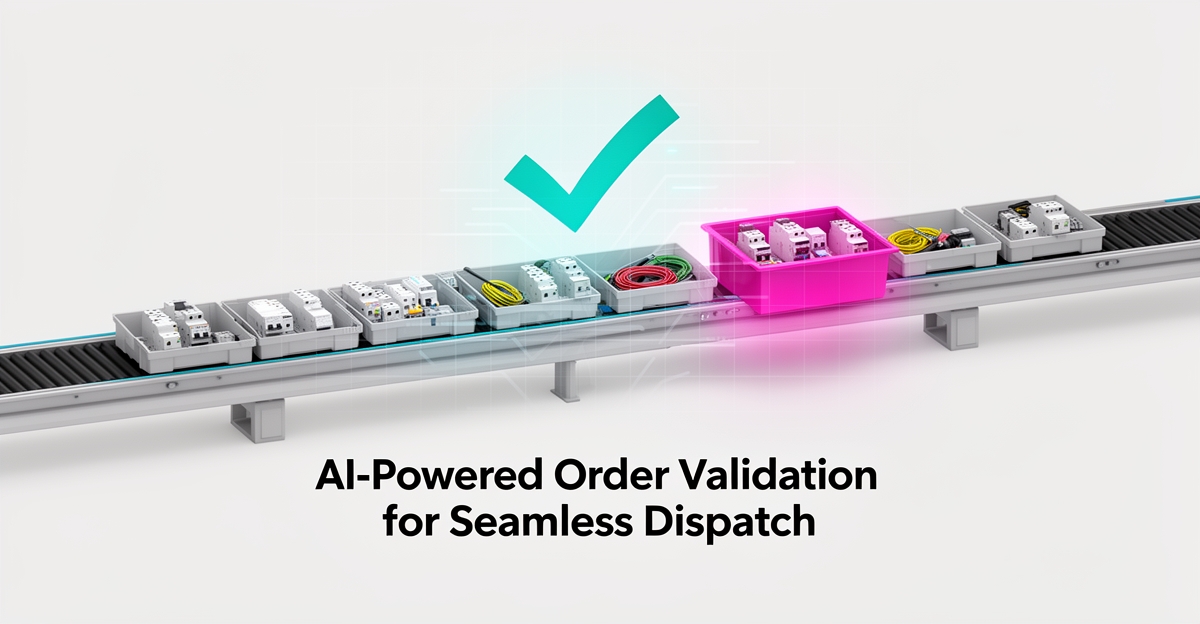
Before dispatch, AI systems can:
- Validate orders against BOMs and project specifications to catch incompatible components
- Cross-check real-time inventory across warehouses to prevent picking from depleted locations
- Flag mismatches in voltage, amperage, certification, or accessories before the pick ticket is released
- Learn from historical returns to proactively suggest corrections for repeat customers
These checks protect margin and preserve client confidence. First-time-right delivery becomes a measurable KPI rather than an aspiration, and service teams spend less time apologizing and more time supporting.
When errors do slip through, the cost is immediate. Site downtime, expedited freight, and rework invoices damage both profitability and brand perception. In electrical distribution, where safety and compliance are non-negotiable, a wrong part is also a risk exposure.
AI-driven validation creates a control layer that scales with catalog complexity. As SKU counts grow and projects become more customized, human-only checks cannot keep pace. Automated order validation and inventory cross-checking provides consistent guardrails without adding headcount.
The operational and reputational impact of delivery errors sets the stage for AI intervention. By validating orders, cross-checking inventory, and flagging mismatches before dispatch, distributors can protect trust, reduce cost, and deliver the reliability electricians depend on.
How AI Automates Order Validation and Inventory Cross-Checking
Wrong parts in a van and a missed installation window erode trust faster than any pricing issue. Electrical distributors face high-mix, low-volume orders where one SKU mismatch can cascade into costly rework and client dissatisfaction.
AI automates the validation layer between the sales order and the warehouse pick. Systems read customer requirements, BOMs and site specifications, then compare them against real-time inventory in ERP and WMS. Mismatches are flagged before dispatch, not after a truck leaves the depot.
This workflow replaces manual double-checks with continuous cross-referencing. An AI agent can verify part numbers, ratings, certifications and compatibility constraints in milliseconds, while also checking stock location, lot and expiry. Automating validation and inventory cross-checks is a core lever for reducing operational errors in parts distribution.
In electrical distribution, speed and accuracy are both compliance matters. AIQ Labs embeds these checks directly into the dispatch workflow as part of its AI Workflow Builds, which rebuild the one workflow that costs the most, at a fixed price and in phases. Validation runs at order entry and pick confirmation, so exceptions surface while there is still time to fix them.
The automation is practical and transparent. Validation rules are built from historical orders, catalog data and customer-specific requirements, then enforced at order entry and pick confirmation.
Key validation checks AI performs automatically include:
- Part number and specification matching against the customer PO and project BOM
- Real-time inventory cross-check for availability, location and reserved stock
- Compatibility and compliance flagging for voltage, rating and certification requirements
- Duplicate, missing or substituted line-item detection before dispatch authorization
When a mismatch is detected, the system routes an exception to a human operator with context and suggested corrections, keeping human oversight in the loop. This reduces rework, protects margins, and preserves client trust.
By embedding validation into workflow automation, distributors gain a consistent safety net that scales with order volume without adding headcount.
Implementing AI for Error Prevention in Electrical Parts Workflows
Electrical parts distributors face persistent challenges with wrong or missing shipments that erode customer trust and increase operational costs. Implementing AI for error prevention starts with integrating intelligent validation directly into order processing workflows, connecting ERP and inventory systems to create a unified source of truth. AI-powered tools can automatically cross-check part numbers, quantities, and compatibility against real-time inventory data and order specifications before any items leave the warehouse. This approach transforms a reactive process into a proactive safeguard.
The implementation begins with defining clear validation rules within the AI system—such as verifying that ordered breakers match panel specifications or that conduit lengths align with project requirements. These rules are applied at multiple checkpoints: during order entry, when pulling items from inventory, and prior to dispatch. For SMBs in the electrical trade, this means leveraging existing data from platforms like QuickBooks or specialized trade software through API connections, eliminating manual data re-entry. AI agents can also flag inconsistencies—for example, if a customer orders a 20-amp GFCI outlet but the project notes specify a 15-amp circuit—prompting immediate review before fulfillment proceeds.
Human oversight remains essential, particularly for complex or atypical orders. A human-in-the-loop design ensures that AI flags potential mismatches for expert review while routine validations proceed automatically. This balance maintains accuracy without slowing down high-volume operations. Teams receive alerts through familiar channels like email or dashboard notifications, allowing them to resolve exceptions quickly. Over time, the AI system learns from these interactions, refining its validation logic to reduce false positives and adapt to evolving product catalogs or seasonal demand patterns.
For distributors aiming to scale reliably, AI integration extends beyond error prevention to include predictive inventory alerts and automated reorder triggers based on historical usage and lead times. AIQ Labs builds these capabilities as owned systems—through AI Operating Systems built in phases and owned outright, or targeted Workflow Builds for a single high-cost workflow—so businesses maintain full control over their workflows and data rather than renting fragmented subscriptions. The result is a more resilient distribution process where errors are caught early, customer satisfaction improves, and teams spend less time correcting preventable mistakes. To explore how these steps apply to your specific operations, start with the two-minute Fit Check to assess your current workflows and identify high-impact automation opportunities.
Still paying for 10+ subscriptions that don’t talk to each other?
We build custom AI systems you own outright. No vendor lock-in. Full control.
Not sure where to start? Ask our AI planner
Frequently Asked Questions
How much can AI reduce delivery errors in electrical parts distribution?
What specific checks does AI perform to prevent wrong parts from being shipped?
Do I still need human oversight when using AI for order validation?
Can AI work with my existing systems like QuickBooks or ERP software?
What happens if AI makes a mistake in validation?
How do I get started with AI validation for my distribution business?
Building Trust Through Precision Delivery
Electrical parts distributors know that a single wrong breaker or missing conduit can halt a job site and damage hard-earned contractor relationships. As explored, delivery errors ripple through operations—causing rework, emergency shipments, and eroded margins—while undermining the trust that drives repeat business in this relationship-driven industry. AI transforms this challenge by embedding validation directly into workflows: automatically checking orders against BOMs, cross-checking real-time inventory, and flagging mismatches in voltage, certification, or compatibility before dispatch. This proactive approach doesn't just reduce errors; it makes first-time-right delivery a measurable reality, protecting both profitability and brand reputation. Whether you start with a single fixed-price workflow build or a phased operating system you own outright, the path to more reliable fulfillment is clear. To see how these principles apply to your specific operations, take the two-minute Fit Check at aiqlabs.ai/apply—a free, no-obligation way to map your biggest bottlenecks and explore where AI can deliver real value.
Make AI your competitive advantage — not just another tool.
Strategy, implementation and ongoing optimization. One partner, end to end.
Not sure where to start? Ask our AI planner