How AI Can Reduce Equipment Downtime by Predicting Maintenance Needs
Key Facts
- AI predictive maintenance is widely reported to deliver a 30-50% reduction in unplanned downtime according to industry data
- Manufacturers have historically reported losses of roughly $260,000 per hour due to unplanned equipment downtime per Aberdeen Research
- Organizations implementing AI predictive maintenance typically report strong multi-x returns on investment per implementation research
- Shell's deployment across 10,000+ refinery assets reduced unplanned downtime by 35% and increased asset uptime by 20% per MIT Sloan Review
Hire a team member that works 24/7 — for less than a part-time wage.
AI receptionists, SDRs, dispatchers and 99+ roles. Trained on your business, fully managed.
Not sure where to start? Ask our AI planner
The Costly Reality of Unplanned Equipment Failures in Mining
The mining industry operates on razor-thin margins where equipment failure isn't just an inconvenience, it's a financial catastrophe. When critical machinery stops unexpectedly, the ripple effects cascade through entire operations, turning routine maintenance into emergency crisis management.
Unplanned equipment failures carry staggering financial consequences. Aberdeen Research has put the average cost of unplanned downtime for manufacturers at roughly $260,000 per hour according to industry data. For mining operations running 24/7, a single day of unexpected downtime can run into millions in lost production, delayed shipments, and emergency repair premiums.
Traditional maintenance approaches exacerbate these costs through two critical flaws: over-servicing and missed failures. Preventive maintenance schedules often replace components with significant remaining life, wasting parts and labor while creating unnecessary downtime. Conversely, fixed-interval servicing misses developing faults between cycles, allowing small issues to escalate into catastrophic failures that require extensive repairs and prolonged outages.
This reactive cycle creates a lose-lose scenario where mining companies either spend excessively on maintenance that provides diminishing returns or gamble with operational continuity. The hidden costs multiply through secondary impacts: rushed repairs increase safety risks, expedited parts shipments drive up logistics expenses, and production bottlenecks affect downstream processing and shipment schedules.
AIQ Labs helps mining equipment suppliers break this cycle. Through [AI Workflow Builds](/workflow-builds), we rebuild the one workflow that costs you the most, like maintenance scheduling and failure response, as a fixed-price, phased project. Instead of relying on arbitrary schedules or waiting for breakdowns, these AI-driven approaches identify the optimal maintenance window, maximizing component life while preventing unexpected failures that devastate operational budgets and safety records.
How AI Predictive Maintenance Delivers 30-50% Downtime Reduction
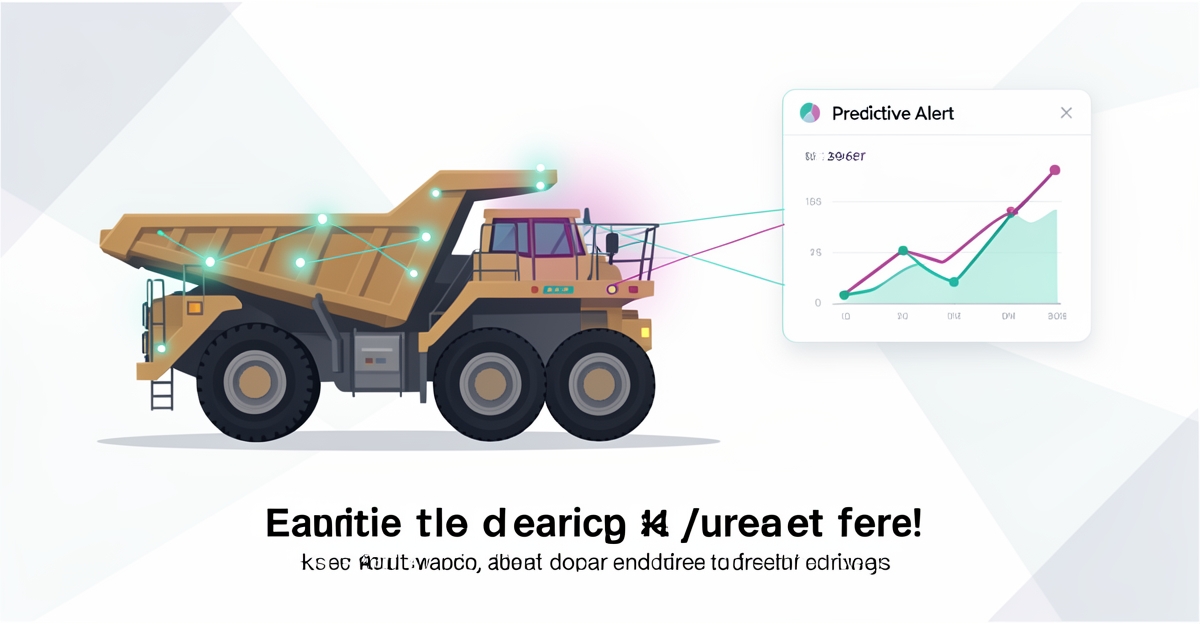
AI predictive maintenance transforms equipment management by turning raw sensor data into actionable maintenance insights. The process begins with continuous monitoring of vibration, temperature, pressure, and current draw from machinery using strategically placed sensors. This data flows through IoT gateways into centralized systems where machine learning models analyze patterns against historical failure data to predict issues weeks in advance.
For mining equipment suppliers, this means detecting wear on crushers, conveyors, and drilling rigs before catastrophic failure occurs. Models trained on maintenance logs learn to recognize subtle combinations of sensor changes that precede breakdowns, patterns invisible to traditional threshold-based alerts. When risk scores exceed safe thresholds, maintenance teams receive prioritized work orders allowing repairs during planned shutdowns rather than emergency responses.
The financial impact is substantial. Organizations implementing AI predictive maintenance commonly report a 30-50% reduction in unplanned downtime, directly translating to higher asset availability and productivity. Shell's deployment across over 10,000 refinery assets demonstrated a 35% drop in unplanned downtime and a 20% increase in asset uptime, per MIT Sloan Review. Results like these depend heavily on data quality and workflow integration, there are no guarantees, but the pattern across published deployments is consistent.
- Sensor data collection from vibration, temperature, and current monitors
- ML model training on historical failure patterns
- Real-time health scoring and failure probability estimates
- Actionable alerts integrated into maintenance workflows
- Feedback loops from technician inspections improving model accuracy
Beyond downtime reduction, the ROI case is compelling. Businesses implementing these systems typically report strong multi-x returns through avoided emergency repairs, extended equipment life, and optimized maintenance scheduling. For mining operations where a single hour of unplanned downtime can cost hundreds of thousands of dollars, savings accumulate rapidly. The system's ability to provide weeks of advance notice, compared to the same-day scramble under reactive maintenance, enables efficient parts procurement and crew scheduling.
AIQ Labs applies this same workflow to mining equipment suppliers, building owned solutions that analyze usage patterns and predict servicing needs. By integrating predictive alerts directly into maintenance workflows rather than generating isolated alerts, the technology ensures insights translate into timely actions. For suppliers who want predictive maintenance as part of a broader connected system rather than a standalone tool, our [AI Operating Systems](/ai-operating-systems) approach builds one operating layer in phases that you own outright. This end-to-end approach transforms maintenance from a cost center into a strategic advantage.
Implementing AI Predictive Maintenance: A Phased Approach for Mining Suppliers
The fastest path to ROI in predictive maintenance isn't a plant-wide rollout, it's a focused pilot on the handful of machines whose failure hurts the most. Industry guidance consistently recommends starting with just 5-10 of the highest-cost-of-failure assets before expanding, and the payoff for getting it right is substantial: businesses implementing AI predictive maintenance report strong multi-x returns on investment, according to implementation research.
For mining equipment suppliers, a phased approach turns a complex transformation into a series of manageable, low-risk steps.
Phase 1: Prioritize and instrument
Begin by identifying the equipment where unplanned failure carries the steepest price, the machines that halt production or endanger crews. With downtime costs for manufacturers historically reported around $260,000 per hour, even a single prevented failure can justify the entire program. Equip those assets with sensors tracking vibration, temperature, pressure, current draw, and oil quality, since these signals shift measurably as components wear.
Phase 2: Build the data pipeline
Sensors alone don't create predictions, clean, connected data does. Set up IoT devices and edge gateways to transmit readings continuously, with initial filtering at the machine level to reduce network load. Then standardize and timestamp every reading, tying it to specific machines and components. Pair this with historical maintenance logs, which provide the labeled training data that maps sensor signatures to actual past failures. Skipping this discipline is costly: organizations that neglect proper feature engineering typically see meaningful accuracy drops.
Phase 3: Match the model to your data
There is no single "best" algorithm, the right choice depends on what failure data you have:
- Gradient boosting (XGBoost, LightGBM) works well with structured sensor data and a reasonable set of labeled failure events per failure mode
- Autoencoders detect anomalies when labeled failures are scarce, requiring only normal operating data
- LSTM networks capture gradual degradation trends, but need substantial historical sequences
- Survival analysis estimates remaining useful life from time-to-event data
Most successful programs start with gradient boosting on existing structured data, then layer in anomaly detection as history accumulates.
Phase 4: Integrate and close the loop
Predictions only create value when technicians act on them. Route risk-scored alerts directly into existing maintenance systems and work order workflows, systems that generate alerts without workflow integration tend to fail from disuse. Equally important, feed inspection findings back into the model so accuracy improves with every cycle. Watch false positive rates closely, too: technicians who receive repeated false alarms stop trusting the system entirely.
Cultural adoption matters as much as the technology. Involve maintenance teams early, position AI as a diagnostic assistant rather than a job threat, and include them in pilot projects with proper training.
This is where expert guidance pays off. AIQ Labs works with SMBs across the full lifecycle, from readiness assessment and roadmap design through custom system development and workflow integration, so predictive maintenance is engineered as one connected loop rather than a bolted-on dashboard. And it's not limited to maintenance: managed [AI Employees](/ai-employees) can handle the dispatching, scheduling, and follow-up calls that surround every work order, at a fraction of the cost of additional headcount. For mining suppliers, that phased, disciplined approach is what turns early-warning data into weeks of scheduling lead time instead of a same-day scramble.
Still paying for 10+ subscriptions that don’t talk to each other?
We build custom AI systems you own outright. No vendor lock-in. Full control.
Not sure where to start? Ask our AI planner
Frequently Asked Questions
How much does unplanned equipment downtime actually cost a mining operation?
What kind of downtime reduction can we realistically expect from AI predictive maintenance?
How far in advance can AI actually predict equipment failures?
We've tried predictive tools before and got flooded with false alarms, how is this different?
What's the actual ROI timeline for implementing AI predictive maintenance?
Do we need to instrument our entire fleet, or can we start small?
Turn Equipment Reliability into Your Competitive Edge
AI-powered predictive maintenance isn't just about avoiding breakdowns, it's about transforming maintenance from a cost center into a strategic advantage. By shifting from reactive fixes to data-driven foresight, mining equipment suppliers can cut unplanned downtime by 30-50%, extend asset life, and unlock strong ROI through smarter scheduling and fewer emergency repairs. The path forward is clear: start small with your highest-risk machines, build clean data pipelines, and integrate predictions directly into maintenance workflows so insights lead to action. When done right, this approach delivers weeks of lead time instead of same-day scrambles, turning operational stability into measurable savings. To explore how a custom predictive maintenance system could work for your specific equipment and challenges, start with our 2-minute [Fit Check](/apply) and book a free 30-minute strategy call to map your biggest opportunities, no obligation, just clarity on where AI can deliver real value.
Make AI your competitive advantage — not just another tool.
Strategy, implementation and ongoing optimization. One partner, end to end.
Not sure where to start? Ask our AI planner