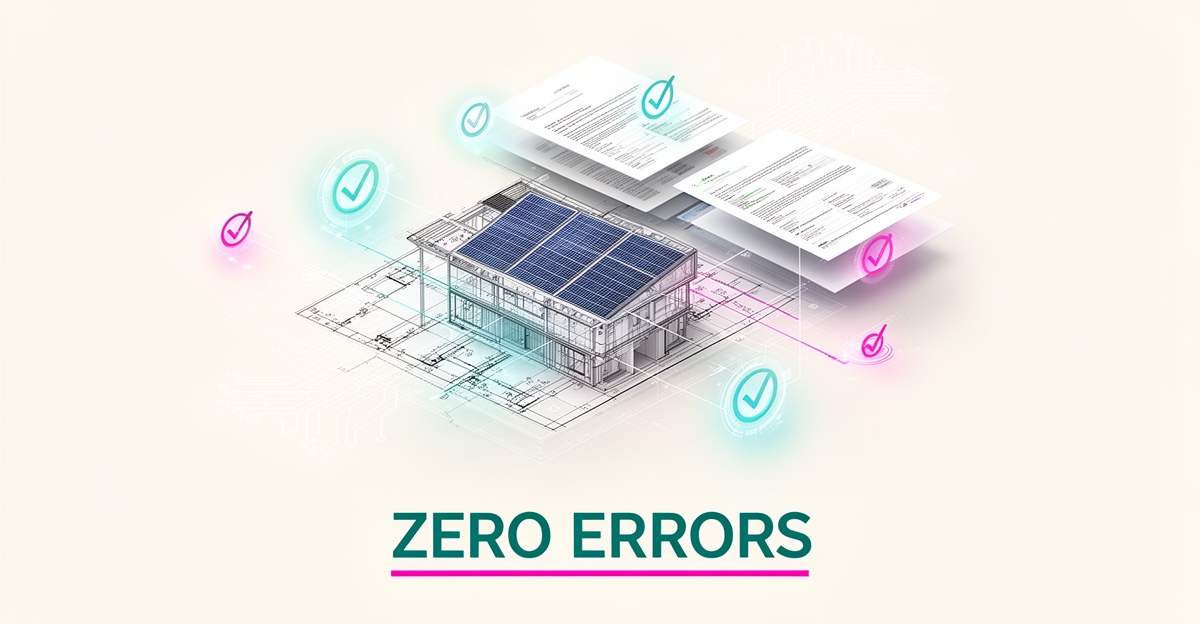
How AI Can Reduce Errors in Net-Zero Design Documentation
Key Facts
- Manual data entry and document review carry materially higher error rates than automated validation — industry analyses commonly cite double-digit error rates for manual processes versus low single digits for well-tuned AI systems
- Data quality problems are consistently ranked among the most expensive operational issues for U.S. businesses, with widely cited estimates running into the trillions of dollars annually
- The majority of carbon emissions in manufacturing and consumer goods typically originate in the supply chain, and much of that data is inaccurate, incomplete or unverifiable
- AI validation typically compresses document processing from hours or days to minutes, freeing reviewers for judgment calls instead of repetitive checks
- AI systems can misjudge data that falls outside their training patterns, which is why human-in-the-loop oversight remains essential for high-stakes compliance work
- Only a small minority of organizations have fully optimized AI for sustainability outcomes, including Scope 3 reporting and sustainability-focused service levels
Hire a team member that works 24/7 — for less than a part-time wage.
AI receptionists, SDRs, dispatchers and 99+ roles. Trained on your business, fully managed.
Not sure where to start? Ask our AI planner
The Hidden Cost of Documentation Errors in Net-Zero Projects
Manual mistakes in net-zero documentation don't stay on the page — they compound across projects, supply chains and compliance audits.
A single inconsistent dimension in a design drawing or an incorrect energy spec can trigger rework, material waste and delayed certifications. When those errors flow into procurement and reporting, they distort the emissions data that underpins net-zero claims.
Industry analyses consistently rank poor data quality among the costliest operational problems for U.S. businesses, with widely cited estimates in the trillions of dollars annually. In design and documentation workflows, manual processes are commonly associated with double-digit error rates, while well-tuned automated validation runs at a fraction of that. The gap widens when teams rely on spreadsheets and disconnected files.
For net-zero projects, the penalty is operational and reputational. The majority of carbon emissions in manufacturing and consumer goods typically come from the supply chain, and much of that data is inaccurate, incomplete or unverifiable. Without auditable documentation, CSRD and Scope 3 reporting efforts fall short in audits.
The hidden cost shows up as:
- Rework cycles from mismatched drawings, energy specs and compliance documents
- Incorrect supply chain emissions data that undermines net-zero targets
- Delayed approvals and certification risk due to inconsistent documentation
- Lost early-payment discounts and carrier corrections from bad data lineage
These errors are not random. Manual validation is limited by human capacity and fatigue, while design lifecycles grow more complex with multi-disciplinary inputs. AI document processing can scan and validate documents continuously, surfacing inconsistencies before they cascade.
AIQ Labs builds systems that scan and validate design drawings, energy specs and compliance documents across the design lifecycle — most often through a fixed-price AI Workflow Build targeting the one workflow that costs you the most, or a phased AI Operating System that connects everything into one layer you own outright. The approach mirrors how AI reduces errors generally: automation, validation, pattern recognition, and removing human bias from repetitive tasks.
Error reduction is not just efficiency. It is the foundation for credible net-zero reporting. When documentation is wrong, emissions calculations are wrong, and targets become unverifiable.
How AI Detects and Prevents Documentation Inconsistencies
AI systems are well suited to identifying inconsistencies in design drawings, energy specifications and compliance documents through continuous pattern recognition and automated validation. Modern platforms trace data lineage across systems to detect mismatches — incorrect dimensions flowing from an item master into freight bookings, postal codes conflicting with stated cities — preventing small errors from cascading into larger operational problems. This real-time validation matters most for net-zero initiatives, where the underlying data quality determines whether reported emissions figures can survive an audit.
AIQ Labs integrates similar validation logic into custom workflows that connect with your existing design and compliance tools, enabling automated checks across document types without disrupting established processes. By deploying pattern recognition models trained on historical project data, these systems identify outliers and inconsistencies that human reviewers miss due to fatigue or oversight. Processing that took hours or days manually typically compresses to minutes. With 200+ multi-agent systems deployed and four live SaaS products we run daily, this is work we do at scale, not in theory.
However, AI systems have real limitations when encountering novel data patterns outside their training sets. Research has shown that neural networks can be reliably misled by slightly modified inputs, producing false positives or missed errors. This vulnerability underscores the need for human-in-the-loop oversight, particularly in high-stakes net-zero documentation where incorrect validations could compromise CSRD or Scope 3 reporting. Effective implementation balances AI's tireless pattern recognition with human judgment for edge cases and evolving design standards.
Implementing AI for Reliable Net-Zero Documentation: A Practical Framework
Implementing AI for reliable net-zero documentation requires a structured approach that balances automation with human expertise. Establishing a single, reliable operational truth across all systems ensures accurate data for AI processing — critical given that most emissions in manufacturing and consumer goods typically originate in supply chains where data is often inaccurate or unverifiable. Mapping decision architecture — identifying who owns decisions, what data sources are trusted, and setting escalation thresholds — creates the foundation for AI to operate effectively within existing workflows.
Deploying intelligent document processing (IDP) systems that go beyond basic OCR to understand context, layout and entity extraction enables AI to detect inconsistencies in design drawings, energy specifications and compliance documents in real time. These systems catch errors such as mismatched dimensions, incorrect safety stock levels or conflicting address data before they cascade. Creating audit trails from raw activity data to reported emissions figures supports CSRD and Scope 3 requirements — because manual processes and spreadsheets cannot withstand regulatory scrutiny.
Human-in-the-loop oversight remains essential, as AI systems can be misled by data outside their training patterns, potentially flagging valid configurations as errors or missing novel issues. Integrating AI with existing ERP and PLM systems enables continuous validation across the design lifecycle, while feedback loops let the system improve over time. AIQ Labs supports this in three ways: start monthly with AI Employees handling document-heavy roles, build in milestones with a fixed-price Workflow Build, or own it outright with a phased AI Operating System. Every engagement starts with the 2-minute Fit Check and a free 30-minute strategy call — no invented numbers, no fake case studies, just a clear view of where automation pays for itself.
Still paying for 10+ subscriptions that don’t talk to each other?
We build custom AI systems you own outright. No vendor lock-in. Full control.
Not sure where to start? Ask our AI planner
Frequently Asked Questions
How much do data quality problems actually cost businesses?
Can AI really reduce documentation error rates compared to manual processes?
What share of carbon emissions in manufacturing come from supply chains, and why does that matter for net-zero documentation?
Is AI completely reliable for detecting errors in design documents, or are there limitations?
What kind of cost savings can businesses expect from implementing AI for documentation accuracy?
How does AIQ Labs help companies implement AI for net-zero documentation without disrupting existing workflows?
Turning Documentation Precision into Net-Zero Credibility
AI-driven document validation transforms how net-zero projects maintain accuracy across design, supply chain and compliance workflows — catching inconsistencies before they become rework, audit failures or unverifiable emissions claims. By establishing auditable data lineage and real-time consistency checks, organizations turn documentation from a liability into proof of credible emissions reporting. The path forward starts with assessing where manual gaps put your net-zero claims at risk. Take the 2-minute Fit Check, then book a free 30-minute strategy call to map your documentation workflows and identify where automation delivers real value — no obligation, just clarity. Prefer to see pricing models first? Review how you can start monthly, build in milestones, or own it outright.
Make AI your competitive advantage — not just another tool.
Strategy, implementation and ongoing optimization. One partner, end to end.
Not sure where to start? Ask our AI planner