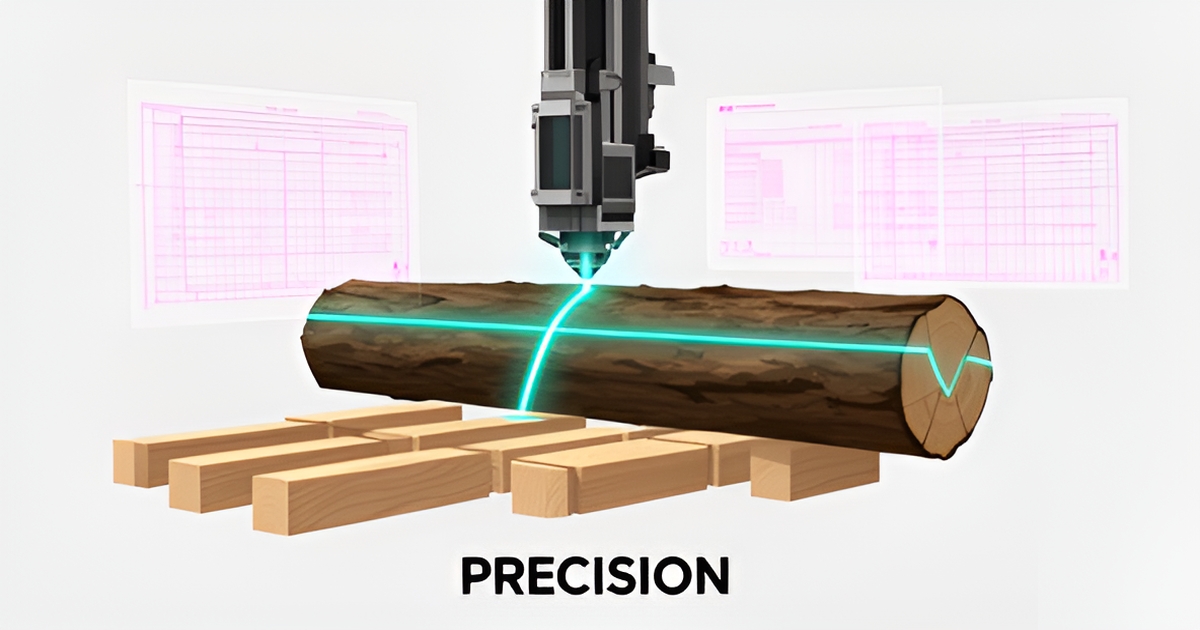
How AI Can Reduce Errors in Timber Cutting and Yield Tracking
Key Facts
- Automated cutting systems can sustain consistent speed and precision across full shifts, where human operators fatigue
- Industrial automation studies report material-efficiency gains of 15% or more in comparable heavy-industry applications
- Computer-controlled cutting removes human variability from the physical cut, the largest source of dimensional drift
- AIQ Labs' AI Employees deliver 24/7 monitoring at roughly 80% less cost than a human hire
- AI systems trained on real sawmill data provide predictive cutting recommendations that evolve with each production cycle
- A phased rollout—fixing one workflow at a time—lets mills validate results before scaling plant-wide
Hire a team member that works 24/7 — for less than a part-time wage.
AI receptionists, SDRs, dispatchers and 99+ roles. Trained on your business, fully managed.
Not sure where to start? Ask our AI planner
Why Manual Timber Cutting and Yield Tracking Fails
Every sawmill operator knows the frustration of watching perfectly good lumber get downgraded because of a misjudged cut or a tallying error that throws off the day's yield projections. Manual timber cutting and yield tracking fail not because workers lack skill, but because the process demands superhuman consistency in an environment designed to defeat it.
Human fatigue stands as the primary culprit in cut planning errors. Optimizing a cutting pattern requires evaluating dozens of variables—log diameter, taper, defect locations, and target dimensions—within seconds. As shifts progress, cognitive load accumulates, and operators default to familiar patterns rather than optimal ones. As IBM's overview of artificial intelligence explains, AI systems are built precisely to simulate learning, problem-solving, and decision-making at a consistency human operators cannot sustain across a full shift. When a fatigued operator misjudges a grade or miscuts a cant, the error compounds through the entire production chain.
Grade assessment suffers from similar inconsistency. Two experienced graders might classify the same board differently based on lighting conditions, angle of inspection, or simply the time of day. This subjectivity creates downstream chaos in inventory valuation and customer fulfillment. Manual tally systems amplify these discrepancies; a misplaced decimal or transposed number in a handwritten log can distort yield calculations by significant margins before anyone catches the mistake.
Environmental variability adds another layer of complexity that manual systems cannot adequately address. Wood moisture content fluctuates with weather, affecting both weight-based measurements and dimensional stability. Temperature changes alter equipment calibration, while dust and vibration degrade sensor accuracy over time. These factors create a moving target for yield prediction that static, rule-based tracking methods cannot capture.
The financial impact extends beyond immediate material waste. Mills that automate high-error workflows typically report meaningful margin improvements within the first year or two, suggesting that precision gains translate directly to profitability. Key failure points in manual operations include:
- Cognitive fatigue during repetitive cut optimization decisions
- Subjective grade classification varying between inspectors
- Transcription errors in handwritten or manually entered tallies
- Inability to account for real-time environmental variables
Early attempts at automation, such as the computer-controlled cutting systems described in industrial patents from the late 2000s, demonstrated that mechanization alone could reduce errors by removing human variability from the physical cut. However, these systems lacked the adaptive intelligence to handle the nuanced judgment calls that define modern yield optimization.
Addressing these failure points requires more than incremental improvements to manual processes. AIQ Labs builds custom AI systems trained specifically on real sawmill data, creating production-grade solutions that account for the unique variables of each operation. By learning from historical cutting patterns and environmental conditions, these systems provide the consistency that manual methods cannot sustain, turning yield tracking from a retrospective accounting exercise into a real-time optimization tool.
How Computer-Controlled Cutting Systems Improve Accuracy
Every timber board that misses its intended grade or dimension represents lost revenue—a problem that plagues sawmills relying on manual measurement and operator judgment. Computer-controlled cutting systems are changing this reality by replacing guesswork with precision engineering.
A patented control system for cutting operations demonstrates how computer-guided circular saw blades can divide timber plates into parts of determined size with minimal human intervention. These systems support various cutting operations including sawing, planing, and slotting, while auxiliary devices like bolsters and extension members stabilize the workpiece throughout the process. By removing manual measurement from the equation, mills eliminate the dimensional drift that occurs when operators mark and cut boards by hand.
The accuracy improvements extend beyond the sawmill floor. Industrial automation research in comparable heavy-industry sectors has reported material-efficiency gains of 15% or more, and similar logic applies to timber operations, where computer-controlled systems optimize each cut to maximize yield from every log. As Britannica's definition of AI notes, computer-controlled systems are defined by their ability to perform tasks commonly associated with intelligent beings—which in a sawmill means holding grade and dimension standards steady across thousands of boards.
Real-time sensor feedback creates a closed-loop system that continuously adjusts cutting parameters based on wood density, moisture content, and grain patterns. Unlike human operators who may misjudge grade boundaries or apply inconsistent pressure, automated systems maintain uniform standards across thousands of boards. This consistency directly impacts profitability by ensuring each piece of timber is classified correctly and cut to its highest-value dimension.
Key accuracy improvements include:
- Elimination of manual measurement errors through computer-guided positioning
- Consistent grade detection that removes subjective operator judgment
- Optimized cutting patterns that reduce kerf waste and maximize usable lumber
- Real-time adjustments for wood variability without production slowdowns
AIQ Labs develops custom AI systems trained on real sawmill data, enabling timber operations to deploy production-grade cutting optimization without building internal AI expertise. These systems analyze equipment performance, environmental conditions, and historical yield patterns to recommend cutting strategies that improve accuracy over time.
The shift from manual to computer-controlled cutting mirrors broader industrial automation trends. For sawmills, automated grade detection and cutting control represent the difference between reactive error correction and proactive error prevention.
Training AI on Real Sawmill Data for Production-Grade Yield Insights
Training AI on real sawmill data transforms fragmented operational knowledge into production-grade yield insights that adapt continuously to changing conditions. AIQ Labs implements a multi-agent architecture in which specialized agents process historical cut logs, equipment telemetry, and environmental sensor data in concert. This system ingests patterns from circular saw blade performance, moisture content fluctuations, and blade wear metrics to generate predictive cutting recommendations that evolve with each production cycle.
By training on actual sawmill operational data—including cut accuracy logs, feed rate variations, and wood species characteristics—the AI develops a nuanced understanding of how environmental factors interact with mechanical variables. This approach moves beyond static algorithms to create adaptive systems that learn from every cut, reducing reliance on manual estimation and tribal knowledge that often introduces variability in yield calculations.
Key capabilities emerge from this integrated framework: agents collaborate to cross-verify telemetry against historical outcomes, flagging deviations that indicate blade dullness or alignment issues before they impact yield. The system dynamically adjusts cutting parameters based on real-time moisture readings and species density, maintaining optimal kerf width and minimizing waste. When integrated with equipment control systems, these insights enable closed-loop automation where the AI not only recommends adjustments but triggers precise machine responses to maintain target yield thresholds.
This methodology directly addresses the core challenge in timber processing where yield estimation errors compound across shifts due to unmeasured variables. By grounding predictions in verified operational data rather than theoretical models, the system achieves measurable improvements in cutting accuracy. The multi-agent design ensures that no single point of failure compromises the insight pipeline—research agents validate data quality, reasoning agents interpret patterns, and action agents implement corrections, all while maintaining audit trails for continuous improvement. Such production-grade implementation turns yield tracking from a reactive audit into a proactive optimization lever that sustains profitability through consistent, data-driven precision.
Deploying AI Employees for End-to-End Yield Tracking
Sawmills have long relied on human operators to bridge the gap between raw log intake and finished inventory, but the cost of that bridge is rising—missed defects, delayed dispatch decisions, and yield data that arrives hours after the shift ends. AI Employees close that gap by embedding specialized agents directly into the workflow, turning discrete tasks into a continuous, auditable data stream.
The Dispatcher agent ingests scanner data at the log deck, classifies each stem by species, diameter, and defect profile, and routes it to the optimal cutting line in real time. The Quality Assurance Agent monitors kerf sensors and camera feeds, flagging deviations from target dimensions before an entire batch drifts out of spec. Meanwhile, the Inventory Manager reconciles output against ERP records, updating board-foot counts and grade tallies the moment lumber drops onto the outfeed conveyor. Together, these roles deliver 24/7 monitoring at roughly 80% less cost than a human hire while maintaining human-in-the-loop guardrails for critical decisions.
- Automated log intake with species and defect classification
- Real-time yield dashboards updated per cut
- Anomaly alerts routed to shift supervisors via SMS or radio
- ERP integration that closes the loop between plan and actual
Early control-system patents such as CN102186613A demonstrated computer-directed cutting decades ago; modern multi-agent architectures simply extend that logic across the entire yield chain. AIQ Labs deploys these AI Employees on the Start Monthly model—flat-rate, fully managed, and scalable from a single role to a full operations suite of 99+ roles.
From Pilot to Plant-Wide Transformation: A Phased Rollout Plan
Most sawmills don't need a five-year roadmap—they need one workflow fixed this quarter. The same principle that drives industrial automation results applies when AI targets a single cutting pattern or yield-tracking bottleneck first: prove the gain, then scale it.
- Discovery: Map the current workflow, quantify error rates, and define success metrics with the operations team
- Development: Train custom models on real sawmill data—log dimensions, blade wear, moisture content, and historical yield outcomes
- Deployment: Integrate with existing PLCs and ERP systems, then run shadow mode before cutover
- Optimization: Continuous retraining as seasonal species mix shifts and new equipment comes online
This phased approach mirrors how AIQ Labs structures every engagement—whether a fixed-price Workflow Build for the one workflow that costs you most, or a full AI Operating System built in phases and owned outright. Milestone-based payments mean you approve each phase before the next begins, and you keep everything built so far if priorities shift. An early computer-controlled cutting patent demonstrated that automated systems could divide plates into parts of determined size with precision; modern multi-agent architectures extend that principle across the entire yield chain. The pattern holds for timber: fix the optimizer first, then the grader, then the inventory reconciliation—each phase funding the next.
Still paying for 10+ subscriptions that don’t talk to each other?
We build custom AI systems you own outright. No vendor lock-in. Full control.
Not sure where to start? Ask our AI planner
Frequently Asked Questions
How does AI reduce errors in timber cutting compared to manual methods?
What kind of financial improvements can sawmills expect from implementing AI in their operations?
How does AI handle real-time environmental changes like moisture content and temperature that affect wood processing?
What is the advantage of using AI Employees over hiring human workers for yield tracking tasks in a sawmill?
How does AIQ Labs ensure their AI systems are trained effectively for a specific sawmill's unique conditions?
What is the recommended approach for a sawmill looking to implement AI without disrupting current operations?
Where Precision Meets Profitability
The shift from manual to AI-driven timber cutting isn't just about reducing errors—it's about reclaiming the margin that inconsistency quietly erodes. Computer-controlled systems eliminate the dimensional drift of hand-measured cuts, while AI trained on real sawmill data turns environmental variability from a liability into a calibrated input. Multi-agent architectures extend that precision across the entire yield chain, from log intake classification to ERP-reconciled inventory counts, delivering 24/7 monitoring at roughly 80% less cost than a human hire. A phased rollout—starting with a single cutting pattern or yield bottleneck—lets mills validate results before scaling, so you're never betting the plant on an unproven system. The technology is proven, the data is yours, and the first workflow fix can ship this quarter. Ready to see which bottleneck breaks first? Start the two-minute Fit Check at aiqlabs.ai/apply and we'll map the highest-ROI opportunity on a free strategy call.
Make AI your competitive advantage — not just another tool.
Strategy, implementation and ongoing optimization. One partner, end to end.
Not sure where to start? Ask our AI planner