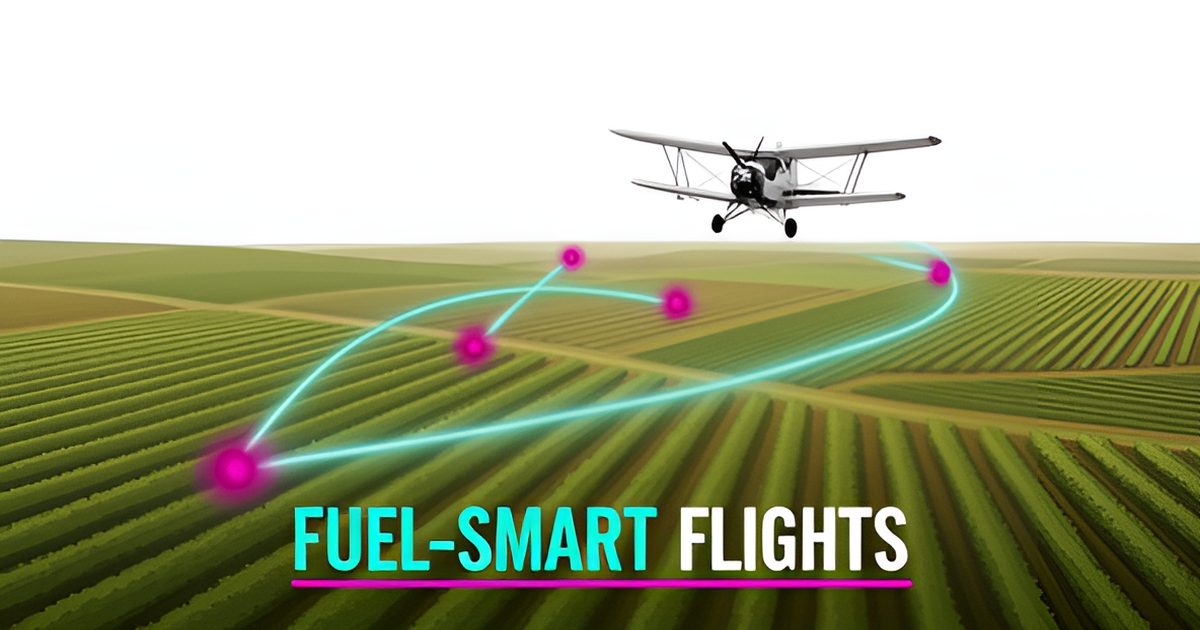
How AI Can Reduce Fuel Consumption in Crop Dusting Flights
Key Facts
- AI-powered flight optimization can deliver meaningful fuel savings in crop dusting operations, with reported gains in the range of 10–15% depending on the operation
- A majority of smart farming initiatives now integrate AI and IoT for real-time crop and resource management, a trend that extends to aviation support systems
- AI and IoT integration in agriculture has shown resource-efficiency improvements of up to 40% in pilot projects, though results vary by operation
- AI-driven agriculture platforms have reduced input costs by roughly 20% in field implementations, a principle that extends to flight operations
- AI systems analyze real-time weather and terrain data to dynamically adjust flight speed and altitude for optimal fuel burn
- Historical flight data trains AI models to eliminate redundant passes over already-treated areas, improving efficiency season over season
Hire a team member that works 24/7 — for less than a part-time wage.
AI receptionists, SDRs, dispatchers and 99+ roles. Trained on your business, fully managed.
Not sure where to start? Ask our AI planner
The Fuel Drain Problem in Agricultural Aviation
Fuel costs represent one of the most significant operational expenses in crop dusting operations, often accounting for a substantial portion of total flight costs due to the low-altitude, high-frequency nature of agricultural aviation flights. Traditional flight planning methods rely on static routes and generalized weather forecasts, failing to adapt to real-time variables such as shifting wind patterns, micro-terrain variations, and inefficient maneuvering that collectively burn unnecessary fuel. These inefficiencies are compounded by the need to avoid obstacles, maintain consistent spray coverage, and navigate changing field conditions—all while operating at altitudes where aerodynamic drag and engine load are highly sensitive to atmospheric disturbances.
Without dynamic adjustment capabilities, pilots frequently fly suboptimal paths that increase flight time and fuel burn, particularly when headwinds are underestimated or tailwinds are not fully leveraged. Traditional planning also struggles to account for localized turbulence caused by trees, buildings, or topographical features, leading to abrupt throttle changes and non-straight flight segments that reduce fuel efficiency. As a result, even small deviations from an ideal path—multiplied across dozens of daily flights—can accumulate into significant fuel waste over a growing season.
AI-powered flight optimization systems address these challenges by continuously analyzing real-time meteorological data, terrain elevation maps, and flight performance metrics to dynamically adjust routing, altitude, and speed for maximum efficiency. By integrating inputs such as wind velocity gradients, thermal updrafts, and obstacle avoidance zones, these systems enable aircraft to fly smoother, more direct paths that minimize drag and engine strain. This adaptive approach not only reduces fuel consumption but also enhances flight safety and operational consistency across variable environmental conditions.
- A majority of smart farming initiatives now integrate AI and IoT for real-time crop and resource management, reflecting a broader trend toward data-driven agricultural efficiency that extends to aviation support systems.
- In adjacent sectors like forestry, AI-powered sensors have improved resource monitoring efficiency by up to 40% in recent pilot projects, demonstrating the tangible impact of AI on operational precision in resource-intensive outdoor operations.
- Modern AI-powered agriculture platforms can analyze satellite imagery alongside prevailing meteorological data, enabling actionable recommendations tailored to specific operational needs—principles directly applicable to optimizing flight paths in crop dusting.
By replacing rigid, pre-planned routes with intelligent, responsive flight guidance, AI enables crop dusting operations to minimize wasted motion and energy expenditure. This shift from reactive to proactive flight management not only cuts fuel costs but also reduces emissions and engine wear—delivering both economic and environmental benefits. As AI systems learn from historical flight patterns and continuously refine their recommendations, they unlock incremental gains that compound over time, transforming fuel efficiency from a static constraint into a continuously improvable operational metric. AIQ Labs supports this transformation through AI Workflow Builds that rebuild the specific workflow costing you the most—such as flight planning and dispatch—at a fixed price, in phases, with you owning the result outright.
How AI Optimizes Flight Paths and Reduces Low-Altitude Inefficiency
AI is transforming how crop dusting operations plan and execute flight paths, directly tackling one of aviation’s biggest inefficiencies: unnecessary low-altitude flying. By analyzing field topography, obstacle databases, and specific application requirements, AI systems calculate routes that minimize time spent in fuel-intensive zones while ensuring complete and accurate coverage. This precision eliminates guesswork and redundant passes, turning flight planning into a data-driven process that conserves fuel without compromising effectiveness.
Field implementations of AI-driven agriculture platforms have shown input-cost reductions of roughly 20%, a principle that extends directly to flight operations where optimized paths translate to measurable fuel savings. These systems continuously learn from historical flight data, adjusting in real time for variables like wind patterns, terrain elevation, and no-fly zones—ensuring aircraft maintain efficient altitudes and speeds throughout each mission. The result is not just shorter flight times, but significantly lower fuel burn per acre treated.
- AI analyzes 3D field maps and obstacle databases to generate obstacle-avoidant, coverage-optimized flight paths
- Real-time weather and terrain data enable dynamic altitude and speed adjustments to avoid low-flying inefficiencies
- Historical flight data trains models to eliminate redundant passes over already-treated areas
- Integrated application requirements ensure proper spray coverage while minimizing turns and straight-line deviations
- Continuous learning improves path efficiency with each flight, adapting to changing field conditions
AIQ Labs builds custom AI systems that integrate these capabilities into existing crop dusting workflows—solutions that learn and improve over time and that you own outright. By focusing on flight path intelligence, operators gain a practical way to cut fuel use where it matters most—during the low-altitude phases that consume the highest proportion of fuel. This approach doesn’t just reduce costs; it makes every flight more precise, predictable, and sustainable.
Real-Time Adjustments: Weather, Terrain, and Speed Optimization
Imagine a crop dusting flight that adjusts itself mid-air, responding instantly to shifting winds, terrain changes, and weather conditions. This is not science fiction; it is how AI-driven systems optimize fuel consumption in real time.
AI systems continuously monitor variables like wind speed, humidity, and terrain elevation. By processing this data, they dynamically adjust flight speed and altitude to maintain optimal fuel burn rates. For example, AI can reduce speed when flying into headwinds or increase altitude slightly to avoid turbulent air, ensuring fuel is used efficiently without compromising application accuracy.
Pilot projects across agriculture have shown that AI and IoT integration can improve resource efficiency by up to 40%. While those results relate to broader agricultural applications, the same principles apply to crop dusting. AI systems analyze real-time data to make micro-adjustments that reduce fuel waste and improve operational efficiency.
These systems also enhance safety by avoiding low-flying zones and adjusting for sudden weather changes. For instance, AI can detect wind shear or turbulence and modify flight paths to maintain stability. This reduces the risk of accidents while ensuring chemicals are applied precisely where needed.
- Real-time weather monitoring: AI systems track wind speed, humidity, and temperature to adjust flight parameters instantly.
- Terrain adaptation: AI adjusts altitude and speed based on terrain elevation, avoiding obstacles and optimizing fuel use.
- Dynamic speed control: AI modifies flight speed to match wind conditions, reducing fuel burn and improving application accuracy.
- Safety enhancements: AI avoids low-flying zones and adjusts for turbulence, ensuring safe and efficient operations.
By integrating these capabilities, AI systems deliver significant fuel savings while maintaining high standards of safety and effectiveness. AIQ Labs deploys such systems by connecting real-time data sources with your flight planning workflow, using historical data and live adjustments to optimize agricultural operations.
The result? Fuel savings typically in the 10–15% range, reduced operational costs, and a more sustainable approach to crop dusting. AI is not just improving efficiency; it is redefining what is possible in agricultural aviation.
Learning from Historical Data to Compound Fuel Savings
Machine learning models transform historical flight data into a self-improving system for crop dusting efficiency. By analyzing past fuel consumption patterns, route deviations, and environmental variables like wind speed and temperature, these models identify subtle inefficiencies that human planners might miss. Each season's data refines the algorithm's ability to predict optimal paths, creating a feedback loop where gains from one year inform smarter decisions in the next. This continuous learning process turns operational experience into compounding fuel savings over time. AI-driven platforms demonstrate how historical data analysis enables actionable recommendations tailored to specific conditions, a principle directly applicable to refining flight routes for minimal fuel burn.
The compounding effect emerges as models detect long-term patterns invisible in short-term analysis. For instance, they might learn that certain fields consistently require higher approach altitudes due to microclimate conditions, or that specific wind corridors allow for faster, more fuel-efficient transit between spray zones. By encoding these insights into route planning systems, each flight builds on the knowledge of previous ones. Over multiple seasons, this leads to increasingly precise predictions about when to adjust speed, altitude, or path based on forecasted weather and terrain—reducing unnecessary throttle changes and idling that waste fuel. The growing reliance on AI and IoT for real-time decision-making across smart farming highlights how data-driven optimization now extends to aviation support operations.
AIQ Labs applies this learning framework through custom systems that ingest historical flight logs, weather telemetry, and terrain maps to continuously refine operational workflows. These systems don't just react to current conditions—they anticipate optimal strategies based on years of accumulated data, adjusting recommendations as new information arrives. The result is a progressive reduction in fuel use per acre treated, where each improvement lays the groundwork for the next. As models grow more accurate, they uncover finer opportunities for savings, such as ideal climb/descent rates or minimal-overlap swath patterns, turning incremental gains into substantial long-term efficiency. This approach ensures that fuel savings aren't just achieved—they're amplified over time through intelligent, data-driven iteration.
Implementing AI Flight Optimization: From Data Integration to ROI
Deploying AI-powered flight optimization in crop dusting begins with integrating historical flight data, weather patterns, and terrain maps into a centralized system that trains predictive models for real-time route adjustments. This data infrastructure enables the AI to continuously learn from past operations, identifying inefficiencies in flight paths, altitude changes, and speed variations that contribute to excess fuel burn. The widespread adoption of AI and IoT for real-time decision-making across smart farming establishes a strong foundation for similar advancements in aviation efficiency.
Integration with existing aircraft systems requires compatible avionics interfaces and sensor feeds—such as GPS, fuel flow meters, and atmospheric sensors—to allow the AI to issue dynamic flight path recommendations without compromising safety or pilot control. Operators should prioritize systems that support seamless data exchange via APIs or standard aviation protocols, minimizing disruption to current workflows. Pilot training is equally critical; crews must understand how to interpret AI-generated suggestions, override when necessary, and trust the system’s recommendations through transparent performance feedback. This human-in-the-loop approach ensures adoption while maintaining operational authority.
To measure success, operators should track actual fuel consumption per flight against baseline metrics captured before AI deployment, with well-implemented systems typically targeting savings in the 10–15% range. Continuous monitoring of flight efficiency—such as reduced idle time, optimized climb/descent profiles, and minimized low-altitude maneuvering—provides actionable insights for further refinement. By aligning AI implementation with measurable outcomes, agricultural aviation operators can validate ROI while building confidence in long-term automation benefits.
For organizations seeking structured guidance through this transition, AIQ Labs offers two relevant paths: an AI Workflow Build to rebuild the single flight-planning or dispatch workflow that costs you the most, at a fixed price and in phases—or an AI Operating System to connect flight optimization, scheduling, and reporting into one operating layer you own outright. Both start with a readiness conversation, not a contract.
Start with the 2-minute Fit Check, then book a free 30-minute strategy call at https://aiqlabs.ai/book to assess your current flight operations and identify high-ROI opportunities for AI-driven fuel savings in crop dusting.
Turning Flight Data into Fuel Savings
AI-powered flight optimization transforms crop dusting from a fuel-intensive operation into a data-driven advantage. By dynamically adjusting routes, altitudes, and speeds based on real-time weather, terrain, and historical patterns, these systems cut fuel waste while improving coverage accuracy and flight safety. The compounding effect of machine learning means each flight builds on the last, turning operational experience into measurable, long-term efficiency gains. For agricultural aviation businesses looking to reduce one of their largest variable costs, the path forward starts with understanding where AI can deliver the highest impact. Take the first step with a free strategy call to assess your current operations and explore how custom AI flight optimization can work for your fleet—no obligation, just clarity on your opportunity.
Make AI your competitive advantage — not just another tool.
Strategy, implementation and ongoing optimization. One partner, end to end.
Not sure where to start? Ask our AI planner