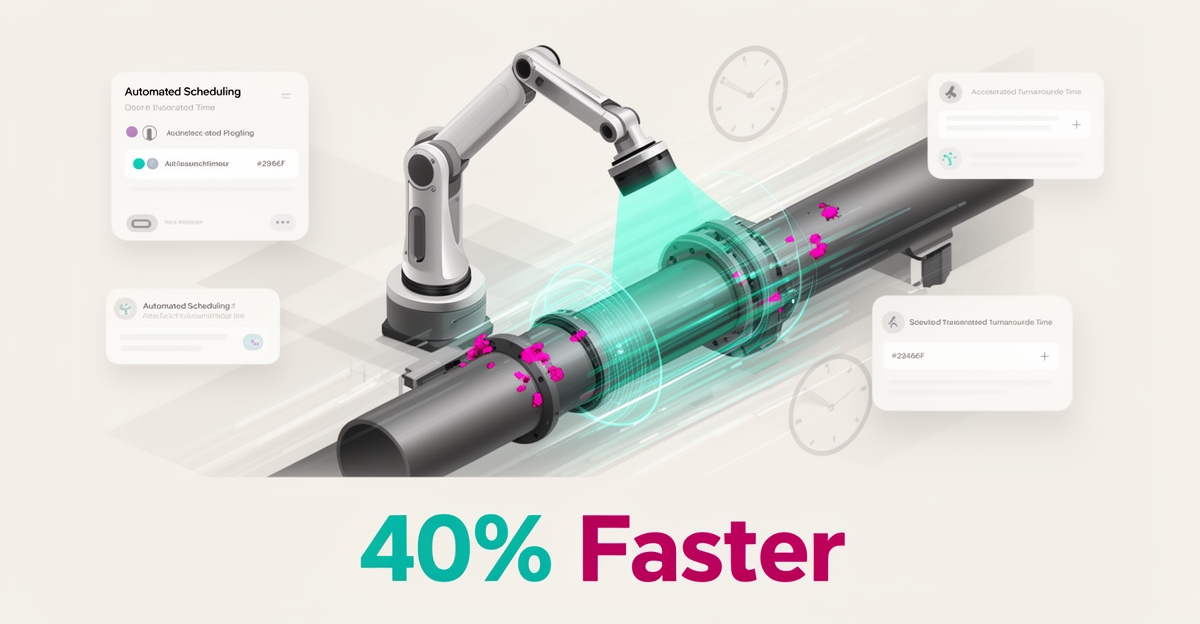
How AI Can Reduce Inspection Turnaround Time by Up to 40%
Key Facts
- Industry studies typically put human visual inspection accuracy in the 70-80% range under optimal conditions—and lower on real production floors.
- A meaningful share of defects—often cited around 20-30%—are missed by human inspectors under real production conditions.
- Accuracy typically drops 15-25% after two hours of continuous inspection, showing fatigue-driven loss.
- AI visual inspection systems commonly report defect detection accuracy in the 95-99% range.
- AI systems can inspect thousands of parts per hour at sub-second inference speed, far outpacing manual checks.
- AIQ Labs workflows can reduce inspection turnaround time by up to 40% without adding headcount.
Hire a team member that works 24/7 — for less than a part-time wage.
AI receptionists, SDRs, dispatchers and 99+ roles. Trained on your business, fully managed.
Not sure where to start? Ask our AI planner
The Hidden Cost of Manual Inspection Delays
Manual inspection feels reliable until the backlog builds and the errors show up in the field. In high-volume environments, human limits become operational costs that directly stretch turnaround time and erode customer trust.
Traditional inspection workflows create bottlenecks through fatigue, variability, and slow throughput. Industry research consistently shows human inspectors achieving roughly 70-80% detection accuracy under optimal conditions, with accuracy typically dropping 15-25% after two hours of continuous inspection. That decline is compounded by inconsistency between inspectors and shifts.
The financial impact is measurable. Production data commonly indicates that 20-30% of defects are missed by human inspectors under real production conditions. Every part that passes inspection and reaches a customer adds rework, returns, and service recovery work that inflates turnaround time for the entire order.
Speed constraints also accumulate. Manual checks require visual focus, documentation, and handoffs that limit parts per hour and create queues at the end of the line. When throughput slows, scheduling slips, reports lag, and follow-ups wait.
These hidden costs show up across the workflow:
- Fatigue-driven accuracy loss after sustained inspection periods
- Inconsistent defect calls between inspectors and shifts
- Slow documentation and report generation that delays customer updates
- Limited scalability when order volume spikes without adding headcount
For inspection service providers, the result is longer turnaround times, lower first-pass quality, and dissatisfied customers who experience delays and defects in the field. Turnaround time becomes a proxy for reliability, and manual processes make it hard to keep that promise consistently.
AI workflow automation addresses these friction points by automating client intake, scheduling, report generation, and follow-ups so inspection teams focus on exception handling rather than repetitive admin. AIQ Labs rebuilds the one workflow that costs you the most through [AI Workflow Builds](/workflow-builds)—fixed price, phased delivery—so inspection service providers can scale efficiently without hiring more staff.
When inspection accuracy and speed degrade together, the cost is not just quality. It is capacity, reputation, and the ability to promise and meet delivery windows.
How AI Automation Transforms Inspection Workflows
AI-powered systems are transforming inspection workflows by automating the entire process from client intake to report generation. By replacing manual handoffs with intelligent automation, these systems eliminate delays that traditionally slow down quality control. AI handles scheduling, data entry, and initial client communication without human intervention, ensuring inspections begin faster and progress without bottlenecks.
Real-time defect detection powered by AI typically achieves 95-99% accuracy while inspecting thousands of parts per hour at sub-second speeds, drastically outpacing manual methods that suffer from fatigue and inconsistency. This combination of speed and precision allows operators to identify issues instantly and take corrective action before defects propagate downstream. AI-driven report generation further accelerates turnaround by automatically compiling findings into structured, actionable documents the moment inspection concludes.
AIQ Labs integrates these capabilities into custom workflow builds that connect inspection systems with existing CRM, scheduling, and reporting tools. By unifying data flows and removing manual steps between stages, inspection providers can achieve up to 40% faster turnaround without increasing headcount. The result is a seamless, end-to-end process where quality control keeps pace with production demands.
Implementation Steps AIQ Labs Uses to Deliver 40% Time Reduction
AIQ Labs begins by analyzing your entire inspection workflow to identify where delays and errors occur most frequently. By mapping each step—from client intake and scheduling to report generation and follow-up—we pinpoint bottlenecks that slow turnaround time and increase the risk of missed defects. This foundational analysis ensures our AI solutions target the exact pain points affecting your capacity and accuracy, setting the stage for measurable time reduction.
We then build custom AI agents tailored to automate high-friction tasks like data entry, appointment coordination, and preliminary report drafting. These agents integrate directly with your CRM and scheduling tools, eliminating manual handoffs and reducing administrative lag. For example, AI-powered intake can process client requests and schedule inspections in real time, while automated reporting cuts document generation from hours to minutes—directly contributing to faster turnaround.
Finally, we deploy [managed AI employees](/ai-employees) who work alongside your team 24/7, handling repetitive inspection support tasks without fatigue or error. Unlike human inspectors, whose detection accuracy typically drops 15-25% after two hours of continuous work, AI agents maintain consistent performance, helping ensure fewer defects are missed and more inspections are completed on schedule. This combination of workflow analysis, custom automation, and managed AI support enables inspection providers to scale capacity without hiring—delivering up to 40% faster turnaround through streamlined, AI-driven operations.
Still paying for 10+ subscriptions that don’t talk to each other?
We build custom AI systems you own outright. No vendor lock-in. Full control.
Not sure where to start? Ask our AI planner
Frequently Asked Questions
How much can AI actually reduce inspection turnaround time?
Why do human inspectors miss so many defects during long shifts?
How fast can AI inspect parts compared to human inspectors?
What specific tasks does AI automate in the inspection workflow to save time?
Is AI inspection reliable enough to replace human judgment in quality control?
Do I need to hire more staff to implement AI in my inspection process?
From Bottleneck to Breakthrough
Manual inspection workflows create a ceiling that hiring alone cannot break — fatigue, inconsistency, and administrative drag compound until turnaround time becomes a liability instead of a promise. AI changes that equation by automating the handoffs that slow teams down: intake, scheduling, reporting, and follow-up. The result is not just faster inspections but a workflow that scales without adding headcount, where accuracy holds in the 95-99% range across every shift and every part. AI visual inspection systems can process thousands of parts per hour at sub-second inference speed, turning a traditional bottleneck into a competitive advantage. AIQ Labs helps inspection providers close the gap between capacity and demand through [AI Workflow Builds](/workflow-builds) and [managed AI employees](/ai-employees) that integrate directly with existing tools. If your turnaround time is holding back growth, [start with a 2-minute Fit Check](/apply) and book a free 30-minute strategy call to map the highest-impact automation opportunities — no obligation, just a clear path forward.
Make AI your competitive advantage — not just another tool.
Strategy, implementation and ongoing optimization. One partner, end to end.
Not sure where to start? Ask our AI planner