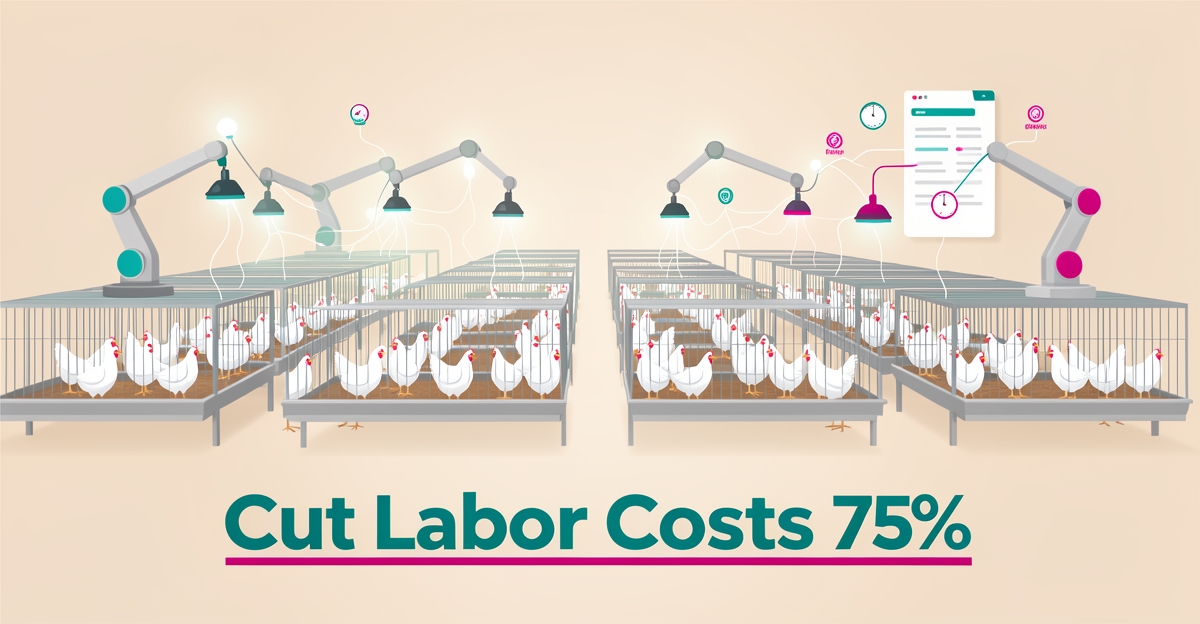
How AI Can Reduce Labor Costs in Daily Poultry Farm Operations
Key Facts
- Weekly labor hours dropped from 48 to 12 in an 8,000-hen farm case study.
- Daily human intervention fell from 12 hours to 3 hours per day after automation implementation.
- Labor cost per hen fell 30% annually with automated H-type cages.
- Egg production rose from 78% to 89% in the same automated operation.
- Early AI monitoring adopters report up to 20% lower mortality according to 2026 farm data.
- Feed typically makes up around 70% of total poultry production cost in current cost breakdowns.
Hire a team member that works 24/7 — for less than a part-time wage.
AI receptionists, SDRs, dispatchers and 99+ roles. Trained on your business, fully managed.
Not sure where to start? Ask our AI planner
The Hidden Cost of Manual Daily Operations
Daily poultry farm operations consume significant labor hours on routine tasks that could be automated, creating a hidden drain on profitability. Manual environmental checks, feed tracking, and data logging can consume dozens of hours weekly on a mid-size farm—time that could be redirected toward strategic activities like flock health management or business growth. A case study of an 8,000-hen farm demonstrated that automation reduced these daily interventions from 12 hours to just 3 hours per day, freeing up 9 hours daily for higher-value work. This labor shift isn’t merely about cutting costs—it’s about transforming how skilled staff spend their time, moving from repetitive tasks to decision-making that directly impacts bird welfare and farm sustainability.
Feed typically represents around 70% of total poultry production expenses, making efficient feed management critical to financial performance. AI-driven feed optimization systems analyze real-time data on bird growth, environmental conditions, and feed conversion rates to adjust rations precisely, reducing waste without compromising output. When combined with automated environmental monitoring—tracking temperature, humidity, ammonia, and CO₂ levels—these systems create a closed-loop operation where adjustments happen continuously based on actual flock needs. The result is not only labor savings but also improved feed efficiency, with early adopters reporting better conversion rates and lower mortality.
- Manual feed tracking and logging commonly consume 2-3 hours daily per worker on medium-scale farms
- Environmental checks often require hourly manual readings across multiple shed zones
- Data entry for production metrics can add many hours of clerical work weekly per farm
- Automated systems can reduce these cumulative tasks substantially—as much as 75% in documented cases
- Labor savings allow staff to focus on preventative health checks and flock observation
By integrating AI workflow automation with existing farm infrastructure, poultry operations can eliminate the manual burden of routine data collection while gaining actionable insights from continuous monitoring. AI systems excel at processing the high-volume, time-sensitive data generated by modern poultry farms—turning what was once a labor-intensive chore into a seamless, background process. This allows farmers to reclaim hundreds of hours annually, redirecting that labor toward activities that truly move the needle: proactive flock management, strategic planning, and value-added operations that improve both bird welfare and bottom-line results. The financial stakes are clear: when feed represents roughly seven of every ten dollars spent, optimizing its use through automation isn’t just efficient—it’s essential for competitive survival in modern poultry farming.
AI-Powered Automation for Routine Farm Tasks
Repetitive daily checks are the hidden labor drain on poultry farms, and AI is quietly taking them over inside the sheds. By pairing sensors, vision and automation, routine workflows become continuous, data-driven processes that run without constant human presence.
IoT sensors now provide 24/7 environmental monitoring that replaces manual logging. Connected IoT sensors track temperature, humidity, ammonia, CO₂, feed and water intake in real time inside poultry sheds as of 2026. Automated systems monitor and regulate temperature, humidity and ventilation to ensure optimal conditions for bird health and productivity in integrated poultry automation. Algorithms analyze these data points to provide actionable insights, such as adjusting ventilation systems to prevent heat stress or detecting the early stages of an outbreak from modern poultry management research.
Computer vision adds an always-on health check that humans cannot sustain. AI-powered cameras monitor flock activity to identify signs of distress or disease earlier than traditional methods in AI poultry management. Early adopters of AI monitoring report up to a 20% lower mortality rate and better feed efficiency according to 2026 farm data. This early detection shifts labor from reactive treatment to proactive care and frees staff for higher-value animal welfare tasks.
Feed is typically around 70% of total production cost in poultry farming in current cost breakdowns, so automated feed optimization delivers immediate savings. Automated systems equipped with AI can adjust feed quantities based on bird size, breed and growth stage, ensuring optimal nutrition while reducing feed wastage in precision feeding systems. AI tools can analyze data to suggest precise feed schedules and ingredient mixes, leading to cost cuts without reduced output from AI savings analysis.
The labor impact is measurable when routine tasks are automated. A case study of an 8,000-hen farm showed weekly labor hours reduced from 48 hours to 12 hours following automation implementation in the automated chicken farm case study. Daily human intervention fell from 12 hours per day to just 3 hours per day, with a 30% reduction in labor cost per hen annually from the same automation project.
These gains align with what AIQ Labs delivers through AI Workflow Builds—rebuilding the one workflow that costs you the most, at a fixed price and in phases. Routine checklists, temperature logging and feed delivery tracking can be absorbed by production-grade AI systems that work seamlessly with existing farm infrastructure. AIQ Labs builds systems that replace manual repetition with continuous monitoring and autonomous adjustments.
Typical routine workflows automated include:
- 24/7 environmental monitoring with IoT sensors for temperature, humidity and ammonia alerts
- Computer vision flock scanning for early disease and distress detection
- Automated feed optimization that adjusts quantities by bird size and growth stage
- Digital logging of daily checklists, feed delivery and water intake without manual entry
The result is less manual repetition and more operational oversight. Data-driven decisions beat intuition every time, and farms can redirect staff from repetitive tasks to animal care, business growth and long-term sustainability.
The Financial Impact: Labor Savings and Efficiency Gains
The numbers tell a compelling story: poultry farms implementing AI-driven automation are seeing measurable returns that directly impact their bottom line. From labor savings to production gains, the financial case for AI adoption has never been clearer.
Consider what happens when automation takes over repetitive daily tasks. According to a documented case study of an 8,000-hen operation, weekly labor hours dropped from 48 to just 12, while daily human intervention fell from 12 hours to only 3. This translated to a 30% reduction in labor cost per hen annually.
The efficiency gains extend far beyond labor. That same operation saw egg production rates climb from 78% to 89%, an 11 percentage point improvement. Meanwhile, farms using AI-powered monitoring systems report up to 20% lower mortality rates, according to industry research on AI adoption.
These improvements compound quickly. Here's what the financial impact looks like in practice:
- Labor costs drop by 30% per hen as automation handles routine tasks
- Egg production increases by 11 percentage points through optimized conditions
- Mortality rates fall by up to 20% with early disease detection
- Feed efficiency improves, addressing the roughly 70% of production costs that feed represents
Payback timelines depend heavily on farm size, current labor costs, and which workflows you automate first. Industry analyses suggest that mid-size farms targeting feed and mortality savings first typically see payback well inside a year, though your own numbers will vary. The most reliable way to estimate your payback is to map your most labor-intensive routine workflows and model the hours reclaimed—something AIQ Labs does with you during a free strategy call.
Beyond the immediate savings, automation creates operational resilience. Automated systems can handle manure removal on more frequent cycles, maintain precise environmental controls around the clock, and free staff to focus on animal care rather than repetitive chores. The pattern across documented implementations is consistent: AI doesn't add cost—it removes inefficiency.
At AIQ Labs, we build custom AI workflow automation systems that integrate seamlessly with existing farm infrastructure, from temperature logging to feed delivery tracking. The goal isn't to replace your team—it's to eliminate the repetitive tasks that consume their time and your budget.
Implementing AI Without Disrupting Your Flock
Many poultry farmers worry that adopting AI means tearing down their existing setup and starting from scratch. In reality, production-grade AI systems are designed to work with what you already have—like H-type cages and current ventilation—without requiring a complete rebuild. These systems layer intelligence onto your existing infrastructure, using sensors and automation that integrate seamlessly with daily operations. The goal isn’t to replace your farm’s foundation but to enhance it with real-time monitoring and automated task handling that reduces manual labor while improving bird health and efficiency.
AI excels at taking over repetitive, time-consuming tasks such as daily checklists, temperature logging, and feed delivery tracking—activities that can consume hours each day. For example, integrating connected IoT sensors with AI allows continuous monitoring of temperature, humidity, ammonia, and CO₂ levels, enabling automatic adjustments to ventilation and feeding schedules. This kind of automation has helped early adopters reduce mortality rates by up to 20% and improve feed efficiency, directly cutting costs since feed typically represents about 70% of total production expenses. By automating these routine functions, farmers reclaim significant time previously spent on manual data collection and reactive adjustments.
As a result, labor shifts from repetitive tasks to higher-value activities like focused animal care, health monitoring, and strategic business management. In the documented case referenced above, weekly labor hours fell from 48 to just 12, and daily human intervention dropped from 12 hours to only 3. This transformation doesn’t eliminate the need for skilled staff; instead, it empowers them to concentrate on what truly matters: flock welfare, operational planning, and long-term sustainability. With AI handling the predictable, the team can focus on the unpredictable—where human expertise adds the most value. Success case studies confirm that this approach leads to measurable gains, including an 11 percentage point increase in egg production rates and more frequent manure removal cycles, all while working within existing housing systems.
Still paying for 10+ subscriptions that don’t talk to each other?
We build custom AI systems you own outright. No vendor lock-in. Full control.
Not sure where to start? Ask our AI planner
Frequently Asked Questions
How much labor can AI automation actually save on a mid-size poultry farm?
What's the typical payback period for investing in AI systems for poultry farming?
Do I need to replace my existing chicken houses and equipment to use AI automation?
How does AI improve feed efficiency when feed is already my biggest expense?
Can AI really detect bird health issues earlier than my experienced staff?
What specific daily tasks can AI automate on my poultry farm?
Reclaim Labor, Protect Margin, Grow the Flock
AI is turning the hidden labor drain of daily poultry operations into a measurable competitive advantage. By automating environmental checks, feed tracking and data logging, documented operations have cut weekly labor from 48 hours to 12 and shifted staff from repetitive tasks to proactive flock health and strategic growth. With feed accounting for roughly 70% of production costs, real-time AI-driven feed optimization and continuous sensor monitoring deliver both labor savings and better conversion, lower mortality and higher egg production. The shift works with existing infrastructure, not against it, layering continuous monitoring and autonomous adjustments onto the systems you already run. If you’re evaluating where automation will pay first, start by mapping your most time-intensive routine workflows — daily checklists, temperature logging and feed delivery tracking — and model the hours reclaimed. AIQ Labs rebuilds the workflow that costs you the most through AI Workflow Builds, at a fixed price and in phases, so you see value before you scale. Start with the two-minute Fit Check at https://aiqlabs.ai/apply, then book your free 30-minute strategy call at https://aiqlabs.ai/book to identify high-ROI automation opportunities for your operation. Prefer email? Reach the team at [email protected].
Make AI your competitive advantage — not just another tool.
Strategy, implementation and ongoing optimization. One partner, end to end.
Not sure where to start? Ask our AI planner