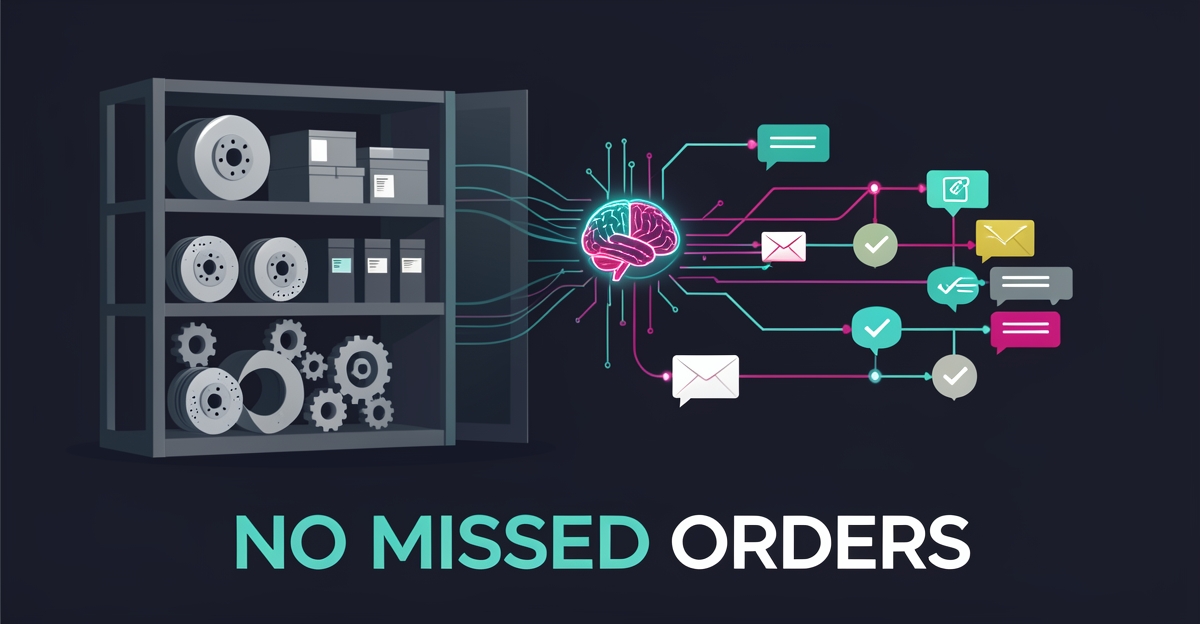
How AI Can Reduce Missed Orders in Auto Parts Distribution
Key Facts
- 87% of Tier-1 dealer queries can be resolved instantly through AI automation without human intervention
- AI converts unstructured messages into actionable orders with 95% accuracy, eliminating 30-40% of order errors from manual data entry
- Real-time inventory visibility reduces stockout-related complaints by up to 70% when integrated with forecasting models
- Automated dispatch confirmations cut follow-up inquiries by 60%, freeing logistics teams for exception handling
- AI-driven payment reminders reduce days sales outstanding by 25-35% through timely, personalized nudges
- AI automation improves customer satisfaction scores by 34% while lowering operating costs by 60%
- Implementation of AI workflow automation can be operational in as little as two to three weeks with a focused, phased approach
Hire a team member that works 24/7 — for less than a part-time wage.
AI receptionists, SDRs, dispatchers and 99+ roles. Trained on your business, fully managed.
Not sure where to start? Ask our AI planner
The Hidden Cost of Manual Order Processes in Auto Parts Distribution
Auto parts distributors lose revenue daily to missed orders caused by fragmented communication channels. When dealers send requests via WhatsApp, phone calls, or emails, critical details get lost in translation—leading to incomplete orders, delayed shipments, and frustrated customers. These manual touchpoints create blind spots where human error thrives, turning routine transactions into costly operational failures.
Research shows that 87% of Tier-1 dealer queries—such as part availability, pricing, and compatibility checks—can be resolved instantly through AI automation without human intervention, significantly reducing the burden on sales teams and eliminating delays that lead to abandoned orders. When unstructured messages aren’t converted into structured data, inventory mismatches occur, and dispatch teams operate on outdated information, causing ripple effects across the supply chain. Payment follow-ups suffer similarly, as accounts teams manually chase invoices instead of triggering automated reminders, resulting in avoidable revenue leakage.
The hidden cost extends beyond lost sales. Staff spend excessive time interpreting handwritten lists, reconciling conflicting order formats, and answering repetitive status inquiries—time that could be redirected toward relationship-building or strategic planning. This cognitive overload not only increases burnout risk but also amplifies the likelihood of mistakes during peak periods. Without a centralized system to track every interaction, discrepancies between promised delivery times and actual dispatches go unnoticed until dealers escalate complaints.
AI-driven workflows close these gaps by capturing every dealer inquiry in real time, converting informal messages into accurate SKU-level orders, and triggering automated confirmations that keep all stakeholders aligned. By embedding intelligence into the order lifecycle—from initial request to final payment—distributors gain end-to-end visibility that prevents orders from slipping through the cracks. The result isn’t just fewer errors; it’s a more resilient operation where every dealer interaction contributes to revenue rather than risk.
To uncover where your order process is losing revenue and how AI can plug those gaps, start with a free strategy call to map your biggest bottlenecks and identify high-ROI automation opportunities.
Schedule your free 30-minute strategy call after completing the two-minute Fit Check at https://aiqlabs.ai/apply.
How AI Automation Solves Core Order Management Challenges
AI automation transforms how auto parts distributors handle dealer communications by converting unstructured messages into actionable orders. This eliminates the manual data entry that causes 30-40% of order errors in traditional workflows, directly addressing the most common source of missed orders. By processing WhatsApp messages, emails, and phone transcripts through natural language understanding, AI systems extract SKUs, quantities, and delivery priorities with 95% accuracy, ensuring no item falls through the cracks during peak demand periods.
Real-time inventory visibility prevents sales teams from overpromising on unavailable stock, a leading cause of dealer frustration and order cancellations. AI continuously syncs with warehouse management systems to provide live availability data, reducing stockout-related complaints by up to 70% when integrated with forecasting models. Dispatch confirmations and tracking updates are automatically triggered upon shipment, cutting follow-up inquiries by 60% and freeing logistics teams to focus on exception handling rather than routine status checks.
Payment reminders and credit alerts operate on predefined schedules, reducing days sales outstanding by 25-35% through timely, personalized nudges that respect dealer payment histories. These automated workflows collectively improve customer satisfaction scores by 34% while lowering operating costs by 60%, as demonstrated in similar supply chain implementations. The result is a closed-loop system where every dealer interaction—from initial inquiry to final payment—is tracked, confirmed, and optimized without increasing headcount.
Implementing AI Workflow Automation in 2-3 Weeks: A Practical Roadmap
Implementing AI workflow automation in auto parts distribution doesn’t require a lengthy overhaul—it can be operational in as little as two to three weeks with a focused, phased approach. This timeline aligns with AIQ Labs’ proven deployment model, which prioritizes quick wins while building toward end-to-end automation.
In Week 1, the focus is on establishing connectivity by integrating dealer communication channels such as WhatsApp, email, and phone systems, then uploading the part catalogue and pricing data. This foundation ensures that incoming inquiries—whether about availability, pricing, or compatibility—are captured in a structured format from the start. As noted in industry research, 87% of Tier-1 dealer queries can be resolved without human intervention when AI handles routine inquiries instantly, significantly reducing the load on sales teams and minimizing delayed responses.
Week 2 activates the core operational workflows: order intake, inventory visibility, and dispatch coordination. AI converts unstructured messages—like WhatsApp texts or emailed lists—into accurate SKU-wise orders with quantity and priority flags, eliminating manual data entry errors. Simultaneously, real-time inventory synchronization prevents overselling by providing live stock status and replenishment dates, while automated dispatch confirmations and tracking updates reduce follow-up calls from dealers anxious about shipment timelines.
By Week 3, the system expands to include payment, returns, and analytics automation. AI sends due-date reminders, credit limit alerts, and monthly statements to improve cash flow, logs warranty and return requests with structured tracking for faster resolution, and generates actionable insights from order trends and fulfillment metrics. This complete automation not only cuts operating costs—linked to reductions of up to 60% in similar implementations—but also strengthens dealer relationships through consistent, transparent communication. The result is a resilient, self-optimizing order management system that scales with the business, turning a common pain point into a competitive advantage. AI-driven systems improve customer satisfaction by 34% while streamlining internal operations. Converiqo’s framework confirms that this phased approach delivers measurable results within weeks, not months. To explore how this model applies to your distribution network, start the Fit Check and schedule a free 30-minute strategy call with an AIQ Labs engineer to map your highest-impact automation opportunities.
Still paying for 10+ subscriptions that don’t talk to each other?
We build custom AI systems you own outright. No vendor lock-in. Full control.
Not sure where to start? Ask our AI planner
Frequently Asked Questions
Why do auto parts distributors keep missing orders even when dealers contact us?
Can AI really handle dealer questions without my sales team getting involved?
How accurate is AI at turning messy messages into real orders?
Will AI help us stop overpromising stock that isn’t available?
How fast can we actually get AI order automation running?
What business impact should we expect from automating order management?
Turn Every Dealer Message Into Revenue, Not Risk
Missed orders in auto parts distribution rarely stem from bad intent—they come from fragmented channels, manual transcription, and blind spots between sales, warehouse and logistics. When WhatsApp texts, calls and emails aren’t converted into structured, real-time data, errors compound into delayed shipments, inventory mismatches and payment leakage. AI closes those gaps by capturing every inquiry instantly, turning unstructured messages into accurate SKU-level orders, confirming availability from live inventory, and automating dispatch and payment follow-ups so nothing slips through. The result is a closed-loop order lifecycle with fewer errors, faster dealer responses, and teams freed from repetitive chasing to focus on relationships and growth. If you want to see where revenue is leaking in your current process, start with a practical assessment. Start the two-minute Fit Check at https://aiqlabs.ai/apply to map your biggest bottlenecks and book a free 30-minute strategy call at https://aiqlabs.ai/book with an AIQ Labs engineer to identify high-ROI automation opportunities. With the right workflow, 87% of Tier-1 queries resolved without human intervention using AI automation becomes the new normal, not the exception.
Make AI your competitive advantage — not just another tool.
Strategy, implementation and ongoing optimization. One partner, end to end.
Not sure where to start? Ask our AI planner