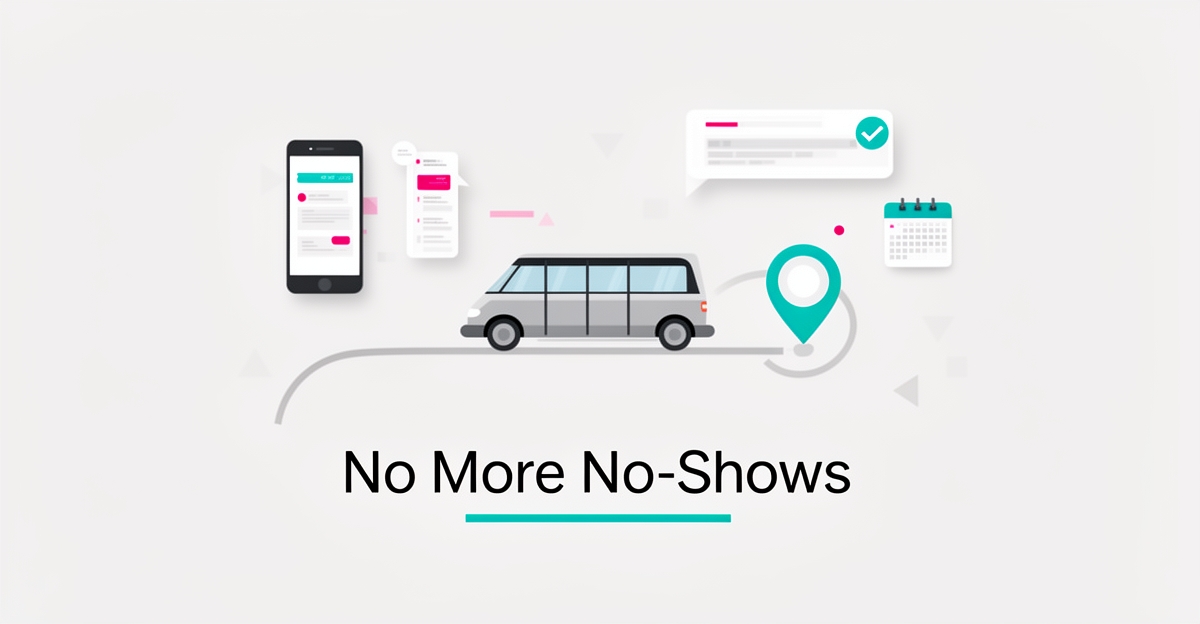
How AI Can Reduce No-Shows and Improve Customer Retention in Shuttle Services
Key Facts
- Operators deploying AI-driven reminder and confirmation systems typically report no-show reductions in the 30–50% range within the first month
- SMS messages are typically read within minutes of delivery, with open rates near 98% — far ahead of email response rates
- Industry surveys consistently show a strong majority of customers prefer text reminders over phone calls
- Passengers who ignore a 48-hour reminder show a substantially elevated no-show probability, making it the single best early-warning signal
- Service businesses commonly lose hundreds to thousands of dollars monthly to no-shows, depending on route volume and fare value
- Complete multi-touch confirmation sequences are associated with meaningfully higher customer lifetime value than single-reminder approaches
- Dynamic message timing — sending when each customer is most likely to engage — typically lifts response rates 15–20% over static scheduling
Hire a team member that works 24/7 — for less than a part-time wage.
AI receptionists, SDRs, dispatchers and 99+ roles. Trained on your business, fully managed.
Not sure where to start? Ask our AI planner
The Hidden Cost of Empty Seats: Understanding the No-Show Crisis
Every empty seat on a scheduled shuttle represents money already spent—fuel committed, a driver on the clock, and a route planned around passengers who never arrived. No-shows aren't a minor nuisance for shuttle operators; they're a silent, compounding drain on revenue and operational capacity.
The financial toll is measurable. Service businesses commonly lose hundreds of dollars per month to no-shows, and appointment-based operations can lose anywhere from $500 to $2,000 monthly depending on volume and ticket value. For a shuttle service running tight margins, that's the difference between a profitable route and a losing one.
The problem is also getting worse. Reservation-based services across hospitality and transport have reported climbing no-show rates in recent years, driven largely by reservation hoarding, where customers book multiple options for the same time slot and hold capacity "just in case." Shuttle passengers behave the same way, booking two services and abandoning one.
And the damage doesn't stop at the empty seat. The hidden costs ripple across the entire operation:
- Wasted resources: Vehicles run partial routes with drivers and fuel committed to full-capacity expectations.
- Opportunity cost: Every no-show seat is a paying customer who may have been turned away or never offered the slot.
- Scheduling inefficiency: Dispatchers and drivers prepared for full volume see productivity evaporate.
- Team morale: Staff frustration grows when consistent preparation repeatedly fails to translate into actual ridership.
What makes this crisis so stubborn is that most shuttle operators still rely on manual, single-touch reminders—a phone call or a lone email that's easy to ignore. Meanwhile, customer behavior has shifted: people expect fast, convenient confirmation on their phones, and silence from a provider is often read as permission to skip the trip.
The good news is that this problem is highly solvable. Businesses implementing AI-driven reminder and confirmation systems typically report no-show reductions in the 30–50% range within the first month, recovering meaningful monthly revenue that was previously leaking away. AIQ Labs builds these systems as part of its AI Workflow Builds—rebuilding the one workflow that costs you the most, at a fixed price and in phases—so high-risk bookings get engaged before they become empty seats.
Why SMS Beats Phone Calls: The Multi-Channel Communication Advantage
Most shuttle operators still rely on phone calls to confirm rides, yet this single-channel approach leaves money on the table. Text messaging is typically read within minutes of delivery—industry benchmarks put SMS open rates near 98%—while email response rates sit in the single digits by comparison.
The preference gap is just as wide. Industry surveys consistently show a strong majority of customers prefer text reminders over phone calls, making SMS the clear winner for reach and engagement. But the real power emerges when channels work together in a structured sequence.
- An immediate booking confirmation locks in details and establishes the communication thread
- A 48-hour reminder catches early conflicts while slots are still resellable
- A 3-hour final notice creates gentle urgency and captures last-minute changes
- A post-ride follow-up builds loyalty and fuels retention
This multi-touch cadence is associated with confirmation rates climbing from roughly 60% to over 85% by layering psychological triggers—personalization, frictionless reply options, and subtle urgency—into every message. Passengers who ignore the 48-hour ping show a substantially higher no-show probability, giving operators an early-warning system to intervene or release inventory.
AIQ Labs builds these exact communication engines into custom AI workflows, letting shuttle fleets automate the entire sequence across SMS, email, and voice without adding headcount. The system reads replies, updates calendars, and triggers waitlist offers automatically—turning a reactive scramble into a predictable, revenue-protecting process.
The 4-Touch Confirmation System: Your Blueprint for Fewer No-Shows
A single missed pickup doesn't just cost you one fare — it leaves a driver idle, burns fuel, and turns away a paying customer. The most effective fix isn't more phone calls from your dispatch team; it's a structured, automated communication sequence known as the 4-touch confirmation system.
Businesses that implement this complete cadence tend to see meaningfully higher customer lifetime value than those relying on a single pre-arrival confirmation. Here's how each touchpoint works for a shuttle operation.
Touch 1: Immediate Booking Confirmation (Within 5 Minutes)
The moment a reservation is made, the customer should receive a text confirming the date, time, and pick-up location. This instant response builds trust, establishes the communication channel, and eliminates manual entry errors. Include complete trip details, a direct phone number for questions, and a clear opt-out option.
Touch 2: The 48-Hour Advance Reminder
This is your single most valuable touchpoint. The 48-hour window gives customers comfortable lead time to adjust plans while leaving you enough runway to resell a cancelled seat. Critically, this touch generates your best predictive data: passengers who don't respond to the 48-hour reminder show a markedly higher no-show probability and should be flagged for extra outreach, such as a personal phone call.
Touch 3: The 3-Hour Final Confirmation
Three hours before departure is the last-chance checkpoint. It creates gentle urgency — mentioning that the seat could be offered to other passengers encourages commitment — and gives your team just enough time to adjust staffing or fill a cancellation from your waitlist. Simple response mechanics like "Reply Y to confirm" remove friction, and operators using these psychological triggers have pushed confirmation rates from around 60% to over 85%.
Touch 4: Post-Service Follow-Up
The next day, a short thank-you message with a feedback request transforms one-time riders into repeat customers. This touch collects reviews, surfaces service recovery opportunities, and keeps your brand top of mind for the next booking.
Why does this cadence work so well? Because it runs on SMS. Text messages are typically read within minutes and generate response rates several times higher than email. Businesses using these systems commonly report no-show reductions in the 30–50% range within the first month, recovering revenue that was previously written off.
AI systems go further, learning when individual customers are most likely to respond and adjusting message timing dynamically — an approach typically worth 15–20% higher response rates than static scheduling. For shuttle operators, that means fewer empty seats and a customer base that keeps coming back.
Beyond Reminders: AI-Powered Prediction and Automatic Slot Recovery
Reminders stop no-shows. Prediction and recovery turn them into retention.
AI moves shuttle operators from chasing missed pickups to protecting revenue before it disappears. Instead of one-size-fits-all nudges, systems analyze booking behavior, response speed, and historical patterns to flag risk in real time.
Predictive no-show scoring is the shift. AI assigns a risk score to each reservation by weighing past no-shows, modification frequency, and lead time to booking. High-risk bookings trigger extra touches, while low-risk ones stay light. Passengers who don't respond to 48-hour reminders show a substantially elevated no-show probability, making early flagging critical.
Dynamic timing optimization lifts response rates without adding messages. The system learns when individual customers typically engage and adjusts send times accordingly — typically worth 15–20% higher response rates compared to static scheduling. For shuttle services, that means confirmations land when phones are picked up, not ignored.
Automatic slot recovery closes the revenue gap instantly. When a cancellation or non-response is detected, AI can contact waitlisted riders and fill the seat without dispatcher intervention, turning empty capacity into paid rides the moment a slot opens.
Together these capabilities create a proactive retention loop:
- Predictive scoring identifies high-risk bookings before they become no-shows
- Dynamic timing improves engagement by delivering messages at the customer's optimal window
- Automatic waitlist filling recovers lost revenue the moment a slot opens
- Intelligent response processing updates booking status and routes complex requests to staff
The impact compounds. Operators typically see no-show reductions in the 30–50% range within the first month of implementing these systems. That protection strengthens loyalty because customers experience reliable communication and fewer rebooking hassles.
AIQ Labs helps shuttle providers implement these capabilities — whether as a single rebuilt workflow or as part of a broader AI Operating System that connects bookings, dispatch, and customer communication in one layer you own outright. The result is less idle vehicle time, higher fill rates, and a customer experience that feels attentive rather than automated.
Implementing AI No-Show Reduction in Your Shuttle Service
Getting started with AI-powered no-show reduction is faster than most shuttle operators expect. Many implementations go live within a week or two, meaning you could be running automated confirmation sequences shortly after making the decision.
The first step is integration. Your AI system needs to connect with your existing booking platform so confirmations and reminders trigger automatically. Integration is possible with major scheduling platforms including Google Calendar, Outlook, Calendly, and many industry-specific management systems, so operators rarely need to replace their current software.
Next, establish a clear cancellation policy and communicate it upfront. A proven approach is the "two-strike rule": if a customer doesn't respond to the 48-hour reminder or the 3-hour final confirmation, the system automatically releases their seat. This policy must be clearly communicated to customers at booking so expectations are transparent from day one.
Your reminder cadence should follow the multi-touch structure that's driving results across service industries. A typical sequence includes:
- An instant booking confirmation within 5 minutes, establishing the communication channel with full trip details
- A 48-hour SMS reminder to catch early cancellations while there's time to resell the seat
- A final confirmation roughly 3 hours before departure, when a cancellation still allows staffing adjustments or waitlist fills
- A next-day follow-up message that builds relationships, collects feedback, and encourages repeat bookings
SMS should anchor this sequence. Text messaging is typically read within minutes and generates response rates several times higher than email, and customers welcome it: a strong majority prefer text reminders over phone calls.
One operational detail deserves attention: handling ambiguous responses. While AI agents process clear replies like "Y" to confirm or "C" to cancel automatically, vague messages or complex modification requests should be flagged for human review. The best systems route these edge cases to your team so no customer communication slips through the cracks.
The payoff for getting this right is measurable. Businesses implementing these systems typically report no-show reductions in the 30–50% range within the first month, and operators running complete four-touch systems see stronger customer lifetime value than those relying on pre-arrival confirmations alone — a retention effect that applies equally to shuttle services building a base of repeat riders.
This is where working with an experienced partner matters. AIQ Labs builds these systems to integrate with your booking tools, track customer behavior, score no-show risk, and automate engagement across SMS, email, and voice — with payment models that fit your stage: Start Monthly, Build in Milestones, or Own It Outright. If you want to see whether this fits your operation, start with the two-minute Fit Check at aiqlabs.ai/apply, followed by a free 30-minute strategy call to map your biggest bottleneck. If there isn't a clear win, we'll tell you that too.
Still paying for 10+ subscriptions that don’t talk to each other?
We build custom AI systems you own outright. No vendor lock-in. Full control.
Not sure where to start? Ask our AI planner
Frequently Asked Questions
How much money do no-shows actually cost a shuttle service each month?
Can AI really reduce no-shows, or is that just hype?
Why should I use text messages instead of phone calls to confirm rides?
What is the 4-touch confirmation system for shuttle bookings?
How can I predict which passengers are likely to no-show?
How long does it take to set up an AI no-show reduction system?
Ready to Fill Those Empty Seats?
The path to reducing costly no-shows and building a loyal customer base is clear. By moving beyond single-channel reminders and embracing an AI-powered, multi-touch communication strategy, shuttle services can protect revenue and enhance the rider experience. Operators implementing predictive analytics and automated slot recovery typically cut no-shows by 30–50% and recover meaningful monthly revenue. This isn't about adding complexity; it's about deploying an intelligent system that handles confirmations, predicts risks, and fills seats automatically, turning a persistent operational headache into a retention advantage. If you're ready to stop letting empty seats drain your profits, the next step is to see how a custom AI system fits your operation. The team at AIQ Labs builds these exact solutions, starting with a free, no-obligation Fit Check to map your biggest opportunities. You can begin the two-minute process at aiqlabs.ai/apply.
Make AI your competitive advantage — not just another tool.
Strategy, implementation and ongoing optimization. One partner, end to end.
Not sure where to start? Ask our AI planner