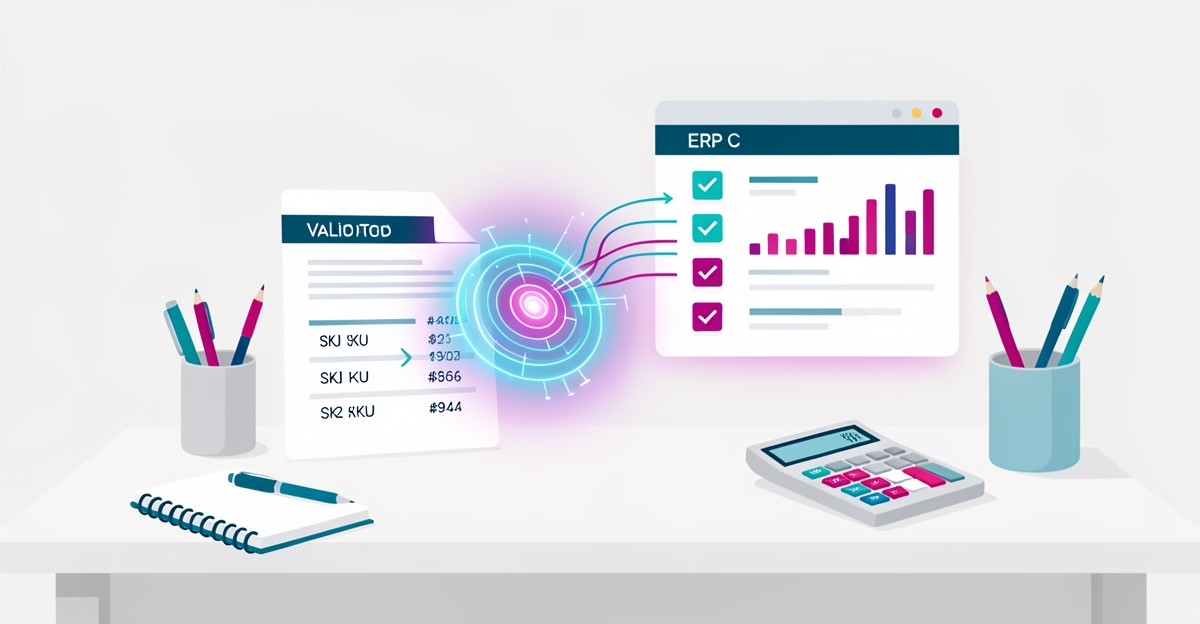
How AI Can Reduce Order Entry Errors in Office Supply Distributors
Key Facts
- AI-powered data entry typically achieves 99%+ accuracy on structured documents, per recent automation research
- Manual data entry carries an average error rate of roughly 1-4% per industry data
- Human error rates tend to rise noticeably after a couple of hours of sustained keying, per fatigue research
- A majority of organizations maintain human review steps in data entry automation workflows, per automation statistics as of late 2026
- Employees in automated environments commonly recover several hours per week, with studies citing averages around 6.5 hours
- AI-assisted entry processes structured forms an order of magnitude faster than manual methods
Hire a team member that works 24/7 — for less than a part-time wage.
AI receptionists, SDRs, dispatchers and 99+ roles. Trained on your business, fully managed.
Not sure where to start? Ask our AI planner
Why Order Entry Errors Are a Process Problem, Not a People Problem
Order entry errors persist not because of careless staff, but because of broken processes that set people up to fail. Manual transcription from emails, PDFs, and faxes forces office supply distributors into a cycle of rekeying data under pressure, where even experienced operators slip. Industry data puts the average manual data entry error rate at roughly 1-4%, and fatigue research suggests error rates climb noticeably after a couple of hours of sustained keying. This isn't a reflection of skill—it's a symptom of a workflow that demands repetitive, error-prone tasks without built-in safeguards.
The real issue lies in the chaos of source formats and the absence of real-time validation. Order desks constantly switch between email threads, scanned PDFs, and faxed sheets, each with its own layout, abbreviations, and ambiguities. Smudged faxes, customer-specific part numbers, and rushed entries during peak hours force guesswork, turning routine orders into error risks. These mistakes stem from the manual movement of data from one format to another under time pressure—not from the individuals performing the task. Fixing who enters the data won't stop errors if the process remains unchanged.
AI shifts the burden from fallible human keying to consistent machine processing, especially when paired with human oversight for complex cases. Intelligent Document Processing typically achieves 99%+ accuracy on structured documents like standardized order forms, far surpassing manual efforts. Unlike humans, AI systems don't fatigue, so their precision holds steady through high-volume periods when error rates typically spike. The most effective implementations use a human-in-the-loop model: AI handles high-confidence, repetitive entries while flagging exceptions—such as unclear SKUs or mismatched quantities—for human review. This approach lets teams focus on the small share of orders requiring judgment, rather than drowning in rekeying tasks.
For office supply distributors, the highest leverage point is validating order data against the live ERP at the moment of entry. Checking every SKU, quantity, and price in real time prevents costly fulfillment mistakes before they happen. AIQ Labs builds document processing pipelines that integrate directly with legacy ERP systems common in distribution, ensuring extracted data is validated against current inventory and pricing. This turns order entry from a liability into a controlled, auditable step—reducing errors not by blaming people, but by redesigning the process they rely on.
How AI Document Processing Cuts Errors and Labor at Scale
AI-powered document processing transforms order entry from a high-error manual task into a streamlined, accurate workflow. Intelligent Document Processing (IDP) and OCR systems typically achieve 99%+ accuracy on structured documents like purchase orders and invoices, compared to the roughly 1-4% error rate inherent in manual data entry. This accuracy advantage becomes even more pronounced at scale, as AI systems do not suffer from fatigue—unlike humans, whose error rates tend to climb after hours of sustained keying work.
These systems also deliver efficiency gains, processing structured forms an order of magnitude faster than manual methods, with deployments commonly reporting meaningful labor-cost reductions within the first year. Employees in automated environments often recover several hours per week—studies cite averages around 6.5 hours—time that can be redirected toward exception handling, customer service, or process improvement. For office supply distributors handling high volumes of standardized order formats, this translates to fewer fulfillment errors and less operational waste.
The most effective implementation strategy combines AI automation with human oversight. Most organizations using IDP maintain a human-in-the-loop approach, routing low-confidence or complex orders to staff for review while automating high-volume, high-confidence entries. This model ensures that AI handles repetitive tasks without compromising accuracy on ambiguous inputs like handwritten notes or non-standard PDFs. By integrating directly with ERP systems to validate SKUs, quantities, and prices at the point of entry, AI catches errors before they propagate through the fulfillment chain—turning a reactive cost center into a proactive accuracy engine. AIQ Labs builds document processing pipelines that enable this level of precision, connecting with legacy and modern distributor systems to ensure every order starts right.
- Validates order data against live ERP catalogs at entry time
- Routes exceptions to human reviewers for judgment calls
- Reduces manual rework by eliminating repetitive data transcription
ERP-First Validation and Human-in-the-Loop Implementation
Office supply distributors face a fundamental challenge: order entry errors stem not from human carelessness but from broken processes. Manual transcription of SKUs, quantities, and prices from emails, PDFs, and faxes creates a high-risk environment where fatigue and format chaos compound mistakes. Manual data entry carries an average error rate of roughly 1-4%, and that rate tends to climb with sustained keying work. This process flaw directly impacts fulfillment accuracy and customer trust.
AI-powered validation changes this dynamic by checking every order detail against the live ERP catalog in real time. As data enters the system—whether from an emailed PDF or a scanned form—AI instantly verifies SKUs exist, quantities are valid for the item, and pricing matches current contracts. This pre-posting check catches errors before they trigger costly downstream issues like mis-shipments or returns. A flagged mismatch takes seconds to resolve; a shipped error incurs return logistics, restocking, and customer service overhead. For distributors relying on legacy systems like AS/400, Infor, or Epicor, custom AI pipelines bridge the gap by pulling live catalog data and pushing validated orders back into the ERP without disruptive rip-and-replace efforts.
The most effective implementation pairs this automation with human-in-the-loop oversight. AI handles high-confidence, high-volume orders—typically achieving 99%+ accuracy on structured documents—while routing exceptions like ambiguous part numbers or unfamiliar customer abbreviations to human reviewers. This approach aligns with the finding that most organizations maintain human review steps in their data entry workflows, recognizing that judgment is still needed for the small share of orders requiring contextual interpretation. By standardizing intake channels and killing retyping wherever structured data exists, distributors free up hours per employee each week, redirecting talent toward relationship-building and complex problem-solving rather than repetitive data transcription. AIQ Labs builds these validation layers into document processing pipelines, ensuring ERP integrity from the moment an order is received.
Seven Practical Steps to Reduce Order Entry Errors Now
Order entry errors spike when manual keying meets volume surges, and the cost shows up later as returns, credits, and re-ships. The fix is not more careful typing; it is a repeatable process that validates data at entry and removes retyping.
Validate against the ERP at the moment of entry. Every SKU, quantity, and price should be checked against the live catalog before the order posts. A flagged mismatch costs seconds; a shipped mismatch costs a return, re-ship, credit, and a phone call. Real-time validation is the single highest-leverage change for distributors.
Standardize the intake, not the customers. Funnel emails, PDFs, faxes, and phone scripts into one consistent review step so teams are not re-parsing a new layout every few minutes. Format chaos creates context-switching that breaks attention and introduces errors.
Kill retyping wherever you can. Any data that already exists in a structured form should flow into the ERP without a human retyping it. AI-powered extraction from emails and PDFs can achieve 99%+ accuracy on structured documents, compared with a roughly 1-4% human error rate for manual entry.
Make exceptions loud and route them to a human. Have the system flag orders it is unsure about and stop them for review rather than making a best guess. A human-in-the-loop model is dominant for a reason: most organizations maintain human review steps in data entry automation workflows.
Measure your error rate before you try to fix it. Put a number on current performance by tracking returns, credits, and re-ships back to "order entry." Without a baseline, improvement is guesswork.
Track errors back to their root cause. When an error happens, log why it happened, such as bad source document, ambiguous part number, or rush-hour volume. This reveals fixable process gaps instead of blaming keyers.
Free your team from volume-driven mistakes. Break the structural link between higher order volume and more manual keying to prevent error rates from spiking during busy weeks. AI-assisted entry is dramatically faster for structured forms and does not fatigue, so accuracy holds at scale.
These steps map directly to how custom document processing works in practice:
- Extract order details from emails, PDFs, and phone scripts with OCR and intelligent document processing
- Validate SKUs, quantities, and pricing against the live ERP catalog at entry
- Route low-confidence items to human reviewers and auto-post high-confidence orders
- Standardize intake channels into one pipeline to eliminate layout re-parsing
Teams using this approach commonly recover several hours per employee each week, with deployments often reporting significant reductions in data entry labor costs within the first year. AIQ Labs rebuilds this kind of workflow through AI Workflow Builds—a fixed-price, phased rebuild of the one workflow that costs you the most—so ownership stays with you. For teams that want ongoing coverage without adding headcount, AI Employees can staff the exception-handling and review layer at a fraction of the cost of a human hire.
Still paying for 10+ subscriptions that don’t talk to each other?
We build custom AI systems you own outright. No vendor lock-in. Full control.
Not sure where to start? Ask our AI planner
Frequently Asked Questions
How much more accurate is AI compared to manual data entry for order processing?
Why do order entry errors increase during busy periods, and can AI help prevent this?
What is a human-in-the-loop approach, and why is it recommended for AI order entry?
How much time can employees save each week with AI-assisted order entry automation?
Can AI integrate with legacy ERP systems commonly used by office supply distributors?
What cost savings can office supply distributors expect from implementing AI in order entry?
From Error-Prone Entry to Controlled Fulfillment
Order entry errors in office supply distribution are a process problem, not a people problem. Manual rekeying from emails, PDFs and faxes creates fatigue-driven mistakes, format chaos and a lack of real-time validation that spike during peak volume. AI shifts the burden from fallible keying to consistent machine processing, with Intelligent Document Processing typically delivering 99%+ accuracy on structured documents and holding steady when human error rates climb. The most durable model is human-in-the-loop: automate high-confidence entries, route exceptions for judgment, and validate every SKU, quantity and price against the live ERP at the moment of entry. That single checkpoint prevents costly mis-shipments, returns and rework while freeing teams for customer-facing work. If you're ready to redesign the workflow rather than blame the keyers, start with a clear baseline, standardize intake, and build ERP-first validation into your order pipeline. AIQ Labs rebuilds exactly this kind of workflow through AI Workflow Builds, and for distributors ready to connect everything, AI Operating Systems provide one connected operating layer you own outright. Take the 2-minute Fit Check at https://aiqlabs.ai/apply to book a free 30-minute strategy call and map your biggest bottleneck.
Make AI your competitive advantage — not just another tool.
Strategy, implementation and ongoing optimization. One partner, end to end.
Not sure where to start? Ask our AI planner