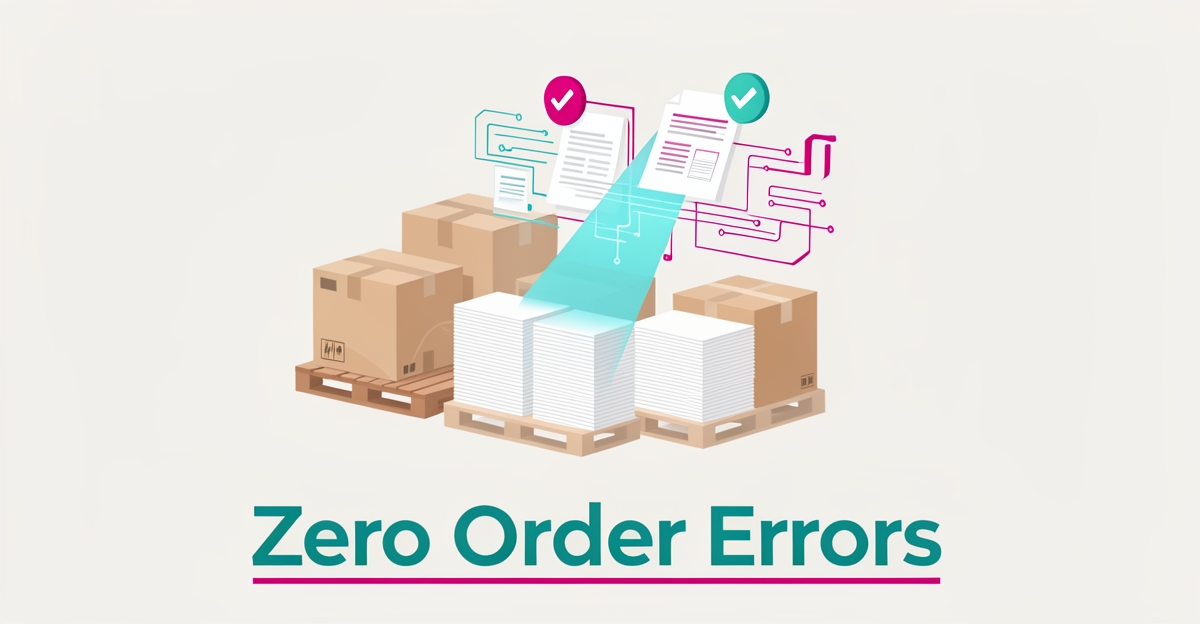
How AI Can Reduce Order Errors and Improve Customer Trust in Paper Distributors
Key Facts
- Order automation has been reported to save roughly $5–$15 per sales order in industry survey data according to order management research.
- The same research reports sales order cycle time reductions of around 46% through automation.
- Industry analyses suggest only a small minority of organizations—often cited near 11%—have successfully deployed AI agents per Gartner-cited analysis.
- Gartner has predicted a large share of agentic AI projects (around 40% by 2027) will be canceled due to unclear value or risk controls.
- Quality investigations in fragmented supply chains can take three to four weeks or more in traditional case studies.
Hire a team member that works 24/7 — for less than a part-time wage.
AI receptionists, SDRs, dispatchers and 99+ roles. Trained on your business, fully managed.
Not sure where to start? Ask our AI planner
The Hidden Cost of Manual Order Errors Have on Paper Distributor Customer Trust
In paper distribution, a single mis-typed line item can trigger a wrong delivery, a chargeback, and a lost account. Manual order entry is the source of that risk, and the cost shows up as both operational waste and eroded B2B trust.
Human keying of PDFs, emails and EDI messages creates errors that result in incorrect shipments and delayed deliveries. Industry research on order management notes that traditional processes relying on human input are prone to mistakes that lead to dissatisfied customers. For paper distributors where accuracy is expected, those mistakes read as unreliability.
The financial impact is measurable. Survey data on order automation has reported savings of roughly $5 to $15 per sales order, alongside cycle time reductions of around 46%. Automation data for distributors makes clear that speed gains come alongside error reduction, not at its expense.
Trust compounds over time. When data is fragmented across ERPs, spreadsheets and warehouse systems, investigations into discrepancies can take weeks and erode confidence. Case analysis of fragmented supply chains highlights how lack of unified data forces multi-week quality investigations. In B2B paper supply, customers expect a single source of truth for order status and product history.
AI changes the entry point. Optical Character Recognition and Natural Language Processing reliably capture and validate data from diverse order documents and channels. Operations analysis of AI in order management confirms these technologies reduce errors significantly by replacing manual data entry. For distributors receiving orders via PDF, email or portal, AI can parse line items, quantities and delivery instructions before the order hits fulfillment.
The trust deficit is not only about accuracy, it is about visibility. Decision architecture matters before automation scales. Retailers and distributors must map decision ownership and data flows, otherwise AI will scale confusion at a speed the business cannot handle. Analysis of agentic AI readiness warns that agents acting on conflicting inventory data create failed deliveries.
When implemented with document workflow integration, AI delivers the transparency B2B buyers demand:
- Automatic capture and validation of orders from email, PDF and EDI
- Real-time inventory visibility and dynamic fulfillment routing
- Immutable audit trails for order status and delivery conditions
Paper distributors face high risks from misentered orders and incorrect deliveries. AI document processing can validate order documents automatically, reducing errors and boosting customer satisfaction. AIQ Labs builds production-grade systems—whether an AI Workflow Build targeting your costliest order workflow or a full AI Operating System—that integrate with existing document workflows, turning operational accuracy into a competitive differentiator that sustains long-term B2B relationships.
Why AI Fails Without a Decision Architecture: The Prerequisite for Accurate Automation
The promise of AI in order management often overlooks a critical prerequisite: decision architecture. Before deploying any automation, paper distributors must map decision ownership and data flows across teams. Without this foundational step, AI doesn't solve problems—it amplifies them. As industry analysts warn, automating a broken process leads to "scaling confusion at a speed the business cannot handle" according to industry analysis. This may help explain why only a small minority of organizations—often cited near 11%—have successfully deployed AI agents, despite growing interest per Gartner-cited figures. Many fail because they skip the essential work of creating a "digital twin" of operations—a unified, real-time data layer that reflects the true state of the business.
This gap between ambition and readiness creates significant risk. Gartner has predicted that a large share of agentic AI projects—around 40% by 2027—will be canceled due to unclear business value or missing risk controls based on their research. For paper distributors, where order accuracy directly impacts customer trust and delivery reliability, deploying AI without addressing fragmented data sources—like disconnected ERPs, spreadsheets, or email-based approvals—invites failure. Agents acting on conflicting information, such as inventory mismatches between systems, will generate errors faster than teams can correct them. The result isn't efficiency; it's accelerated chaos.
A decision architecture isn't optional—it's the operating system for trustworthy automation. It defines who owns decisions, what data is authoritative, and when humans must intervene. Only after establishing this context layer—through steps like consolidating data into a single source of truth and defining governance protocols—can AI reliably validate orders, route fulfillment, and provide immutable audit trails. For paper distributors handling high-volume, complex orders, this preparation transforms AI from a liability into a precision tool. Skipping it doesn't just waste investment; it erodes the very trust AI is meant to build. The technology is ready—but the foundation must come first.
How AI Document Processing Eliminates Errors and Enables Trustworthy Fulfillment
Paper distributors operate in a high-stakes environment where a single misentered order can trigger costly returns, damaged relationships, and eroded trust. Manual data entry from PDFs, emails, and EDI files remains a critical vulnerability, with human error consistently undermining fulfillment accuracy. AI-powered document processing eliminates this risk by automatically capturing and validating order details at the point of entry, transforming a liability into a verifiable competitive advantage.
Optical Character Recognition (OCR) and Natural Language Processing (NLP) technologies now reliably extract line items, quantities, and delivery instructions from diverse document formats with high precision, directly addressing the root cause of misentered orders according to industry experts. This automation reduces errors significantly by replacing manual keystrokes with intelligent data interpretation that understands context, corrects inconsistencies, and flags anomalies before they propagate through the fulfillment chain. For paper distributors handling high-volume, specification-sensitive orders, this means fewer incorrect shipments of wrong grades, sizes, or quantities—each of which can disrupt production lines and damage customer confidence.
The true power emerges when this validated order data integrates with real-time inventory systems and dynamic routing logic. AI can continuously monitor stock levels across distribution centers and automatically select the optimal fulfillment location based on proximity, availability, and delivery windows as demonstrated in cross-industry applications. This prevents both stockouts—which delay orders and frustrate customers—and overstocking, which ties up capital and risks obsolescence. By ensuring that every order is not only accurate but also feasible and efficiently routed, distributors turn operational reliability into a predictable customer experience.
Critically, well-built AI systems generate immutable audit trails that record every data capture, validation check, and routing decision. When combined with ledger-style tracking, these trails provide customers with transparent, tamper-proof proof of order status, fulfillment path, and delivery confirmation as seen in supply chain trust initiatives. For B2B paper distributors managing large-volume contracts, this transforms trust from an assumption into a verifiable attribute—where customers don't just believe the order is correct, they can independently confirm it. AIQ Labs builds these end-to-end systems to ensure accuracy isn't just internal—it's visible, provable, and foundational to long-term customer relationships.
From Pilot to Partnership: Implementing AI Order Accuracy with AIQ Labs' Proven Approach
Most AI projects fail not because the technology is flawed, but because they attempt to automate chaos. Gartner has predicted that around 40% of agentic AI projects will be canceled by 2027 due to unclear business value or missing risk controls—a stark warning for distributors eager to fix order errors overnight.
The antidote is a disciplined, phased approach that respects the complexity of your existing workflows. Rather than overhauling your entire operation, begin by mapping your decision architecture and identifying one high-volume workflow where errors carry the highest cost. This creates the foundation for what industry experts call a digital twin slice—a living data layer that mirrors a single process in real time, allowing AI to act on accurate information rather than fragmented spreadsheets.
For paper distributors, this typically means starting with order document processing. AI-powered OCR and NLP can capture line items, quantities, and delivery instructions from PDFs and emails with significantly higher accuracy than manual entry, immediately reducing the misentered orders that damage customer trust. Once this pilot proves reliable, you can expand into dynamic inventory routing and automated validation.
AIQ Labs structures this journey through three entry points designed to scale with your confidence:
- AI Employees: Managed AI staff—such as order processors and data entry agents across 99+ roles—that work around the clock within your defined governance rules, escalating exceptions to human teams when confidence thresholds aren't met, at roughly 80% less cost than a human hire.
- AI Workflow Builds: We rebuild the one workflow that costs you the most—like order document processing—at a fixed price, delivered in phases so you see value before you scale.
- AI Operating Systems: One connected operating layer across your distribution business, built in phases and owned outright—no vendor lock-in, no guesswork.
This approach directly addresses the readiness gap that stalls most initiatives. While only a small minority of organizations have successfully deployed AI agents, starting with a narrow pilot allows you to prove ROI before scaling. Our Start Monthly model supports this low-risk entry: a flat monthly fee covers the build, training on your specific document workflows, tool integrations, and ongoing optimization. When you're ready to go further, Build in Milestones lets you expand in funded phases, and Own It Outright puts the full system in your hands with no recurring dependency.
The result is a partnership that grows with your operational maturity. With 200+ multi-agent systems deployed and four live SaaS products we run ourselves every day, AIQ Labs has seen what works at production scale. You maintain full ownership of your system while we handle the complexity of monitoring and refinement, transforming order accuracy from a cost center into a verifiable competitive advantage that strengthens customer trust with every correct delivery.
Still paying for 10+ subscriptions that don’t talk to each other?
We build custom AI systems you own outright. No vendor lock-in. Full control.
Not sure where to start? Ask our AI planner
Frequently Asked Questions
How much do manual order errors actually cost paper distributors?
Can AI really read orders from PDFs and emails accurately?
Why do AI order projects fail even with good technology?
How does AI help with trust beyond just accuracy?
Will AI automatically pick the right warehouse to ship from?
Do we need to rebuild our whole ERP before starting with AI?
Turning Order Accuracy into Your Competitive Edge
Paper distributors know that a single misentered order can damage trust, trigger costly returns, and disrupt customer operations. This article has shown how AI-powered document processing eliminates manual entry errors by automatically capturing and validating order details from PDFs, emails, and EDI files—reducing mistakes that erode B2B relationships. But accuracy alone isn't enough; trust grows when decisions are transparent, data is unified, and every action is traceable. That's why successful AI implementation starts with mapping decision architecture and building a digital twin slice of your order workflow, ensuring automation enhances rather than amplifies existing complexity. When AI is grounded in real-time inventory visibility, dynamic fulfillment routing, and immutable audit trails, it transforms order accuracy from a cost center into a verifiable differentiator that strengthens customer confidence with every correct delivery. For distributors ready to move beyond manual chaos, the next step is to identify one high-volume order workflow where errors carry the highest cost and begin a focused pilot. AIQ Labs helps paper distributors build production-grade AI systems—whether through AI Employees, a fixed-price Workflow Build, or a full AI Operating System—turning operational precision into long-term partnership value without vendor lock-in or guesswork. Start the Fit Check to explore how a tailored AI approach can reduce order errors and rebuild trust in your distribution network.
Make AI your competitive advantage — not just another tool.
Strategy, implementation and ongoing optimization. One partner, end to end.
Not sure where to start? Ask our AI planner