How AI Reduces Order Processing Errors in Plumbing Supply Distributors
Key Facts
- Manual data entry in order processing drives error rates between 1% and 5% for data-heavy tasks like invoice and purchase order handling according to research
- Fixing order processing errors consumes 2-4% of total labor costs as staff spend time reconciling discrepancies per industry analysis
- Manual data entry takes 8-15 minutes per invoice, multiplying quickly across high-volume operations based on operational studies
- AI-powered document processing can reduce data entry time to under one minute per invoice while driving error rates below 1% per implementation results
- AI automation delivers 20-30% of total labor costs saved on processing work, with break-even typically in 3-6 months based on distributor case studies
- Real-time inventory validation prevents oversell and backorder cycles by checking stock levels during order creation as noted in workflow analysis
- AI handles 95% of routine orders, freeing humans to focus on the 5% requiring judgment and exception handling per automation best practices
Hire a team member that works 24/7 — for less than a part-time wage.
AI receptionists, SDRs, dispatchers and 99+ roles. Trained on your business, fully managed.
Not sure where to start? Ask our AI planner
The Hidden Cost of Manual Order Entry in Plumbing Distribution
Order processing errors in plumbing distribution are rarely due to careless staff—they stem from the manual transfer of data between formats, where transcription slips, ambiguous documents, and time pressure compound mistakes. This process problem creates a hidden drain on operations, with even small error rates cascading into significant financial and operational costs. For distributors handling hundreds of purchase orders daily, the cumulative impact of manual entry mistakes often goes unnoticed until it affects inventory accuracy, customer trust, or cash flow.
Research shows that manual data entry in order processing drives error rates between 1% and 5% for data-heavy tasks like invoice and purchase order handling. These errors aren’t just occasional typos—they represent systemic inefficiencies where every incorrect SKU, quantity, or customer detail requires downstream correction. When errors occur, fixing them consumes 2-4% of total labor costs, as staff spend time reconciling discrepancies, contacting customers, or reprocessing documents. This correction work is not value-added; it’s pure overhead that scales directly with order volume.
The time investment per invoice further amplifies the burden: manual entry takes 8-15 minutes per document, a duration that multiplies quickly across high-volume operations. During peak periods or when managing complex, multi-line-item orders, this time pressure increases the likelihood of mistakes, creating a cycle where rushing to keep up leads to more errors that then require even more time to fix. The result is a process that feels constantly behind, tying up skilled employees in repetitive, error-prone tasks instead of higher-value activities like supplier negotiation or customer service.
- Transcription errors from re-keying data between formats
- Ambiguity in source documents requiring interpretation
- Time pressure during peak ordering periods
- Lack of real-time validation against inventory or pricing
- Inconsistent intake channels requiring constant reformatting
These inefficiencies directly impact the bottom line, with manual processes consuming resources that could be redirected toward growth initiatives. By contrast, AI-powered document processing can reduce data entry time to under one minute per invoice while driving error rates below 1%, eliminating the need for costly corrections. For plumbing distributors looking to streamline operations, addressing the root cause of manual entry errors isn’t just about accuracy—it’s about reclaiming labor capacity and reducing avoidable costs that accumulate with every order processed. AI Workflow Builds helps businesses identify and automate these high-friction workflows through custom AI systems designed to own and control, turning a persistent operational drain into a streamlined, accurate process.
How AI Automates and Validates Order Processing to Eliminate Errors
Manual order entry in plumbing supply distribution is a process problem, not a people problem. Time pressure, multiple line items, and format chaos drive transcription slips that cost distributors time and money.
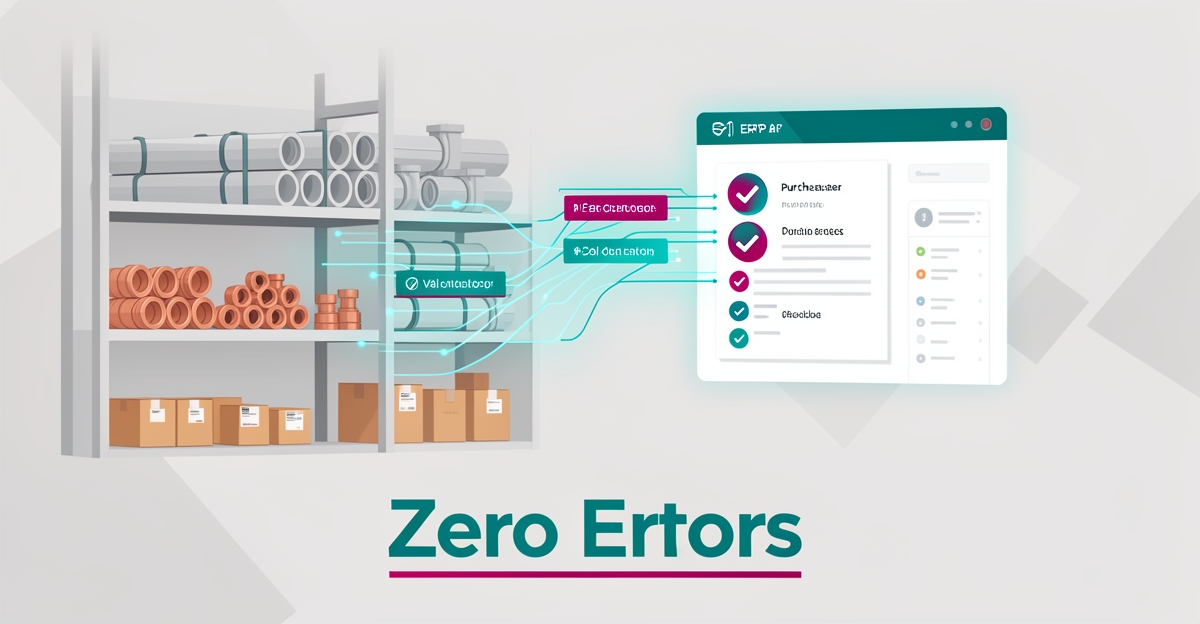
AI changes the workflow by parsing purchase orders as they arrive and extracting key details without retyping. The system reads PDFs, emails, EDI files, and handwritten notes, then pulls part numbers, quantities, pricing, ship-to addresses, and payment terms into structured fields. Validation against the ERP happens at the moment of entry, catching errors before the order posts.
Real-time inventory validation prevents the classic oversell and backorder cycle. AI checks stock levels, lot numbers, and warehouse location while the order is being built, and flags discrepancies for review. This real-time validation replaces batch checks that only surface after shipping.
Speed and accuracy improve together. Manual data entry averages 8-15 minutes per invoice, while AI processing runs under 1 minute per invoice. Error rates for data-heavy tasks sit at 1-5% with manual handling, and AI reduces that to under 1% for structured, repetitive work. Error correction alone can cost 2-4% of total labor costs.
The automation follows a clear, repeatable sequence:
- Parse incoming purchase orders from any channel and extract line-item details with contextual understanding
- Validate extracted data against ERP inventory, pricing, and customer records in real time
- Flag discrepancies, missing items, or pricing mismatches for human review
- Post clean orders automatically and create an audit trail for every decision
Standardizing intake without standardizing customers reduces re-parsing work. Funneling every channel into one consistent review step lets AI handle layout variations while humans focus on exceptions. Killing retyping wherever possible eliminates the source of transcription errors.
Good automation points people at the 5% of orders that need judgment, not the 95% that do not. Exceptions become loud and routed to a human, which preserves trust and keeps processing fast. Measuring error rate before implementation gives a baseline to prove improvement.
The business impact compounds. Distributors see 20-30% of total labor costs saved on processing work, with break-even typically in 3-6 months for high-volume, repetitive tasks. Faster processing improves fill rates and customer satisfaction while better auditability supports compliance.
AI Operating Systems builds custom AI systems for this workflow within AI Document Processing & Management, designing parsing and validation that fits existing ERP and ordering channels. The approach aligns with proven automation principles for plumbing distributors who need accuracy without adding headcount.
Implementing AI Order Processing: From Validation to Human Exception Handling
Plumbing supply distributors face a persistent challenge: order processing errors that ripple through operations, delaying shipments and inflating costs. Manual data entry remains a primary source of these mistakes, with transcription slips and format inconsistencies creeping in under pressure. Research shows that data-heavy tasks like order entry typically carry an error rate of 1-5%, directly impacting efficiency and customer trust. Industry research confirms that correcting these errors consumes 2-4% of total labor costs—a significant drain on resources that could be redirected toward growth.
Implementing AI-driven order processing begins with validating orders against the ERP system at the very moment of entry. This proactive check catches discrepancies—such as mismatched part numbers or quantities—before they propagate through the workflow, preventing costly rework downstream. By standardizing intake across all channels—email, fax, portal, or EDI—distributors eliminate the need to constantly re-parse varying document layouts. This consistency reduces cognitive load and minimizes the risk of misinterpretation during data extraction. Crucially, AI removes the need for retyping entirely; any structured data already present in source documents flows directly into the system, eliminating the transcription slips that account for the majority of manual entry errors.
Exceptions—such as ambiguous line items, inventory mismatches, or unfamiliar customer formats—are flagged immediately and routed to human specialists for judgment. This human-in-the-loop approach ensures that AI handles routine, high-volume tasks while reserving human expertise for the 5% of orders that truly require nuanced decision-making. Before deployment, establishing a baseline error rate is essential; measuring current performance provides a clear benchmark to quantify improvement. Distributors that follow these steps see data entry time drop from 8-15 minutes per invoice to under 1 minute, with error rates falling below 1% for structured, repetitive work. Studies confirm that such automation delivers 20-30% in labor cost savings, with break-even typically achieved within 3-6 months for high-volume operations. For plumbing distributors seeking to own their AI transformation, AI Workflow Builds builds custom systems that embed these validation and exception-handling principles directly into core workflows—ensuring accuracy, scalability, and long-term control without vendor lock-in.
Still paying for 10+ subscriptions that don’t talk to each other?
We build custom AI systems you own outright. No vendor lock-in. Full control.
Not sure where to start? Ask our AI planner
Frequently Asked Questions
What's the actual error rate for manual order processing in plumbing distribution, and how much does fixing those errors cost us?
How much faster is AI order processing compared to manual entry, and what accuracy improvement can we expect?
Will AI completely replace our order processing staff, or do we still need people involved?
What's the typical ROI timeline for implementing AI order processing in a high-volume plumbing distributor?
Our orders come through email, fax, EDI, and handwritten notes—can AI handle all these different formats without us standardizing our customers?
How do we know if AI order processing will actually work for our specific ERP and workflow before committing?
From Manual Chaos to Automated Accuracy: The Path Forward for Plumbing Distributors
The transition from manual order entry to AI-driven automation isn't just about upgrading technology—it's about fundamentally rethinking how plumbing supply distributors handle their most critical operational workflow. By implementing AI that parses purchase orders, validates data against ERP systems in real-time, and routes only true exceptions to human review, distributors can slash error rates from 1-5% to under 1% while reducing processing time from minutes to seconds per order. The financial case is compelling: research indicates that automation delivers 20-30% labor cost savings with break-even typically achieved within 3-6 months for high-volume operations. For distributors ready to eliminate the hidden costs of manual entry, AI Workflow Builds creates custom systems tailored to your specific order processing workflows. Start with a free 2-minute Fit Check to identify your highest-ROI automation opportunities—no obligation, just clarity on what's possible for your operation.
Make AI your competitive advantage — not just another tool.
Strategy, implementation and ongoing optimization. One partner, end to end.
Not sure where to start? Ask our AI planner