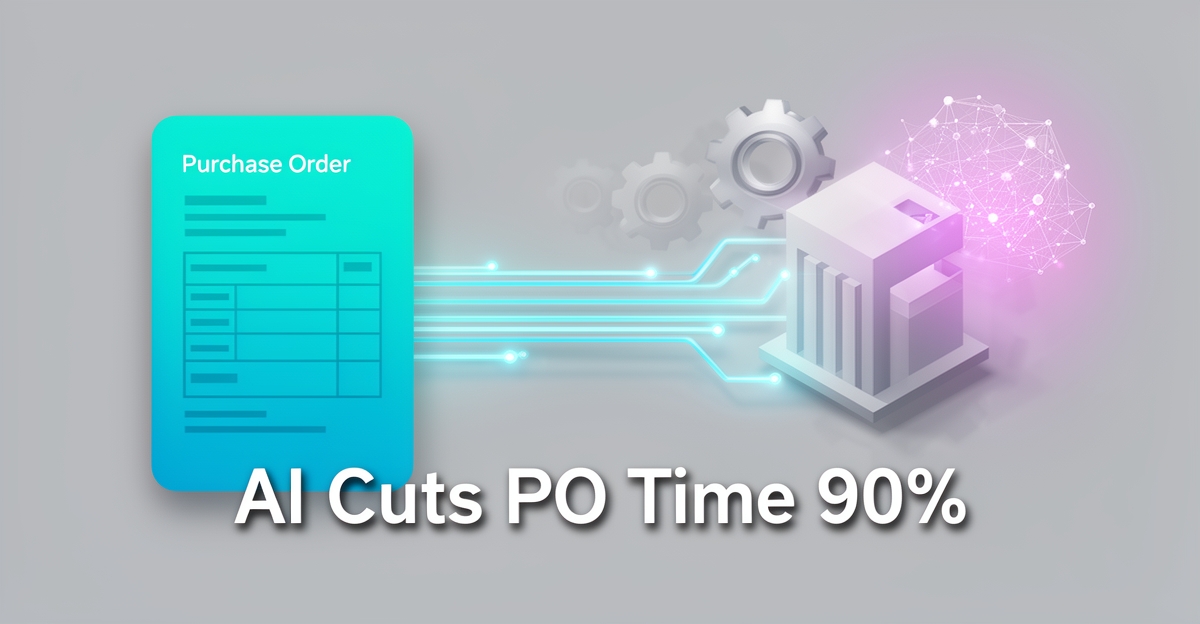
How AI Can Reduce Order Processing Time for Fastener & Hardware Distributors
Key Facts
- Manual purchase order processing typically consumes 40–90 minutes of buyer labor per PO across the full lifecycle; AI agents reduce that hands-on time to roughly 1–2 minutes
- Manual ERP data entry commonly produces errors in a few percent of records, while automated write-back typically pushes error rates well below 1%
- At around 500 purchase orders per month, manual processing can consume the equivalent of three or more full-time employees — capacity that automation recovers
- Labor cost per PO typically falls from the $15–$35 range to a few dollars once AI handles entry, validation and sync
- Cycle time commonly collapses from 2–5 business days to same-day processing with AI order automation
- AI agents turn 20–45 minute exception escalations into 2–5 minute reviews by routing issues proactively with full context
- AIQ Labs has deployed 200+ multi-agent systems and runs four live SaaS products daily — this is proven infrastructure, not experimental tooling
Hire a team member that works 24/7 — for less than a part-time wage.
AI receptionists, SDRs, dispatchers and 99+ roles. Trained on your business, fully managed.
Not sure where to start? Ask our AI planner
The Manual Order Processing Bottleneck in Fastener Distribution
Fastener and hardware distributors still run order processing like it's 1998 — spreadsheets, email threads, and manual ERP clicks. That friction shows up every time a purchase order moves from transmission to confirmation.
The median total buyer labor for a direct procurement purchase order is typically around 60 minutes across the full lifecycle, ranging from roughly 40 to 90 minutes depending on complexity. That time is not one task but a chain of handoffs.
PO transmission alone consumes 5–10 minutes exporting, printing, emailing, and finding the correct contact. Acknowledgment follow-up adds another 5–15 minutes of inbox monitoring and manual nudges. Acknowledgment logging takes 5–10 minutes to read supplier replies and update spreadsheets or ERP records.
Delivery date monitoring, supplier response handling, and ERP data entry each add 5–20 minutes. Exception escalation is the heaviest drag at 20–45 minutes to identify stakeholders and coordinate responses for delays or shortages. This repetitive data entry creates time-consuming, error-prone work that is hard to scale.
The cost compounds quickly at 500 to 1,000 orders per month.
- Manual ERP data entry errors commonly affect a few percent of records, with a fully-loaded remediation cost of $40–$75 per error
- Labor cost per PO typically sits at $15–$35 at $30–$35/hr fully loaded, versus a few dollars with automation
- A distributor processing 500 POs/month can spend the equivalent of roughly three full-time employees on manual processing; at 1,000 POs/month that roughly doubles
At 500 POs per month, error remediation alone can run $600–$1,875 per month. Cycle time from PO creation to confirmation stretches to 2–5 business days, while real-time transparency is lost between systems.
This is where AI order automation changes the economics. AIQ Labs helps distributors rebuild the one workflow that costs the most — order entry, validation, and ERP sync — through AI Workflow Builds, at a fixed price and in phases. The goal is not to replace buyers but to remove the manual steps that drain capacity.
The bottleneck is not the people; it is the manual lifecycle that forces them to act as data clerks between email, spreadsheets, and ERP.
How AI Agents Automate the Full Order Lifecycle
A single purchase order can take a buyer nearly an hour of hands-on work before it's confirmed — and every one of those minutes is a chance for something to slip. For fastener and hardware distributors juggling hundreds of SKUs and dozens of suppliers, AI agents now automate that entire lifecycle, compressing an hour of labor into one or two minutes.
The scale of the change is well documented in industry benchmarks: AI agent processing typically reduces buyer time per PO from a median of about 60 minutes to 1–2 minutes — an 80–95% reduction in hands-on time. The remaining minutes aren't busywork; they're human judgment on the exceptions that actually need attention.
Here's how the automation works across each stage of the order lifecycle:
- Automated order entry: AI reads order details from emails, PDFs, and spreadsheets, then writes them directly into the ERP — eliminating keystroke errors and handling high volumes continuously.
- Intelligent validation: The system extracts and compares product, customer, and terms data against existing records, flagging discrepancies and running stock availability checks before anything is processed.
- Supplier communication: AI transmits POs automatically, monitors for acknowledgments, sends follow-ups when none arrive within the configured SLA, and parses supplier responses using natural language processing.
- Real-time ERP sync: Confirmed quantities and delivery dates flow straight back into the ERP as they happen, replacing slow, error-prone manual transcription.
- Proactive exception handling: When a supplier flags a delay or partial shipment, the AI classifies it and routes it to the right buyer with full context — turning a 20–45 minute scramble into a 2–5 minute review.
The accuracy gains are just as striking as the speed. Manual ERP data entry errors commonly affect a few percent of records, while automated write-back typically drops that rate below 1% — a meaningful margin when a single PO error carries a fully-loaded cost of $40–$75 to remediate. Cycle time improves in parallel: instead of waiting 2–5 business days for PO confirmation, distributors get same-day turnaround measured in hours.
The compounding effect matters most. At 500 POs per month, manual processing consumes the equivalent of roughly three full-time employees; automation reduces the labor cost per PO from $15–$35 to a few dollars while freeing staff for supplier management and strategic work. An AI-powered order processing system works like a smart assistant that runs 24/7 — never waiting, never forgetting a follow-up.
The catch is that generic software rarely fits a distributor's actual workflow. Fastener distributors deal with unit-of-measure quirks, long-tail SKUs, and supplier communication habits that off-the-shelf tools weren't built for. That's why AIQ Labs builds custom systems tailored to each distributor's supply chain, integrating directly with existing ERP and email systems rather than forcing a generic template onto the operation.
From Hours to Minutes: Measurable Impact on Cost and Customer Experience
For fastener and hardware distributors, the shift from manual to AI-powered order processing delivers measurable financial and operational gains that directly impact the bottom line. Labor cost per purchase order typically falls from $15–$35 to a few dollars when AI handles data entry, validation, and ERP synchronization, based on fully loaded labor rates and time savings from roughly 60 minutes to 1–2 minutes per PO. This represents an 80–95% reduction in buyer time, freeing staff to focus on exception handling and strategic supplier management rather than repetitive tasks. At a volume of 500 orders per month, this translates to recovering roughly three full-time employee equivalents, enabling reinvestment in higher-value activities.
Cycle time collapses from 2–5 business days to same-day processing, dramatically improving responsiveness and reducing the risk of stockouts or delayed shipments. AI agents continuously monitor order status, proactively flag exceptions, and route them with full context — turning a 20–45 minute manual escalation into a 2–5 minute review. The acceleration extends beyond the warehouse: faster acknowledgments and accurate order confirmations mean customers get reliable answers in minutes instead of chasing status by phone. These downstream gains reinforce the core efficiency, creating a cycle of faster fulfillment, fewer errors, and stronger customer loyalty. AIQ Labs helps distributors architect this end-to-end automation — either as a single workflow rebuild or as part of a fuller AI Operating System — ensuring AI agents integrate with existing ERP and CRM systems to deliver these outcomes at scale.
Implementing AI Order Automation with Owned Systems
Implementing AI order automation begins with a clear audit of your current workflow to pinpoint where manual effort creates delays. The median time to process a single purchase order is typically around 60 minutes of buyer labor, with manual steps like PO transmission, acknowledgment follow-up, and ERP data entry consuming the bulk of that time. For fastener distributors handling high volumes of repetitive SKU-based orders, this effort scales quickly — processing 500 orders per month equates to roughly three full-time employee equivalents spent on routine tasks. Identifying these bottlenecks allows you to target automation where it will yield the greatest relief.
Start by focusing on high-volume, repetitive tasks that AI can handle with near-zero marginal cost, such as automated order entry from email or PDF feeds and real-time ERP synchronization. AI agents excel at extracting product details, quantities, and delivery dates from unstructured formats and updating systems like ERP or CRM without human intervention, typically reducing ERP data entry errors from a few percent to below 1%. This shift not only cuts labor cost per order from $15–$35 to a few dollars but also enables same-day cycle times instead of the 2–5 business days typical of manual processing. By beginning with a narrowly defined workflow — like after-hours order acknowledgment logging — you can validate the system's accuracy and build team confidence before expanding scope.
Integrate the AI solution directly with your existing email inbox and ERP platform to create a seamless, owned workflow that eliminates tool sprawl. Unlike generic AI assistants that require constant prompting and manual data transfer, custom-built systems from AIQ Labs use multi-agent architectures to autonomously manage the full order lifecycle: transmitting POs, monitoring for supplier acknowledgments, parsing responses via natural language processing, and triggering exception routing when delays or discrepancies arise. This approach ensures that AI handles the routine while your team focuses on high-value activities like supplier negotiation and exception resolution. AIQ Labs builds in milestones, so you pay for working phases — and with the Own It Outright model, the system is yours with no vendor lock-in, creating a scalable foundation for long-term operational efficiency. To map your specific bottlenecks, start with the free 2-minute Fit Check, then book a free 30-minute strategy call at https://aiqlabs.ai/book.
Still paying for 10+ subscriptions that don’t talk to each other?
We build custom AI systems you own outright. No vendor lock-in. Full control.
Not sure where to start? Ask our AI planner
Frequently Asked Questions
How much time does AI actually save on processing a single purchase order compared to doing it manually?
Will AI make mistakes on complex fastener SKUs or unit-of-measure conversions that are common in hardware distribution?
What happens when a supplier doesn't respond or sends a partial shipment — does the AI just ignore it?
We already have an ERP and email system — do we need to replace them to use AI order automation?
Is this only worth it if we process thousands of orders a month, or does it pencil out at lower volumes?
How do we know the AI won't create more work by generating false alerts or requiring constant babysitting?
Turning Order Processing from a Cost Center into a Competitive Edge
Fastener and hardware distributors no longer need to accept the hidden drain of manual order processing — where an hour per PO, error-prone data entry, and delayed acknowledgments quietly erode capacity and customer trust. AI-powered automation flips that script, compressing order lifecycle tasks into minutes while typically cutting labor cost per PO from $15–$35 to a few dollars and pushing error rates below 1%. The result isn't just faster processing; it's reclaimed team bandwidth for strategic supplier management, same-day cycle times, and a foundation for scalable growth without proportional hiring. For distributors ready to move beyond spreadsheets and email chains, the next step is clear: pinpoint your biggest bottleneck with a focused assessment. Start the Fit Check — a free, two-minute evaluation — to see where custom AI automation from AIQ Labs can deliver immediate relief, then schedule your free 30-minute strategy call at https://aiqlabs.ai/book to map a tailored path forward.
Make AI your competitive advantage — not just another tool.
Strategy, implementation and ongoing optimization. One partner, end to end.
Not sure where to start? Ask our AI planner