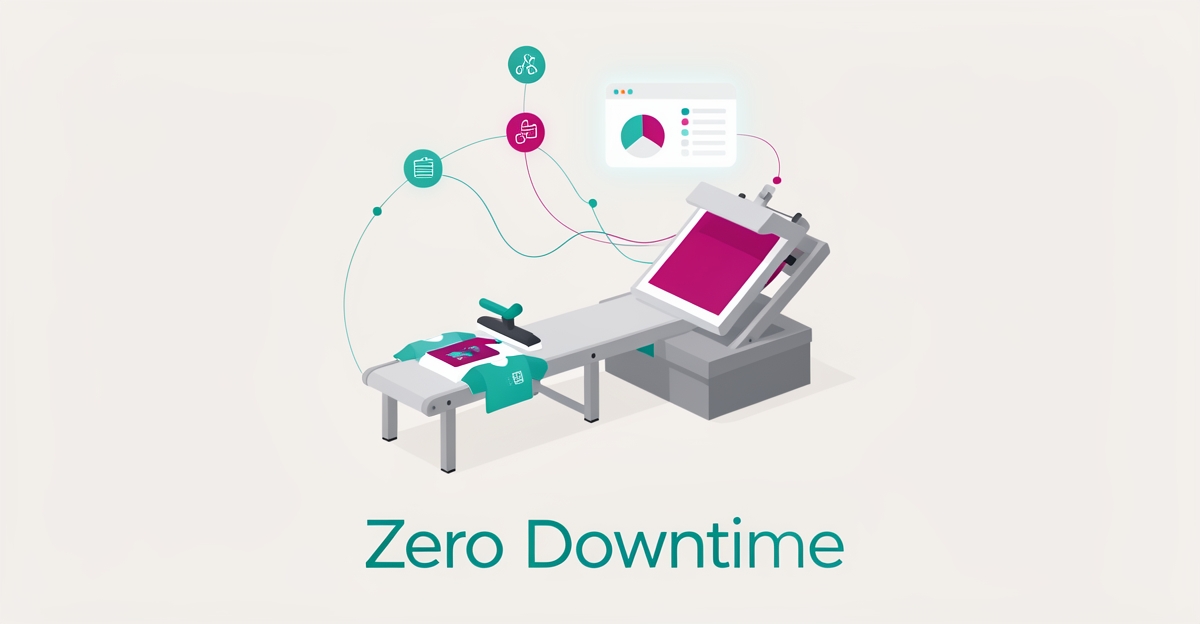
How AI Can Reduce Production Delays in Screen Printing Operations
Key Facts
- AI scheduling typically recalculates production sequences in minutes, while manual rescheduling can consume hours of a planner's day
- AI systems can give supervisors visibility into bottlenecks a day or more before they impact the shop floor, depending on data quality
- Facilities moving from reactive to predictive maintenance commonly report substantial reductions in unplanned downtime and maintenance costs
- AI-driven scheduling enables continuous re-optimization as conditions change, eliminating stale schedules
- Predictive analytics typically delivers measurable uptime and throughput gains in manufacturing environments
- Manual scheduling in mid-sized facilities often requires several hours daily, with frequent disruptions forcing replanning
Hire a team member that works 24/7 — for less than a part-time wage.
AI receptionists, SDRs, dispatchers and 99+ roles. Trained on your business, fully managed.
Not sure where to start? Ask our AI planner
Why Screen Printing Schedules Break Down
Most screen printing shops don't have a production problem—they have a visibility problem that only becomes obvious when the schedule collapses at 10 AM on a Tuesday.
Manual scheduling sits at the center of this fragility. Planners typically spend two to four hours daily building and rebuilding schedules, yet the plan becomes obsolete the moment a press goes down or a rush order lands. The system works fine until reality intervenes, at which point the entire shop reverts to tribal knowledge and whiteboard markers.
When a machine drops in a manual environment, the rescheduling loop drags on for hours. Planners must recalculate sequences, reassign work, and communicate changes across the floor while operators continue printing from outdated instructions. AI systems can collapse this loop from hours to minutes, but manual shops remain stuck in a cycle where supervisors discover bottlenecks at the machine rather than a day or more in advance.
Maintenance failures compound the scheduling chaos. Reactive maintenance—fixing equipment only after it breaks—misses the subtle degradation signals that precede catastrophic failure. Facilities that remain in reactive mode forgo the downtime reductions that predictive approaches typically deliver, leaving them vulnerable to sudden press failures that destroy delivery commitments.
Material and inventory blind spots create the third pressure point. Without real-time visibility into ink levels, mesh counts, and substrate availability, shops promise dates based on assumptions rather than actual capacity. The result is a cascade of small surprises that compound into missed deadlines.
These breakdowns share common characteristics:
- Schedules built on static assumptions rather than real-time floor conditions
- Maintenance triggered by breakdowns instead of vibration or temperature anomalies
- Inventory checks that happen weekly while orders arrive continuously
- Priority decisions made by whoever shouts loudest rather than systematic rules
The schedule becomes a fiction the shop tells itself until physical constraints expose the gaps. AIQ Labs approaches these challenges by rebuilding the workflow that costs the most — often dynamic scheduling or maintenance coordination — as a fixed-price AI workflow build, replacing static planning with dynamic optimization that accounts for actual machine capacity and material availability. When supervisors can see bottlenecks forming a full day before they impact production, the entire operational posture shifts from firefighting to strategic capacity management.
How AI Predicts and Prevents Bottlenecks
When a press goes down or a rush order lands, manual rescheduling can consume half a planner's afternoon — AI-driven scheduling recalculates the sequence in minutes. The system reads real-time inputs like machine status, operator certifications, and actual capacity, then enforces job priorities through defined rules instead of ad-hoc persuasion. Supervisors gain visibility into bottlenecks before they hit the shop floor, shifting the conversation from firefighting to proactive capacity decisions.
- Continuous re-optimization as conditions change — no more stale schedules
- Rule-based priority enforcement eliminates the "squeaky wheel" effect
- Planners shift from reactive updates to strategic capacity planning
- Operators receive updated priorities directly on mobile or workstation displays
Predictive analytics typically delivers meaningful uptime gains and throughput improvements in manufacturing environments, and facilities moving from reactive to predictive approaches commonly report large reductions in unplanned downtime. AIQ Labs builds production-focused AI systems — from individual AI employees that handle scheduling coordination to full AI operating systems that connect the shop floor — integrating with print shop operations to surface these insights directly in existing workflows, helping teams act on predictions rather than just observe them.
Optimizing Ink, Materials, and Equipment Uptime
Equipment failures and material inconsistencies silently erode production schedules long before they show up as missed deadlines. AI shifts the paradigm from reactive firefighting to proactive control by continuously monitoring the variables that actually determine output quality and machine availability.
Predictive maintenance represents one of the highest-ROI applications for screen printing operations. Facilities moving from reactive to predictive maintenance typically see substantial reductions in unplanned downtime and maintenance costs by addressing equipment degradation during planned windows instead of emergency breakdowns. AI models analyze sensor data — vibration, temperature, current draw, cycle times — to identify failure precursors that human operators often miss, scheduling interventions before a dryer motor fails mid-run or squeegee pressure drift ruins a batch.
Process parameter optimization extends this preventive logic to quality-critical variables. AI systems monitor ink viscosity, cure temperatures, humidity, and substrate conditions in real time, detecting combinations that historically correlate with adhesion failures, color shifts, or curing defects. Rather than discovering scrap at final inspection, operators receive early warnings — the same predictive lead time that lets supervisors see bottlenecks before they hit the machine.
- Continuous viscosity tracking prevents ink starvation or flooding mid-print
- Cure temperature profiling catches drift before under-cured garments ship
- Environmental monitoring adjusts for humidity-driven registration issues
- Substrate batch analysis flags material variability before it hits press
AIQ Labs builds production-focused AI systems that integrate directly with shop floor operations, connecting sensor data to actionable workflows so predictions translate to prevented delays. The technology doesn't replace operator judgment — it gives them the lead time to apply it effectively.
Implementation Roadmap for Print Shops
The difference between a print shop that consistently hits deadlines and one that constantly firefights often comes down to how quickly they can turn data into decisions. AI doesn't just add another dashboard—it creates a closed loop where predictions automatically trigger the right response on the floor.
Start by mapping every step from art approval to shipment, noting where information stalls or decisions get delayed. Manual scheduling typically requires several hours daily for a mid-sized facility, with frequent disruptions forcing replanning. Target the highest-leverage pain point first—usually dynamic scheduling or predictive maintenance on your bottleneck press. AI scheduling reworks the plan in minutes when a machine drops or a hot order lands, while manual rescheduling eats half a planner's afternoon.
- Audit existing sensor data, ERP records, and historian logs for completeness and consistency
- Involve press operators in labeling historical downtime events—their tribal knowledge trains better models
- Define clear escalation paths: when the model flags a 4-hour window for screen failure, who swaps it and when?
- Pilot on one press line, measure on-time delivery and unplanned downtime, then expand
Facilities moving from reactive to predictive maintenance typically see meaningful reductions in both maintenance costs and unplanned downtime. The key is ensuring every alert has an owner and a standard work instruction—predictions without prescribed actions are just noise. AIQ Labs helps print shops build these closed-loop systems, integrating with existing ERPs and sensor networks so the technology amplifies what your best operators already know.
Still paying for 10+ subscriptions that don’t talk to each other?
We build custom AI systems you own outright. No vendor lock-in. Full control.
Not sure where to start? Ask our AI planner
Frequently Asked Questions
Why do screen printing schedules keep falling apart even when we plan carefully?
How quickly can AI reschedule a print shop compared to doing it manually?
Can AI actually cut unplanned downtime in screen printing?
Will AI replace our press operators and planners?
How far in advance can AI warn us about bottlenecks?
What kind of production gains should we expect from AI in screen printing?
From Firefighting to Forecasting
Screen printing delays rarely start with a broken press. They start with static schedules, reactive maintenance, and inventory assumptions that collapse the moment reality intervenes. AI changes that equation by turning real-time shop floor data into minutes-long rescheduling, early bottleneck warnings, and predictive maintenance that lets you act before a dryer motor fails or ink runs out mid-run. The result is less time rebuilding plans and more time managing capacity strategically, with measurable gains in uptime, throughput, and on-time delivery.
The most practical path is to start where pain is highest — typically dynamic scheduling or predictive maintenance on your bottleneck press — and build a closed loop where predictions trigger clear, owned actions. AIQ Labs builds production-focused AI systems that integrate directly with existing ERPs and shop operations so insights translate to prevented delays, not more dashboards.
Start the 2-minute Fit Check at https://aiqlabs.ai/apply for a free 30-minute strategy call to map your biggest bottleneck and identify high-ROI automation opportunities. If there isn't a clear win, we'll tell you.
Make AI your competitive advantage — not just another tool.
Strategy, implementation and ongoing optimization. One partner, end to end.
Not sure where to start? Ask our AI planner