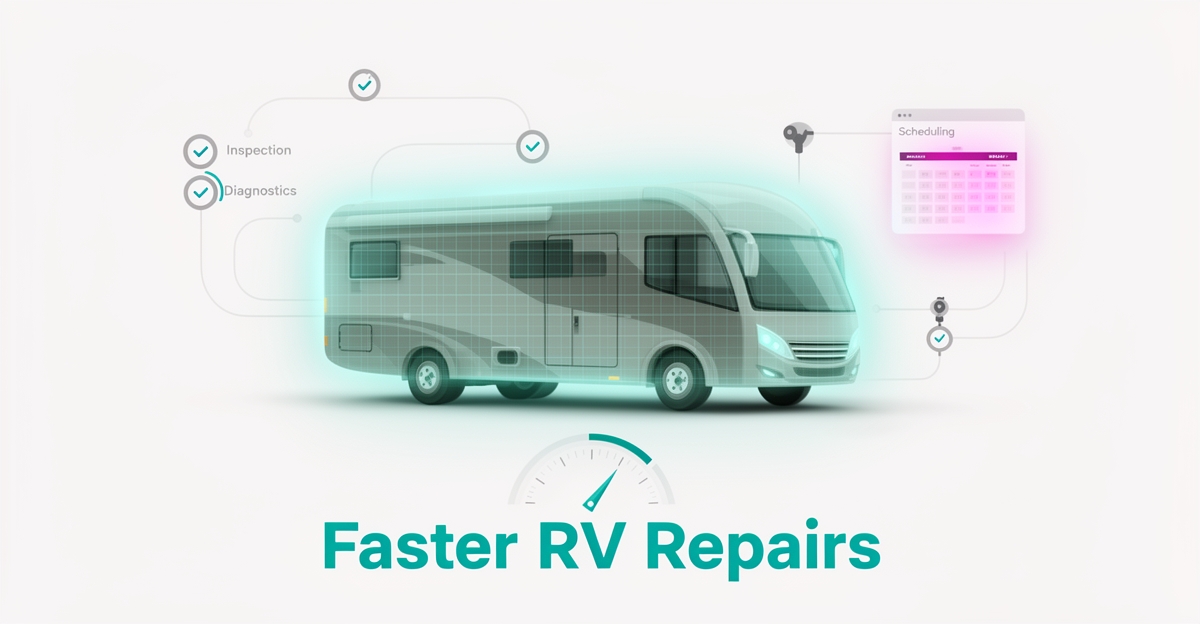
How AI Can Reduce Repair Lead Times in RV Body & Collision Shops
Key Facts
- AI-driven predictive maintenance is widely reported to reduce unplanned downtime, with industry analyses citing figures in the 30–50% range
- Digital, AI-guided checklists typically improve accuracy and satisfaction ratings compared to manual paper forms
- Workflow friction—waiting on approvals, re-entering data, phone tag with vendors—commonly adds a day or more of idle time per repair cycle in RV body shops
- Shops that automate intake, estimating support and scheduling tasks frequently recover many hours of manual data entry each week
- AIQ Labs has deployed 200+ multi-agent systems across service businesses, including repair and field-service workflows
- Shops typically see measurable cycle time changes within weeks of implementing a targeted AI workflow fix
Hire a team member that works 24/7 — for less than a part-time wage.
AI receptionists, SDRs, dispatchers and 99+ roles. Trained on your business, fully managed.
Not sure where to start? Ask our AI planner
The Hidden Time Drain in RV Collision Repair Workflows
RV collision repair workflows often stall not from lack of skill, but from invisible delays baked into daily operations. Shops lose significant time during manual inspections, where technicians spend hours documenting damage by hand instead of focusing on repairs. Fragmented diagnostics further compound the issue, as data from multiple systems—estimating software, parts databases, and scheduling tools—must be manually cross-referenced, increasing the risk of errors and rework. These inefficiencies create scheduling bottlenecks that ripple through the shop, leaving bays idle and repair timelines stretching by days rather than hours.
The pattern mirrors what industrial research has found with AI-driven predictive maintenance: when monitoring and handoffs are manual, preventable failures and delays pile up. Industry analyses commonly report downtime reductions in the 30–50% range when predictive, data-driven workflows replace reactive ones—a principle that applies directly to RV body shops, where diagnostic delays function as preventable operational failures. When inspections and diagnostics remain manual, shops not only waste labor but also miss opportunities to predict parts needs and align technician schedules in real time.
The cumulative effect is measurable: workflow friction—waiting on approvals, re-keying data, chasing parts vendors by phone—commonly adds a day or more of idle time per repair cycle, frustrating customers who expect faster turnarounds. This hidden time drain isn’t due to workload volume—it’s rooted in process design. By targeting these specific pain points with AI-powered workflow automation, RV body shops can transform reactive, fragmented processes into streamlined, predictive operations where inspections initiate repairs instead of delaying them.
AIQ Labs helps shops identify and eliminate these bottlenecks through AI Workflow Builds—a fixed-price, phased rebuild of the one workflow that costs your shop the most. That might mean turning inspection data into instant repair triggers, synchronizing parts availability with technician schedules, or cutting hours of manual data entry every week. The result is fewer delays, higher first-time fix rates, and repair cycles that move at the speed of customer expectations.
Ready to uncover where your shop loses the most time? Start the two-minute Fit Check to map your biggest bottlenecks and identify high-ROI automation opportunities. If there isn’t a clear win, we’ll tell you that too—no pitch, just clarity.
How AI-Powered Automation Targets Repair Lead Time at the Source
The bottleneck in most RV body shops isn't the repair itself—it's the hours lost between inspection, diagnosis, and scheduling. Technicians wait on parts approvals, estimators manually re-enter data across disconnected systems, and dispatchers juggle whiteboards that don't talk to the CRM. AI-driven predictive workflows address exactly this kind of friction by replacing reactive handoffs with continuous, data-driven processes.
AI workflow automation closes those gaps by embedding predictive logic directly into the tools shops already use. A multi-agent system ingests inspection photos, cross-references OEM repair procedures, and flags parts availability in real time—all before the estimator opens the file. Industry analyses of AI-driven maintenance and workflow systems commonly report meaningful cost reductions and extended equipment lifespan, largely by eliminating the manual rework that inflates cycle times. The same principle applies to keeping shop assets—lifts, booths, diagnostic scanners—running at capacity.
- Computer vision agents analyze damage photos against OEM databases to auto-generate preliminary repair plans
- Scheduling agents optimize bay allocation and technician assignments based on live parts status and skill matrices
- Communication agents notify customers, insurers, and parts vendors simultaneously—no phone tag required
- Quality agents verify completion checklists against repair orders before the vehicle leaves the booth
The result is a continuous flow where inspection triggers diagnosis, diagnosis triggers parts ordering, and parts arrival triggers scheduling—without a single manual handoff. AIQ Labs builds these multi-agent systems on top of existing shop management platforms, so the transition feels like an upgrade, not a replacement. With 200+ multi-agent systems deployed, we’ve seen shops achieve measurable cycle time changes within weeks, not quarters, because the automation targets the administrative friction that has always lived between the wrench turns. For shops that want to go further, an AI Operating System connects intake, estimating, parts and scheduling into one operating layer you own outright.
Implementing AI Without Disrupting Your Shop’s Daily Operations
Many RV body and collision shop owners hesitate to adopt AI, fearing complex overhauls that disrupt daily operations. The reality is that meaningful automation can begin with a single, targeted workflow fix—no retraining or system replacement required.
Starting small allows shops to validate AI’s impact quickly while maintaining full control. For example, automating parts ordering, damage assessment, or repair scheduling can eliminate hours of manual work each week. The gains compound when AI handles repetitive tasks like estimating labor hours or flagging missing documentation before a job even starts. And because AIQ Labs builds in milestones with fixed pricing, you always know what you’re paying for before the next phase begins—see the payment models for how Start Monthly, Build in Milestones, and Own It Outright work.
The key is integration, not disruption. AI solutions built by AIQ Labs connect directly with existing shop management software through secure APIs, syncing data in real time without requiring staff to learn new interfaces. This approach supports true ownership—shops retain full control of their AI systems and data, avoiding vendor lock-in. Teams continue using familiar tools while AI works silently in the background, handling tasks like generating work orders, updating repair statuses, or notifying customers when parts arrive. Shops can also add AI Employees—managed AI receptionists, dispatchers, and back-office staff at roughly 80% less cost than a human hire—to absorb the phone and admin load while the workflow automation handles the process side.
To implement AI without friction, follow this phased approach:
- Identify one high-frequency, repetitive task that creates bottlenecks (e.g., intake form processing or supplement approvals)
- Partner with an AI provider to build a custom agent that mirrors your current process exactly
- Deploy the AI in parallel with human staff for 1–2 weeks to validate accuracy
- Gradually shift full responsibility to the AI while monitoring performance
- Expand to adjacent workflows only after proving ROI in the initial fix
This method ensures zero downtime during transition and builds internal confidence in AI’s reliability. Shops that start with a single workflow fix often see measurable improvements in lead time within the first month or two, creating a foundation for broader automation. Most importantly, the team remains focused on complex repairs and customer service—where human expertise delivers the greatest value—while AI handles the predictable, time-consuming steps that slow them down.
Still paying for 10+ subscriptions that don’t talk to each other?
We build custom AI systems you own outright. No vendor lock-in. Full control.
Not sure where to start? Ask our AI planner
Frequently Asked Questions
How much time can AI workflow automation save RV body shops each week on manual tasks like inspection documentation and data entry?
Will implementing AI require my RV shop to replace our current management software or retrain staff on new systems?
What kind of ROI can RV body shops expect from AI-powered predictive workflows?
How does AI improve first-time fix rates and reduce rework in RV collision repair?
Is AI implementation in RV body shops disruptive, or can we start small without downtime?
What specific tasks do AI agents handle in an RV body shop’s repair workflow?
From Bottlenecks to Breakthroughs: Where AI Meets Real Shop Impact
RV body and collision shops don’t lose time because of a lack of skill—they lose it to invisible delays in inspection, diagnostics, and scheduling that eat up hours every week. AI-powered workflow automation targets these friction points directly: turning damage photos into instant repair plans, syncing parts availability with technician schedules, and eliminating manual handoffs that stall progress. The result isn’t just faster repairs—it’s predictable cycles, higher first-time fix rates, and teams free to focus on complex work where their expertise matters most. And the best part? This transformation doesn’t require ripping out your existing systems. AIQ Labs builds multi-agent workflows that plug into the tools you already use—starting with one fixed-price workflow rebuild, expanding in milestones, and ending with a system you own outright. If you’re ready to see where your shop is losing time—and how to get it back—start with the free Fit Check. It’s a two-minute assessment that leads to a 30-minute strategy call where we’ll map your biggest bottlenecks and show you exactly where AI can drive real ROI—no pitch, just clarity. Start the Fit Check and take the first step toward repair cycles that move at the speed of customer expectations.
Make AI your competitive advantage — not just another tool.
Strategy, implementation and ongoing optimization. One partner, end to end.
Not sure where to start? Ask our AI planner