How AI Can Reduce Repetitive Tasks in a Repair Shop's Daily Workflow
Key Facts
- The average vehicle age has reached roughly 12.7 years, increasing repair complexity and documentation needs according to industry data
- Repair severity for 5-year-old vehicles has risen substantially since 2019, making jobs more documentation-heavy per recent analysis
- Industry estimates suggest AI-powered accounts payable automation can save repair shops 40+ hours per month based on industry research
- A majority of auto repair shops are expected to use some form of AI by late 2026 per market projections
- The AI in auto repair software market is projected to grow from roughly $3.4 billion in 2026 to $8.6 billion by 2033 with an estimated 14.2% CAGR
- AI-powered diagnostics may reduce labor costs meaningfully in repair shops—some industry findings cite figures around 25% per industry findings
Hire a team member that works 24/7 — for less than a part-time wage.
AI receptionists, SDRs, dispatchers and 99+ roles. Trained on your business, fully managed.
Not sure where to start? Ask our AI planner
The Hidden Admin Tax: Why Your Technicians Are Buried in Paperwork
Picture this: a technician who spent years mastering complex diagnostics spends the first hour of every shift typing up work orders, logging service history, and chasing paperwork instead of turning a wrench. Across the industry, that scene plays out daily—and it's costing shops more than they realize.
The administrative burden isn't just annoying; it's structural. Work order creation, service logging, follow-up emails, and phone tag all pull skilled hands away from the lift. And the math behind those manual processes is getting worse, not better.
Consider what shops are up against right now:
- The average vehicle age has reached roughly 12.7 years, meaning more aging cars arriving with layered, compounding issues.
- Repair severity for 5-year-old vehicles has risen substantially since 2019, making each job more documentation-heavy than the last.
- A shortage of skilled technicians means every hour of wrench time lost to admin is an hour that's nearly impossible to replace through hiring.
Put those three forces together and the conclusion is hard to escape: manual processes that worked when bays were quieter simply no longer scale. Every new vehicle through the door brings more complexity, more line items to log, more customer updates to send—and the same finite administrative capacity to absorb it all.
The real cost is compounded by the labor market. When qualified technicians are scarce, burying them in data entry is the equivalent of paying premium wages for clerical work. Industry analysis notes that the goal of automation is not replacing workers but augmenting their capabilities—handling routine tasks so technicians and service advisors can focus on complex repairs and customer interaction.
This is where AI workflow automation changes the equation. Systems can now generate work orders automatically from intake information, log completed service history without manual entry, and send follow-up emails and appointment reminders on their own. The payoff is measurable: industry estimates suggest shops using AI-powered automation for back-office tasks like accounts payable reconciliation can save 40+ hours per month—time that flows directly back into productive work.
For service businesses evaluating this shift, the key is choosing automation built around their actual workflows rather than generic software. That's the approach AIQ Labs takes with AI Workflow Builds: mapping a shop's specific repetitive tasks—work orders, service logging, customer follow-up—and rebuilding them as automated systems the business owns outright.
The hidden admin tax compounds quietly, one keystroke at a time. The shops that thrive will be the ones that stop paying it.
Five Repetitive Tasks AI Can Take Off Your Plate Today
Repair shops are drowning in repetitive tasks that pull skilled technicians away from the work they're trained to do. From creating work orders to chasing down parts, these daily chores eat up hours that could be spent on complex repairs and customer engagement.
AI-powered workflow automation directly targets these pain points, turning manual drudgery into streamlined, intelligent processes. By automating the highest-impact repetitive tasks, shops reclaim significant time and reduce operational friction without overhauling their entire system.
One of the biggest time sinks is work order creation and service history logging, which often involves manual data entry across multiple systems. AI can auto-populate work orders from customer inputs, vehicle data, and past service records, eliminating redundant entry and ensuring accurate, complete histories every time.
Accounts payable and invoice reconciliation is another major drain—industry research suggests AI-powered AP automation can save shops 40+ hours per month industry research. Intelligent invoice capture, automated data extraction, and approval routing cut processing time dramatically while reducing errors and late fees.
Customer communication and scheduling also benefit immensely from AI. Automated appointment booking, reminders, and follow-up messages handled by AI agents—like the managed AI employees AIQ Labs deploys for front-desk and dispatch roles—free up staff and improve response times, leading to higher satisfaction and fewer missed opportunities.
Parts ordering and inventory management become proactive rather than reactive with AI. Predictive models analyze usage patterns and lead times to trigger reorders before stock runs out, optimizing levels and preventing costly delays on repairs.
Finally, documentation and compliance reporting—often overlooked but critical—can be largely automated. AI generates repair summaries, warranty claims, and regulatory reports from structured shop data, ensuring consistency and audit readiness without manual compilation.
By offloading these five repetitive tasks, repair shops not only save time but also empower their teams to focus on what matters most: fixing vehicles and building customer trust. AIQ Labs helps shops implement these automations through custom workflow solutions designed specifically for service businesses, integrating with existing tools to deliver measurable efficiency gains. Start the Fit Check to identify your shop's highest-impact automation opportunities.
What AI Automation Actually Looks Like in a Working Shop
Walk into a shop running AI automation and the difference isn't a robot under a lift—it's a front counter that never backs up. The phone gets answered at 7 a.m. before anyone clocks in, appointments land directly on the calendar, and the work order for that morning's brake job already exists in the shop management system.
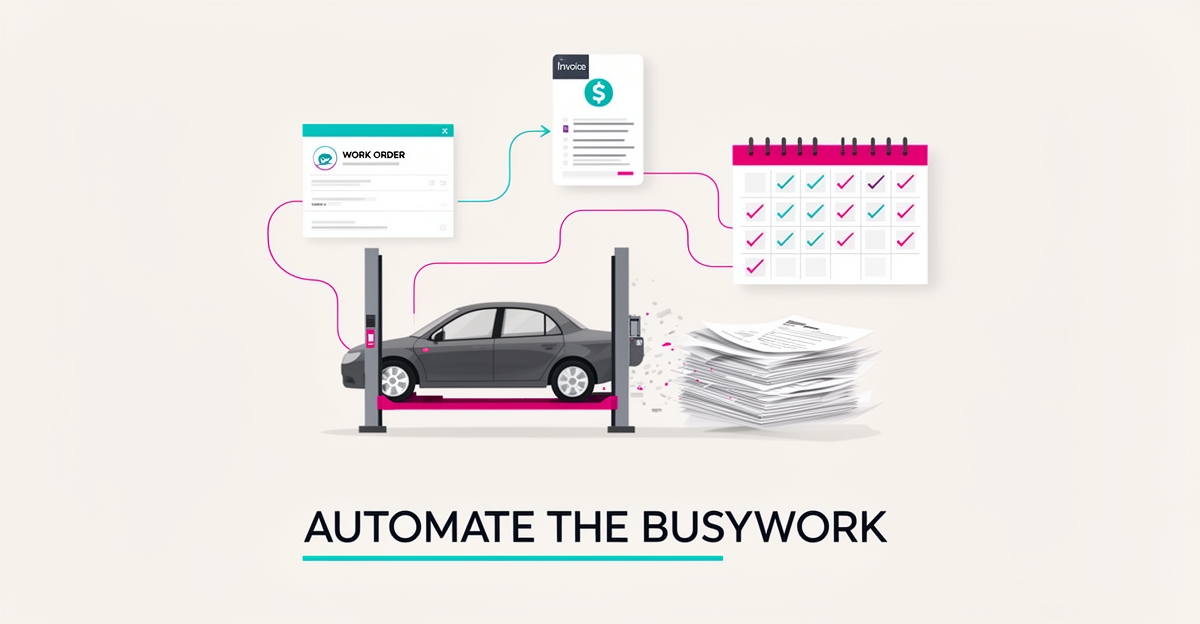
That's what modern AI workflow automation actually does: it handles end-to-end processes, not isolated tasks. An AI voice agent picks up an incoming call, answers the customer's question about pricing or availability, books the appointment, and creates the work order with the vehicle's details already populated. After the repair is complete, the same system sends the follow-up email, logs the service history, and queues a reminder for the next recommended maintenance interval. No sticky notes, no double entry, no forgotten callbacks.
The scale of this shift is measurable. Industry projections show the AI in auto repair software market growing from roughly $3.4 billion in 2026 to a projected $8.6 billion by 2033—an estimated 14.2% CAGR—and a majority of auto repair shops are expected to use some form of AI by late 2026, according to industry analysis. These aren't experimental tools anymore; they're production systems handling daily shop operations.
A typical automated day in a working shop looks something like this:
- Calls answered and routed 24/7, with appointment details captured and scheduled without staff touching the phone
- Work orders generated automatically from booked appointments, with customer and vehicle data synced into the shop management software
- Service history logged as repairs are completed, building a searchable record without manual data entry
- Follow-up emails, review requests, and service reminders sent on schedule after each job
- Invoices and parts orders matched automatically, with AP reconciliation estimated to save shops 40+ hours per month
The integration piece is where many shop owners hesitate, and rightly so. The goal isn't to rip out the shop management software the team already knows—it's to connect AI agents to it through APIs so data flows in both directions. As workflow automation guidance emphasizes, the value comes from connecting systems into unified workflows rather than adding another disconnected tool. AIQ Labs builds this kind of custom workflow automation for service businesses, integrating AI agents directly with the scheduling, invoicing, and customer records platforms a shop already runs.
Just as important is what AI doesn't do. Industry experts consistently stress that AI is about augmentation, not replacement—the focus is leveraging AI to handle routine tasks so technicians and service advisors can concentrate on complex repairs and customer interaction. The AI answers the fourth call of the morning; the technician still explains the repair to the customer face-to-face. Some industry findings cite labor cost reductions around 25% from AI-powered diagnostics, but the hands-on expertise that keeps customers loyal remains entirely human.
The shops seeing real results treat AI as a new team member with a defined job description—answering, booking, documenting, following up—while their people do the work only people can do.
How to Implement AI in Your Shop Without Disrupting Operations
Rolling out AI in a repair shop works best when you treat it like any other new piece of equipment: start small, measure the impact, then scale. The shops seeing the fastest returns begin with a single workflow—often appointment scheduling or invoice reconciliation—rather than trying to automate everything at once. According to industry research, a majority of auto repair shops are expected to use some form of AI by late 2026, making a deliberate rollout plan a competitive necessity.
- Audit every repetitive task—creating work orders, logging service history, sending follow-up emails—and rank them by hours consumed and error rate.
- Pilot one high-impact workflow first; industry estimates put AP reconciliation savings at 40+ hours per month.
- Verify two-way integration with your existing shop management system so data flows without manual re-entry.
- Train technicians and service advisors on the new process, emphasizing that AI handles the paperwork so they can focus on repairs.
- Monitor key metrics weekly—cycle time, first-time fix rate, administrative hours—and iterate before expanding.
Common concerns around cost, data security, and staff adoption are addressable with the right engagement model. AIQ Labs offers three ways in: Start Monthly with a managed AI employee covering a role like reception or dispatch, Build in Milestones with a fixed-price rebuild of your single costliest workflow, or Own It Outright with a phased AI operating system your business keeps. A single workflow fix lets you prove ROI in weeks, while a monthly AI employee plan runs at a fraction of the cost of a human hire—with the flexibility to pause or adjust anytime. Shops that pair this phased approach with clear governance see adoption climb quickly because the team experiences the relief of eliminated busywork firsthand. AIQ Labs structures builds so the shop owns the resulting system outright, avoiding vendor lock-in while gaining an AI-driven operating asset that scales with the business.
Your First Step: Finding Your Shop's Biggest Automation Win
The decision to automate isn't about chasing trends—it's about recognizing where your shop is losing time and money every single day. With a majority of auto repair shops expected to adopt some form of AI by late 2026, delaying your first step puts you at a growing competitive disadvantage as peers streamline their most repetitive workflows. Industry research confirms this shift is accelerating, driven by the need to combat technician shortages and rising vehicle complexity.
Your biggest automation win likely lives in the tasks that consume your team's focus but don't require their expertise: creating work orders, logging service history, sending follow-up emails, or managing parts inquiries. These are the exact repetitive, rule-based processes where AI excels—freeing technicians to diagnose complex issues and advisors to build customer relationships. Industry estimates suggest some shops reclaim 40+ hours monthly just from automating accounts payable reconciliation. Data shows this kind of efficiency gain directly impacts throughput and profitability without adding headcount.
Identifying that highest-impact opportunity doesn't require a massive overhaul—it starts with clarity. The free two-minute Fit Check at https://aiqlabs.ai/apply followed by a no-obligation 30-minute strategy call at https://aiqlabs.ai/book is designed to pinpoint your shop's single biggest automation win. We'll map your current workflows, highlight where AI delivers the fastest ROI, and give you an honest assessment—if there isn't a clear win, we'll say so. For immediate questions, reach the team at [email protected]. The risk isn't in trying; it's in letting another month pass while competitors turn routine tasks into silent, scalable advantages.
Still paying for 10+ subscriptions that don’t talk to each other?
We build custom AI systems you own outright. No vendor lock-in. Full control.
Not sure where to start? Ask our AI planner
Frequently Asked Questions
How much time can AI-powered accounts payable automation save a repair shop each month?
Will using AI in my repair shop replace my technicians or service advisors?
What percentage of auto repair shops are expected to use AI by late 2026?
Can AI integrate with my existing shop management software without disrupting operations?
What's the best way to start implementing AI in my repair shop without overwhelming my team?
How does AI help with parts ordering and inventory management in a repair shop?
Stop Paying the Hidden Admin Tax
The admin tax is compounding—older vehicles, more complex repairs, and a shrinking technician pool mean every hour lost to work orders, service logging, and follow-up emails costs more than it used to. AI changes that equation by handling the repetitive, rule-based work shops already know by heart: auto-populating work orders from intake, logging service history without manual entry, sending reminders and review requests, and reconciling invoices—with industry estimates often citing 40+ hours saved per month. It's augmentation, not replacement—freeing technicians to diagnose and advisors to connect with customers while the routine runs in the background. Shops that start small, map one high-impact workflow, and integrate AI with the systems they already use see relief first, then scale. With a majority of auto repair shops expected to use some form of AI by late 2026 industry analysis, the advantage goes to those who act now. Start the two-minute Fit Check at https://aiqlabs.ai/apply for a free 30-minute strategy call to pinpoint your shop's biggest automation win—and if there isn't one, we'll tell you.
Make AI your competitive advantage — not just another tool.
Strategy, implementation and ongoing optimization. One partner, end to end.
Not sure where to start? Ask our AI planner