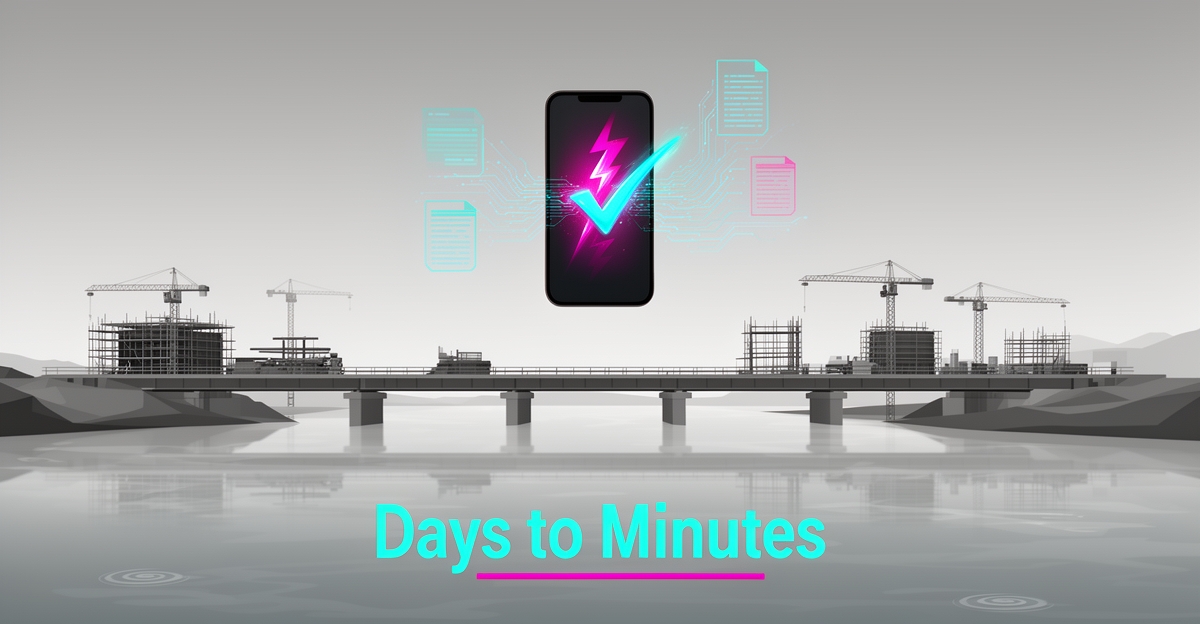
How AI Can Reduce Safety Incident Reporting Time in Bridge Construction
Key Facts
- 94% of frontline workers say incident reporting is easy, but only 57% find it very easy according to Sphera's survey
- 10% of workers admitted withholding a reportable safety event in the past six months per Sphera's research
- U.S. employers recorded roughly 2.5 million nonfatal workplace injuries and illnesses in 2024 per Bureau of Labor Statistics
- 5,070 fatal work injuries were reported in the U.S. in 2024 according to BLS data
- AI can reduce incident reporting time from hours or days to near-zero through automated classification and analysis as noted by Notify Technology
- AI-powered systems automatically extract key details from voice notes, photos, and text entries within minutes based on Sphera's findings
- AI detects patterns across time, location, and equipment to flag emerging risks before they escalate per Protex AI buyer guidance
Hire a team member that works 24/7 — for less than a part-time wage.
AI receptionists, SDRs, dispatchers and 99+ roles. Trained on your business, fully managed.
Not sure where to start? Ask our AI planner
The Reporting Gap Slowing Down Bridge Safety Response
On a bridge deck, the gap between a near-miss and a documented incident can stretch from minutes to days—and that gap is where the next accident forms. Safety response on construction sites is only as fast as the reports that trigger it, and those reports are slower and thinner than most safety leaders assume.
The scale of the problem is substantial. U.S. employers recorded roughly 2.5 million nonfatal workplace injuries and illnesses in 2024, according to Bureau of Labor Statistics data, along with 5,070 fatal work injuries reported that same year. Behind each of those figures sits a reporting process that had to be initiated, completed, and routed—often manually—before anyone could act.
The friction starts at the frontline. In Sphera's AI + Safety Culture survey, 94% of workers said it is easy to report incidents, but only 57% described it as very easy. That 37-point spread represents a real operational risk: workers who find reporting merely tolerable report less, later, and with less detail.
More troubling is what never gets reported at all. The same survey found that 10% of workers admitted withholding a reportable safety event within the previous six months. On a bridge project—where work at height, crane operations, and live traffic overlap—one in ten unreported events is a blind spot no supervisor can manage around.
Why does reporting lag on bridge sites specifically? The conditions compound the friction:
- Paper forms and end-of-shift reporting delay data entry until hours after the event, when details have faded.
- Loud, wet, and elevated work environments make typing a full incident narrative impractical in the moment.
- Manual classification and routing mean reports sit in queues before reaching the people who can authorize corrective action.
- Fear of blame or paperwork burden quietly suppresses near-miss reporting—the early-warning signals safety teams need most.
The result is a system that captures incidents after the fact but struggles to surface the patterns that predict them. Traditional EHS software functions as a system of record; as buyer guidance on safety AI notes, what's missing is a sensing layer that turns raw reports into real-time risk detection.
This is where AI document processing changes the equation. Systems like those AIQ Labs builds can capture incident reports in the field, automatically classify and route them, and surface patterns and likely root causes—compressing the time between event, report, and response to near-zero. As one analysis of AI in incident reporting puts it, AI can dramatically reduce the administrative burden for safety leaders by automating incident analysis, summaries, and insights, freeing time for proactive safety management.
The reporting gap isn't a people problem—it's a process problem. And processes built on manual collection, classification, and analysis are exactly what AI was built to fix.
How AI Automates Collection, Classification and Analysis of Field Reports
AI-powered systems are changing how bridge construction teams collect, classify, and analyze safety incident reports. By automating the intake process, these tools reduce manual effort and ensure consistent data capture from the field. This shift allows safety personnel to focus on intervention rather than paperwork, directly cutting reporting delays. According to Sphera's AI + Safety Culture survey, 94% of frontline workers find incident reporting easy, yet only 57% describe it as very easy, highlighting room for improvement in current workflows.
AI enhances classification by using natural language processing to tag and categorize reports instantly, eliminating subjective delays. Machine learning models identify recurring patterns across incident types, locations, and shifts, revealing hidden risk factors that manual review often misses. For example, AI can detect that certain weather conditions or equipment combinations correlate with higher near-miss rates, enabling preemptive action. These capabilities support a move from reactive to proactive safety management, a key benefit noted in industry analyses of AI in workplace safety.
Beyond classification, AI enables predictive hazard modeling and real-time safety analytics that transform raw data into actionable insights. Systems continuously monitor incoming reports, flagging emerging trends before they escalate into incidents. This allows supervisors to adjust workflows, retrain crews, or modify site layouts based on data-driven forecasts. AI-powered safety analytics can provide real-time insights into safety performance, enabling data-driven decision-making and continuous improvement. By reducing the administrative burden of incident handling, AI frees up safety leaders to focus on prevention—directly addressing the 10% of workers who admitted to withholding reportable safety events in the past six months due to reporting friction.
AIQ Labs designs custom AI systems—whether a single AI employee handling incident intake or a full workflow rebuild of your safety reporting process—that integrate with field reporting tools, automate classification, and deliver predictive analytics tailored to bridge construction environments. These solutions help teams shift from logging incidents to preventing them, creating safer sites through continuous learning and automated insight generation. The result is a safety culture where data doesn't just record the past—it actively shapes a safer future.
From Field Voice Note to Root Cause in Minutes with Custom AI Systems
The safety reporting process in bridge construction often stalls at the first step—getting accurate information from the field. Frontline crews face time pressure, complex forms, and uncertainty about what details matter most, leading to delayed or incomplete reports that slow down investigations. This gap between observation and action increases risk and undermines safety culture.
AIQ Labs builds custom AI systems that transform voice notes, photos, and quick text entries from construction sites into structured safety reports within minutes. Using natural language processing and computer vision, these tools automatically extract key details—location, equipment involved, personnel, and environmental conditions—from unstructured field inputs. The system then classifies the incident type and severity using predefined safety taxonomies aligned with OSHA and industry standards, eliminating manual sorting and reducing misclassification.
Once captured, the AI analyzes the report against historical safety data to detect patterns and suggest potential root causes. For example, if multiple reports cite similar equipment failures near specific bridge joints, the system flags recurring mechanical stress points and recommends preventive maintenance checks. This shifts safety teams from reactive documentation to proactive risk identification, cutting the time from report to insight from hours or days to near-zero.
Sphera's research shows that while 94% of frontline workers find incident reporting easy, only 57% describe it as very easy—highlighting friction in current processes. Additionally, 10% of workers admit to withholding reportable safety events within six months, often due to reporting burden or fear of blame. By minimizing effort and ensuring anonymity where appropriate, AI-powered tools increase reporting completeness and timeliness.
- Voice-to-text conversion with industry-specific terminology recognition
- Automatic tagging of incident type, severity, and contributing factors
- Pattern detection across time, location, and equipment variables
- Root-cause hypotheses generated from historical incident correlations
- Real-time alerts to supervisors when high-risk patterns emerge
These capabilities are embedded in AIQ Labs' AI Workflow Builds, which integrate directly with field tools like mobile apps, radios, and wearable sensors. The system learns from each report, refining its accuracy over time without requiring constant retraining. Safety managers receive prioritized insights instead of raw data, enabling faster toolbox talks, targeted inspections, and timely corrective actions.
By reducing the administrative lag between incident detection and response, AI doesn't just speed up reporting—it strengthens the entire safety feedback loop. Crews see that their input leads to visible action, which builds trust and encourages more honest, frequent reporting. In high-risk environments like bridge construction, where delays can mean the difference between a near-miss and a fatality, this near-zero response time isn't just efficient—it's essential.
Implementation Roadmap for AI Safety Reporting on Bridge Projects
Implementing AI on a bridge project isn't about flipping a switch; it's about building a digital safety culture one phase at a time. With 10% of workers admitting to withholding reportable safety events, the roadmap below prioritizes trust and usability alongside technical deployment.
Before selecting tools, map how incident data actually moves from the ironworkers and carpenters to the safety manager's desk. Identify where delays occur—whether it's deciphering handwritten notes at the trailer or chasing witness statements days after a near-miss. AI can dramatically reduce the admin burden for safety leaders by automating these bottlenecks, but only if you first understand where the friction lives. Document your baseline: how many hours does your team currently spend compiling a single OSHA 300 log entry?
Traditional EHS platforms serve as systems of record, while Safety AI acts as a sensing layer for real-time risk detection. For bridge construction, you need a system that handles unstructured field data—voice notes from noisy decks, photos of formwork failures, and text messages from night shifts. Look for solutions that offer offline functionality and integrate with your existing project management stack rather than forcing a complete rip-and-replace.
AIQ Labs structures these deployments through Build in Milestones, allowing contractors to approve and pay for each phase—voice capture, automated classification, predictive analytics—as it ships, ensuring the system evolves with the project's specific hazards. For contractors who want the reporting layer connected to scheduling, dispatch, and compliance across the whole operation, an AI Operating System built in phases—and owned outright—is the longer-term path.
Technology fails when crews view it as surveillance. Since only 57% of frontline workers describe reporting as "very easy", your training must emphasize how AI protects them, not monitors them. Roll out the system with toolbox talks that demonstrate voice-to-text reporting in under sixty seconds. Address the "reporter's dilemma" head-on: show how AI anonymizes data to focus on hazards, not blame.
- Conduct hands-on sessions during pre-shift meetings
- Designate "AI champions" among veteran foremen
- Establish feedback loops for false positives or missed classifications
- Integrate with existing PPE and badge systems to reduce friction
Implementation doesn't end at go-live. Establish a cadence for reviewing AI-generated insights—weekly for active phases like deck pours, monthly for trend analysis. Poor data quality can cripple AI effectiveness, so audit the classification accuracy regularly. With roughly 2.5 million nonfatal workplace injuries reported annually in the U.S., the goal is to move from lagging indicators to leading ones.
For firms seeking lower-risk entry points, AIQ Labs offers a Start Monthly model—deploying a managed AI safety coordinator to handle incident intake and initial classification at roughly 80% less cost than a human hire. This allows safety managers to validate the technology's impact on response times before scaling to full predictive analytics across the entire bridge lifecycle.
Still paying for 10+ subscriptions that don’t talk to each other?
We build custom AI systems you own outright. No vendor lock-in. Full control.
Not sure where to start? Ask our AI planner
Frequently Asked Questions
How much can AI actually reduce safety incident reporting time on bridge construction sites?
Why do workers on bridge sites underreport near-misses and safety incidents?
Is AI safety reporting just another EHS software platform, or is it genuinely different?
What happens if the AI misclassifies an incident or gets the analysis wrong?
How do you get frontline crews to actually trust and use an AI reporting system?
What does it cost to implement AI safety reporting on a bridge project?
Closing the Gap Between Incident and Action
Bridge construction will always carry high risk, but the reporting gap that turns near-misses into delays is a process problem AI can fix. Voice-to-text capture, automatic classification and routing, and pattern detection compress the time from field observation to root-cause insight from hours or days to minutes, turning thin, late reports into timely, complete data. That shift moves safety teams from reactive documentation to proactive risk management, and it addresses the real friction workers feel — where 94% say reporting is easy but only 57% say it is very easy. For contractors ready to act, the first step is mapping where reports stall today, then piloting AI intake that crews can use in noisy, elevated conditions without adding paperwork. AIQ Labs builds custom AI systems that integrate with field tools and deliver predictive analytics tailored to bridge environments, so teams own the solution and can scale it by phase. Start with the 2-minute Fit Check at https://aiqlabs.ai/apply, then book a free 30-minute strategy call at https://aiqlabs.ai/book to map your biggest bottleneck and see if a clear, high-ROI automation path exists for your project.
Make AI your competitive advantage — not just another tool.
Strategy, implementation and ongoing optimization. One partner, end to end.
Not sure where to start? Ask our AI planner