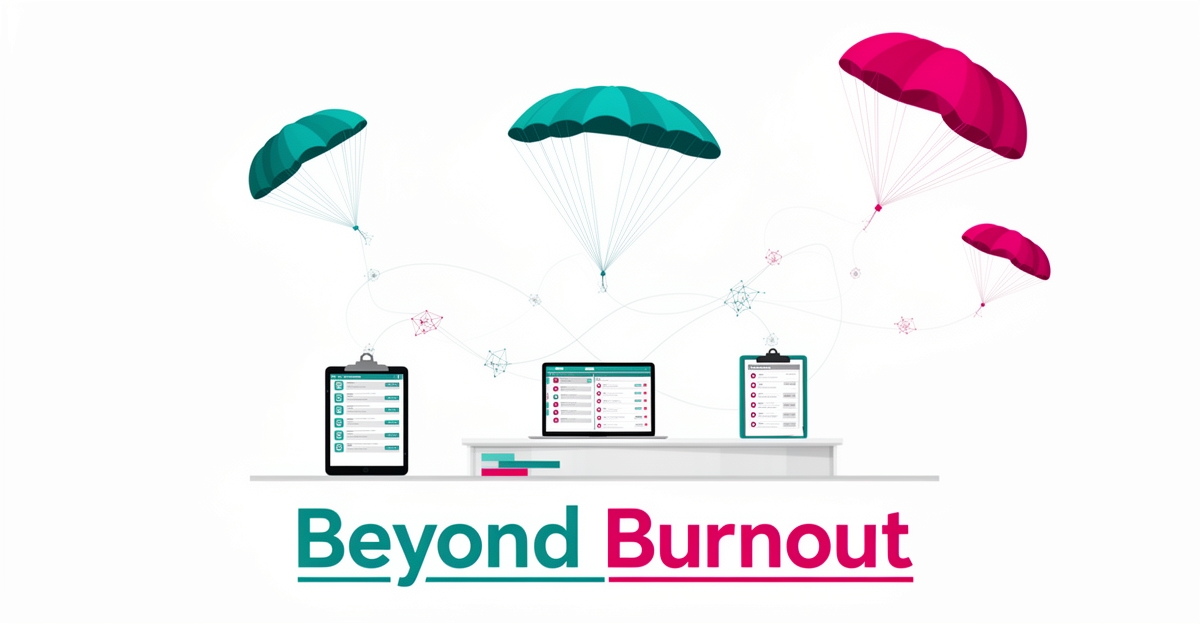
How AI Can Reduce Staff Burnout at High-Volume Skydiving Centers
Key Facts
- Workforce surveys in recent years consistently find a majority of full-time employees reporting feelings of burnout, with administrative overload a leading driver.
- AI deployed on top of broken workflows tends to add work rather than remove it—workflow design matters more than the tool.
- Repetitive admin tasks like manual check-in and waiver verification drive burnout in high-volume skydiving centers.
- Workflow issues, not motivation problems, cause staff exhaustion from paperwork and confirmation calls.
- AIQ Labs has deployed 200+ multi-agent systems and runs 4 live SaaS products daily.
- Start small, prove value, then scale is the core of AIQ Labs' Start Monthly model.
Hire a team member that works 24/7 — for less than a part-time wage.
AI receptionists, SDRs, dispatchers and 99+ roles. Trained on your business, fully managed.
Not sure where to start? Ask our AI planner
The Hidden Cost of Repetitive Tasks in Adventure Tourism
The thrill of skydiving draws thousands of visitors each season, yet behind the scenes, staff at high-volume centers face a less glamorous reality: relentless administrative repetition. While guests anticipate the rush of freefall, employees often drown in paperwork, digital forms, and confirmation calls that have little to do with the adventure itself.
This disconnect between the exciting product and exhausting process creates a dangerous operational gap. Workforce research in recent years has consistently found that a majority of full-time employees report feeling burned out, a pattern that rings especially true in adventure tourism where emotional labor runs high. When staff spend their days manually processing waivers, confirming tandem slots, and collecting guest information, they have little energy left for the safety briefings and customer connections that actually require human expertise.
The problem intensifies when facilities attempt quick technological fixes without strategic implementation. Employees frequently report that AI layered onto outdated processes increases their workload rather than reducing it, creating a paradox where tools meant to help instead add layers of complexity. This misimplementation often stems from focusing on technology rather than workflow design, leaving staff to bridge the gaps between systems.
High-volume centers typically overload their teams with repetitive tasks such as:
- Manual check-in processing and waiver verification for hundreds of daily jumpers
- Repetitive phone and email confirmations for weather delays and scheduling changes
- Collecting and entering guest medical information and emergency contacts
- Managing last-minute cancellations and rebooking logistics across multiple channels
These duties represent a workflow issue rather than a motivation problem. Staff didn't join the industry to push paper; they came to facilitate life-changing experiences and ensure safety protocols. When administrative tasks consume their cognitive bandwidth, both service quality and safety oversight suffer.
Addressing this requires rethinking how work flows through the organization. Introducing new technologies into outdated operational models rarely unlocks productivity gains. For skydiving centers, this means deploying AI employees that handle routine guest communications and data collection autonomously, rather than simply adding more software for staff to manage.
AIQ Labs specializes in building these managed AI workforces for high-demand facilities, creating systems where technology handles the repetitive administrative burden. By automating the check-in pipeline and confirmation workflows, centers can redirect human talent toward coaching, safety oversight, and the high-touch guest interactions that define exceptional adventure tourism.
AI Employees as Force Multipliers for Safety-Focused Staff
High-volume skydiving centers face intense operational pressure, with staff juggling repetitive administrative tasks while trying to maintain safety and guest experience. When human instructors spend hours on check-ins, scheduling, and data collection, they have less mental bandwidth for the nuanced coaching and risk assessment that prevents accidents. This imbalance not only strains resources but directly contributes to burnout, especially when AI is layered onto existing workflows without rethinking how work gets done.
AI Employees offer a fundamentally different approach—not as add-ons, but as managed team members who own entire workflows from start to finish. Across 99+ roles, these AI staff handle end-to-end guest intake, session confirmations, waiver processing, and scheduling across phone, email, and chat, integrating directly with booking systems and CRM tools. By taking over these routine, high-volume interactions, AI Employees free human instructors to focus exclusively on safety briefings, skill progression coaching, and real-time supervision during jumps—tasks that require judgment, empathy, and situational awareness no algorithm can replicate.
In high-stress environments like skydiving centers, the right AI integration doesn't just reduce strain—it redirects talent toward higher-value, safety-critical roles. AIQ Labs' managed AI Employee model ensures these systems are continuously trained, monitored, and optimized to perform reliably within defined boundaries, so human staff gain back time without sacrificing operational control or compliance. The result is a workforce that's less overwhelmed, more engaged, and better positioned to deliver the consistent, safety-first experience that keeps guests returning and staff thriving.
From Pilot to Partner: Implementing AI Without Adding Complexity
Many skydiving centers struggle with staff burnout as repetitive front-desk tasks pile up during peak seasons. AIQ Labs offers a low-risk entry point through its Start Monthly model, allowing centers to deploy a single AI Employee for front desk automation without overhauling existing systems. This approach lets businesses test AI's impact on workload reduction before scaling further.
By integrating with tools already in use—like Calendly for scheduling and Stripe for payments—the AI Employee handles check-ins, session confirmations, and guest information collection autonomously. This reduces the manual burden on human staff, freeing them to focus on safety briefings and personalized coaching. The model emphasizes true ownership, meaning the center retains full control over the AI Employee's behavior and data, with no vendor lock-in.
Centers can pause or adjust the service at any time, directly addressing SMB concerns about complexity and long-term commitment. Employees frequently report that poorly implemented AI increases their workload, so a phased, manageable rollout is critical to avoid adding stress to an already stretched team.
Start small, prove value, then scale—this is the core of AIQ Labs' Start Monthly model. It includes setup, training on your specific workflows, tool integrations, ongoing monitoring, and continuous improvements—all for a flat monthly cost far below a comparable human hire. There are no hidden fees or complex contracts; adjustments can be made based on real-world performance and seasonal demand. For centers ready to commit, Build in Milestones and Own It Outright options let you phase a larger build or take full ownership of the system outright.
This model supports sustainable adoption by aligning with how successful implementations actually work: investing beyond the tech stack, bringing in outside expertise, and rethinking productivity metrics. For skydiving centers aiming to reduce burnout without disrupting operations, this practical path turns AI from a potential burden into a real partner in staff well-being. Centers with deeper operational tangles can also explore a focused Workflow Build to rebuild the single costliest process first.
Still paying for 10+ subscriptions that don’t talk to each other?
We build custom AI systems you own outright. No vendor lock-in. Full control.
Not sure where to start? Ask our AI planner
Frequently Asked Questions
Why do employees feel more burned out even after their company adopts AI?
How can AI actually reduce burnout at a busy skydiving center?
What specific tasks can an AI Employee handle at a dropzone?
What's the difference between an AI Employee and a standard chatbot?
How do I implement AI without overwhelming my already stressed team?
How much does it cost to hire an AI Employee compared to a human?
Lift the Load, Keep the Thrill
High-volume skydiving centers don't have a motivation problem, they have a workflow problem. When instructors spend their day on manual check-ins, waiver verification, and repetitive confirmations, burnout rises and safety-critical focus falls. The shift that works is replacing fragmented tools with managed AI employees that own entire front-desk workflows end-to-end, from intake and scheduling to guest communications, so human staff can stay where they matter most: briefings, coaching, and real-time supervision. AIQ Labs has deployed 200+ multi-agent systems and runs 4 live SaaS products daily, so the model is proven in production—not theorized. Through Start Monthly, centers can test impact with a single employee before scaling. If your team is stretched thin during peak season, start with a clear bottleneck assessment. Complete the 2-minute Fit Check at https://aiqlabs.ai/apply, then book a free 30-minute strategy call at https://aiqlabs.ai/book, or email [email protected] to explore options.
Make AI your competitive advantage — not just another tool.
Strategy, implementation and ongoing optimization. One partner, end to end.
Not sure where to start? Ask our AI planner