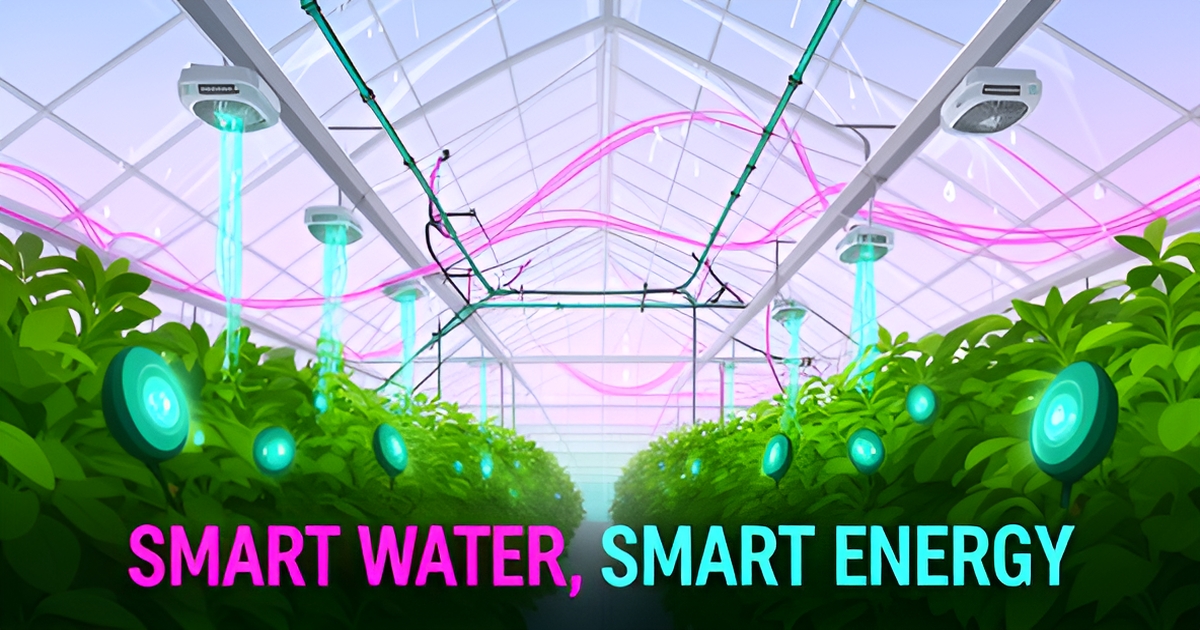
How AI Can Reduce Water and Energy Consumption in Greenhouse Farming
Key Facts
- 20% to 30% of treated water is lost globally due to leaks, pipe bursts, and aging infrastructure according to industry reporting
- AI is projected to consume up to 600 billion gallons of water by 2030 as data center power demands rise per projected analysis
- A single AI query can consume up to 23.8 Wh of energy depending on model complexity according to environmental impact analysis
- Training a large AI model like GPT-4 can consume up to 13.4 million gallons of water in just one month per water usage tracking
- Google's data centers consumed 6.4 billion gallons of water in 2023 while Microsoft's usage surged 34% to 1.7 billion gallons according to water usage tracking
- The efficiency gap between AI models spans over 200x, making model selection a critical sustainability decision per environmental impact analysis
- AI models analyze sensor data, weather forecasts, and crop cycles in real time to make continuous micro-adjustments that optimize irrigation and climate control
Hire a team member that works 24/7 — for less than a part-time wage.
AI receptionists, SDRs, dispatchers and 99+ roles. Trained on your business, fully managed.
Not sure where to start? Ask our AI planner
The Hidden Resource Crisis in Modern Greenhouse Operations
Greenhouse operators are caught between two rising costs: the water and energy they use to grow, and the water and energy required to run the AI that could save it.
Inefficient irrigation and climate control drive utility bills up while wasting a resource that is already under pressure. Industry reporting estimates 20% to 30% of treated water is lost globally due to leaks, pipe bursts, and aging infrastructure. In a greenhouse, those losses compound with overwatering, evaporation, and poorly tuned HVAC.
Energy demand adds a second layer of strain. A single AI query can consume up to 23.8 Wh of energy, according to environmental impact analysis. At data center scale, the footprint is visible: Google's data centers consumed 6.4 billion gallons of water in 2023, and Microsoft's data center water use increased 34% from 2022 to 2023, reaching 1.7 billion gallons, per water usage tracking.
The paradox is clear. Greenhouse operators need smarter control of irrigation and climate systems, yet the AI models that deliver those recommendations carry their own resource cost. Projected analysis warns AI is set to consume up to 600 billion gallons of water by 2030, driven primarily by rising data center power demands.
This dual pressure shows up in daily operations:
- Rising utility costs from leaky distribution and climate control systems that run on fixed schedules
- Water waste from manual irrigation decisions and undetected anomalies in distribution
- Energy-intensive AI infrastructure that powers modern ag-tech and analytics platforms
The hidden cost is not just financial. It is the environmental toll of water waste paired with the carbon intensity of the compute used to monitor it. Operators face a sustainability gap where efficiency gains in the greenhouse can be offset by inefficiencies elsewhere in the technology stack.
AI models can analyze usage patterns to optimize irrigation and climate control systems, reducing water and energy consumption in greenhouse farming. The value comes from real-time recommendations that adapt to crop needs, weather, and system performance rather than static rules.
At AIQ Labs, this challenge is addressed through custom AI systems that deliver real-time recommendations to cut utility costs and improve sustainability. The focus is on practical optimization of usage patterns, not generic dashboards, with models built to own and control.
Without targeted analytics, the resource crisis remains hidden in spreadsheets and utility bills. With the right analysis, the same data that reveals waste becomes the lever for measurable reduction.
How AI Models Optimize Irrigation and Climate Control in Real Time
Greenhouse operators face a constant tension between precision and waste, where small miscalculations in irrigation or climate quickly compound into lost water, energy, and yield.
AI models change that equation by analyzing sensor data, weather forecasts, and crop cycles in real time to make continuous micro-adjustments. Predictive analytics for demand forecasting and leak detection are already core uses in water resource management, and the same principles apply inside a controlled growing environment.
Soil moisture probes, canopy temperature sensors, and CO₂ monitors feed a live data stream that machine learning models correlate with short-term weather forecasts and growth stage requirements. The system learns the unique water uptake curve for each crop variety and adjusts irrigation schedules before stress appears. Real-time monitoring and anomaly detection in urban water distribution systems shows how AI adapts to changing conditions, a capability that transfers directly to greenhouse climate control.
Climate control benefits from the same closed-loop logic. Instead of fixed HVAC setpoints, AI models modulate heating, cooling, ventilation, and shading based on predicted solar gain, humidity load, and transpiration rates. This dynamic control reduces energy spikes while maintaining the stable microclimate plants need.
The environmental context matters. Global assessments note that 20% to 30% of treated water is lost due to leaks, pipe bursts, and aging infrastructure. In greenhouses, AI-driven precision helps avoid a similar invisible loss through over-irrigation and evaporative waste.
AIQ Labs builds custom AI systems in the AI Data Analytics & Business Intelligence space that deliver real-time recommendations to cut utility costs and improve sustainability. The approach mirrors how AI is being used in water resource management to optimize wastewater treatment and resource recovery through machine learning.
A practical implementation typically includes:
- Sensor fusion of soil, air, and plant-level data with hyperlocal weather forecasts
- Predictive irrigation scheduling that aligns water delivery with evapotranspiration demand
- Adaptive HVAC tuning that anticipates heat and humidity loads before they occur
- Anomaly detection for leaks, clogged emitters, and equipment drift
The sustainability conversation around AI itself is important. Industry reporting projects AI could consume up to 600 billion gallons of water by 2030, driven by data center power demands. A single AI query can consume up to 23.8 Wh of energy according to environmental impact analysis.
Because of that footprint, efficient model selection and edge deployment are part of responsible design. AIQ Labs focuses on custom-built systems that businesses own, enabling targeted analytics without unnecessary compute overhead while delivering measurable utility savings in the greenhouse.
The Sustainability Paradox: Balancing AI’s Resource Cost Against Its Savings
There's an uncomfortable truth at the heart of AI-driven sustainability: the technology promising to slash your greenhouse's water and energy consumption carries its own substantial environmental footprint. Training a single large AI model like GPT-4 can consume up to 13.4 million gallons of water in just one month—equivalent to the annual water needs of a small community.
The scale of AI's resource appetite extends far beyond initial training. Google's data centers consumed 6.4 billion gallons of water in 2023, while Microsoft's usage surged 34% year-over-year to 1.7 billion gallons. Industry analysts project that AI systems will consume up to 600 billion gallons of water by 2030 as data center power demands escalate.
Every AI query carries an energy cost—up to 23.8 watt-hours per query depending on model complexity. Multiply that across thousands of daily irrigation decisions, climate adjustments, and predictive analytics running continuously in a commercial greenhouse operation, and the resource consumption compounds quickly.
The efficiency gap between AI models spans over 200x, making model selection itself a critical sustainability decision. Choosing an oversized, resource-intensive model for straightforward irrigation optimization is like using a fire hose to water a single plant—technically effective, but fundamentally wasteful.
This is where strategic implementation becomes essential. At AIQ Labs, we architect custom AI systems that match computational power to actual need, analyzing your specific usage patterns to optimize irrigation and climate control without unnecessary overhead. The goal isn't to deploy the largest model available—it's to deploy the right-sized solution that delivers measurable resource savings while minimizing its own footprint.
Achieving net-positive sustainability requires deliberate choices:
- Select models with computational requirements proportional to your actual optimization needs
- Prioritize inference efficiency over raw capability for routine decision-making
- Implement edge computing where feasible to reduce data center dependency
- Monitor the environmental cost of your AI systems alongside the savings they generate
- Partner with providers who prioritize renewable energy and water-efficient cooling infrastructure
The sustainability paradox resolves when the resources your AI system saves dramatically exceed what it consumes—a threshold entirely achievable with thoughtful architecture and honest accounting of both sides of the equation.
Implementation Roadmap: From Sensor Integration to Closed-Loop Automation
Deploying AI for greenhouse resource management isn't a single leap — it's a structured progression that moves from raw data collection to fully automated climate and irrigation control. Growers who follow a phased roadmap avoid the most common failure mode: investing in sophisticated models before establishing the data foundation those models depend on.
The first phase is a resource audit. Before any sensor is installed, operators need a clear baseline of current water and energy consumption across irrigation zones, HVAC systems, and lighting. This step matters more than most realize — globally, an estimated 20% to 30% of treated water is lost to leaks and aging infrastructure, and greenhouses face similar hidden inefficiencies in their distribution lines.
Phase two involves deploying edge sensors throughout the facility. Soil moisture probes, temperature and humidity sensors, flow meters, and light sensors create the raw data stream that feeds everything downstream. The goal is granular, zone-level visibility — not a single aggregated reading that masks variation across the growing environment.
Once sensor data flows reliably, the third phase integrates AI models with existing SCADA and irrigation control systems. Rather than replacing infrastructure, the AI layer sits on top of it, analyzing patterns and generating recommendations. This is where AI's ability to adapt to changing conditions delivers its clearest advantage over static, rule-based scheduling — adjusting irrigation timing and climate setpoints based on real-time conditions rather than fixed timers.
Phase four is model validation. Before handing control to any algorithm, growers should run AI recommendations in parallel with existing practices for a defined trial period. This mirrors the challenge the broader industry faces: the efficiency gap between AI models spans over 200x, meaning the choice of model architecture directly affects both accuracy and resource footprint. Validating against actual crop outcomes — not just data metrics — separates useful models from expensive noise.
The final phase scales toward closed-loop automation, but with a critical safeguard: human-in-the-loop oversight. AI handles routine adjustments autonomously, while anomalies, threshold breaches, and unusual patterns escalate to a human operator. This structure reflects how AIQ Labs approaches its Build in Milestones engagements — each phase ships as a working, production-ready system the client owns, with the option to pause, evaluate, and expand only when results justify the next step.
- Audit current water and energy usage to establish a measurable baseline
- Deploy zone-level edge sensors for granular environmental data
- Integrate AI models with existing SCADA and irrigation infrastructure
- Validate model accuracy against real crop and resource outcomes
- Scale to closed-loop automation with human-in-the-loop escalation controls
Each milestone delivers standalone value — better visibility, tighter irrigation scheduling, reduced energy waste — so the investment compounds even if the operation never reaches full automation. The end state is a greenhouse that continuously optimizes itself, with growers making strategic decisions while AI handles the minute-by-minute adjustments that drive measurable resource savings.
Measuring ROI: Utility Savings, Compliance, and Long-Term Resilience
Greenhouse operators can't improve what they can't measure, and utility costs are the fastest way to prove sustainability is working. Tracking the right KPIs turns AI-driven irrigation and climate control from a technical experiment into a quantifiable financial and ESG story.
Gallons saved per crop cycle is the clearest water metric. AI models analyze usage patterns to optimize irrigation and climate control systems, reducing water and energy consumption in greenhouse farming. With 20% to 30% of treated water lost globally due to leaks, pipe bursts, and aging infrastructure, baseline measurement against historical use exposes real recovery.
Energy efficiency is tracked as kWh reduction per square foot. A single AI query can consume up to 23.8 Wh of energy, so efficiency matters both in the greenhouse and in the models that run it. Model drift monitoring ensures recommendations stay accurate as seasons, crops, and sensor data change, preventing silent creep back to wasteful setpoints.
Compliance and resilience complete the picture. Regulatory compliance tracking logs water withdrawals, discharge events, and energy reporting in auditable formats. This data supports certifications and ESG funding applications where proof, not promises, is required.
AIQ Labs builds custom AI systems that deliver real-time recommendations to cut utility costs and improve sustainability, and the measurement layer is built in from day one. Growers can quantify gains with:
- Gallons saved per crop cycle vs. baseline irrigation schedules
- kWh reduction per square foot from climate control optimization
- Regulatory compliance tracking with automated reporting and audit trails
- Model drift monitoring to maintain prediction accuracy and ROI over time
Context matters when interpreting savings. AI is set to consume up to 600 billion gallons of water by 2030, driven by data center power demands. Google's data centers consumed 6.4 billion gallons of water in 2023, and Microsoft's data center water use increased 34% from 2022 to 2023, reaching 1.7 billion gallons. Those figures underscore why efficient model selection and infrastructure choices are part of a credible sustainability claim.
Long-term resilience comes from continuous evaluation. Performance is reviewed per cycle, models are retrained on new sensor and yield data, and savings are tied to cost avoidance and carbon intensity. That discipline turns utility reductions into secured ESG funding and certifications rather than one-off wins.
Key Takeaways
{ "title": "The Greenhouse That Learns", "content": "Greenhouse operators don't need more dashboards — they need systems that close the loop between sensor data and control decisions. The path forward is clear: audit your baseline, deploy zone-level sensors, validate AI recommendations against r
Make AI your competitive advantage — not just another tool.
Strategy, implementation and ongoing optimization. One partner, end to end.
Not sure where to start? Ask our AI planner