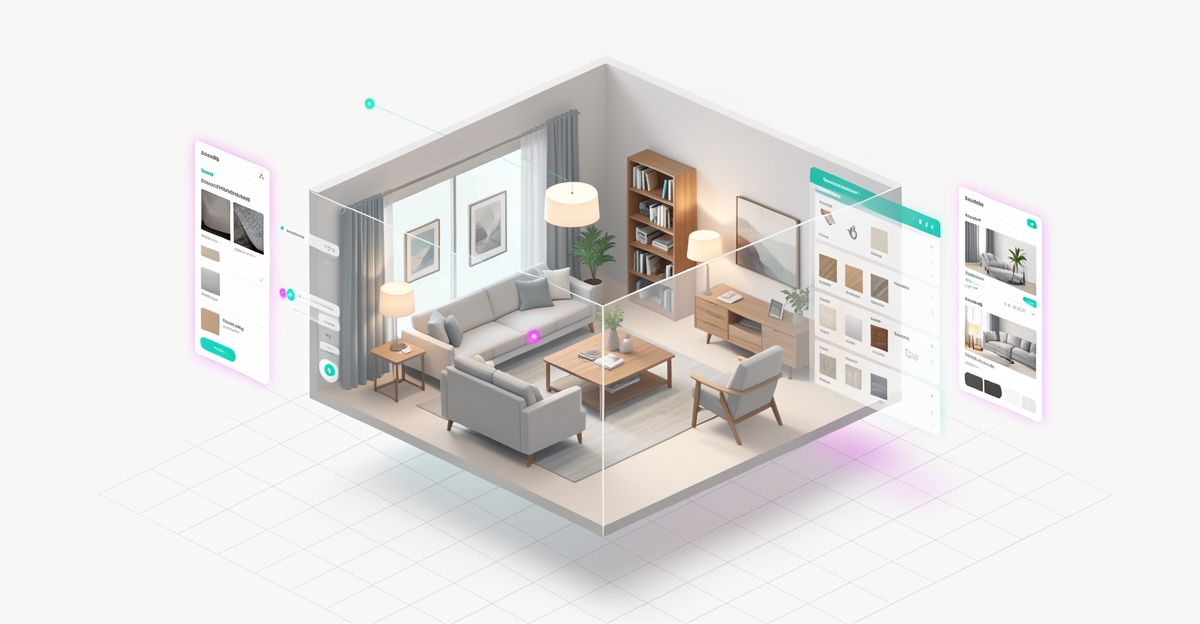
How AI Can Streamline Home Design Consultations with Virtual Showrooms
Key Facts
- Personalized digital coupons generate 30% higher redemption rates than generic promotions.
- 43% of Gen Z shoppers use AI assistants for purchase-related tasks.
- Personalized digital coupons generate 30% higher redemption rates than generic promotions.
- 43% of Gen Z shoppers use AI assistants for purchase-related tasks.
- 48% of U.S. consumers use search engines to find promotions before buying.
- 62% of executives are actively exploring agentic shopping tools.
- 9 in 10 retailers are adopting or piloting AI solutions.
- 30% faster app launches and 70% quicker photo loading times enable immersive experiences.
- Autonomous AI agents demonstrate a 40X improvement in completing verification loops.
- 31% of respondents report their products are not optimized for AI discovery.
What if you could hire a team member that works 24/7 for $599/month?
AI Receptionists, SDRs, Dispatchers, and 99+ roles. Fully trained. Fully managed. Zero sick days.
The Shift to Agentic Personalization
The era of static, one-size-fits-all digital experiences is rapidly ending. Modern consumers no longer want to browse generic catalogs; they demand hyper-personalized, immediate digital interactions that anticipate their specific design needs. This shift is driving a massive market transition from traditional e-commerce to "agentic commerce," where AI agents actively guide discovery and decision-making.
According to Entrepreneur, personalized digital interactions generate significantly higher engagement than generic offerings. In fact, personalized digital coupons drive 30% higher redemption rates compared to standard promotions. This data proves that relevance, not just availability, is the new currency of conversion.
Key drivers of this shift include:
- Active AI Discovery: 43% of Gen Z shoppers now use AI assistants to find products before purchasing.
- Search-First Behavior: 48% of U.S. consumers primarily use search engines to find promotions before buying.
- Executive Interest: 62% of respondents are actively exploring agentic shopping tools.
- Retailer Adoption: 9 in 10 retailers are currently adopting or piloting AI solutions.
Consider a kitchen and bath designer struggling to visualize complex material combinations. In a generic showroom, this requires hours of manual research. However, an agentic system can instantly interpret structured data to recommend layouts based on specific style preferences. This moves the interaction from passive browsing to active collaboration.
Why generic data fails:
- AI agents prioritize explicit attributes over vague marketing copy.
- "Fluffy" content is not interpretable by intelligent agents.
- Brands with unstructured data risk lower visibility.
- Structured metadata enables accurate "mental models" of offerings.
As noted by Spins industry research, the defining feature of this new commerce model is real-time personalization. This allows brands to unlock a level of customization previously impossible at scale.
For AI to effectively recommend styles, materials, and layouts, brands must provide explicit, structured data. Vague descriptions like "modern elegance" are useless to an algorithm; specific tags like "matte black finish," "quartz composition," and "42-inch depth" are essential. This structural clarity allows AI agents to form accurate mental models of design assets.
Food Navigator USA reports that while 62% of executives are exploring agentic tools, 31% admit their products are not optimized for AI discovery. This gap represents a massive competitive disadvantage for brands that haven’t yet structured their design data for machine interpretation.
Essential data requirements for AI showrooms:
- Explicit Material Attributes: Specific textures, finishes, and compositions.
- Spatial Constraints: Precise dimensional data for layout planning.
- Style Metadata: Tagged aesthetic categories for filtering and matching.
- Machine-Readable Formats: Structured data that agents can parse instantly.
Without this foundation, even the most advanced personalization engine cannot deliver relevant results. The goal is to move beyond aspirational marketing speak toward actionable, data-driven design intelligence.
Advancements in spatial computing are enabling photorealistic, context-aware virtual environments. New technologies allow devices to convert panoramas into immersive spaces and recognize physical objects in real-time. This creates a bridge between digital design and physical reality, allowing clients to interact with 3D elements as if they were physically present.
Research from Digital Trends highlights that recent iOS updates enable up to 30% faster app launches and 70% quicker photo loading times. These performance gains are critical for maintaining engagement in high-fidelity virtual showrooms where latency breaks the illusion of presence.
Benefits of spatial integration:
- Real-Time Adaptation: Environments adjust instantly to user input.
- Photorealistic Rendering: High-fidelity visuals build trust and desire.
- Contextual Personalization: Designs adapt to the user’s actual space.
- Seamless Interaction: Natural gestures replace clunky menu navigation.
This technology transforms the consultation from a static presentation into a dynamic, collaborative experience.
The market is moving toward full autonomy in complex workflows. While currently demonstrated in high-stakes engineering, the principle of AI agents executing multi-step verification and design processes is directly applicable to home design. Autonomous agents can handle material selection, layout planning, and even preliminary compliance checks.
In analogous fields, autonomous AI agents have demonstrated 40X improvement in completing verification loops. This suggests that AI can handle the tedious, multi-stage tasks of design consultation, freeing human designers to focus on creative strategy. By automating these workflows, designers can scale their impact without sacrificing personalization.
Workflow automation benefits:
- Reduced Manual Entry: Automate data transfer between tools.
- Faster Iterations: Generate multiple design options in minutes.
- Consistent Quality: Ensure all recommendations meet brand standards.
- Scalable Engagement: Serve more clients without adding headcount.
AIQ Labs leverages these principles to build custom systems that own the entire design journey.
Brands that embrace agentic commerce will outperform those relying on traditional e-commerce models. By combining structured data, spatial computing, and automated workflows, designers can offer one-to-one marketing at scale. This approach not only increases conversion rates but also builds deeper client relationships through relevant, timely interactions.
Entrepreneur notes that services competing for customers must now offer immediate, tailored experiences. AIQ Labs’ custom development capabilities allow businesses to build these systems from the ground up, ensuring true ownership and integration with existing tools.
Why this matters now:
- Consumer Expectations: Shoppers demand AI-assisted discovery.
- Operational Efficiency: Automation reduces time-to-market.
- Data Readiness: Structured data is the key to personalization.
- Competitive Edge: Early adopters capture market share.
The shift to agentic personalization is not just a technological upgrade; it is a fundamental change in how businesses connect with clients. By adopting these strategies, home design consultants can future-proof their operations and deliver unmatched value.
The Data Foundation: Structured Assets for AI Discovery
AI agents cannot recommend what they cannot understand. For virtual showrooms to function effectively, design assets must be tagged with precise, machine-readable metadata rather than relying on vague marketing descriptions.
Without structured data, AI struggles to form accurate "mental models" of your offerings. Brands that fail to provide explicit attributes risk lower visibility and missed conversion opportunities.
AI discovery relies on explicit data points, not aspirational language. Vague marketing copy is not easily interpretable by AI assistants, leading to irrelevant recommendations.
Many businesses underestimate the impact of poor data formatting on AI performance. 31% of respondents report their products are not optimized for AI discovery, causing significant friction in automated workflows.
- Material Specifications: Exact wood types, stone compositions, and finish codes.
- Spatial Constraints: Precise dimensions, clearance requirements, and layout compatibility.
- Style Tags: Categorized attributes like "Mid-Century," "Industrial," or "Farmhouse."
- Availability Status: Real-time inventory levels and lead times for AI filtering.
Case Study Insight: In chip design, autonomous agents achieve a 40X improvement in verification loops by using structured data. Home design consultations require similar precision to avoid costly errors.
The market is shifting toward "agentic commerce," where AI agents determine product visibility based on personalized queries. Consumers expect immediate, tailored experiences rather than generic browsing.
Personalized digital interactions generate significantly higher engagement than static catalogs. Personalized digital coupons generate 30% higher redemption rates compared to generic promotions.
- Targeted Recommendations: AI matches client preferences with specific material attributes.
- Real-Time Adaptation: Systems adjust layouts based on immediate client feedback.
- Automated Filtering: AI handles complex multi-step queries without human intervention.
- Consistent Brand Voice: Structured data ensures uniform representation across platforms.
43% of Gen Z shoppers already use AI assistants for purchase-related tasks. Your virtual showroom must speak their language: precise, fast, and personalized.
AIQ Labs’ personalization engines thrive on clean, organized data. By integrating structured metadata, designers can leverage AI to streamline consultations and boost engagement.
- Audit Existing Assets: Identify gaps in current material and style metadata.
- Standardize Tagging Protocols: Create a unified system for all design attributes.
- Integrate with AI Engines: Connect structured data to AIQ Labs’ personalization systems.
- Test and Refine: Monitor AI recommendations for accuracy and relevance.
Expert Insight: Jessica Wright of Spins notes that "AI agents are catching structured data" to highlight product value, emphasizing that "fluffy marketing content" fails in automated environments.
Structured data is the foundation of effective AI discovery. By prioritizing explicit, machine-readable metadata, kitchen and bath designers can unlock the full potential of AI-powered virtual showrooms.
This readiness enables hyper-personalization, driving higher engagement and conversion rates. In the next section, we will explore how to leverage these insights to build immersive, spatial computing experiences.
Immersive Implementation: Spatial Computing and Visual Intelligence
The era of static 2D renderings is over, replaced by a demand for hyper-realistic, interactive virtual environments. Modern consumers expect design consultations to feel immediate, tangible, and deeply personalized. By leveraging emerging spatial computing technologies, designers can now create photorealistic showrooms that adapt to user context in real-time.
This shift is driven by agentic commerce, where AI agents determine product visibility based on personalized queries rather than generic promotions. To meet this demand, brands must move beyond vague marketing copy to provide explicit, structured data regarding materials and spatial constraints.
- Visual Intelligence: Devices can now convert panoramas into immersive spatial environments, recognizing physical objects instantly.
- On-Device AI: Processing occurs locally, enabling faster load times and secure, private user data handling.
- Contextual Adaptation: Virtual spaces adjust lighting, texture, and layout based on real-time user interaction and preferences.
According to recent analysis from Digital Trends, new iOS updates enable up to 30% faster app launches and 70% quicker photo loading times. These performance gains are critical for maintaining engagement in immersive experiences, where even slight latency can break the illusion of reality.
For AI to effectively recommend designs, it requires precise input. As noted by industry experts in Food Navigator USA, AI agents prioritize explicit attributes over fluffy marketing content. This means design assets must be tagged with machine-readable metadata to form accurate mental models for the AI.
- Structured Metadata: Tag materials, styles, and dimensions for AI interpretation.
- Real-Time Rendering: Use spatial frameworks to update visuals instantly.
- Multi-Agent Orchestration: Deploy separate agents for preference gathering and layout generation.
Consider a kitchen and bath designer using AIQ Labs’ personalization engine. Instead of flipping through static PDFs, a client uses a spatial device to walk through a virtual kitchen. The AI recognizes the client’s physical space and suggests layouts that fit, adjusting materials based on the client’s past behavior.
This approach transforms passive browsing into active collaboration. The result is a seamless blend of human creativity and computational precision, allowing designers to focus on high-value strategic decisions rather than manual drafting.
As we move toward fully autonomous design workflows, the integration of spatial computing becomes not just a feature, but a necessity for competitive differentiation.
Operational Efficiency via Multi-Agent Workflows
Traditional design consultations often drown in administrative bottlenecks, forcing talented designers to spend hours on manual data entry and repetitive scheduling rather than creative problem-solving.
By deploying multi-agent systems, businesses can automate complex, multi-step consultation processes, freeing human experts to focus on high-value strategic tasks.
For example, instead of a designer manually researching materials and checking inventory for every client request, specialized AI agents can handle these workflows in parallel.
One agent might gather client preferences while another verifies material availability and a third generates visual layouts simultaneously.
This orchestration reduces consultation time significantly, allowing designers to handle more clients without increasing headcount.
Key benefits of this approach include:
- Automated Pre-Consultation Research: Agents gather client history and preferences before the human designer even joins the call.
- Real-Time Material Verification: AI checks inventory and pricing across multiple suppliers instantly, eliminating manual lookups.
- Instant Visual Generation: Layouts and mood boards are created automatically based on structured design data and client constraints.
- Seamless Handoffs: Complex queries are routed to the right specialist or human designer only when necessary, reducing friction.
The shift toward agentic commerce means consumers expect immediate, tailored experiences rather than generic responses.
Research from Entrepreneur highlights that personalized digital interactions generate 30% higher redemption rates compared to generic promotions.
This efficiency is not just theoretical; it is proven at scale by companies like AIQ Labs, which runs 70+ production agents daily across their own SaaS platforms.
In analogous high-complexity fields like chip design, autonomous AI agents have demonstrated a 40X improvement in completing verification loops compared to previous methods (as reported by Forbes).
When designers are no longer bogged down by "boring babysitting of various design tools," they can move up the stack to focus on core competencies like client relationship building and creative vision.
This allows senior professionals to increase their output without burnout, directly impacting the bottom line through higher capacity and improved client satisfaction.
To achieve this, businesses must prioritize structured data integration, ensuring AI agents have access to explicit, machine-readable metadata about styles, materials, and spatial constraints.
As Food Navigator USA notes, AI agents prioritize explicit attributes over vague marketing copy, making data structure critical for accurate recommendations.
By implementing these multi-agent workflows, kitchen and bath designers can transform their consultations from tedious administrative tasks into immersive, personalized experiences.
This operational shift not only boosts efficiency but also aligns with the growing consumer expectation for real-time personalization and instant digital engagement.
Next Steps: Building Your AI-Driven Showroom
The era of static catalogs is over, replaced by an interactive future where hyper-personalized digital experiences dictate consumer engagement. Kitchen and bath designers who fail to adapt risk losing relevance to competitors offering smarter, faster, and more immersive consultation tools.
By integrating AI-driven personalization, you transform passive browsing into active collaboration. This shift isn't just about technology; it's about meeting the modern consumer’s demand for immediate, tailored design solutions that resonate with their unique lifestyle and spatial constraints.
Modern clients expect real-time personalization that generic marketing simply cannot provide. Traditional static displays fail to capture the nuance of individual preferences, leading to lower engagement and missed conversion opportunities.
Data confirms the urgency of this shift. Personalized digital interactions generate 30% higher redemption rates compared to generic promotions, proving that tailored experiences drive tangible business results. Furthermore, 43% of Gen Z shoppers now rely on AI assistants to guide their purchasing decisions, signaling a fundamental change in how clients discover and evaluate design options.
To capture this demand, you must move beyond simple chatbots to agentic commerce systems. These advanced AI agents can autonomously handle complex consultation tasks, from gathering client preferences to generating layout suggestions based on structured data.
Consider the power of structured data in action. As noted by industry experts, AI agents prioritize explicit attributes over vague marketing copy. When your design assets are tagged with precise metadata, AI can form accurate "mental models" of your inventory, ensuring recommendations are not just visually appealing but technically feasible.
- Eliminate Design Ambiguity: AI interprets structured data (materials, dimensions, style tags) to recommend exact matches, reducing back-and-forth revisions.
- Automate Initial Consultations: Agents can pre-screen clients, gathering key requirements before a human designer even joins the call.
- Scale Personalization: Deliver one-to-one design advice to hundreds of clients simultaneously without increasing headcount.
The foundation for these advanced interactions is already here. Advances in spatial computing, such as visionOS 27, enable devices to recognize physical objects and adapt visual content in real-time. This allows for photorealistic virtual environments where clients can see how a specific countertop material looks in their actual kitchen space.
This technology supports on-device AI capabilities that process user preferences instantly, creating a seamless flow from discovery to decision. For designers, this means offering a showroom experience that feels less like a website and more like a collaborative design studio.
31% of businesses currently report their products are not optimized for AI discovery, creating a significant competitive gap. By structuring your design data now, you position your firm ahead of the majority of the market.
Building an AI-driven showroom requires more than just software; it demands a strategic partner who understands both engineering and business impact. AIQ Labs specializes in custom AI development and managed AI employees, ensuring your virtual showroom is robust, scalable, and uniquely tailored to your brand.
We don’t just provide tools; we build the underlying intelligence that makes your showroom smart. Our personalization engines analyze client behavior to recommend styles, materials, and layouts with precision, turning casual browsers into committed clients.
- Custom-Built Systems: Unlike off-the-shelf solutions, we build engines that reflect your specific design aesthetic and inventory.
- True Ownership: You own your data and code, ensuring no vendor lock-in and complete control over your digital assets.
- End-to-End Partnership: From strategy to ongoing optimization, we handle the complexity so you can focus on design.
70+ production agents run daily across our live platforms, proving that our multi-agent architectures work at scale. We eat our own dogfood, applying the same rigorous engineering standards to your project that we use for our own revenue-generating SaaS products.
The technology to revolutionize your consultations is ready. The question is whether you will seize the sustainable competitive advantage it offers. Partner with AIQ Labs today to architect a showroom that doesn’t just display designs, but actively sells them.
Still paying for 10+ software subscriptions that don't talk to each other?
We build custom AI systems you own. No vendor lock-in. Full control. Starting at $2,000.
Frequently Asked Questions
How do I make sure my design data is actually usable by AI agents for recommendations?
Is investing in AI virtual showrooms worth it for small home design businesses?
Can AI handle the complex parts of a design consultation, or is it just for basic chat?
Will my clients notice if the virtual showroom loads slowly or looks fake?
How much of the consultation process can be automated to save me time?
From Passive Browsing to Active Collaboration: The Agentic Advantage
The shift toward agentic commerce isn't just a trend; it’s the new standard for consumer expectations. As data shows, personalized digital interactions drive significantly higher engagement, with personalized coupons achieving 30% higher redemption rates. For kitchen and bath designers, the difference between a static showroom and an agentic system is the difference between passive browsing and active collaboration. AI agents thrive on structured data, prioritizing explicit attributes over vague marketing copy to deliver hyper-personalized recommendations instantly. To compete, brands must move beyond generic catalogs and invest in the structured metadata that powers these intelligent systems. At AIQ Labs, we build the AI-driven personalization engines that make this possible, recommending styles, materials, and layouts based on specific client preferences and past behavior. By transforming your digital presence into an intelligent, responsive partner, you can significantly increase engagement and conversion rates. Don’t let unstructured data hinder your visibility. Partner with AIQ Labs to architect the custom AI solutions that turn your virtual showrooms into powerful, conversion-driving engines.
Ready to make AI your competitive advantage—not just another tool?
Strategic consulting + implementation + ongoing optimization. One partner. Complete AI transformation.