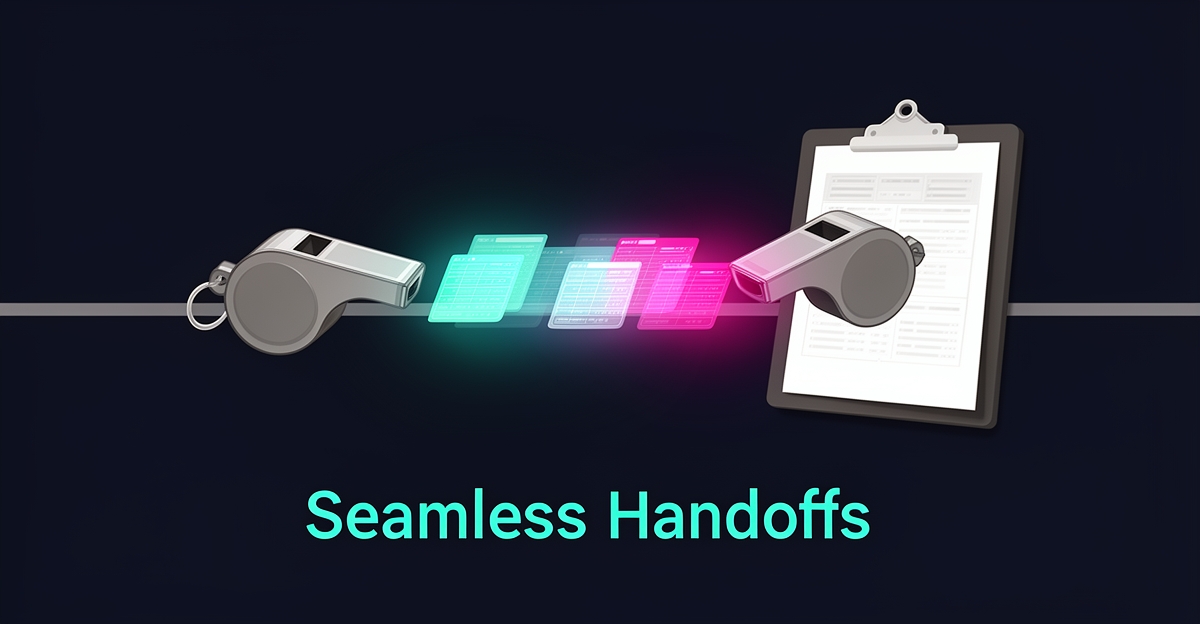
How AI Can Streamline Officiating Shift Handoffs Between Teams
Key Facts
- AI-assisted handoffs can substantially reduce pre-handoff preparation time by generating digital summaries that replace manual prep
- AI-generated briefings improve information parity between shifts by capturing every item in a consistent, written format
- Studies of AI-assisted handoffs in other shift-based industries report fewer missed handoff items compared with verbal-only methods
- Most enterprises adopting AI workflows favor hybrid task execution, where humans retain decision ownership and AI handles documentation
- Standardized AI handoffs produce a consistent five-section format every single time
- AI handoffs enable instant search across weeks of records instead of manual clipboard reviews
- Supervisors retain call ownership while AI ensures their end-of-shift knowledge is written down before the next crew starts
Hire a team member that works 24/7 — for less than a part-time wage.
AI receptionists, SDRs, dispatchers and 99+ roles. Trained on your business, fully managed.
Not sure where to start? Ask our AI planner
Why Traditional Officiating Handoffs Fail Teams and Games
A shift change in officiating should protect game integrity. In practice it often erodes it.
Traditional handoffs rely on verbal briefings, handwritten notes, and hallway conversations that fade as soon as the whistle blows. Shift-based industries that have studied this problem describe the same pattern: "oral only" handoff methods with frequent information gaps. Manufacturing and logistics teams face the same reality — "a clipboard, a whiteboard, a paper log, or a 90 second hallway conversation. Sometimes a spreadsheet."
Fatigue and time pressure make the loss inevitable. The supervisor is tired. The incoming lead is half-caffeinated. The detail that mattered most was the one nobody had time to write down. When key player updates, procedural notes, or next-shift alerts are not captured, the incoming crew starts blind.
The cost shows up as small, compounding errors. The cost of poor handoffs is invisible because it is spread across thousands of small moments — a repeat repair, a duplicate vendor call, a missed commitment, a safety incident that was almost flagged the shift before. Most operations leaders accept this as a tax on running the business.
In officiating, those moments translate directly to game integrity. Missed foul trends, unrecorded injury notes, or inconsistent positioning instructions create variability between crews. Without a standardized record, institutional knowledge leaves with the outgoing team and auditability disappears.
Common failure points include:
- Verbal-only briefings that create frequent information gaps between shifts
- Handwritten logs and clipboards that are slow to search and easy to misread
- Inconsistent documentation formats that force each incoming official to hunt for context
- No automated reminders for critical player updates or next-shift alerts
AI-assisted workflow automation changes the handover from memory-dependent to record-driven. By automating the handover of game responsibilities — notes, player updates, and next-shift alerts — teams preserve continuity without adding burden. AIQ Labs Workflow Builds rebuild the one workflow that costs you the most, at a fixed price and in phases, capturing structured context at the moment it matters.
The shift from ad-hoc to structured handoffs is measurable elsewhere. Research on AI-assisted shift handoffs in healthcare and manufacturing settings points to meaningful reductions in pre-handoff preparation time, improved information parity between shifts, and fewer missed handoff items when AI generates the briefing. Those gains come from digital documentation, real-time updates, and standardized reporting rather than from replacing human judgment.
Officiating crews still own the call. The system simply makes sure the information that was in the supervisor's head at 06:55 is also in writing by 07:05. Standardization without flattening content lets each incoming official find the same five sections in the same order every time, while preserving the nuance of the outgoing crew's observations.
How AI-Powered Handoff Systems Ensure Perfect Information Transfer
A missed detail at shift change can cost a game. Officiating crews lose critical context in hallway briefings, handwritten logs, and tired verbal exchanges, and the incoming team starts blind.
AI-powered handoff systems replace that fragility with automated digital documentation, real-time updates, and standardized reporting. Instead of relying on memory, crews receive auto-generated briefings that capture notes, player updates, and next-shift alerts in a consistent format every time.
Organizations using AI-assisted handoffs report meaningful reductions in pre-handoff preparation time with digital summaries that replace manual prep, based on research into AI-assisted handoffs in shift-based industries. The same research documents improved information parity between shifts and fewer missed handoff items when AI generates the briefing.
Real-time updates keep teams aligned throughout the shift. AI provides immediate reminders and modifications, pushing critical tasks to incoming officials and synchronizing schedules so nothing slips through a changeover. Predictive analytics can flag potential challenges before they escalate, acting as a proactive sentinel for the crew.
Standardization is the quiet force multiplier. AI imposes a uniform operating procedure so every handoff follows the same five sections in the same order. Analyses of AI shift handoffs in manufacturing note that incoming supervisors know exactly where to look because the format never changes, even if the story does.
The most effective systems are hybrid. The supervisor still owns the call; AI ensures the information in the supervisor's head at 06:55 is also in writing by 07:05. This mirrors the broader market direction, where most enterprises adopting AI workflows cite hybrid task execution — humans in charge, AI handling the documentation — as a top requirement.
AIQ Labs builds production-grade workflow automation systems that automate the handover of game responsibilities, including notes, player updates, and next-shift alerts, ensuring continuity and reducing confusion during transitions. With 200+ multi-agent systems deployed and four live SaaS products the company runs daily, this is proven infrastructure, not a prototype. For teams that want handoffs handled by a managed AI role rather than a custom build, AI Employees offer a lower-cost alternative to adding human staff.
Practical wins from AI-assisted handoffs include:
- Consistent format across shifts that normalizes structure without flattening content
- Faster handoffs that capture more in a structured pass than a hallway briefing
- Better incident traceability with instant search across weeks of handoffs
- Cleaner audit and compliance posture with structured, searchable records
By handling structured data collection and context preservation, AI preserves the human judgment officials rely on while eliminating information loss at the most vulnerable moment.
Implementing AI Handoffs: A Practical Guide for Officiating Teams
Implementing AI handoffs in officiating teams requires a structured, human-centered approach that builds on proven frameworks from healthcare and manufacturing. Before deploying any technology, teams should first define clear escalation triggers — such as ambiguous player conduct, equipment issues, or weather-related delays — so the AI knows when to alert human supervisors rather than attempt autonomous resolution. This precision prevents over-escalation and ensures the system supports, rather than disrupts, game flow.
Next, design standardized handoff notes that capture essential context: what occurred during the shift, any unresolved incidents, player behavior patterns, and specific alerts for the incoming team. AI-generated briefings improve information parity between shifts, closing the gaps common in verbal or handwritten methods. These notes should follow a consistent format — like the five-section structure preferred in manufacturing — so incoming officials know exactly where to find critical details, reducing cognitive load during high-pressure transitions.
Finally, route AI-generated handoffs to the appropriate personnel using role-based rules, and train all staff on how to interpret and act on the information. Effective training ensures officials understand what the AI has already processed, avoiding duplicated effort and building trust in the system. The supervisor still owns the call — the AI simply ensures that what was in their head at the end of the shift is also in writing by the start of the next. AIQ Labs supports this transition with Workflow Builds that integrate with existing officiating tools, delivered in fixed-price phases so you approve each step before it ships. For organizations ready to connect handoffs into a broader operating layer, AI Operating Systems are built in phases and owned outright.
Still paying for 10+ subscriptions that don’t talk to each other?
We build custom AI systems you own outright. No vendor lock-in. Full control.
Not sure where to start? Ask our AI planner
Frequently Asked Questions
How does AI reduce the time spent preparing for a shift handoff in officiating?
Can AI ensure that no information is lost between officiating shifts?
Will using AI for officiating handoffs replace the judgment of human officials?
What are the practical benefits of standardizing handoff formats with AI in sports officiating?
Why do traditional officiating handoffs often fail, and how does AI fix this?
What steps should officiating teams take before implementing an AI handoff system?
From Hallway Briefings to Game-Ready Continuity
Officiating handoffs don't have to be a memory test. When verbal briefings, handwritten logs and 90-second hallway conversations are replaced with structured, auto-generated briefings, crews keep the nuance of their observations while gaining a consistent format they can trust every shift. The result is fewer blind starts, faster preparation, and a searchable record that preserves institutional knowledge instead of losing it at changeover. The human still owns the call; the system simply ensures what was in the supervisor's head at 06:55 is in writing by 07:05. For teams ready to move from ad-hoc to record-driven handoffs, the next step is mapping your current handoff flow, defining the five sections you need every time, and testing AI-assisted documentation in one crew. AIQ Labs builds production-grade workflow automation systems that automate the handover of game responsibilities — notes, player updates and next-shift alerts — ensuring continuity and reducing confusion during transitions. Start the two-minute Fit Check at https://aiqlabs.ai/apply, then book a free 30-minute strategy call at https://aiqlabs.ai/book to map your biggest bottleneck. Prefer email? Reach the team at [email protected].
Make AI your competitive advantage — not just another tool.
Strategy, implementation and ongoing optimization. One partner, end to end.
Not sure where to start? Ask our AI planner