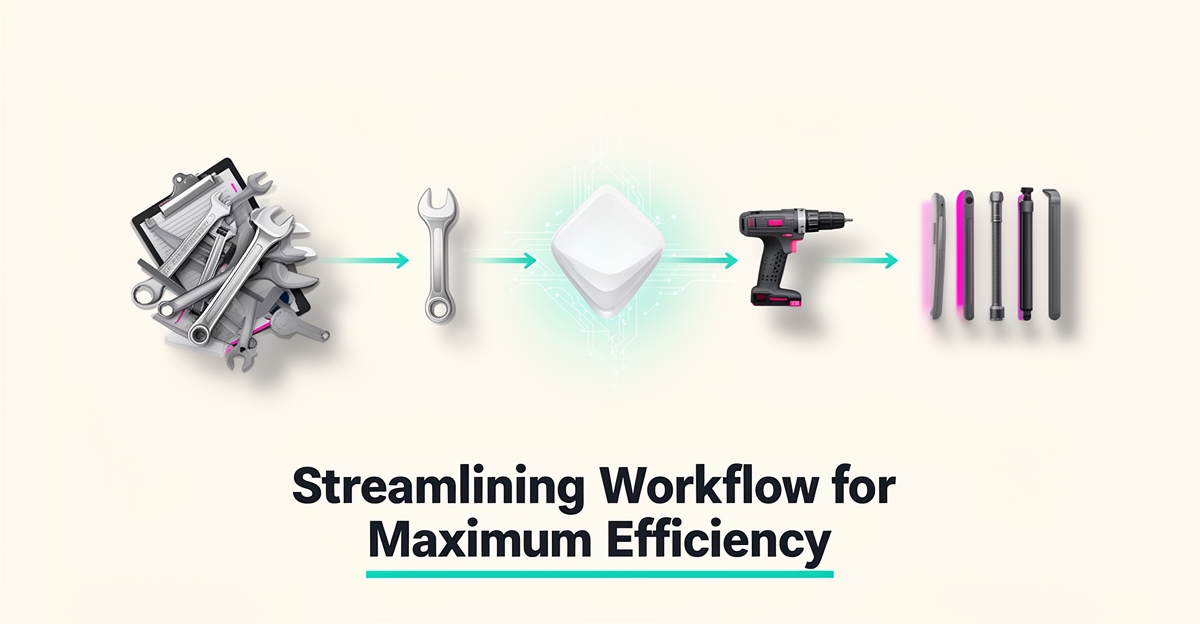
How AI Can Streamline Tool Returns and Reduce Staff Workload
Key Facts
- Most customers consider how easy refunds and returns are when deciding whether to shop with a business again
- Manual return processing typically takes around 20 minutes per return; automated pipelines can bring that down to roughly 90 seconds
- Rules-based automation typically reduces returns-processing error rates to under 1%, compared with error-prone manual data entry
- AI tools can typically automate a large share of tier-1 customer support queries, cutting response times from hours to seconds
- A majority of shoppers check a retailer's return policy before making a purchase
- The global workflow automation market has been growing steadily as businesses replace manual processes that cannot scale
Hire a team member that works 24/7 — for less than a part-time wage.
AI receptionists, SDRs, dispatchers and 99+ roles. Trained on your business, fully managed.
Not sure where to start? Ask our AI planner
The Hidden Cost of Manual Tool Returns
Every tool return in your business quietly drains more resources than you realize. While your team focuses on serving customers, manual return processes are consuming staff hours, introducing costly errors, and creating friction that drives customers away.
The typical manual return takes around 20 minutes of staff time, while a well-built automated pipeline can process the same return in roughly 90 seconds. For a business handling 50 returns weekly, that difference adds up to more than 16 hours of staff time consumed by administrative tasks that could run without human input.
The hidden costs extend far beyond processing time. Manual workflows create multiple pressure points that compound throughout your operation:
- Staff must manually inspect returned tools, complete paperwork, and update inventory systems
- Return forms require manual generation, printing, and filing for compliance tracking
- Team members spend time notifying relevant departments about return status and condition
- Human error rates remain high in data entry, leading to inventory discrepancies and customer disputes
- Resolution times stretch into days or weeks, frustrating customers who expect faster service
The error risk alone justifies concern. Manual processes are inherently prone to mistakes, while rules-based AI systems typically push error rates below 1%. When staff juggle multiple returns simultaneously, details get missed, forms get filed incorrectly, and customers receive conflicting information about their return status.
Customer expectations have shifted dramatically. Industry research consistently shows that a large majority of customers say the ease of refunds directly impacts their decision to shop with a business again. When your return process involves phone calls, paperwork delays, and unclear timelines, you're not just creating operational inefficiency—you're actively pushing customers toward competitors.
The financial impact compounds quickly. Reduced labor per return, fewer disputes, and fewer inventory discrepancies translate into meaningful savings at volume. For SMB operations teams already stretched thin, these savings represent the difference between reactive firefighting and proactive growth.
Staff workload reaches a breaking point when return volumes spike during busy seasons or promotional periods. Manual processes that barely function during normal operations break down under pressure, forcing overtime costs and creating service delays that damage customer relationships.
AIQ Labs understands this operational challenge because we've deployed 200+ multi-agent systems and run four live SaaS products daily. Our AI Workflow Builds rebuild the one workflow that costs you the most—like returns processing—at a fixed price, in phases, so you see results before committing to more.
The broader market reflects this operational necessity. Workflow automation adoption keeps climbing as businesses recognize that manual processes cannot scale with modern customer expectations.
How AI Automates Returns From Check-In to Staff Alert
Return check-ins are the quiet bottleneck that eats staff hours and frustrates customers. AI removes the manual handoff between customer arrival, form creation, and team notification.
The workflow starts the moment a return is initiated. An AI agent validates the item, customer, and reason against existing records. It then generates a return form instantly and routes it for approval without staff re-keying. Real-time staff notifications fire as soon as the check-in is complete, so the right team member can act immediately.
This automation typically compresses processing time from ~20 minutes per return manually to ~90 seconds automated. Automation also retains revenue by encouraging exchanges instead of pure refunds. Error rates drop from human-prone to rules-based as the system enforces consistent validation.
Customer expectations make speed non-negotiable. Most customers say the ease of refunds directly impacts their decision to shop with a business again, and a majority of shoppers check a retailer's return policy before making a purchase. Fast, predictable returns protect loyalty while freeing staff.
Support load also shrinks. AI tools can typically automate a large share of tier-1 queries, cut average response time from hours to seconds, and free support teams to handle complex issues. That shift lets teams focus on high-value interactions instead of repetitive status checks.
The business impact compounds. AI-driven process automation typically reduces operational costs meaningfully, cuts error rates to under 1%, and boosts productivity by automating tasks that take hours or days manually. That is especially true in return operations, where small delays scale quickly.
A typical AI-driven return pipeline includes:
- Automated check-in that verifies purchase history and condition criteria without agent input
- Instant return form generation pre-filled from the customer record and order data
- Real-time staff alerts with context, location, and next-step instructions
- Status updates sent automatically to the customer, reducing follow-up inquiries
AIQ Labs builds these pipelines as fixed-price AI Workflow Builds, architecting custom workflows that reduce staff workload and improve return accuracy. The result is faster resolution, lower labor cost per return, and a support team that can focus on exceptions rather than paperwork.
ROI and Customer Experience Gains from Automated Returns
AI can transform the returns process from a costly burden into a streamlined operation that benefits both staff and shoppers. Automating return check-ins, form generation, and staff notifications reduces the time spent on repetitive administrative tasks, allowing teams to focus on higher-value work. This shift not only cuts labor costs but also minimizes errors that often lead to customer frustration and revenue loss.
Processing time typically drops from roughly 20 minutes per return manually to about 90 seconds automated, and resolution timelines shrink by days. These efficiency gains directly reduce workload and improve the speed at which customers receive refunds or replacements.
Fast, hassle-free returns significantly influence repeat business. Most customers say the ease of refunds directly impacts their decision to shop with a business again, and a majority of shoppers review a retailer's return policy before purchasing, making a smooth return experience a key factor in acquisition and retention. When returns are resolved quickly and accurately, trust increases, and the likelihood of future purchases rises.
Beyond cost and speed, AI-driven returns boost productivity by handling tier-1 inquiries and routine tasks that would otherwise consume support teams. Studies indicate AI tools can automate a substantial share of these queries, cut response times from hours to seconds, and free staff to address complex issues. This redistribution of effort enhances overall service quality without increasing headcount.
The financial and operational advantages align with broader market trends in workflow automation, which continues to grow as demand rises for intelligent process optimization. As businesses adopt AI to streamline returns and other workflows, they position themselves for scalable efficiency and improved customer experience—core outcomes that AIQ Labs helps achieve through custom automation built for real-world operations.
Implementing AI Returns Automation Without Disruption
The difference between a smooth AI rollout and a stalled one usually comes down to process, not technology. Businesses that follow a structured implementation path see returns automation deliver measurable gains — meaningful cost savings and error rates typically reduced to under 1%.
Start by auditing where staff time actually goes. Return check-ins, return form generation, and staff notifications are the three most commonly automated tasks, and together they eliminate the bulk of administrative work. Manual returns take roughly 20 minutes each, while automated processing takes about 90 seconds — a difference that compounds quickly across hundreds of returns.
Look for tasks that are repetitive, rules-based, and high-volume. These are your strongest automation candidates.
AI should slot into your current workflow, not force a rebuild. Effective integrations connect your returns system with inventory, customer communication, and notification tools so data flows automatically. Support automation research shows AI can handle a large share of tier-1 queries and cut response times from hours to seconds — but only when systems are properly connected.
When evaluating build partners, ownership terms deserve scrutiny. AIQ Labs builds custom automation that clients own outright — no vendor lock-in, no platform dependencies — which means the system can evolve with your business rather than holding it hostage to subscription fees. Our payment models are straightforward: Start Monthly, Build in Milestones, or Own It Outright.
Automation succeeds when it enhances workflows and supports human decision-making, not when it replaces judgment entirely. Proper employee training is a core requirement for realizing AI's ROI.
- Show staff exactly which tasks the AI handles and which remain theirs
- Establish clear escalation paths for exceptions the AI flags
- Set expectations that AI frees time for complex, higher-value work
- Gather feedback in the first weeks to catch friction early
Track concrete metrics from day one: processing time per return, error rates, and staff hours reclaimed. The benchmarks are clear — automated returns resolve days faster than manual ones and eliminate the bulk of per-return labor cost.
Review performance monthly and adjust. Treat your returns automation as an ongoing capability, not a one-time project: measure, refine, and expand as results prove out. If you want a connected layer across returns, inventory, and customer communication rather than a single workflow, AI Operating Systems build that in phases, owned outright.
Still paying for 10+ subscriptions that don’t talk to each other?
We build custom AI systems you own outright. No vendor lock-in. Full control.
Not sure where to start? Ask our AI planner
Frequently Asked Questions
How much time does AI actually save on processing tool returns compared to doing it manually?
Will automating returns really make a difference in whether customers come back?
What kind of cost savings can we expect from automating our return workflows?
Our team is already stretched thin — won't implementing AI just add more work upfront?
How do we know the AI won't make mistakes on returns that need human judgment?
What happens after implementation — do we own the system or are we locked into a subscription?
From Return Bottleneck to Competitive Advantage
Manual tool returns quietly drain staff hours, create errors, and push customers toward competitors. Automating check-ins, form generation, and staff notifications compresses processing from ~20 minutes to ~90 seconds per return, cuts error rates to under 1%, and accelerates resolution by days. Faster, predictable returns also protect loyalty in a market where most customers say ease of refunds impacts where they shop again. The real gain is shifting your team from repetitive paperwork to higher-value work that requires human judgment. If you want to see where this applies to your operation, start with a focused audit of return check-ins, form creation, and notifications — the three highest-impact tasks to automate first. AIQ Labs builds custom automation workflows that clients own outright, so the system evolves with your business. Start the 2-minute Fit Check at https://aiqlabs.ai/apply to book a free 30-minute strategy call and map your biggest bottleneck — no pitch, just a working session with an AI engineer.
Make AI your competitive advantage — not just another tool.
Strategy, implementation and ongoing optimization. One partner, end to end.
Not sure where to start? Ask our AI planner