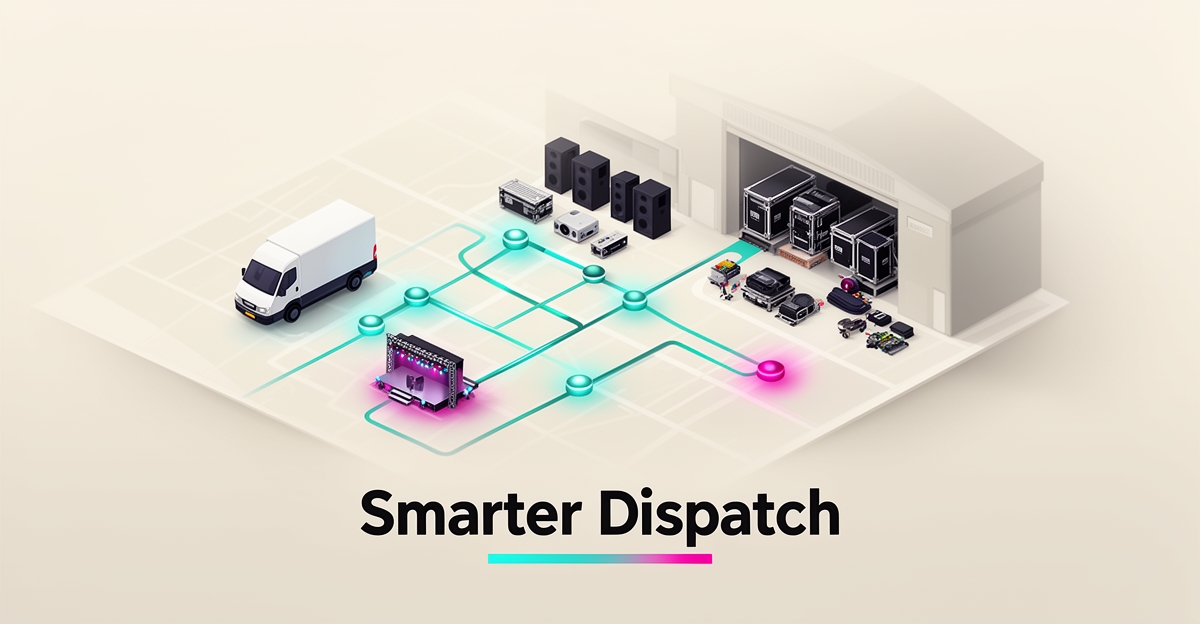
How AI-Powered Dispatchers Can Streamline Rental Equipment Pickup and Drop-Off for Audio Visual Companies
Key Facts
- AI dispatchers automate repetitive tasks like status tracking, data entry, and route planning, freeing human dispatchers for exception handling and client work
- Fleet-service organizations using AI routing typically report meaningful reductions in miles driven per job, directly lowering fuel and vehicle costs
- A majority of companies implementing AI-powered field service scheduling report improved operational efficiency
- Most firms see return on investment within roughly a year of implementing AI dispatch software
- AI dispatchers enable proactive client notifications at each stage of the rental lifecycle, reducing inbound inquiries
- AI-powered dispatch systems free dispatchers from repetitive coordination, allowing focus on higher-value work like exception handling
Hire a team member that works 24/7 — for less than a part-time wage.
AI receptionists, SDRs, dispatchers and 99+ roles. Trained on your business, fully managed.
Not sure where to start? Ask our AI planner
The Hidden Cost of Manual Dispatch in AV Rentals
An AV rental company's busiest hour is rarely the event itself—it's the window when trucks return gear late and the next client is already calling. When pickup and drop-off are coordinated through phone calls, texts, and spreadsheets, small hiccups compound into missed windows, double-booked crews, and idle inventory.
Manual dispatch is also a people problem. Repetitive coordination and constant phone tag contribute to burnout, pulling skilled staff away from higher-value work like exception handling and client communication. In AV rentals, that strain shows up as last-minute reroutes, unclear site instructions, and rushed handoffs that increase the chance of damage or missing items.
The revenue impact is practical, not theoretical. When teams rely on manual routing and reactive scheduling, they lose billable utilization because equipment sits in transit longer than it should. Fleet-service organizations that adopt AI routing and dispatch typically report meaningful reductions in miles driven per job—an indicator of how much waste is baked into traditional planning.
Inefficiency also hides in the "micro-delays" that never get logged: waiting on a confirmation, hunting for a driver, re-typing the same address, or calling a venue contact for gate access. Over a week, those minutes become late starts, overtime, and fewer turns per day. A majority of companies that implement AI-enabled field service scheduling report improved efficiency—which suggests many organizations underestimate how much manual coordination costs until they measure it.
Common failure points in manual AV rental dispatch include:
- Scheduling conflicts between overlapping pickup and drop-off windows
- Inconsistent ETAs and status updates for drivers, warehouse staff, and clients
- Human error in addresses, contact details, and equipment checklists
- Slow response when traffic, weather, or venue rules change mid-route
The broader market is moving quickly because the upside is measurable. As of late 2026, a large share of shippers and logistics providers already use generative AI for tasks like data entry, route and load optimization, and forecasting—signals that manual dispatch is becoming the outlier, not the norm.
AIQ Labs works with rental and field-service businesses to replace these fragile workflows with production-ready AI systems—including AI dispatchers as managed AI staff—that automate scheduling, real-time tracking, and customer updates. The goal isn't to remove dispatchers; it's to give them time and sanity back while protecting margins that manual coordination quietly erodes.
How AI Dispatchers Automate Core Rental Workflows
For audio visual rental companies, managing equipment pickup and drop-off has long been a logistical headache—especially when relying on manual scheduling and fragmented communication. AI-powered dispatchers are changing that by automating core workflows that once consumed hours of dispatcher time each day. These systems handle everything from intelligent job assignment to real-time route adjustments, reducing the need for constant human intervention while improving accuracy and responsiveness. As a result, dispatch teams can shift focus from reactive problem-solving to proactive service coordination.
AI dispatchers streamline scheduling by automatically matching equipment availability, technician location, and job requirements in real time—eliminating the back-and-forth of phone calls and spreadsheets. Once a rental is booked, the system assigns the nearest qualified technician, optimizes the pickup and drop-off sequence, and adjusts dynamically for traffic or delays. Companies using AI for routing and dispatch typically report meaningful reductions in miles driven per job, directly lowering fuel costs and vehicle wear while improving on-time performance. This level of optimization isn't just about efficiency—it ensures AV gear arrives ready for events, shoots, or installations without costly last-minute scrambles.
Beyond routing, AI enhances communication by automatically sending status updates to clients and field teams via SMS or email—such as when equipment is en route, delayed, or successfully returned. This reduces the volume of inbound inquiries dispatchers typically handle, freeing them to manage exceptions or complex logistics. Industry reporting suggests substantial productivity gains are achievable in dispatch operations when AI automates repetitive tasks like status tracking and data entry, allowing teams to handle more jobs without adding headcount. For AV rental businesses, this means faster turnaround times, fewer scheduling conflicts, and a smoother experience for both clients and crews.
- Automated job assignment based on technician skills, location, and equipment compatibility
- Real-time route optimization using live traffic and weather data
- Proactive client notifications at each stage of the rental lifecycle
- Dynamic rescheduling when delays or changes occur
- Centralized dashboard for tracking all active pickups and drop-offs
AIQ Labs helps audio visual rental companies implement these capabilities through AI Workflow Builds that integrate with existing rental management tools, calendars, and communication platforms. By automating the operational core of equipment logistics, businesses gain more than just time savings—they build a foundation for scalable, reliable service that keeps clients coming back.
Implementation Roadmap: From Manual to AI-Driven Dispatch
Transitioning from manual dispatch to AI-powered automation doesn't require a complete overhaul—it can be achieved through a structured, phased approach that minimizes disruption while maximizing impact. The first step involves a thorough workflow assessment to identify repetitive tasks such as scheduling pickups, tracking equipment, and managing client communications—areas where AI delivers the greatest efficiency gains. Because a majority of companies report improved efficiency after AI implementation, this diagnostic phase is critical for targeting high-ROI opportunities.
Next, AIQ Labs integrates the AI dispatcher with existing tools like CRM systems, calendars, and inventory platforms using secure API connections, ensuring seamless data flow without replacing current infrastructure. This integration enables automated status updates, smart scheduling, and real-time equipment tracking—capabilities that typically reduce miles driven per job through optimized routing. Throughout development, the system is tested and refined to match the company's specific rental cycles and service protocols.
Finally, deployment includes role-based training for dispatchers and field teams, focusing on how to interpret AI insights and handle exceptions—shifting their role from task executor to strategic decision-maker. With ongoing monitoring and optimization, most firms see ROI within roughly a year, validating the effectiveness of this staged transformation. By aligning technology adoption with operational readiness, AV rental companies can modernize dispatch operations while maintaining service continuity and team confidence. For businesses ready to begin, AIQ Labs offers a free 30-minute strategy call to map bottlenecks and outline a tailored implementation path—start with the 2-minute Fit Check at https://aiqlabs.ai/apply.
Still paying for 10+ subscriptions that don’t talk to each other?
We build custom AI systems you own outright. No vendor lock-in. Full control.
Not sure where to start? Ask our AI planner
Frequently Asked Questions
How much time can an AI dispatcher actually save my AV rental team?
Will AI dispatching work with my existing rental management software?
What happens when a delivery runs late or a venue changes access requirements mid-route?
How quickly do AV rental companies typically see ROI from AI dispatch automation?
Does AI dispatching replace my human dispatchers?
What's the biggest operational improvement AV rental companies see after switching to AI dispatch?
From Chaos to Control: How AI Dispatchers Transform AV Rental Operations
Manual dispatch in AV rentals creates hidden costs through scheduling conflicts, micro-delays, and dispatcher burnout—eroding margins and limiting scalability. By automating job assignment, real-time routing, and proactive client communication, AI-powered dispatchers deliver measurable gains: fewer miles driven per job, substantial productivity improvements, and faster equipment turnaround. These efficiencies free skilled staff to focus on exception handling and client relationships, directly improving service reliability and utilization rates. For AV rental companies ready to move beyond spreadsheets and reactive scheduling, the path forward starts with identifying specific workflow bottlenecks. Take the first step with a free 30-minute strategy call to map your biggest operational pain points and explore how a custom AI dispatcher system can build a foundation for scalable, profitable growth—without disrupting your existing tools or team confidence.
Make AI your competitive advantage — not just another tool.
Strategy, implementation and ongoing optimization. One partner, end to end.
Not sure where to start? Ask our AI planner