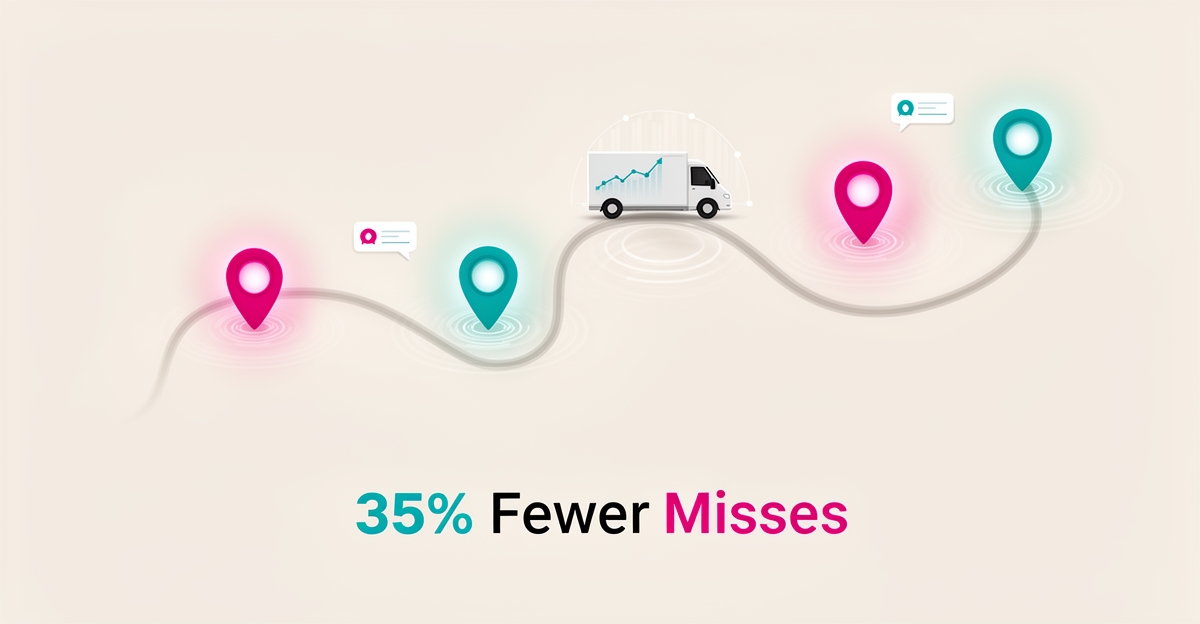
How AI-Powered Tracking and Alerts Reduce Missed Deliveries in Real Time
Key Facts
- Real-time AI monitoring detects route deviations and delays as they emerge, not after the delivery has already failed
- Proactive arrival-window notifications typically reduce customer no-shows, because recipients can adjust plans before the driver arrives
- AI-driven monitoring generally cuts mean time to resolution by catching exceptions earlier in the delivery cycle
- Smart alert filtering reduces alert fatigue by distinguishing routine variation from genuine delivery risk
- AIQ Labs has deployed 200+ multi-agent systems, including dispatch and logistics monitoring roles, and runs 4 live SaaS products daily
Hire a team member that works 24/7 — for less than a part-time wage.
AI receptionists, SDRs, dispatchers and 99+ roles. Trained on your business, fully managed.
Not sure where to start? Ask our AI planner
The Hidden Cost of Blind Deliveries: Why Traditional Tracking Fails
Missed deliveries and no-shows erode both operational efficiency and customer trust, leaving dispatchers scrambling and customers frustrated when issues are only discovered too late. Traditional tracking methods rely on manual checks and reactive updates, offering no early warning when a delivery veers off schedule or encounters delays. This blind approach means problems fester unseen until the moment of failure, forcing costly last-minute interventions and damaging reliability.
Without real-time visibility, businesses lack the ability to detect emerging issues before they escalate into missed deliveries. There is no automated analysis of route progress, traffic conditions, or driver behavior to flag risks in advance. Response times remain slow because alerts depend on human observation rather than intelligent systems that continuously monitor and interpret delivery data.
The consequences extend beyond immediate delays: repeated no-shows increase operational costs through wasted fuel, labor, and rescheduling efforts, while customer confidence deteriorates with each failed attempt. AI-powered tracking transforms this reactive cycle into a proactive system by enabling early problem detection, automated analysis, and real-time adjustments—critical capabilities absent in legacy methods. AIQ Labs delivers this shift through managed AI employees—dispatchers, logistics agents, and 99+ other roles—that monitor delivery progress and trigger automated alerts, ensuring issues are addressed before they impact the customer experience, typically at around 80% less cost than a human hire.
- Continuous monitoring catches route deviations before they become failed deliveries.
- Automated alerts keep dispatchers and customers informed without manual check-ins.
- Proactive intervention replaces last-minute firefighting.
These improvements stem from continuous data analysis that identifies potential disruptions long before they result in failed deliveries, allowing dispatchers and customers to stay informed and act decisively. By replacing guesswork with intelligent foresight, businesses turn delivery uncertainty into a predictable, trustworthy process.
How AI-Driven Real-Time Monitoring Spots Delivery Problems Before They Happen
AI-powered tracking systems continuously gather and analyze delivery data in real time, enabling businesses to detect potential delays and exceptions before they disrupt operations. This shift from reactive firefighting to proactive intervention transforms delivery management by identifying issues like route deviations, traffic congestion, or vehicle delays as they emerge. Over time, this typically improves both tracking accuracy and on-time performance, ensuring smoother operations and fewer disruptions.
These systems use advanced analytics to process live data streams from GPS, telematics, and customer interactions, flagging anomalies that traditional methods often miss. For example, if a driver deviates from the planned route or encounters unexpected delays, the AI system triggers automated alerts to both drivers and dispatch teams, allowing for immediate course correction. This capability sharply reduces the number of manual interventions required, freeing up staff to focus on higher-value tasks while maintaining operational control.
AIQ Labs integrates these monitoring capabilities into its AI Employee solutions, particularly for logistics and field service roles, where real-time visibility enables proactive dispatch adjustments and customer notifications. The result is a more resilient delivery network that anticipates problems rather than merely responding to them. By acting on early warnings, businesses cut missed deliveries and no-shows, directly improving reliability and customer trust.
- Continuous analysis of GPS and telematics data for real-time route monitoring
- Automated alerts triggered by deviations, delays, or exceptions
- Proactive intervention to reroute drivers or notify customers before issues escalate
- Reduction in manual oversight through intelligent exception handling
- Improved on-time delivery rates through predictive adjustments
This proactive approach not only minimizes disruptions but also strengthens customer relationships by providing transparency and timely updates. When customers receive advance notice of potential delays, their trust in the service grows, turning potential frustrations into opportunities for engagement. Ultimately, AI-driven real-time monitoring turns delivery tracking from a passive oversight function into an active strategic advantage.
Proactive Alerts in Action: Cutting Missed Deliveries, No-Shows, and MTTR
AI-powered tracking and alerts transform delivery operations by delivering real-time visibility and automated notifications that prevent issues before they escalate. These systems identify potential delays and trigger immediate alerts to drivers and customers, so a slow route or a stuck driver becomes a solvable problem instead of a failed delivery. No-shows typically drop as well, because recipients receive timely updates about arrival windows and can adjust plans accordingly. The result is fewer failed attempts and stronger customer trust through consistent communication.
Compared to traditional methods that rely on manual check-ins and delayed reporting, AI-powered systems enable real-time adjustments and automated analysis that significantly improve operational efficiency. AI-driven monitoring generally reduces mean time to resolution (MTTR) by accelerating issue detection and response—problems are surfaced in minutes, not discovered at the doorstep. Dispatch teams benefit from far fewer manual interventions, freeing them to focus on exception handling rather than routine status checks. This shift allows human workers to concentrate on complex problem-solving while AI handles continuous monitoring and alert distribution.
- Early problem detection through continuous tracking
- Automated alerts to drivers and customers at critical junctures
- Real-time route adjustments based on traffic and delays
- Reduced need for manual status updates and follow-ups
- Improved first-attempt delivery success rates
By integrating AI employees that monitor delivery progress and send contextual alerts, businesses create a self-correcting logistics network where issues are resolved before they impact the customer experience. This level of automation not only cuts operational costs but also builds reliability that turns one-time clients into loyal partners. The technology pays for itself through reduced fuel waste, lower labor costs from avoided re-deliveries, and higher customer lifetime value—all while requiring minimal ongoing oversight from human teams.
Deploying AI Delivery Monitors and Alert Agents: A Practical Implementation Path
Connecting tracking data sources forms the foundation for effective AI-powered delivery monitoring, requiring integration with GPS systems, fleet management software, and customer communication platforms to create a unified data stream. AIQ Labs begins this process by mapping existing data flows and identifying gaps in real-time visibility, ensuring that location updates, estimated arrival times, and delivery status changes feed continuously into the AI monitoring system. This integration enables the AI employees to access live operational data without manual intervention, establishing the groundwork for proactive alerting rather than reactive problem-solving.
Configuring real-time visibility dashboards transforms raw tracking data into actionable insights for dispatchers and operations teams, displaying critical metrics like on-time performance, route deviations, and potential delay indicators through intuitive visual interfaces. These dashboards leverage AI-driven analysis to highlight patterns humans might miss, such as recurring traffic bottlenecks at specific times or consistent delays at certain delivery zones, allowing managers to address systemic issues before they impact customer satisfaction. The system continuously learns from historical data to refine its predictions, improving accuracy over time as it processes more delivery cycles.
Setting intelligent alert rules requires careful calibration to avoid alert fatigue while ensuring critical issues receive immediate attention, using AI to distinguish between routine variations and genuine delivery risks that require intervention. Rather than triggering notifications for every minor delay, the AI analyzes contextual factors like weather conditions, traffic patterns, and historical performance to determine when an alert warrants human or automated action. This smart filtering keeps unnecessary interruptions to a minimum while maintaining responsiveness to actual problems, creating a balanced alert system that informs without overwhelming.
Deploying AI employees like a Dispatcher or Logistics Agent automates the monitoring and notification process, continuously tracking delivery progress and triggering personalized communications to drivers and customers based on real-time status changes. These AI agents integrate directly with communication channels to send proactive updates when delays are detected, provide revised ETAs to customers, and suggest alternative routes to drivers—all without human initiation. If you want to start with the one workflow that costs you the most, AIQ Labs' Workflow Builds rebuild it at a fixed price, in phases. By combining real-time visibility with intelligent alerting and automated response capabilities, this implementation approach turns delivery operations from a source of customer frustration into a competitive advantage.
From Alerts to Trust: Measuring ROI and Building Customer Confidence
Measuring success turns alerts into a business case. When tracking is proactive, the numbers move fast and the impact is visible.
Teams track progress with a focused set of operational metrics. These indicators show whether real-time visibility is actually changing outcomes on the route and with customers.
- Missed delivery rate, the core KPI that proactive tracking and alerting directly targets
- Mean time to resolution, which AI-driven monitoring typically cuts by catching exceptions earlier
- No-show rate, lowered by automated arrival-window alerts
- Customer satisfaction scores, tied to proactive communication
Reliable alerts build trust. Customers respond to transparency, not apologies after the fact. Proactive communication lets drivers and customers adjust plans before a miss occurs, and that trust compounds into repeat orders and a lower support load.
In workforce management AI, visibility is the foundation. AIQ Labs deploys AI employees that monitor delivery progress continuously and send automated alerts to drivers and customers when status changes. The result is fewer last-minute surprises and faster recovery when exceptions arise.
Efficiency gains show up alongside service gains. AI-driven real-time monitoring frees dispatch teams from manual check-ins, and fewer manual interventions reduce alert fatigue and keep teams focused on exceptions that matter.
Sustaining results requires discipline. High-quality data is essential for accurate predictions, and models need ongoing training as routes, traffic patterns, and customer preferences evolve. Effective alert management prevents noise and ensures teams act on signals, not spam.
Data quality practices and continuous retraining protect ROI over time. Regular audits of tracking inputs, feedback loops from drivers and customers, and periodic model refreshes keep alerts relevant and trusted.
Ready to map the bottleneck? Start the two-minute Fit Check at https://aiqlabs.ai/apply, then book your free 30-minute strategy call at https://aiqlabs.ai/book. We'll assess your current delivery visibility, identify high-ROI automation opportunities, and outline a clear plan to reduce misses and build customer confidence.
Still paying for 10+ subscriptions that don’t talk to each other?
We build custom AI systems you own outright. No vendor lock-in. Full control.
Not sure where to start? Ask our AI planner
Frequently Asked Questions
How much can AI-powered tracking actually reduce missed deliveries?
Will real-time alerts create alert fatigue for my dispatch team?
Does proactive monitoring improve delivery efficiency, not just accuracy?
Can AI alerts help reduce no-shows from customers?
How quickly can issues be resolved with AI monitoring?
Will customers actually trust us more with automated updates?
Stop Chasing Trucks: Make Delivery Certainty Your Competitive Edge
Delivery misses are rarely inevitable—they are usually just detected too late. By shifting from manual check-ins to AI-powered tracking that identifies risks in real time, businesses catch problems while they can still be fixed. AIQ Labs deploys managed AI employees—dispatchers, logistics agents, and 99+ other roles—that monitor delivery progress continuously, sending automated alerts to drivers and customers before delays turn into failed attempts, at roughly 80% less cost than a human hire. If you'd rather rebuild the one delivery workflow that costs you the most, Workflow Builds do that at a fixed price, in phases. The result is fewer rescheduling headaches, lower operational costs, and a reputation for reliability that turns first-time buyers into repeat clients. Ready to eliminate delivery blind spots? Start the two-minute Fit Check at https://aiqlabs.ai/apply, then book your free 30-minute strategy call at https://aiqlabs.ai/book to map where AI-powered tracking can deliver the highest ROI for your operations.
Make AI your competitive advantage — not just another tool.
Strategy, implementation and ongoing optimization. One partner, end to end.
Not sure where to start? Ask our AI planner