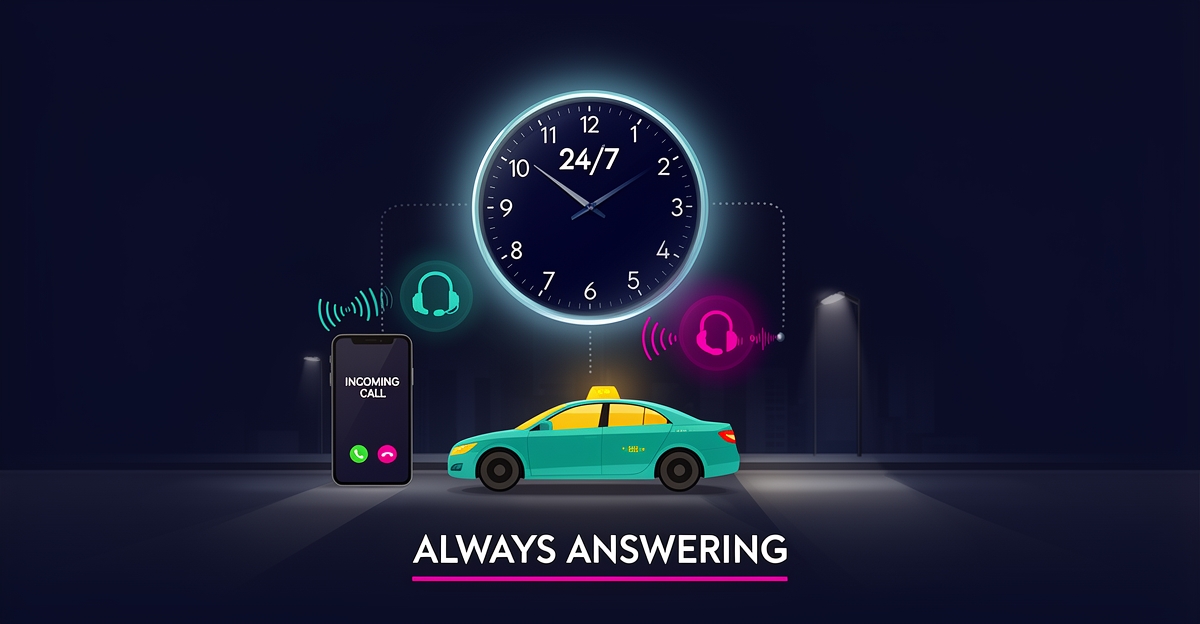
How AI Voice Receptionists Can Handle Taxi Customer Inquiries 24/7
Key Facts
- Small businesses typically miss a large share of inbound calls—platform research has reported figures as high as 60-80% for some operators
- Industry research suggests a majority of unanswered calls result in lost jobs to competitors who picked up
- Leading AI receptionist platforms report resolving roughly 90-95% of routine calls without human intervention, as of late 2026
- Sub-600ms response times are widely cited as the benchmark for natural conversation flow with AI voice agents
- Taxi companies using AI voice agents report a drastic drop in missed calls during peak hours, per industry case studies
Hire a team member that works 24/7 — for less than a part-time wage.
AI receptionists, SDRs, dispatchers and 99+ roles. Trained on your business, fully managed.
Not sure where to start? Ask our AI planner
The Off-Hours Call Problem Costing Taxi Companies Revenue
The off-hours call problem isn't just an inconvenience—it's a silent revenue drain for taxi companies. When phones ring during late nights, early mornings, or peak demand periods and go unanswered, potential fares evaporate instantly. Platform research has reported that small businesses can miss 60-80% of inbound calls, creating a critical gap between customer intent and service delivery. For taxi operators, each unanswered ring represents not just a missed booking but a direct transfer of revenue to competitors who answer the line.
This issue intensifies during off-hours when staffing is minimal or nonexistent. Industry research suggests that when a majority of calls go unanswered, the jobs go to competitors who picked up. Whether it's a late-night airport run or an early-morning commute request, customers won't wait—they'll call the next available service. For taxi companies operating in competitive urban markets, this leakage compounds quickly, turning occasional missed calls into significant monthly revenue loss. The problem isn't merely about convenience; it's about capturing every possible fare in a business where timing and availability define success.
Traditional staffing models fail to solve this without inflating costs. Hiring additional receptionists for 24/7 coverage means paying for idle time during slow periods, creating an unsustainable cost structure. Taxi companies need a solution that provides constant availability without proportional staffing expenses—one that scales with demand while eliminating the revenue leak from missed calls. This is where AI voice receptionists transform the economics of customer service, turning every inbound call into an opportunity rather than a liability.
How AI Voice Receptionists Transform Taxi Customer Inquiries
Missed calls mean lost rides, and for taxi companies that run around the clock, every unanswered ring is revenue handed to a competitor. AI voice receptionists close that gap by handling reservations, tracking ride requests, and providing real-time status updates without human intervention.
An AI voice agent for taxi management is an automated system that uses artificial intelligence to handle inbound calls and respond to booking requests without human input. It understands and replies to customers in real time, 24/7. This continuous availability is crucial for services that operate around the clock and experience fluctuating call volumes.
The shift is measurable. Small businesses can miss a large share of inbound calls—as much as 60-80% in some reported cases—and industry research suggests a majority of unanswered calls result in lost jobs to competitors who picked up. AI agents answer every call instantly, preventing that loss.
Performance standards have become clear for natural conversation. Anything above 800ms tends to cause callers to talk over the AI, and the widely cited target is sub-600ms. Leading AI receptionist platforms, as of late 2026, report resolving roughly 90-95% of routine calls without human intervention.
For taxi operations, that speed combines with integration and coverage. AI agents can manage multiple phone lines simultaneously, ensuring no ride requests are missed during peak hours or when staff is unavailable. Smart dispatch integration syncs with dispatch systems to assign rides in real time, monitoring driver availability and vehicle routing with precision.
Key capabilities that transform taxi customer inquiries include:
- Smart dispatch integration that sends requests straight to available drivers and logs vehicle availability
- Sub-600ms response times for natural conversation flow and high routine-call resolution without human handoff
- Multilingual support—leading platforms offer 45+ languages—for handling diverse caller populations natively
- 24/7 multi-line handling that eliminates missed calls and streamlines booking end-to-end
Custom scripts with branded greetings and specific booking process flows allow personalized experiences, while call insights and reporting tools track response times and customer interactions to optimize peak hour performance.
Many taxi companies face constant customer calls during off-hours. AI receptionists can manage reservations, track ride requests, and provide real-time status updates without human intervention. AIQ Labs deploys managed AI Employees—including AI receptionists and dispatchers—that work 24/7 at roughly 80% less cost than a human hire, improving response times through voice agents built for continuous operation.
The result is consistent service quality regardless of time or staffing availability, faster pickups, and fewer lost opportunities. Eliminating missed calls and streamlining booking processes lets dispatch teams focus on the road while the AI handles the phone.
Essential Features and Performance Standards for Taxi AI Receptionists
For taxi companies, an AI receptionist must go beyond basic call answering to deliver reliable, real-time service that matches the pace of urban transportation. The most effective systems integrate directly with dispatch platforms to assign drivers instantly, monitor vehicle availability, and optimize routing without manual intervention—ensuring ride requests are never lost during peak hours or off-hours. Leading AI receptionists, as of late 2026, report resolving roughly 90-95% of routine calls without human intervention, making seamless dispatch integration critical for maintaining operational flow.
Beyond integration, taxi AI receptionists require custom branded scripts that reflect the company's voice and booking workflows, combined with multilingual support to serve diverse customer bases. Leading platforms offer 45+ languages for handling diverse caller populations natively, and many provide flow builders for tailoring conversations to specific taxi service needs. Equally important are call insights and reporting tools that track response times, peak-hour performance, and customer sentiment—data that enables continuous optimization of service quality.
Technical performance standards are non-negotiable for natural, frustration-free interactions. Voice quality must maintain sub-600ms response time to prevent callers from talking over the AI—a benchmark several platforms now meet with modern voice models. Additionally, robust off-script handling ensures the system adapts to unexpected queries without resetting the conversation. Rapid deployment matters too: some platforms can get a basic receptionist live within minutes of signup, though a taxi-grade setup with dispatch integration and custom scripts typically takes longer. These features collectively ensure AI receptionists deliver consistent, professional service 24/7—turning every call into a potential ride without missing a beat.
Implementation Roadmap for 24/7 Taxi Voice Coverage
Missed calls during off-hours cost taxi operators revenue every night. An AI voice receptionist eliminates that gap by answering instantly, booking rides, and updating dispatch without human intervention.
A practical rollout starts with understanding current demand. Evaluate call volume and peak hours to size capacity and script coverage. Small businesses can miss a large share of inbound calls—platform research has reported figures as high as 60-80%—a loss that compounds when staff are off the road. Mapping when calls spike informs staffing rules and escalation paths.
Platform selection determines latency, integration depth, and caller experience. Research platforms for latency and integration with dispatch and booking systems. The best AI receptionists aim for sub-600ms response time to prevent callers from talking over the AI, and typically answer in under 5 seconds while maintaining strong caller sentiment. Compare voice quality, multilingual support, and real-time dashboards for response times and satisfaction.
Configuration should reflect brand and operations. Configure branded greetings and dispatch connections so the agent mirrors your service voice and routes requests straight to available drivers. Build custom scripts for reservations, ride tracking, and status updates, and enable multilingual options for diverse caller populations. Integration with dispatch logs vehicle availability and optimizes routing without manual input.
Testing validates reliability before live traffic. Test routine and peak scenarios including standard bookings, off-script requests, and dispatch handoffs. Simulate peak hour load to confirm the system handles multiple phone lines simultaneously and captures every ride request.
Deployment with monitoring sustains performance. Deploy with monitoring of response time and satisfaction, missed call rates, and integration performance with dispatch systems. Continuous monitoring reveals bottlenecks in booking flows and caller friction points.
Optimization uses call analytics to refine the agent. Use call insights to identify bottlenecks, improve peak hour performance, and train responses. Taxi companies using AI voice agents report a drastic drop in missed calls during peak hours, per industry case studies.
AIQ Labs follows this roadmap through its managed AI Employee model, handling build, training on your business processes, tool integrations, and ongoing optimization. The approach delivers 24/7 coverage without hiring overhead, with the AI Employee working alongside human teams and improving over time.
Implementation steps to follow:
- Audit call volume, peak hours, and lost-call cost to define success metrics
- Select a platform with sub-600ms latency, dispatch integration, and reporting
- Configure branded greetings, booking scripts, and multilingual support
- Test routine, peak, and off-script scenarios with dispatch verification
- Deploy with dashboards for response time, satisfaction, and missed calls
With analytics-driven refinement, well-configured systems resolve the large majority of routine calls without human intervention, as of late 2026, keeping phones answered and rides booked around the clock.
Still paying for 10+ subscriptions that don’t talk to each other?
We build custom AI systems you own outright. No vendor lock-in. Full control.
Not sure where to start? Ask our AI planner
Frequently Asked Questions
How do AI voice receptionists help taxi companies avoid losing revenue from missed calls?
Can AI voice agents handle taxi bookings and dispatch integration without human help?
What response time is needed for AI voice agents to sound natural during taxi customer calls?
Do AI voice receptionists support multiple languages for diverse taxi customers?
How quickly can a taxi company deploy an AI voice receptionist?
Is using an AI voice receptionist more cost-effective than hiring human staff for 24/7 taxi call coverage?
Turn Every Ring Into Revenue
The taxi business runs on immediacy—customers need rides now, not after a callback. Yet traditional staffing models force an impossible choice: pay for idle coverage during slow periods or lose fares to competitors when phones go unanswered. AI voice receptionists eliminate this trade-off entirely. By answering every call instantly with sub-600ms response times, integrating directly with dispatch systems, and resolving the large majority of routine bookings without human intervention, these systems transform your phone line from a cost center into a 24/7 revenue engine. The result is consistent service quality regardless of time or staffing availability, faster pickups, and fewer lost opportunities. AIQ Labs deploys managed AI Employees—receptionists, dispatchers, and more—that work around the clock at roughly 80% less cost than a human hire, built specifically for continuous operation. Start with the free two-minute Fit Check at https://aiqlabs.ai/apply to identify your highest-ROI automation opportunity, then book a free 30-minute strategy call to map your implementation. If there isn't a clear win for your operation, we'll tell you—no obligation, just clarity on your path forward.
Make AI your competitive advantage — not just another tool.
Strategy, implementation and ongoing optimization. One partner, end to end.
Not sure where to start? Ask our AI planner