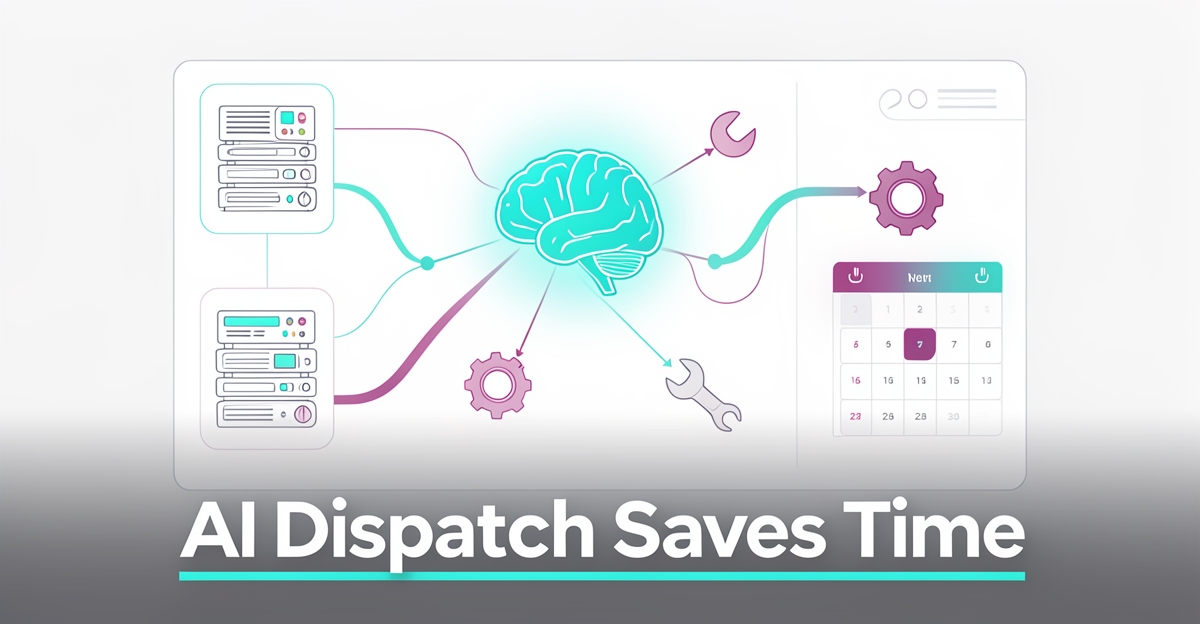
How an AI Dispatch System Can Improve Equipment Maintenance Scheduling
Key Facts
- Manual dispatch typically takes tens of minutes per work order; AI systems complete assignments in a fraction of that time
- Skill-mismatched assignments made under time pressure are a leading driver of return visits and rework
- Field technicians commonly lose a significant share of productive hours to inefficient travel under intuition-based routing
- AI scheduling consistently improves technician utilization by eliminating idle time between assignments
- Predictive maintenance can substantially reduce unexpected downtime compared with reactive approaches
- AI-optimized routing typically reduces miles driven by 20–35% versus manual dispatch, according to industry analyses
Hire a team member that works 24/7 — for less than a part-time wage.
AI receptionists, SDRs, dispatchers and 99+ roles. Trained on your business, fully managed.
Not sure where to start? Ask our AI planner
The Hidden Cost of Manual Maintenance Dispatching
Relying on human coordinators for technician assignment creates hidden costs that quietly erode maintenance efficiency. Assigning a single work order manually can take tens of minutes once you account for checking certifications, availability, location, and parts. Industry research on AI maintenance dispatching suggests this slow assignment process directly contributes to delayed repairs and accelerated asset deterioration.
Beyond slow response times, manual systems frequently produce skill mismatches when dispatchers bend rules under pressure. When technicians lack the required certifications for assigned tasks, return visits follow—wasting technician time and customer trust while increasing operational expenses. Industry analyses consistently identify skill-mismatched assignments made under time pressure as a major driver of rework.
- Technicians lose a meaningful share of productive hours to inefficient travel under intuition-based routing
- Manual dispatchers commonly spend hours each day building schedules that AI systems can generate in minutes
- Skill-mismatched assignments under time pressure are a leading cause of return visits and rework
The financial impact compounds through wasted technician hours and avoidable overtime. When coordinators overload some technicians while others sit idle, utilization drops and overtime costs rise. These inefficiencies prevent maintenance teams from operating at peak capacity, turning what should be a streamlined process into a continuous drain on resources that could otherwise support predictive maintenance initiatives.
How AI Dispatch Automates and Optimizes Maintenance Workflows
In modern facilities, the difference between operational flow and costly downtime often comes down to minutes, not hours. While manual dispatching relies on a coordinator's memory and spreadsheets, AI-powered systems transform maintenance workflows by processing real-time variables to match work orders with the optimal technician instantly.
The core advantage lies in multi-variable optimization. AI dispatch systems evaluate skill certifications, geographic proximity, current workload, and asset criticality to complete assignments in a fraction of the time manual dispatch requires. This precision eliminates the information gaps that lead to skill mismatches—one of the most common sources of rework in field maintenance.
AI dispatch mechanics operate through several interconnected capabilities:
- Real-time queue balancing: Monitors technician workloads continuously to prevent burnout and idle time
- Dynamic rescheduling: Instantly redistributes work orders when disruptions occur, such as sick calls or extended job durations
- Portfolio-level routing: Breaks down site silos by deploying specialists across multiple locations based on priority rather than proximity to a single dispatcher
- Parts availability integration: Cross-references inventory data with work orders to ensure technicians arrive with necessary components
These systems excel at handling complexity that overwhelms human coordinators. When a technician calls in sick or an emergency breakdown occurs, the AI recalculates the entire day's schedule in seconds, automatically updating ETAs and customer notifications. This capability proves particularly valuable for organizations managing large portfolios: a single manual coordinator can realistically manage only a limited number of technicians, while AI scales from a handful to hundreds of field workers.
The financial impact extends beyond simple speed. By eliminating idle time between assignments and optimizing routes to reduce travel, organizations see meaningful improvements in technician utilization. For mid-sized teams, those recovered hours translate into substantial annual savings compared to manual coordination.
However, these mechanics depend entirely on data quality. AI dispatch requires clean, structured information from CMMS platforms, accurate skill tags, and real-time location data to function effectively. Organizations that build robust data foundations—often through custom integrations—can leverage these algorithms to predict maintenance needs before failures occur, shifting from reactive firefighting to proactive asset management. AIQ Labs builds these foundations through its AI Workflow Builds, which rebuild the one workflow that costs your business the most.
The result is a self-optimizing workflow where high-criticality assets receive immediate attention regardless of submission order, travel time drops measurably, and dispatchers evolve from schedule builders to strategic operations managers. Rather than replacing human judgment, AI handles the computational heavy lifting, ensuring the right technician arrives at the right asset with the right parts—every time.
From Reactive to Predictive: Using AI to Prevent Equipment Failures
Traditional maintenance approaches wait for equipment to fail before taking action, leading to costly downtime and emergency repairs. AI-powered dispatch systems transform this reactive cycle by continuously analyzing sensor data and historical patterns to forecast failures before they happen. This shift enables maintenance teams to schedule interventions proactively, turning unexpected breakdowns into planned, efficient service events.
By leveraging real-time equipment health data and usage trends, AI algorithms detect subtle anomalies that signal impending failure—deviations often invisible to manual inspections until it's too late. Industry analyses of predictive maintenance programs report substantial reductions in unexpected downtime and maintenance costs. These improvements stem from addressing issues during optimal maintenance windows rather than reacting to catastrophic failures that require extensive repairs and prolonged asset unavailability.
Beyond failure prediction, AI enhances maintenance precision through intelligent resource allocation and root cause analysis. The system automatically matches work orders to technicians based on skill certification, location, and current workload—eliminating the rework associated with skill-mismatched assignments made under time pressure. When failures do occur, AI-powered root cause analysis can investigate sensor logs and maintenance history far faster than manual methods, identifying recurring underlying issues rather than just treating symptoms.
- Predictive scheduling reduces wasted technician travel time by optimizing routes, typically cutting miles driven by 20–35%
- AI dispatch assigns work orders in minutes rather than the tens of minutes manual dispatch requires
- Smart parts inventory alignment prevents both stockouts and excess holding costs
AIQ Labs builds custom AI workflows that integrate with existing maintenance logs and equipment tracking systems to enable this predictive capability. By automating equipment checks and scheduling maintenance based on actual usage patterns rather than fixed intervals, organizations achieve higher asset utilization while extending equipment lifespan. The technology continuously learns from new data, refining its predictions to improve accuracy over time and adapt to changing operational conditions.
This predictive approach transforms maintenance from a cost center into a strategic function that maximizes uptime, improves workforce efficiency, and delivers measurable financial returns through reduced emergency repairs and optimized resource deployment.
Implementing AI Dispatch: A Practical Roadmap for SMBs
Moving from concept to execution requires a structured approach that respects the complexity of field operations. The most successful implementations follow a phased roadmap that prioritizes data readiness before algorithm deployment, ensuring the system optimizes reality rather than automating chaos.
- Audit and centralize data through your CMMS: AI models fail without clean, structured inputs. Standardize asset naming conventions, validate technician certification records, and ensure work order histories have accurate timestamps before introducing any predictive layer. Industry analysts have repeatedly warned that most AI projects stall on poor data readiness, making this foundation non-negotiable.
- Select a high-impact, measurable use case: Target a specific pain point — such as emergency response delays or skill-mismatch rework — rather than attempting a full portfolio rollout. Skill-mismatched assignments made under time pressure are a quantifiable problem AI can solve immediately.
- Define KPIs before the pilot launches: Establish baseline metrics for response time, first-time fix rate, and technician utilization. Without defined metrics, testing becomes risky and success remains subjective.
- Run a controlled pilot on a single site or asset class: Validate the model against real-world variability — traffic, parts availability, technician absences — before scaling. This phase reveals integration gaps with inventory systems and ERP platforms that lab testing misses.
- Iterate with human-in-the-loop governance: Treat the dispatcher's role as an evolution from route builder to operations manager who handles exceptions. Continuous monitoring of prediction accuracy and data drift ensures the system improves as more high-quality data accumulates.
AIQ Labs applies this exact methodology through its phased service model: start with a single high-cost workflow rebuilt at a fixed price via AI Workflow Builds, then scale toward a connected AI Operating System your business owns outright. The goal is not just software installation, but a sustainable shift where maintenance becomes a predictive, strategic function rather than a reactive cost center.
Still paying for 10+ subscriptions that don’t talk to each other?
We build custom AI systems you own outright. No vendor lock-in. Full control.
Not sure where to start? Ask our AI planner
Frequently Asked Questions
How much time does AI dispatch actually save compared to manual scheduling?
Will AI dispatch reduce rework from skill mismatches?
Can AI dispatch help with travel time and technician utilization?
What kind of cost savings can a maintenance team expect?
Does AI dispatch only help with scheduling or can it prevent failures?
What data do we need before implementing AI dispatch?
Make Maintenance Work for You, Not Against You
Manual dispatch quietly drains maintenance teams with slow assignments, rework from skill mismatches, and productive hours lost to travel. AI changes that equation by matching the right technician, parts and priority in minutes, rebalancing workloads in real time, and shifting operations from reactive firefighting to predictive prevention. The result is faster response, higher first-time fix rates, and measurable financial returns through improved utilization and less unexpected downtime. The shift starts with clean CMMS data and a focused use case, then scales through a controlled pilot and human-in-the-loop governance. AIQ Labs helps SMBs build custom AI workflows that integrate with existing maintenance logs and equipment tracking systems to automate checks, schedule based on usage patterns, and alert staff before breakdowns occur—with 200+ multi-agent systems deployed behind that work. Ready to see where the biggest win is for your team? Take the two-minute Fit Check at aiqlabs.ai/apply, then book a free 30-minute strategy call to map your bottleneck and highest-ROI automation opportunity. Prefer email? Reach the team at [email protected].
Make AI your competitive advantage — not just another tool.
Strategy, implementation and ongoing optimization. One partner, end to end.
Not sure where to start? Ask our AI planner