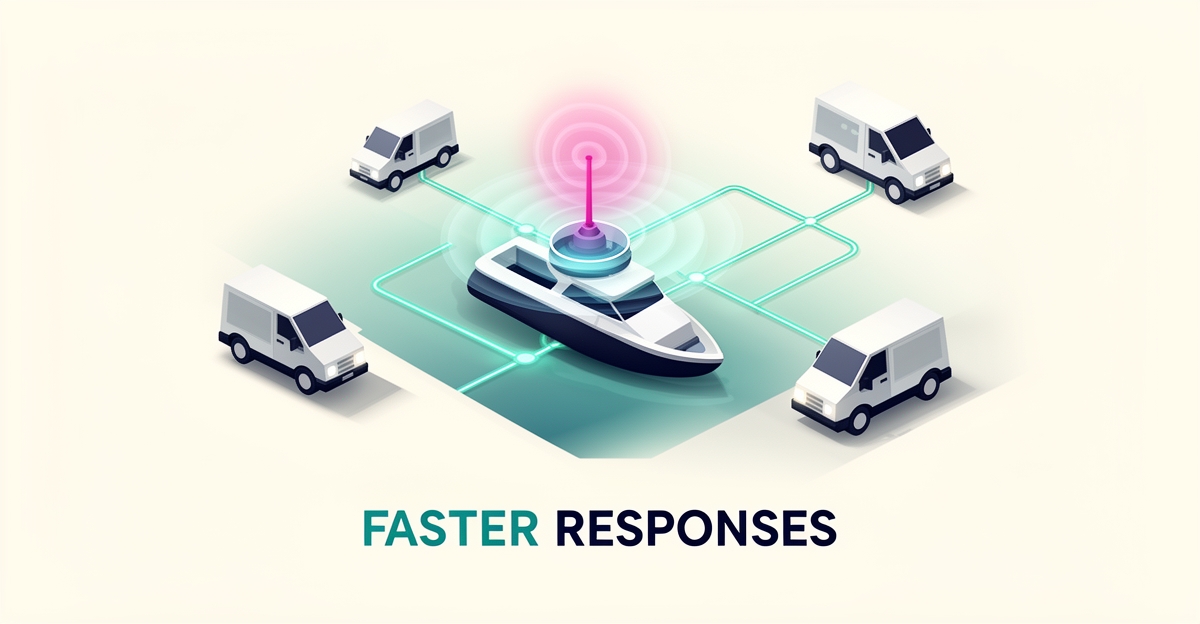
How an AI Dispatch System Improves Response Times for Marine Repair Requests
Key Facts
- AI job booking can enable same-day booking for standard marine repair requests received overnight, as of late 2026 implementations
- AI dispatch typically allows a single dispatcher to manage several times more vehicles than the manual ratio of roughly 1:10-12
- Smarter routing and reduced idle time typically lower fuel consumption and overtime costs for marine service fleets
- Dispatcher shortages remain a persistent bottleneck, with vacancy rates in many regions still well above pre-pandemic levels
- AIQ Labs has deployed 200+ multi-agent systems and runs 4 live SaaS products daily, so dispatch automation is proven in production—not theoretical
Hire a team member that works 24/7 — for less than a part-time wage.
AI receptionists, SDRs, dispatchers and 99+ roles. Trained on your business, fully managed.
Not sure where to start? Ask our AI planner
The Cost of Delayed Marine Repairs: Why Response Time Is Critical
When marine engines fail, every hour of downtime adds up—whether you're a commercial operator losing revenue or a recreational owner missing time on the water. Delayed responses don't just frustrate customers; they amplify financial losses and erode trust in repair providers who can't act fast enough.
Dispatcher shortages remain a critical factor in slow response times. In many regions, vacancy rates are still well above pre-pandemic levels as of late 2026. This staffing gap means fewer people handling more urgent repair requests, leading to bottlenecks that delay technician deployment and leave vessels idle longer than necessary.
The financial impact of these delays compounds quickly. For marine service providers relying on manual dispatch, inefficiencies in routing and technician assignment drive up operational costs through overtime, wasted fuel, and missed jobs. Beyond direct expenses, prolonged downtime translates to lost productivity, missed charters, or delayed cargo deliveries, all of which strain customer relationships.
- Increased labor costs from overtime and inefficient technician routing
- Revenue loss from vessels unable to operate during repair wait times
- Higher fuel consumption due to suboptimal dispatch routing
- Eroded customer trust when response promises aren't met
- Missed maintenance windows leading to more severe, costly failures
This is exactly the problem an [AI Employee](/ai-employees) dispatcher solves: it prioritizes urgent marine repair requests and matches them with qualified technicians based on real-time location, skill set, and parts availability—reducing response delays while maintaining the human oversight needed for complex diagnostic judgments. By minimizing idle time and improving first-contact resolution, AI-driven dispatch helps marine service providers protect both their bottom line and their reputation for reliability.
How AI Dispatch Systems Prioritize and Assign Repairs in Real Time
When marine repair requests come in, every minute counts—especially when engines are down and vessels are stranded. AI dispatch systems turn this urgency into action by analyzing multiple factors in real time to prioritize and assign jobs automatically. Instead of relying on manual triage, the AI evaluates repair severity, technician proximity, skill certifications, and current workload to determine the optimal response path within seconds.
This intelligent workflow enables same-day booking for standard marine repair requests received overnight, ensuring customers aren't left waiting until the next business day. By continuously monitoring technician locations and job statuses, the system dynamically reassigns tasks if delays occur or higher-priority emergencies arise. AI job booking is particularly valuable for teams that receive more leads than they can call back quickly and risk losing jobs due to unanswered calls after hours.
The impact on operational efficiency is significant: where a manual dispatcher typically manages 10-12 vehicles, an AI-assisted dispatcher can oversee coverage for a much larger fleet. This scalability allows marine service providers to handle fluctuating demand without adding staff, maintaining consistent service levels even during peak seasons or unexpected surges in requests.
- Real-time analysis of repair urgency based on symptom descriptions and customer-reported impact
- Geolocation matching to assign the nearest qualified technician
- Skill verification against required certifications for specific engine types or repair complexity
- Workload balancing to prevent technician burnout and ensure equitable job distribution
- Dynamic reprioritization when emergency requests interrupt scheduled maintenance
By automating routine prioritization and assignment, AI dispatch systems free human dispatchers to focus on complex situations requiring judgment—such as coordinating multi-vessel rescues or managing parts logistics for custom repairs. This hybrid approach ensures that while AI handles the speed and efficiency of standard dispatches, human expertise remains available for nuanced decision-making. For marine repair businesses seeking to improve response times without sacrificing service quality, this intelligent workflow delivers measurable gains in both operational efficiency and customer trust.
Implementation: Deploying AI Dispatch with Measurable ROI in Marine Services
Marine repair shops often face bottlenecks when technicians are assigned based on availability alone, not skill or location. An AI dispatch system evaluates incoming requests in real time, matching jobs to the most qualified technician while factoring in proximity and current workload. This reduces unnecessary travel and ensures the right person is sent the first time.
The implementation process starts with assessing current workflow gaps—such as delayed response times or misassigned jobs—followed by configuring automation rules for lead qualification and technician routing. Integration with existing tools like scheduling software or CRM systems ensures seamless data flow without disrupting daily operations. Staff training focuses on how to monitor the AI system, handle exceptions, and intervene when human judgment is needed, supporting a hybrid model where AI manages routine dispatch and technicians focus on complex repairs. This approach lets dispatchers concentrate on jobs requiring real conversation or judgment calls.
Once deployed, the system delivers measurable ROI through faster response times, reduced fuel consumption from optimized routing, and higher first-time fix rates. For marine repair operations facing urgent engine failures or time-sensitive maintenance, these improvements translate directly into increased customer trust and repeat business. If dispatch is your single most expensive broken process, a [Workflow Build](/workflow-builds) rebuilds exactly that one workflow at a fixed price, in phases. For shops that want dispatch connected to scheduling, parts, billing, and customer follow-up in one layer, an [AI Operating System](/ai-operating-systems) ties it together—and you own it outright. AIQ Labs supports the transition end to end, from workflow analysis to ongoing optimization, ensuring the system evolves with the shop's needs.
Still paying for 10+ subscriptions that don’t talk to each other?
We build custom AI systems you own outright. No vendor lock-in. Full control.
Not sure where to start? Ask our AI planner
Frequently Asked Questions
How does an AI dispatch system actually improve response times for marine repair requests?
Can AI dispatch really save marine repair businesses money, and if so, how much?
Will using AI dispatch mean I have to lay off my human dispatchers?
How long does it take to implement an AI dispatch system in a marine repair shop?
What kind of ROI can I expect from implementing AI dispatch, and how soon will I see it?
Is AI dispatch only useful for high-volume marine repair shops, or can smaller operations benefit too?
Turn Faster Response Times Into Lasting Customer Trust
When marine engines fail, the difference between a quick dispatch and a delayed one is lost revenue, missed charters, and eroded trust. Manual triage and dispatcher shortages create bottlenecks that keep vessels idle longer than necessary, while AI-driven prioritization matches urgent repair requests to the nearest qualified technician based on real-time location, skill set, and workload. That hybrid model preserves human judgment for complex diagnostics while automating routine routing and same-day booking, delivering measurable gains in first-time fix rates, fuel efficiency, and dispatcher coverage. Marine service providers who move from reactive scheduling to intelligent workflow automation can protect both their bottom line and their reputation for reliability. If you're evaluating how to reduce wait times without adding headcount, start with a clear view of your current dispatch gaps and where automation can take over routine decisions. AIQ Labs builds custom dispatch AI agents that learn from real shop operations and integrate with the tools you already use—backed by 200+ multi-agent systems deployed and 4 live SaaS products we run daily. Start the 2-minute Fit Check at https://aiqlabs.ai/apply, then book a free 30-minute strategy call to map your biggest bottleneck and identify high-ROI automation opportunities—we'll tell you plainly if there isn't a clear win. Questions first? Email [email protected].
Make AI your competitive advantage — not just another tool.
Strategy, implementation and ongoing optimization. One partner, end to end.
Not sure where to start? Ask our AI planner