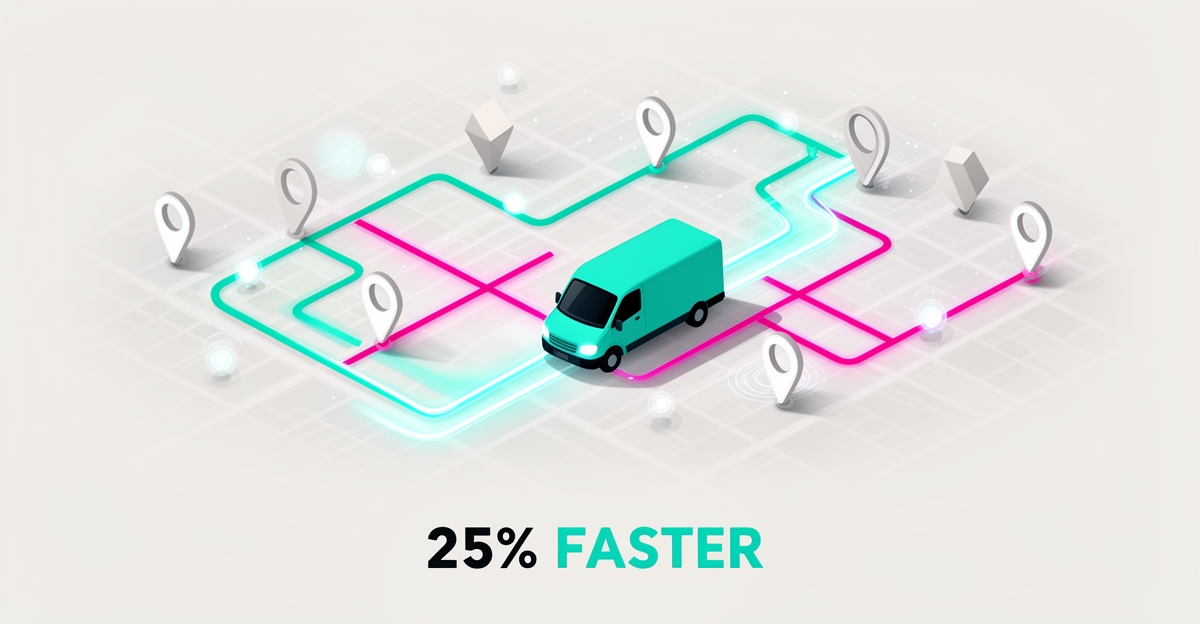
How an AI Dispatcher Can Cut Delivery Times by 25% for Local Courier Services
Key Facts
- AI dispatching can cut delivery times by up to 25% for local courier services through optimized routing and real-time adaptation.
- AI route optimization typically reduces miles driven by double-digit percentages, directly lowering fuel and vehicle wear costs.
- On-time delivery rates often reach the mid-90s or higher once dynamic re-routing replaces manual planning.
- AI dispatch systems typically scale from a handful of drivers to hundreds using the same planning workflow, without added dispatch staff.
- Hybrid AI-human dispatching commonly reduces dispatch labor costs while maintaining service quality, as of late 2026 industry reporting.
- AIQ Labs has deployed 200+ multi-agent systems and runs 4 live SaaS products daily, so these workflows are built and proven in production.
Hire a team member that works 24/7 — for less than a part-time wage.
AI receptionists, SDRs, dispatchers and 99+ roles. Trained on your business, fully managed.
Not sure where to start? Ask our AI planner
The Hidden Cost of Manual Dispatching: Why Local Couriers Are Falling Behind
Local courier services often struggle with the hidden costs of manual dispatching, where human limitations create bottlenecks that silently erode profitability and growth potential. When dispatching relies solely on human judgment, planning becomes slower, visibility diminishes, and error rates climb—especially as operations scale beyond a handful of drivers.
These inefficiencies compound quickly. Manual dispatching limits real-time visibility into driver locations and traffic conditions, forcing reactive decisions instead of proactive optimization. This lack of foresight leads to longer routes, increased fuel consumption, and avoidable delays. Industry studies of AI route optimization consistently show double-digit reductions in miles driven and on-time delivery rates in the mid-90s or higher—gains nearly impossible to achieve consistently with manual methods alone.
Beyond routing, human-only dispatching drives up labor costs through overtime and inefficient resource allocation. Operators who move to AI-assisted dispatch typically report meaningful overtime reductions and annual savings that often reach into the tens of thousands of dollars, with break-even frequently measured in months rather than years. For growing courier services, these savings aren't just operational—they're strategic, freeing up capital to reinvest in fleet expansion or customer acquisition.
Perhaps most critically, manual dispatching caps scalability. As order volumes increase, human dispatchers face cognitive overload, leading to missed assignments, delayed responses, and declining service quality. AI systems, by contrast, can handle anywhere from a handful of drivers to several hundred using the same planning workflow, enabling growth without proportional increases in dispatch staff. This scalability ensures that local couriers aren't held back by outdated processes when demand surges.
The result is a widening gap between couriers still dependent on manual dispatching and those leveraging AI to optimize every stage of the delivery lifecycle. Without intervention, the hidden costs of human-only dispatching don't just persist—they amplify, turning manageable inefficiencies into barriers to competitiveness. For local couriers aiming to grow, the choice isn't whether to modernize dispatching—it's how quickly they can make the shift.
- Slower planning cycles that delay driver assignments
- Limited real-time visibility into traffic and driver locations
- Higher error rates in route sequencing and task allocation
- Increased overtime costs from inefficient scheduling
- Scalability constraints that hinder operational growth
How AI Dispatching Delivers 25% Faster Deliveries and 96%+ On-Time Rates
Local courier services lose time on every manual decision. AI dispatching replaces guesswork with continuous pattern recognition and real-time adjustment.
AI systems analyze demand patterns across days, neighborhoods and order types to forecast volume and cluster stops before the day starts. That analysis feeds optimized delivery sequences that shorten total route time and reduce backtracking. The result is a potential 25% reduction in delivery times with AI dispatching.
Route optimization is where the savings compound. Route optimization studies typically find AI can reduce miles driven by double-digit percentages, cut overtime significantly, and push on-time delivery rates into the mid-90s or higher. Fewer miles mean lower fuel burn and less vehicle wear, while higher on-time performance lifts customer satisfaction and repeat business.
Real-time traffic adaptation keeps plans from falling apart mid-route. AI dispatching continuously re-sequences stops as conditions change, reassigning drivers and updating ETAs without dispatcher intervention. This creates real-time visibility for both operations and customers and lowers error rates compared with manual planning.
The mechanics behind the gains are consistent across local fleets:
- Demand pattern analysis that predicts hotspots and pre-builds efficient clusters
- Dynamic sequencing that minimizes travel distance and wait time between stops
- Live traffic and exception handling that re-routes instantly as conditions shift
For courier operators, this translates into cost control and scalability. AI-assisted dispatching typically saves tens of thousands of dollars per year versus fully manual dispatching, with break-even often reached within the first few months. The same systems scale from a handful of drivers to several hundred on the same planning workflow.
AIQ Labs builds AI dispatchers as managed AI Employees or as a focused Workflow Build that rebuilds the one workflow costing you the most—dispatch planning—at a fixed price, delivered in phases. Either way, you get a production-ready system designed for delivery operations, not a generic tool you have to bend around.
When dispatch becomes predictive and self-adjusting, delivery times fall, overtime shrinks, and on-time performance becomes the norm rather than the exception.
The ROI Case: What AI Dispatching Is Worth Annually
The financial case for AI dispatching becomes clear when examining the direct cost savings compared to manual processes. Depending on fleet size and order volume, operators commonly report annual savings ranging from tens of thousands of dollars upward, with break-even frequently achieved in one to three months. These savings stem from measurable operational efficiencies: AI route optimization typically reduces miles driven by double-digit percentages, which directly translates to lower fuel costs. At the same time, labor expenses often drop by 20-40% as AI handles routine dispatching tasks, freeing human teams to focus on exception management and customer service.
Beyond immediate cost reductions, AI dispatching improves scalability without proportional cost increases. While manual dispatching struggles to manage more than a handful of drivers efficiently, AI systems can coordinate operations for fleets of nearly any size using the same planning workflow. This scalability eliminates the need for proportional dispatcher headcount growth as delivery volumes rise. Additionally, AI-driven systems achieve on-time delivery rates in the mid-90s or higher by dynamically adjusting routes based on real-time traffic, weather, and demand fluctuations—capabilities that manual dispatching cannot match consistently.
For local courier services evaluating AI adoption, the decision extends beyond technology to partnership. AIQ Labs supports this transition through AI workflow builds designed specifically for delivery operations, ensuring systems integrate with existing tools while delivering owned, scalable infrastructure. By reducing fuel consumption, labor overhead, and planning inefficiencies, AI dispatching transforms a cost center into a predictable, high-margin operation—proving that smarter routing isn't just about faster deliveries, but sustainable profitability.
The Hybrid Model: AI Optimization with Human Judgment Where It Counts
The fastest courier operations don't choose between algorithms and people — they let each do what they do best. AI handles the scale and speed of optimization while dispatchers stay in control of the exceptions that define customer experience.
AI-driven route optimization and driver assignment deliver measurable gains on their own: typically double-digit reductions in miles driven, meaningful overtime savings, and on-time delivery rates in the mid-90s or higher. Annual savings versus manual dispatch commonly reach into the tens of thousands of dollars, with break-even often in one to three months.
That efficiency creates space for human judgment where it matters most. Augmentation, not replacement, is the pattern that sustains adoption. Dispatchers remain the owners of exceptions, escalations, and relationships while AI removes repetitive sequencing work.
A hybrid model pairs AI optimization with human oversight in three practical layers:
- AI plans and assigns routes in real time based on demand patterns, traffic, and capacity
- Human dispatchers handle exceptions, customer escalations, and real-time problem solving
- Dispatchers validate, override, and coach the system to improve future decisions
This division preserves real-time visibility and automated assignment while keeping empathy and negotiation in human hands. The key to successful AI dispatching is finding the right balance between technology and human judgment.
Manual dispatch relies on experience and can be prone to errors under volume. AI dispatching offers faster planning, improved mileage efficiency, and increased scalability, while human dispatchers add context for late pickups, access issues, and priority customers. As of late 2026, the consensus across the industry is clear: AI dispatching is not a replacement for human dispatchers, but a tool to augment their abilities and improve efficiency.
For local courier services, that means delivery times can fall by up to 25% without losing the service quality that builds repeat business. AIQ Labs designs these workflows as custom AI workflow automation tailored to delivery operations, integrating with existing dispatch systems so teams keep their tools and gain intelligence.
The result is a dispatch desk that scales with your fleet on the same planning workflow, reduces error rates, and keeps dispatchers focused on customers rather than spreadsheets.
Your Implementation Roadmap: From Assessment to AI-Powered Dispatch
Start by auditing your current dispatch process to uncover inefficiencies in route planning, driver assignment, and response to real-time disruptions. This assessment should map existing workflows, identify manual bottlenecks, and quantify baseline performance metrics like average delivery time and on-time delivery rate. Understanding these pain points creates a clear foundation for measuring the impact of AI-driven improvements.
Next, evaluate how an AI dispatcher aligns with your operational goals using data-backed projections. AI dispatching can reduce delivery times by up to 25% while cutting miles driven and overtime, directly boosting efficiency and customer satisfaction. These gains translate to annual savings that frequently reach the tens of thousands of dollars, with break-even often measured in months. This analysis ensures the investment addresses your most pressing operational challenges.
Select an AI dispatching system that integrates seamlessly with your existing tools, such as CRM, scheduling, and fleet management platforms. Prioritize solutions built on scalable multi-agent architectures, which enable real-time traffic adaptation, demand forecasting, and dynamic route optimization. AIQ Labs builds custom AI dispatch systems that businesses own outright, eliminating vendor lock-in and ensuring long-term control over your automation assets.
Deploy the system through phased integration, beginning with core dispatch functions before expanding to driver notifications and customer updates. Provide hands-on training for dispatchers and drivers focused on interpreting AI recommendations, handling exceptions, and leveraging real-time dashboards. Continuous monitoring of key metrics—delivery times, fuel usage, and on-time performance—allows for iterative improvements, ensuring the AI dispatcher evolves with your business needs and sustains peak efficiency.
From Bottleneck to Breakthrough: Your Dispatching Evolution Starts Here
AI dispatching transforms local courier operations by cutting delivery times by up to 25%, reducing miles driven by double-digit percentages, and delivering annual savings that often reach the tens of thousands of dollars—with break-even frequently measured in months. Beyond the numbers, it creates a hybrid model where AI handles optimization and scale while human dispatchers focus on exceptions, customer relationships, and real-time problem-solving—delivering efficiency without sacrificing service quality. The path forward begins with clarity: audit your current workflow, quantify your bottlenecks, and explore how AI workflow automation can be tailored to your specific delivery operations. Take the first step with a free strategy call to assess your biggest opportunities and see if AI dispatching is the right fit for your business—no obligation, just actionable insights. Book your free 30-minute strategy call and discover how owned, production-ready AI systems can turn your dispatch desk into a competitive advantage.
Make AI your competitive advantage — not just another tool.
Strategy, implementation and ongoing optimization. One partner, end to end.
Not sure where to start? Ask our AI planner