How an AI Dispatcher Can Cut Response Times in Fleet Collision Repair Shops
Key Facts
- Technicians lose 7.27 hours weekly to low-value admin tasks, keeping them from actual repairs according to industry research
- 82% of service professionals agree customer expectations are higher than they used to be per survey data
- 43% of consumers say a poor experience will prevent them from making a repeat purchase based on consumer feedback
- 69% of service professionals say their organization uses at least one form of AI, with 39% using agentic AI per industry research
- 79% of service leaders say investing in AI agents is essential to meet business demands from recent survey data
- 85% of field service leaders believe their AI investments will increase over the next year per executive outlook
- 37% of technicians report spending over seven hours weekly on low-value administrative tasks based on workforce surveys
Hire a team member that works 24/7 — for less than a part-time wage.
AI receptionists, SDRs, dispatchers and 99+ roles. Trained on your business, fully managed.
Not sure where to start? Ask our AI planner
The Collision Repair Bottleneck: Wait Times, Admin Load, and Rising Expectations
Fleet collision repair shops are caught in a perfect storm of operational strain. Technicians lose an average of 7.27 hours per week to low-value administrative tasks that keep them from performing actual repairs, according to industry research. This drain on skilled labor directly impacts shop capacity and slows response times when vehicles need attention.
At the same time, customer expectations have risen sharply, with 82% of service professionals agreeing that demands are higher than they used to be. Yet representatives spend less than half their time—just 46%—building relationships with customers, as they’re pulled into administrative work instead. When service falters, the consequences are immediate: 43% of consumers say a poor experience will prevent them from making a repeat purchase.
These pressures create a bottleneck where limited talent, rising expectations, and inefficient workflows collide. Shops struggle to assign vehicles quickly, prioritize repairs by severity, or keep customers informed—all while fighting to retain business in a competitive market. Without intervention, wait times grow, satisfaction erodes, and revenue slips away.
Why AI-Powered Dispatchers Change Vehicle Assignment and Prioritization
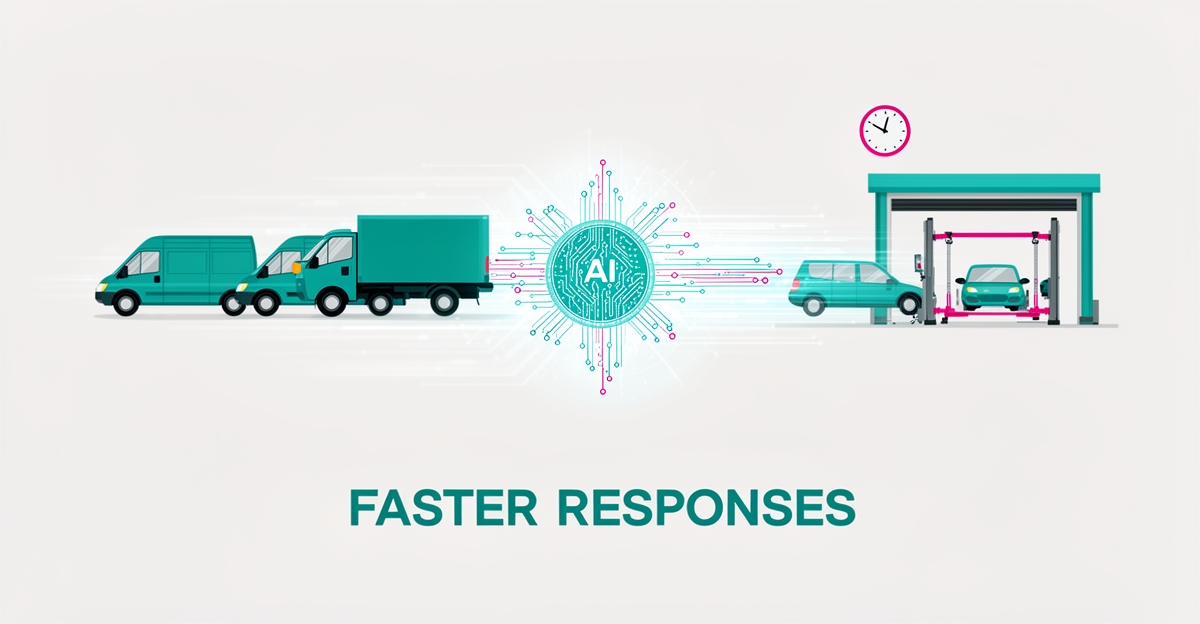
Collision repair shops are losing time every time a dispatcher manually triages incoming vehicles. An agentic AI dispatcher changes that by reading damage severity, shop capacity, and parts availability in real time and assigning work without the delays that frustrate customers.
The shift is already underway. According to industry research, 69% of service professionals say their organization uses at least one form of AI, with 39% reporting the use of agentic AI. Demand is accelerating, with 79% of service leaders saying investing in AI agents is essential to meet business demands.
AI-powered dispatchers streamline vehicle assignment by replacing static rules with dynamic prioritization. The system ingests photos, estimates, and repair history, then matches each vehicle to the right bay, technician skill set, and parts lead time. That reduces idle time and prevents bottlenecks where high-severity repairs wait behind low-impact work.
Prioritization becomes consistent and transparent. Instead of subjective triage, an agentic dispatcher ranks jobs by safety impact, customer wait time, and revenue urgency. This approach supports the operational efficiency gains seen in fleet management, where AI can streamline vehicle assignment, prioritize repairs based on damage severity, and reduce wait times for customers.
Field service leaders expect continued investment. Recent survey data shows 85% of field service leaders believe their AI investments will increase over the next year. The momentum reflects pressure from rising customer expectations, with 82% of service professionals agreeing expectations are higher than they used to be.
In practice, an AI dispatcher can:
- Automatically assign vehicles to technicians based on certification and current workload
- Prioritize repairs by damage severity, safety risk, and promised completion date
- Sync with scheduling tools and real-time vehicle data to prevent double-booking
- Flag parts delays early and re-route work to keep bays productive
The result is faster throughput and fewer status-call interruptions. Technicians spend less time on admin, and customers receive clearer ETAs. For shops exploring AI Business Process Automation, this is a classic workflow automation use case where assignment and prioritization become data-driven, not manual.
AIQ Labs helps repair shops build custom AI workflows that integrate with existing scheduling tools and real-time vehicle data, creating dispatchers that learn from each shop’s history. When assignment logic is owned and tuned in-house, shops retain control over how priorities are set as demand changes.
From Data Silos to Unified Dispatch: Making AI Work in Real Shops
The gap between pilot projects and production reality often comes down to data architecture. Most collision repair shops run on fragmented systems—estimating software that doesn't talk to fleet portals, scheduling tools that ignore real-time vehicle telemetry, and communication channels that create duplicate work orders. Industry research shows that integrating service channel data into a unified platform directly addresses the resource constraints and talent shortages that stall AI adoption.
- Consolidate estimating, fleet, and communication data into a single operational layer
- Train AI dispatchers on historical repair patterns and damage severity classifications
- Build escalation paths that preserve context when human expertise is required
- Monitor technician capacity in real time to prevent bottlenecks before they form
Service professionals report that 85% of voice AI interactions transition seamlessly to human representatives when the handoff is designed with context preservation in mind. That statistic reflects a deeper truth: customers don't care whether they're talking to AI or a person—they care that they don't have to repeat themselves. Maintaining brand voice and empathy across that boundary requires training AI on actual shop conversations, not generic scripts.
Eighty-eight percent of companies rate themselves good or excellent at consistent brand voice, yet only 35% say their AI excels at understanding emotions. The disconnect matters in collision repair, where a fleet manager calling about a totaled vehicle needs different handling than a retail customer with a fender bender. AIQ Labs builds AI Employees that learn these distinctions through ongoing optimization—each interaction refines the dispatcher's ability to prioritize repairs, assign the right technician, and flag when a human estimator needs to step in.
The shops seeing measurable gains didn't start with a platform migration. They started with one workflow—triage inbound fleet requests, match damage codes to bay availability, confirm appointments—and let the AI prove itself before expanding.
Build vs Buy: Deploying a Custom AI Dispatcher with AIQ Labs
Many fleet collision repair shops face a critical decision: build a custom AI dispatcher or buy an off-the-shelf solution. According to industry research, 79% of service leaders say investing in AI agents is essential to meet business demands, yet 37% of technicians report spending over seven hours weekly on low-value administrative tasks that distract from core repair work. AIQ Labs helps shops evaluate this build vs. buy choice by aligning custom AI workflows with existing scheduling tools and real-time vehicle data—ensuring the solution enhances, rather than disrupts, current operations.
For shops seeking immediate impact without long-term commitment, the Start Monthly model deploys an AI Employee like a dispatcher within weeks, handling vehicle triage, parts coordination, and technician assignment while integrating with tools like Mitchell or Shop-Ware. The Build in Milestones approach breaks deployment into phases—such as damage assessment automation or real-time bay optimization—so shops validate ROI at each step and retain all completed work. For those pursuing full control, the Own It Outright model delivers a production-proven multi-agent architecture where the shop owns the code, data, and future evolution of their AI dispatcher, eliminating vendor lock-in.
- Start Monthly: Flat fee covering build, training, integrations, and monitoring—less than a part-time hire
- Build in Milestones: Phase-based payment; stop anytime, keep everything built
- Own It Outright: Full ownership of code, agents, and data—no platform dependencies
AIQ Labs’ multi-agent architecture, proven across 70+ production agents in our own SaaS platforms, enables the AI dispatcher to reason, act, and adapt using LangGraph workflows while connecting to CRM, calendar, and parts inventory systems via MCP. This ensures the dispatcher doesn’t just assign jobs—it prioritizes based on damage severity, predicts parts delays, and communicates updates to customers and insurers in natural language. By grounding the solution in AIQ Labs’ three pillars—AI Development Services, AI Employees, and AI Transformation Consulting—shops gain a partner that builds, manages, and strategically guides their AI journey from pilot to transformation. To explore how a custom AI dispatcher fits your shop’s workflow and technology stack, start the Fit Check at aiqlabs.ai/apply for a free two-minute assessment, then schedule a no-obligation 30-minute strategy call at aiqlabs.ai/book.
Still paying for 10+ subscriptions that don’t talk to each other?
We build custom AI systems you own outright. No vendor lock-in. Full control.
Not sure where to start? Ask our AI planner
Frequently Asked Questions
How does an AI dispatcher actually speed up collision repair response times?
Will customers be frustrated if they're talking to an AI instead of a human?
We're already busy—why should we invest in AI now instead of waiting?
Can an AI dispatcher integrate with our existing estimating and scheduling software?
What's the difference between buying dispatch software and building a custom AI dispatcher?
Do we need to replace our dispatchers or service advisors with AI?
Turning Repair Shop Bottlenecks into Competitive Advantage
Fleet collision repair shops face a clear challenge: skilled technicians spending over 7 hours weekly on administrative tasks while customer expectations rise and wait times grow. An AI-powered dispatcher directly addresses this by automating vehicle assignment, prioritizing repairs based on damage severity and parts availability, and syncing with existing scheduling tools to reduce idle time and improve throughput. The result is faster service, clearer customer communication, and technicians focused on what they do best—repairing vehicles. For shops ready to move beyond manual triage and fragmented systems, the path forward starts with assessing where AI can deliver the quickest wins. Take the first step with a free two-minute Fit Check to see how a custom AI dispatcher could fit your workflow, then schedule a no-obligation strategy call to explore the details.
Make AI your competitive advantage — not just another tool.
Strategy, implementation and ongoing optimization. One partner, end to end.
Not sure where to start? Ask our AI planner