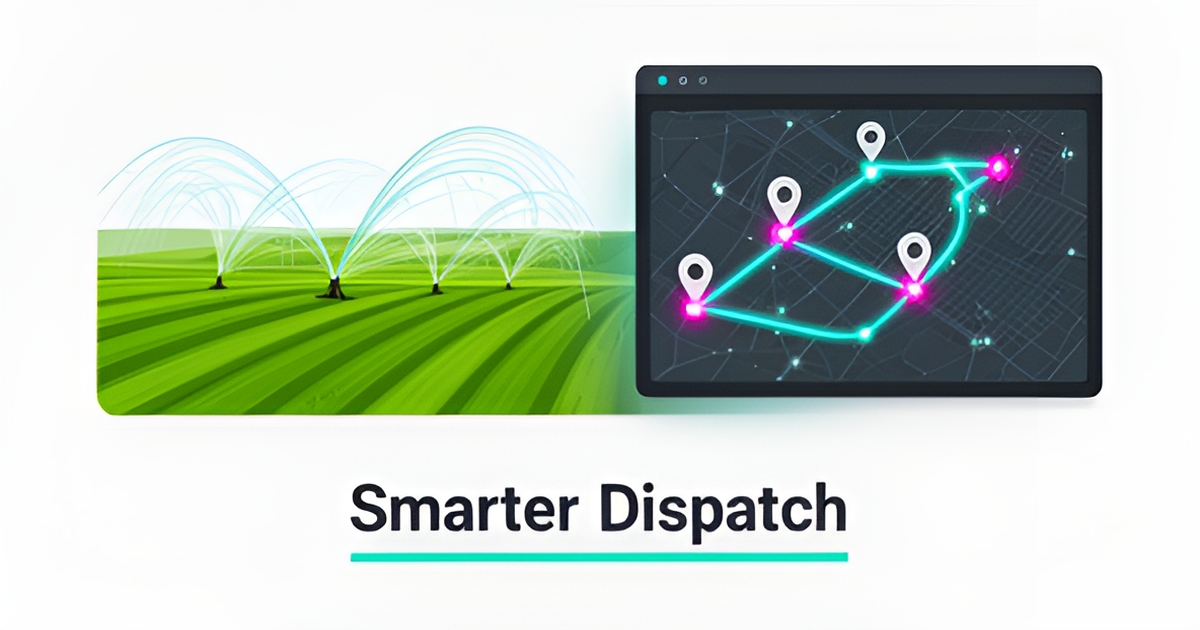
How an AI Dispatcher Can Improve Field Service Efficiency for Irrigation Dealers
Key Facts
- 80% of the global workforce reports lacking enough time or energy for work according to a Microsoft report cited by TechRadar
- 86% of decision-makers said they needed better tools to manage technician scheduling in a 2023 Salesforce field service report
- Assigning 80 jobs to 20 technicians involves roughly 1.2×10¹⁰⁴ combinations classified as the Technician Routing and Scheduling Problem
- Average first-time fix rate is often cited around 75% across 156 organizations per Aberdeen Group research
- 51% of repeat visits reportedly stem from parts unavailability confirming dispatch is a skills-plus-parts problem
- Manual dispatch planning typically takes 2 to 4 hours each morning versus AI calculating assignments in seconds
- Industry analyses report AI dispatch can reduce response times by up to 60% and improve on-time service delivery
Hire a team member that works 24/7 — for less than a part-time wage.
AI receptionists, SDRs, dispatchers and 99+ roles. Trained on your business, fully managed.
Not sure where to start? Ask our AI planner
Why Manual Dispatch Breaks Down in Irrigation Operations
When the spring rush hits, an irrigation dealer's office can feel like an air traffic control tower during a storm. Phones ring nonstop, technicians call in with delays, and customers demand updates on emergency repairs. It is a high-stakes coordination challenge, and it is precisely where manual dispatch methods begin to fail.
The problem is not a lack of effort; it is a lack of capacity. According to a Microsoft report cited by TechRadar, 80% of the global workforce reports feeling they lack enough time or energy to do their work. For a human dispatcher, the mental load of tracking every moving part is immense. As the article notes, "This isn't a motivation problem, it's a capacity one."
This capacity crunch is colliding with a growing complexity crisis in field service. A 2023 Salesforce report found that 86% of decision-makers believed they needed better tools to manage technician scheduling. The reason is mathematical reality. Manually assigning 80 jobs to 20 technicians involves navigating roughly 1.2 × 10¹⁰⁴ possible combinations before you even factor in traffic, skill sets, or parts inventory. This is a class of problem known as the Technician Routing and Scheduling Problem (TRSP), and it is effectively impossible for the human brain to solve optimally in real time.
When dispatchers rely on whiteboards, spreadsheets, or gut instinct, they face specific operational bottlenecks:
- Information Silos: Customer details, technician locations, and job histories live in different systems, forcing constant phone tag.
- Reactive Scheduling: A single delay—a job running long or a tech stuck in traffic—creates a cascade of manual phone calls to reschedule the rest of the day.
- Skill Mismatches: Without a real-time view of certifications, the wrong technician may be sent to a job, leading to repeat visits.
- Communication Gaps: Customers are left waiting without updates, while office staff scramble to keep everyone informed.
These inefficiencies have a direct financial cost. Aberdeen Group research often cited in the field service industry puts the average first-time fix rate at around 75%, meaning roughly one in four service calls requires a costly repeat visit. With the cost of a single truck roll commonly estimated between $200 and $300, these errors erode margins quickly. Furthermore, 51% of repeat visits are reportedly caused by parts unavailability, proving that dispatch is not just a routing problem but a complex coordination of skills and inventory.
Manual methods simply cannot process these variables simultaneously. While an experienced dispatcher excels at judgment calls, they cannot compete with an algorithm that calculates optimal routes in seconds. As noted by Upper Inc, manual planning can take 2 to 4 hours each morning, whereas AI dispatch software recalculates instantly when orders change mid-day. This is why forward-thinking dealers are moving beyond manual coordination. At AIQ Labs, our AI Employees include a fully managed AI Dispatcher role that handles this complexity automatically, allowing your team to focus on service rather than logistics.
How AI Dispatchers Solve the Technician Assignment Problem
Manual dispatch works fine when you have three trucks and a predictable schedule. It collapses the moment a high-priority repair jumps the queue, a technician calls out sick, or traffic turns a 20-minute drive into an hour. The assignment space for just 80 jobs and 20 technicians balloons to roughly 1.2 × 10¹⁰⁴ combinations before factoring in skills, parts, SLAs, and real-time conditions—a complexity classified academically as the NP-hard Technician Routing and Scheduling Problem.
AI dispatch systems solve this by processing every variable simultaneously. Instead of a dispatcher spending two to four hours each morning building schedules, algorithms analyze technician certifications, current GPS location, job priority, parts inventory, and predicted travel time to calculate optimal assignments in seconds. When a job runs long or a truck hits traffic, the system identifies the ripple effect on subsequent appointments and recalculates automatically, eliminating the frantic phone calls and manual reshuffling that define peak-season chaos.
- Skills and certification matching ensures the right technician arrives with the right parts
- Real-time GPS and traffic data feed dynamic travel-time calculations
- SLA deadlines and job priority weight assignments automatically
- Instant re-optimization when conditions change mid-day
Consumer navigation tools like Google Maps cannot handle this workload; they solve a single-destination problem for one driver, not multi-stop sequencing across a fleet with hard constraints like time windows and skill requirements. The payoff is measurable: industry analyses report response time reductions of up to 60% and a measurable lift in on-time service delivery. For irrigation dealers juggling seasonal surges, this shift moves the dispatcher from route builder to operations manager—focused on exceptions, capacity planning, and customer communication rather than spreadsheet Tetris. AIQ Labs builds AI Dispatchers as part of its AI Employees lineup, integrating directly with your existing CRM and scheduling platforms so dealers get enterprise-grade optimization without the enterprise price tag or implementation timeline.
Beyond Routing: The Full Scope of AI Field Service Coordination
Peak season turns dispatch into a high-stakes juggling act for irrigation dealers, where one late arrival can cascade into missed windows and repeat visits.
Beyond routing, AI field service coordination relieves cognitive overload by handling simultaneous variables that overwhelm human dispatchers. Industry research shows 80% of the global workforce report lacking enough time or energy to do their work, and the demand is for relief, not more digital noise.
An AI dispatcher analyzes technician skills, current location, job priority, and estimated travel time at once to make real-time scheduling recommendations. AI field service analysis explains that when a job runs long or a technician is delayed, the system can identify the impact on subsequent appointments and suggest adjustments before the delay becomes a problem for the customer.
Automated customer communication closes the loop without manual calls. The same analysis notes AI-powered communication tools can automatically send customers an updated arrival estimate when schedules change, while inside sales and back-office staff receive notifications through the system so everyone stays aligned.
The real efficiency gain comes from addressing the three-part problem that drives repeat service. Field service research found the average first-time fix rate across 156 organizations was 75%, meaning one in four service calls required a repeat visit. The same study found 51% of repeat visits were caused by parts unavailability, confirming dispatch optimization is a skills-plus-parts-plus-routing problem, not just a map problem.
AI coordination tackles this by integrating availability data across the operation. Dispatch logic considers certified skills for irrigation systems, real-time parts inventory at the warehouse or truck, and travel constraints together. When parts are missing, the system reschedules with a technician who can pick up stock or bundles the job with a nearby stop to avoid a second truck roll.
The shift changes the dispatcher role from route builder to exception manager. A comparison of AI vs manual dispatch reports AI dispatch software processes all variables simultaneously, calculating optimal assignments in seconds compared to manual planning that takes 2 to 4 hours each morning. The same analysis cites response time reductions of up to 60% and improved on-time service delivery with automation.
For dealers managing peak irrigation season, this means:
- Proactive schedule adjustments when jobs run long, preventing cascading delays
- Automatic arrival-time updates to customers and internal teams without manual calls
- Skill and parts-aware assignment that reduces repeat visits and truck rolls
Demand for better tools is clear. A 2023 Salesforce field service report found 86% of decision-makers said they needed better tools to manage field technician scheduling, and that gap is precisely where AI enters.
AIQ Labs builds managed AI Employees that work alongside human teams—including dispatchers and service coordinators for trades and field services, among 99+ roles—to automate these coordination workflows around the clock, typically at a fraction of the cost of an additional human hire.
Implementation Path: From Manual Chaos to AI Coordination
Transitioning from a traditional, manual dispatch model to an AI-driven system is less about installing software and more about redefining operational workflows. For irrigation dealers, this shift addresses the "capacity crisis" highlighted by a Microsoft report, which found that 80% of the global workforce reports lacking the time or energy to complete their work.
The first step in implementation is rigorous data auditing. As noted in a guide on AI dispatch, output quality depends almost entirely on data accuracy; bad job duration estimates and incomplete skill profiles will degrade results regardless of the platform used. Dealers must ensure technician certifications, parts inventory, and historical job times are digitized and precise before the AI can make reliable decisions.
Once data integrity is established, the role of the human dispatcher undergoes a fundamental transformation. Instead of spending 2 to 4 hours every morning manually building schedules—a common reality cited in comparisons of dispatch methods—dispatchers shift to exception handling. The AI processes variables simultaneously, calculating optimal assignments in seconds and automatically rerouting technicians when mid-day changes occur.
This transition allows the human team to focus on complex problem-solving and relationship management rather than administrative logistics. The system acts as a force multiplier, handling the computational heavy lifting while your staff manages the nuanced customer interactions that require empathy and judgment.
When evaluating the return on investment, expectations must align with operational scale. Industry analyses suggest the clearest ROI appears in mid-to-large operations with high daily volumes and recurring job types. However, the financial impact is significant for those who fit the profile; industry analysis shows AI dispatch can reduce response times by up to 60% and improve on-time service delivery.
For irrigation dealers, this efficiency translates directly to the bottom line by addressing costly inefficiencies like repeat visits. Aberdeen Group research cited by NextBillion.ai indicates the average first-time fix rate is around 75%, with 51% of repeat visits reportedly caused by parts unavailability. By integrating skills, parts, and routing data, an AI dispatcher prevents these expensive errors.
Implementing this level of coordination requires a partner who understands both the technology and the trades. AIQ Labs approaches this through the AI Employee model, specifically the AI Dispatcher role, which integrates with your existing CRM and scheduling tools to work around the clock. Dealers can start monthly with a managed AI Dispatcher, or—if dispatch is just one of several broken workflows—rebuild the whole coordination layer through a phased Workflow Build or a full AI Operating System owned outright. This approach avoids the enterprise-level complexity that often puts advanced AI out of reach for small and mid-sized businesses.
Still paying for 10+ subscriptions that don’t talk to each other?
We build custom AI systems you own outright. No vendor lock-in. Full control.
Not sure where to start? Ask our AI planner
Frequently Asked Questions
Why does manual dispatch fall apart during peak irrigation season?
Is AI dispatch really better than just using Google Maps for my technicians?
How bad is the scheduling problem for a typical dealer?
Will an AI dispatcher actually reduce repeat visits?
What kind of speed improvements can I expect with AI dispatch?
Do I need perfect data before an AI dispatcher will work?
From Chaos to Control: The Dispatcher's New Role
The spring rush doesn't have to mean chaos. As we've seen, the complexity of modern irrigation operations — balancing technician certifications, real-time parts inventory, traffic variables, and SLA deadlines — has simply outgrown the whiteboard. The math is unforgiving: billions of routing combinations, a first-time fix rate commonly cited around 75%, and over half of repeat visits reportedly caused by missing parts. AI dispatch doesn't just solve the routing puzzle; it transforms the dispatcher's role from a frantic route builder into a strategic operations manager who handles exceptions, not spreadsheets. The result is measurable: faster response times, fewer truck rolls, and customers who actually know when their technician will arrive. For dealers ready to stop managing logistics and start scaling service quality, the path forward is clear. Start the two-minute Fit Check to see where AI coordination fits your operation, or book a free 30-minute strategy call to map your highest-ROI automation opportunities — no pitch, just a working session. Questions in the meantime? Reach the team at [email protected].
Make AI your competitive advantage — not just another tool.
Strategy, implementation and ongoing optimization. One partner, end to end.
Not sure where to start? Ask our AI planner