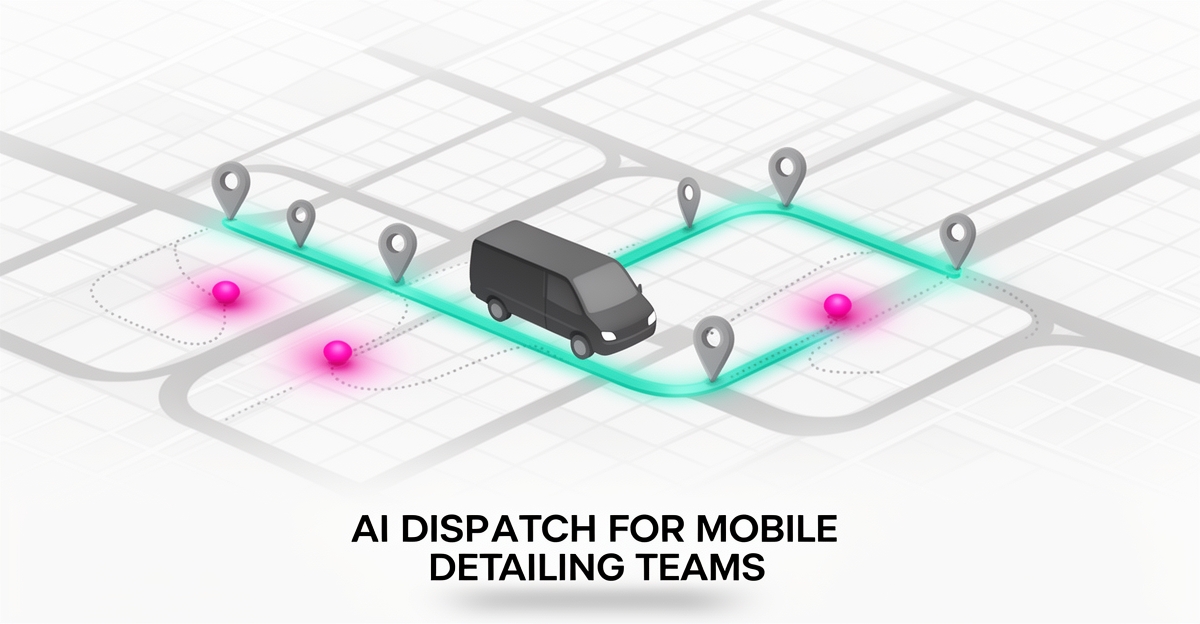
How an AI Dispatcher Can Improve Field Service Efficiency for Mobile Detailing Teams
Key Facts
- Assigning 80 jobs to 20 technicians creates roughly 20⁸⁰ combinations—about 1.2 × 10¹⁰⁴ options—beyond human capacity, per field service research.
- Field service organizations typically report first-time fix rates around 75%, meaning roughly one in four jobs requires a repeat visit, per field service research.
- Each unnecessary truck roll typically costs $200–$300 in labor, fuel, and opportunity cost, according to industry data.
- Roughly half of repeat field service visits are caused by parts unavailability, making dispatch a skills-plus-parts-plus-routing problem, research shows.
- Around half of field service leaders cite data quality as a key AI implementation challenge, industry surveys have found.
- Half of frontline employees report burnout at work, and 66% say they lack enough time to finish tasks, Microsoft's Work Trend Index reports.
- AI dispatch uses constraint matching—not proximity bias—to assign the best-fit technician based on skills, SLA priority, and parts readiness, industry research explains.
Hire a team member that works 24/7 — for less than a part-time wage.
AI receptionists, SDRs, dispatchers and 99+ roles. Trained on your business, fully managed.
Not sure where to start? Ask our AI planner
The Monday Morning Dispatch Bottleneck
The Monday morning rush hits mobile detailing teams like a wave: 20+ technicians, 80+ jobs, each with unique skill requirements, parts needs, customer time windows, and SLA deadlines. Manual dispatch in this scenario isn’t just difficult—it’s mathematically overwhelming. Even before considering traffic or parts availability, assigning 80 jobs to 20 technicians creates approximately 20⁸⁰ possible combinations—roughly 1.2 × 10¹⁰⁴ options—far beyond human cognitive capacity to evaluate exhaustively. This combinatorial explosion forces dispatchers into heuristic shortcuts that consistently miss optimal solutions.
These shortcuts manifest as costly operational flaws. Proximity bias—sending the nearest technician instead of the best-skilled one—leads to repeat visits when the assigned tech lacks the right certification or equipment. Static routes, built at dawn and never adjusted, ignore real-time traffic congestion and job duration variances, causing geographic backtracking that burns fuel and delays subsequent appointments. Skill mismatches send generalists to specialized detailing jobs requiring paint correction or ceramic coating expertise, triggering escalations and second trips. Field service research consistently shows first-time fix rates hovering around 75%, meaning roughly one in four jobs requires a repeat visit. With each unnecessary truck roll typically costing $200–$300 in labor, fuel, and opportunity cost, these inefficiencies compound rapidly across a high-volume detailing operation.
The result is a cascade of SLAs slipping and customer dissatisfaction mounting. When a technician arrives unprepared due to a dispatch error, the job either fails to meet the promised time window or requires a return visit—both violations of service-level agreements. In mobile detailing, where customers often schedule around work or personal commitments, even a 30-minute delay can trigger frustration and negative reviews. AIQ Labs’ AI Dispatcher directly addresses this bottleneck by continuously optimizing assignments using live data on technician location, skill inventory, parts readiness, traffic, and time windows—shifting dispatch from reactive triage to proactive precision. For teams drowning in Monday morning complexity, this isn’t incremental improvement—it’s the difference between chaos and control.
How AI Dispatch Matches Jobs to Technicians in Real Time
Dispatch is who gets the job and when; routing is how they move between stops. Mixing the two creates tool mismatches and missed SLAs for mobile detailing teams juggling skills, parts, and tight windows.
AI dispatch starts by mapping constraints before any assignment is made. The engine ingests required skills and certifications, estimated duration from historical benchmarks, customer time windows, SLA deadlines, parts readiness, and technician location. It then queries the live pool for GPS position, schedule load, verified skill set, remaining shift availability, and on-vehicle inventory. Disqualified technicians are eliminated before ranking.
This is constraint matching, not proximity bias. According to industry research, AI dispatch uses constraint matching to assign the best-fit technician based on skills, location, availability, SLA priority, and parts readiness. The output is a ranked recommendation or an automated assignment pushed to the technician device.
Routing solves a different problem: multi-stop sequencing across a full day. It calculates the most efficient order of stops while honoring time windows, traffic, job durations, and travel distance simultaneously. Consumer navigation tools fail here because they optimize a single destination for one driver.
The combinatorial scale explains why manual boards break down. With 80 jobs and 20 technicians, the assignment space alone is roughly 20⁸⁰ combinations before route sequence and real-time traffic are added. Academic work classifies this as the Technician Routing and Scheduling Problem, an NP-hard extension of the Vehicle Routing Problem.
Data quality determines whether the math helps or hurts. Missing duration history, stale skill profiles, or undefined SLA rules propagate into every downstream decision. Industry surveys have found roughly half of field service leaders cite data quality as a key AI implementation challenge.
Real-time signals make the match actionable for mobile detailing:
- Live traffic and distance to reduce drive time between washes
- Certifications and equipment fit for paint correction or ceramic coating
- Parts readiness and on-truck inventory to protect first-time fix
- SLA priority and customer time windows for on-time completion
When technicians are dispatched on availability alone, first-time fix suffers. Field service research has found first-time fix rates around 75%, with roughly half of repeat visits caused by parts unavailability. That reinforces why dispatch is a skills-plus-parts-plus-routing problem.
AIQ Labs builds smart, production-grade dispatch systems that reduce travel time and increase on-time completions across mobile detailing operations by applying this constraint-first logic in real time. The result shifts dispatchers from routine assignment work to exception handling, with clearer ROI in high-volume operations with recurring job types and SLA accountability.
From Assignment to On-Site Execution
AI dispatchers do more than assign jobs—they extend support throughout the entire service lifecycle, ensuring technicians have what they need before they even arrive on site. By analyzing real-time data like traffic, distance, and vehicle availability, AIQ Labs’ dispatch systems match each detailing job to the best-suited technician while factoring in skill level, parts readiness, and SLA deadlines. This intelligent assignment reduces travel time and increases on-time completions, laying the foundation for efficient field execution. Industry research shows that AI-powered dispatch minimizes geographic backtracking and skill mismatches—two leading causes of repeat visits in field service operations.
Before a technician leaves the depot, AI enhances pre-job preparation through intelligent scheduling and dynamic work order generation. Systems can auto-populate work orders using customer request details, pull historical service data for similar vehicles, and flag required tools or specialty products based on job type. This ensures technicians arrive with accurate context and the right inventory, reducing guesswork on-site. Microsoft’s research highlights that real-time inventory synchronization down to the truck level can meaningfully improve first-time fix rates by preventing avoidable delays caused by missing supplies.
Once on site, AI continues to support technicians through guided workflows and contextual knowledge delivery. Mobile interfaces can provide step-by-step instructions, access to vehicle service history, and real-time parts availability across nearby trucks or depots—all without requiring the technician to leave the job location. This on-site intelligence reduces backtracking and enables faster, more accurate service delivery. Field service management guides emphasize that combining AI-driven scheduling with inventory visibility and expert guidance creates a measurable competitive advantage, especially in mobile operations where time and precision are critical.
- Intelligent scheduling that matches technician skills to job requirements
- Pre-job work order prep using historical data and customer inputs
- Truck-level inventory visibility to prevent parts shortages
- Guided on-site support via mobile workflows and knowledge access
Building a Production-Grade AI Dispatcher for Detailing
Mobile detailing teams live or die on tight windows, clean routes, and the right products on the truck. When dispatch is manual, the cost shows up in backtracking, missed SLAs, and technicians arriving without supplies.
A production-grade AI dispatcher replaces guesswork with constraint-based matching in real time. AIQ Labs builds systems that ingest live job requirements, technician GPS, traffic, parts inventory, and SLA deadlines, then solves the assignment and sequencing problem as a unified workflow. The result is fewer manual overrides and more exception handling for the dispatcher.
The approach starts with an AI Workflow Build that connects CRM, scheduling, inventory, and technician apps into a single source of truth. This eliminates the data silos that degrade AI output. According to industry research, roughly half of field service leaders cite data quality as a key AI implementation challenge, and field service analysis shows most decision-makers say they need better tools to manage technician scheduling.
From that foundation, the dispatcher operates as a managed AI Employee. The agent has a defined Dispatcher role, performs real job tasks, and works 24/7/365. It books, qualifies, and dispatches jobs end-to-end, learns from performance data, and integrates with the tools the team already uses. This is the same done-for-you model AIQ Labs uses for Receptionist, SDR, and Dispatcher roles across trades and field services—typically at a fraction of the cost of a human hire.
A production system for detailing typically includes:
- Constraint matching for skills, certifications, vehicle capacity, and product load-out
- Multi-stop route optimization that accounts for time windows, traffic, and job duration variance
- Dynamic reoptimization when jobs run long or traffic shifts mid-day
- Parts and inventory readiness checks to protect first-time fix rates
The business impact is measurable. Field service research has found first-time fix rates around 75%, with roughly half of repeat visits caused by parts unavailability. Manual dispatch also creates proximity bias and geographic backtracking that burns drive time.
Teams feel the strain too. Microsoft Work Trend Index research reports half of frontline employees report being burned out at work, and 66 percent say they don’t have enough time to finish tasks on the job. Better dispatch reduces windshield time and context switching.
AIQ Labs delivers this as owned infrastructure, not a subscription widget. Clients can start with Start Monthly for a managed AI Dispatcher with setup, training, integrations, monitoring, and improvements included. Teams needing a scoped build can use Build in Milestones to approve and pay per phase while keeping everything built so far. For a full connected operating layer, Own It Outright transfers code, agents, and data to the business with no vendor lock-in—see AI Operating Systems for how that works.
The system is built on proven multi-agent architecture—AIQ Labs has deployed 200+ multi-agent systems and runs four live SaaS products daily—and it’s deployed with validation layers, guardrails, and human-in-the-loop escalation for critical decisions.
Still paying for 10+ subscriptions that don’t talk to each other?
We build custom AI systems you own outright. No vendor lock-in. Full control.
Not sure where to start? Ask our AI planner
Frequently Asked Questions
Will an AI dispatcher actually reduce repeat visits for my mobile detailing team?
How is AI dispatch different from just using Google Maps for routing?
What data do I need to have clean for an AI dispatcher to work?
Can AI help with pre-job prep and on-site support, not just dispatch?
Is manual dispatch really that bad on a busy Monday morning?
Will AI dispatch reduce technician burnout and windshield time?
From Dispatch Chaos to Controlled Precision
Manual dispatch in mobile detailing isn't just inefficient—it's mathematically impossible to optimize at scale, leading to skill mismatches, parts shortages, geographic backtracking, and costly repeat visits that erode SLAs and customer trust. AI dispatch solves this by using constraint-based matching with real-time data on technician skills, location, parts readiness, traffic, and time windows, transforming dispatch from reactive triage into proactive precision. This shift reduces windshield time, increases first-time fix rates, and allows dispatchers to focus on exceptions rather than routine assignments. For mobile detailing teams drowning in Monday morning complexity, AIQ Labs offers a production-grade AI Dispatcher built on proven multi-agent architecture—available via Start Monthly, Build in Milestones, or Own It Outright models—to deliver measurable efficiency without vendor lock-in. To see how this applies to your operation, start with a 2-minute Fit Check, or book a free strategy call to map your biggest bottleneck and identify high-ROI automation opportunities: Free 30-Minute Strategy Call.
Make AI your competitive advantage — not just another tool.
Strategy, implementation and ongoing optimization. One partner, end to end.
Not sure where to start? Ask our AI planner