How an AI Dispatcher Can Improve Response Times for Emergency Glass Repairs
Key Facts
- Industry estimates suggest glass repair businesses miss a meaningful share of inbound calls—often cited in the 20-40% range—turning urgent opportunities into lost revenue according to industry research
- Each missed call can represent hundreds to thousands of dollars in lost revenue depending on job scope per industry research
- Emergency board-up services are typically high-value calls, with customers expecting technicians on-site within roughly 45 minutes per industry data
- AI dispatchers can meaningfully reduce response times through intelligent routing and real-time technician matching, with industry reports citing reductions of up to 40% per industry research
- Businesses that reliably capture emergency calls tend to see substantially more emergency service volume than those relying on traditional answering methods per glass repair specialists research
- AI answering services eliminate the voicemail bottleneck, a major driver of caller satisfaction per glass repair specialists research
Hire a team member that works 24/7 — for less than a part-time wage.
AI receptionists, SDRs, dispatchers and 99+ roles. Trained on your business, fully managed.
Not sure where to start? Ask our AI planner
The Cost of Slow Response in Emergency Glass Repairs
When a storefront window shatters at 2 AM or a homeowner discovers a broken sliding door during a weekend storm, every passing minute compounds the damage. Yet industry research suggests glass repair businesses can miss a substantial share of inbound calls—estimates often fall in the 20-40% range—turning urgent opportunities into lost revenue and damaged reputations.
Each missed call carries a measurable financial penalty. That same research indicates every unanswered phone line can represent hundreds to thousands of dollars in lost revenue, depending on the job scope. For emergency board-up services specifically, industry data points to these being high-value calls, with customers typically expecting technicians on-site within about 45 minutes.
The financial bleeding extends beyond single transactions. Emergency callers facing security risks or weather exposure rarely wait for callbacks; they simply dial the next competitor. When businesses fail to answer, they lose not only the immediate repair but also the potential for future contracts and referrals.
The operational costs compound quickly:
- Property damage escalates when broken glass remains unsecured, increasing liability exposure
- Customer trust erodes when urgent needs meet voicemail instead of immediate assistance
- Technicians sit idle while high-value emergency jobs route to competitors who answer first
- After-hours calls—which often carry premium pricing—go straight to competitors with 24/7 availability
Research from glass repair specialists indicates that businesses capturing these emergency calls tend to see substantially more emergency service volume than those relying on traditional answering methods. The disparity stems from availability: emergencies do not respect business hours, yet many shops still rely on voicemail or understaffed front desks during nights and weekends.
This response gap explains why forward-thinking glass companies are rethinking their dispatch infrastructure. AIQ Labs deploys AI dispatchers as managed AI employees that integrate with existing scheduling tools, ensuring every call connects immediately with the nearest available technician. By eliminating the voicemail bottleneck, these systems address the root cause of revenue leakage while keeping callers satisfied enough to drive repeat business.
The mathematics are stark: missing a large share of emergency calls creates an unsustainable competitive disadvantage. In an industry where speed equals trust, slow response times cost far more than the immediate repair fee—they erode the customer relationships that sustain long-term growth.
How AI Dispatchers Optimize Technician Routing for Faster Response
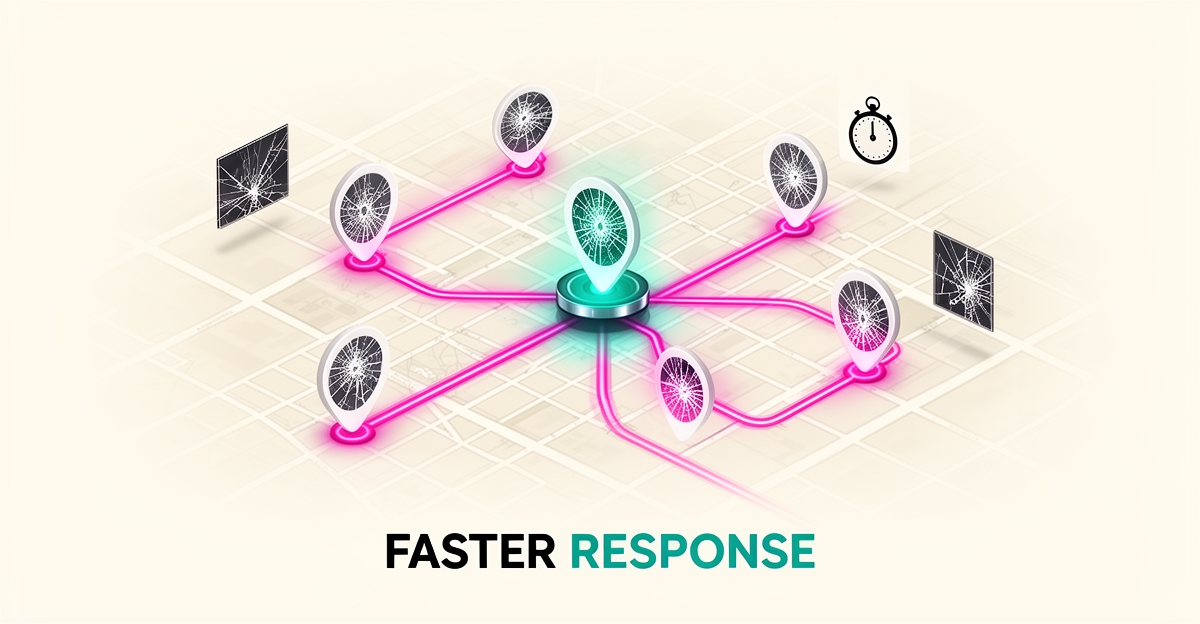
In emergency glass repair, every minute counts—delays can mean increased damage, safety risks, and lost customer trust. AI dispatchers transform response logistics by intelligently matching incoming calls with the most suitable technician in real time.
These systems analyze live technician locations, current workloads, and the specific complexity of each repair—such as whether it requires emergency board-up or full replacement—to make optimal routing decisions. By continuously processing geospatial data and service histories, AI dispatchers ensure that the nearest qualified technician is assigned immediately, minimizing travel time and avoiding unnecessary delays. Industry research reports that this intelligent routing can reduce response times—by up to 40% in some accounts—through predictive modeling and dynamic resource allocation.
The optimization goes beyond simple proximity. AI dispatchers factor in technician skill sets, vehicle equipment, and even real-time traffic conditions to prevent bottlenecks during peak demand or adverse weather. For example, a technician closer in distance might be unavailable or lack the tools for a complex storefront glass replacement, while a slightly farther technician with the right expertise and parts is better suited. The system evaluates these variables instantly to make data-driven assignments that improve first-time fix rates and overall efficiency.
- Real-time location tracking of all field technicians
- Dynamic assessment of repair complexity and required expertise
- Integration with traffic and weather data for accurate ETAs
- Continuous learning from past dispatch outcomes to refine future decisions
This approach not only cuts response times but also increases the likelihood of capturing emergency calls that might otherwise be missed—industry research suggests 20-40% of inbound emergency calls can go unanswered by glass repair businesses without intelligent dispatch support. By ensuring faster, smarter routing, AI dispatchers help businesses improve customer satisfaction, reduce secondary damage, and increase revenue opportunities from time-sensitive emergency services. For companies ready to go further, AIQ Labs can also rebuild the dispatch workflow end-to-end so this optimization becomes a seamless extension of daily operations.
Implementing AI Dispatch: From Assessment to Ongoing Optimization
For glass repair businesses facing emergency calls, implementing an AI dispatcher starts with a clear assessment of current workflows. Many shops miss a meaningful share of inbound calls, with each missed opportunity costing hundreds to thousands of dollars in lost revenue. Begin by mapping call volume, peak times, and technician availability to identify where delays occur most frequently. This baseline helps pinpoint where AI can route calls to the nearest available technician based on real-time location and repair complexity, directly addressing response time gaps.
Next, choose an implementation path that fits how you want to pay and own the technology. AIQ Labs offers three: start monthly with a managed AI dispatcher, build in milestones with a fixed-price rebuild of your dispatch workflow, or own the system outright as part of a connected AI operating system. In every case, look for real-time data analysis, geospatial routing, natural language processing for accurate call intake, and instant SMS updates to crews. Compatibility with current infrastructure minimizes disruption during rollout and accelerates time-to-value.
Train both AI and human teams to work in tandem. The AI handles initial call triage, prioritizing emergencies like board-ups where speed drives close rates, while staff focus on complex cases requiring human judgment. Use role-specific training sessions to clarify handoff protocols and monitor early interactions for accuracy. Finally, establish ongoing optimization by tracking key metrics such as average response time, call capture rate, and technician utilization. Regularly refine the AI's routing logic based on performance data to maintain efficiency gains and adapt to changing demand patterns. Start with AIQ Labs' 2-minute Fit Check, then schedule a free 30-minute strategy call to map a tailored implementation path.
Still paying for 10+ subscriptions that don’t talk to each other?
We build custom AI systems you own outright. No vendor lock-in. Full control.
Not sure where to start? Ask our AI planner
Frequently Asked Questions
How much money can a glass repair business lose from a single missed emergency call?
What percentage of emergency glass repair calls do businesses typically miss without AI dispatch support?
How much can AI dispatchers reduce response times for emergency glass repairs?
What is the expected response time customers have for emergency board-up glass services?
How does an AI dispatcher improve first-time fix rates in emergency glass repair?
How do AI dispatchers affect caller satisfaction in emergency glass repair?
Turning Missed Calls into Momentum: Your Next Step Forward
Emergency glass repair is a race against time—where every missed call means lost revenue, escalating damage, and eroded trust. As we've seen, AI dispatchers close that gap by intelligently routing calls to the nearest available qualified technician, cutting response times and capturing the emergency calls most businesses currently lose. The result isn't just faster service—it's stronger customer relationships, higher first-time fix rates, and a measurable boost in emergency service volume. For glass repair businesses ready to stop leaving money on the table, the path forward starts with clarity. Take the first step with AIQ Labs' 2-minute Fit Check, then book a free 30-minute strategy call to assess your current workflow and uncover where AI-driven dispatch can deliver real, immediate impact—no obligation, just insight.
Make AI your competitive advantage — not just another tool.
Strategy, implementation and ongoing optimization. One partner, end to end.
Not sure where to start? Ask our AI planner