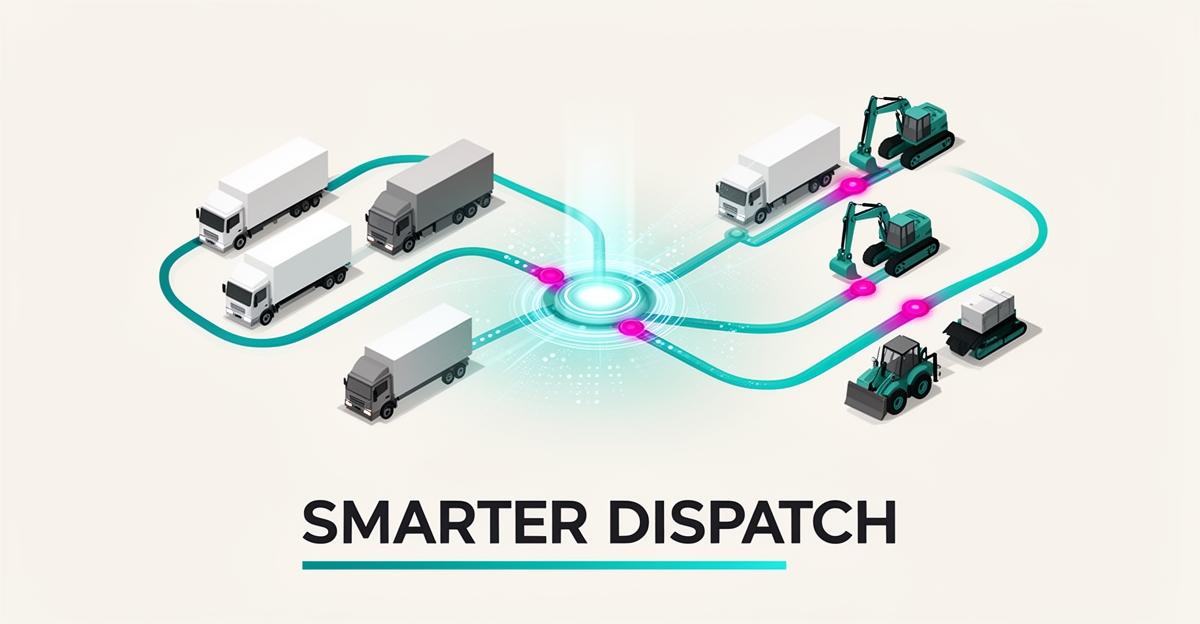
How an AI Dispatcher Can Streamline Equipment Dispatch for Rental Fleets
Key Facts
- Industry analyses report AI dispatch can cut daily planning time dramatically—work that takes hours manually often resolves in minutes according to industry analysis.
- Fleets using AI-powered dispatch typically report meaningfully fewer total miles driven per industry research.
- One dispatcher can typically manage far more vehicles with AI support than the 10–12 common with manual methods per fleet management research.
- Comparative fleet data suggests manual dispatch carries a meaningful cost premium in total operating expenses versus AI-optimized alternatives per comparative fleet data.
- A dispatcher covering 30 loads may spend several hours daily on check calls alone per logistics operations research.
Hire a team member that works 24/7 — for less than a part-time wage.
AI receptionists, SDRs, dispatchers and 99+ roles. Trained on your business, fully managed.
Not sure where to start? Ask our AI planner
The Hidden Costs of Manual Equipment Dispatch
Most rental fleet operators don't realize how much manual dispatch is quietly draining their margins until they hit the operational ceiling. Industry benchmarks commonly put the practical limit at 10 to 12 assets per dispatcher — a ratio that forces hiring cycles to outpace revenue growth.
- A dispatcher covering 30 active loads can spend several hours daily on check calls alone, leaving little bandwidth for proactive fleet optimization.
- Manual operations typically carry a meaningful cost premium in total operating expenses compared to AI-optimized alternatives.
- Planning that consumes hours manually can often be resolved in minutes with algorithmic dispatch.
The hidden cost isn't just labor — it's the reactive workflow itself. Phone-based coordination means problems surface only after customers escalate or equipment sits idle. Research from logistics operations shows this model prevents dispatchers from ever shifting into strategic fleet management. Meanwhile, fleet benchmarks suggest AI-enabled teams can manage several times more vehicles per person while cutting daily planning time from hours to minutes.
AIQ Labs builds AI dispatchers trained specifically for rental environments — agents that proactively assign forklifts and equipment based on location, availability, and demand patterns rather than waiting for the phone to ring. The shift from reactive check calls to predictive assignment is where idle time drops and response times improve.
How AI Dispatchers Proactively Optimize Fleet Allocation
The traditional dispatcher spends their day reacting to chaos, but AI flips the script entirely by predicting problems before they surface. Instead of waiting for a customer to call about a late delivery, an AI dispatcher monitors every asset in real time, analyzing location data, equipment availability, and demand patterns to make proactive allocation decisions that keep rental operations running smoothly.
This shift from reactive to proactive dispatch delivers measurable efficiency gains. According to industry analysis, AI dispatch can reduce daily planning time dramatically, turning a process that typically takes hours into one that completes in minutes. The same research shows fleets using AI-powered dispatch often report significantly fewer total miles driven, which translates directly to lower fuel costs and reduced equipment wear.
The scalability advantage is equally compelling. Where manual dispatch hits a practical ceiling at roughly 10–15 drivers per dispatcher, fleet management research suggests AI can enable a single dispatcher to manage several times that number effectively. This means rental operations can grow their fleet without proportionally growing their dispatch overhead.
The real power lies in what AI can see that humans cannot. An AI dispatcher analyzes invisible data patterns that would be impossible to track manually:
- Historical dwell times at specific customer sites, revealing which locations consistently cause delays
- Lane performance trends by day of week, identifying optimal delivery windows
- Demand probability models that predict which equipment types will be needed in specific areas
- Real-time availability across the entire fleet, enabling instant reallocation when plans change
This intelligence compounds over time. Every dispatch decision generates data that improves the next prediction, creating a system that gets smarter with each rental cycle. For rental fleets, this means the AI can pre-position equipment based on forecasted demand rather than waiting for orders to arrive.
AIQ Labs builds AI dispatchers specifically trained for field operations in rental environments, integrating with existing fleet management systems to automate routine assignments while escalating complex decisions to human dispatchers. The result is a hybrid model where AI handles optimization and humans focus on customer relationships and exception handling.
The operational impact extends beyond efficiency metrics. According to logistics research, manual dispatchers covering 30 active loads may spend several hours daily just on check-in calls. AI eliminates this administrative burden, freeing dispatchers to focus on strategic decisions that actually require human judgment.
The Hybrid Model: AI Optimization with Human Judgment
The most effective dispatch systems don’t choose between AI and human expertise—they combine both. Research shows that AI handles routing, compliance, and real-time tracking with precision, while human dispatchers excel at managing exceptions, customer escalations, and nuanced field knowledge like site access constraints. This hybrid approach lets AI compress daily planning from hours to minutes and cut total miles driven, freeing dispatchers from reactive check-in calls and manual data entry. With AI expanding how many vehicles one dispatcher can cover—versus the manual ratio of roughly 1:10–12—the role shifts from administrative burden to strategic decision-maker.
- AI optimizes equipment assignment based on location, availability, and demand patterns
- Human dispatchers resolve exceptions like blocked loading docks or after-hours access restrictions
- Real-time tracking reduces customer support calls through proactive status updates
- Dispatchers focus on relationship-driven value instead of administrative tasks
- The model preserves nuanced judgment that algorithms cannot replicate
For rental fleets, this means AI can proactively position forklifts or aerial lifts before demand spikes, while dispatchers use their expertise to navigate complex customer sites or urgent service requests. AIQ Labs supports this balance through AI Employees that handle routine dispatch workflows, enabling human teams to concentrate on high-impact decisions that build loyalty and operational resilience. The result is a dispatcher role elevated—not replaced—where technology handles the predictable and humans manage the unpredictable.
Implementation Realities: Data Readiness and Fleet Thresholds
For rental fleets considering an AI dispatcher, success hinges on two foundational elements: data readiness and fleet scale. Before any algorithm can optimize equipment assignments, the underlying data must be accurate and complete—meaning CRM records reflect real-time equipment status, tags denote specific capabilities (like lift height or fuel type), and location logic aligns with actual job site accessibility. AI scheduling is only as good as the CRM data feeding it, and poor data quality is a process problem, not a software flaw. Industry analysts have consistently flagged weak data readiness as a leading cause of AI project failure, so treat clean records as a prerequisite, not an afterthought.
Fleet size also critically influences ROI. Fleets under 5–10 units often see limited gains from automation because the contextual knowledge held by experienced dispatchers—such as which customer prefers morning deliveries or which narrow alley requires a specific forklift model—is rarely documented in systems. These unwritten "it depends" rules create a trap where AI cannot replicate nuanced judgment without explicit logic extraction. In such cases, investing in process documentation and standard operating procedures typically yields better immediate returns than pursuing AI dispatch.
- Manual dispatch remains practical for very small fleets, where human intuition outperforms algorithmic optimization
- AI can expand a single dispatcher's coverage several-fold versus the manual ratio of roughly 1:10–12
- Fleets of 20+ vehicles typically see the clearest payback from AI dispatch investment
Ultimately, AI dispatch thrives in environments where data hygiene is prioritized and scale justifies the shift from reactive, human-dependent workflows to proactive, data-driven orchestration—freeing skilled dispatchers to focus on exceptions, relationships, and strategic decisions rather than administrative check-ins. For rental operations meeting these thresholds, the path to streamlined dispatch begins not with technology, but with truthful data and clear rules.
Measurable ROI and the Cost of Delay
Delay in dispatch decisions is not a neutral choice; it is a daily margin leak that compounds across every rental. For a mid-sized fleet, manual dispatch is often already costing more than the automation it avoids.
A fleet management analysis suggests AI fleet management can save tens of thousands of dollars per year compared to manual dispatch for a 25-vehicle fleet, with the strongest returns coming from reductions in fuel, overtime, idle time, and dispatcher labor. The exact figures vary by operation, so we won't quote a fixed number here—your own utilization and labor data will tell you more than any benchmark.
The financial impact is driven by time and miles. Industry research finds AI dispatch can reduce daily planning time from hours to minutes. Fleets using AI-powered dispatch also often report meaningfully fewer total miles driven, which directly lowers fuel spend and driver hours.
Every day of delay compounds in three ways that hit the P&L immediately:
- Lost margin from idle equipment and late deliveries as manual check calls and reactive reassignments pile up
- Wasted labor when a dispatcher covering 30 active loads spends several hours a day on check calls alone
- Competitive erosion as customers increasingly expect speed and transparent status updates
Manual dispatch typically costs fleets more in total operating expenses than AI-optimized alternatives, according to comparative fleet data. The cost of transitioning to intelligent dispatch is fixed and one-time. The cost of delay compounds indefinitely in lost margin, wasted labor, and foregone growth.
This is why adoption is framed as operational survival, not a tech upgrade. AI dispatch replaces reactive, intuition-based workflows with proactive assignment based on location, availability, and demand patterns, reducing idle time and improving response times. The hybrid model keeps human dispatchers for exceptions and relationships while AI handles optimization and routine assignments.
AIQ Labs deploys AI Employees trained specifically for field operations in rental environments, working 24/7/365 alongside human teams. Through the Start Monthly engagement, a single AI Dispatcher can be built, trained on your business, integrated with your tools, and monitored on a flat monthly plan that typically costs far less than a human hire, with the ability to pause or adjust anytime. Larger operations can also phase in deeper automation through AI Workflow Builds or a full AI Operating System.
Still paying for 10+ subscriptions that don’t talk to each other?
We build custom AI systems you own outright. No vendor lock-in. Full control.
Not sure where to start? Ask our AI planner
Frequently Asked Questions
What exactly does an AI dispatcher do for a rental fleet?
When is my fleet too small to benefit from AI dispatch?
How much can I actually save by switching to AI dispatch?
Will an AI dispatcher replace my human dispatchers?
What data or systems do I need in place before implementing AI dispatch?
How does AI dispatch actually improve day-to-day operations?
From Reactive Calls to Proactive Revenue
Manual dispatch quietly caps growth at roughly 10 to 12 assets per dispatcher, burns hours a day on check calls, and typically carries a cost premium versus AI-optimized operations. The shift is from reactive phone coordination to proactive, data-driven allocation that cuts planning from hours to minutes, reduces miles, and lets one dispatcher cover far more vehicles. AI sees the patterns humans can’t — dwell times, lane trends, demand probability — and compounds smarter with every rental cycle. The most durable model is hybrid: AI handles routine assignment and optimization while humans own exceptions, relationships, and complex site knowledge. For rental fleets with clean data and 20+ assets, the payoff is real and measurable in fuel, labor, and idle-equipment costs. If your operation is hitting the manual ceiling, start by auditing data readiness and documenting the unwritten dispatch rules that drive decisions. Take the 2-minute Fit Check at https://aiqlabs.ai/apply, then book a free 30-minute strategy call at https://aiqlabs.ai/book to map your biggest bottleneck and see if an AI dispatcher trained for rental field operations is the right next step.
Make AI your competitive advantage — not just another tool.
Strategy, implementation and ongoing optimization. One partner, end to end.
Not sure where to start? Ask our AI planner