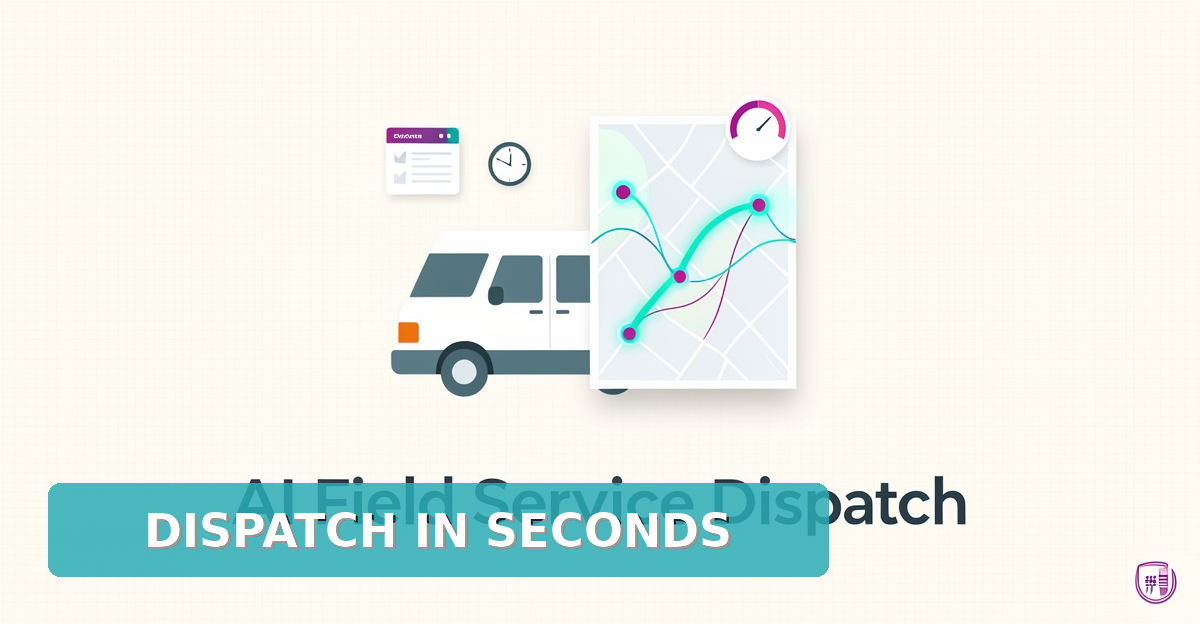
How an AI Dispatcher Can Transform Field Service Operations
Key Facts
- AI dispatchers are typically reported to reduce drive time by 30-40% within the first month of deployment according to FieldCamp data
- Manual dispatch generally becomes unsustainable when companies grow from 5 to 15-20 technicians across multiple zones per operational research
- 43% of field service organizations cite inefficient scheduling as their top operational pain point per Service Council research
- AI dispatchers can evaluate 50+ variables simultaneously in seconds vs. human dispatchers processing one job at a time per comparative analysis
- Emergency response coordination can drop from 15-20 minutes to seconds with AI dispatching per adoption studies
- AI-driven dispatching has been associated with a 20-30% lift in field workforce productivity when paired with operational improvements per Boston Consulting Group research
- Traditional dispatch software tends to become unstable past 6-8 technicians, producing 2.5+ hours of daily firefighting per dispatch software analysis
Hire a team member that works 24/7 — for less than a part-time wage.
AI receptionists, SDRs, dispatchers and 99+ roles. Trained on your business, fully managed.
Not sure where to start? Ask our AI planner
The Dispatch Bottleneck Breaking Field Service Growth
Manual dispatch works until it doesn't. Owners describe waking up at 5:30 am to figure out who's going where, and field service owners report "My dispatcher quit, and I realized everything was in her head." That tribal knowledge breaks the moment teams grow.
The skilled labor shortage forces companies to do more with fewer technicians. Industry coverage notes the shortage can only be solved by making existing people dramatically more productive, not by replacing them. Manual boards create the bottleneck.
Combinatorial complexity explodes with scale. Picture a dispatcher managing 20 technicians and 80 jobs on a Monday morning. Field service analysis explains each job carries skill requirements, time windows, SLA deadlines, and locations. Balancing all of this manually before the first job starts is where operations routinely break down.
The scaling threshold is predictable. Operational research suggests manual dispatching becomes unsustainable when companies grow from 5 technicians to 15-20 technicians spread across multiple zones. Dispatch software analysis finds traditional systems tend to become unstable past 6-8 technicians, producing 2.5+ hours of daily firefighting just to keep schedules from collapsing.
Pain points compound. Best practices research reports 43% of field service organizations cite inefficient scheduling as their top operational pain point. Salesforce industry data shows 86% of decision-makers say they need better tools to manage field technician scheduling.
Manual coordination also wastes time and money. Field service reporting documents AI dispatchers reducing drive time by 30-40% for many teams. Adoption studies point to similar travel-time reductions within the first month of deployment, with emergency response coordination dropping from 15-20 minutes to seconds.
The bottleneck is not laziness, it is cognitive load. Comparative analysis notes AI can evaluate 50+ variables simultaneously in seconds, compared to human dispatchers who process one job at a time. Traditional dispatch is a rule-based system where the human picks every assignment from a drag-and-drop calendar. It displays availability but does not tell you who should go.
Field service coordination is complex and time-intensive, and manual methods rely on spreadsheets and whiteboards that cannot adapt in real time. AIQ Labs deploys AI Employees — including dispatchers — that work 24/7 to ensure fast, reliable service delivery, handling technician assignments, route planning, and service requests in real time.
Signs the dispatch bottleneck is breaking growth:
- Owners personally building routes before sunrise to avoid conflicts
- Drive time creeping up as jobs are assigned by proximity, not optimization
- Technician burnout from overloaded days and last-minute reshuffles
- Missed SLAs and callbacks because skills and parts were not matched at dispatch
When dispatch becomes a daily firefight, growth stalls even with strong demand.
How AI Dispatchers Automate Assignment, Routing, and Real-Time Response
Every morning, field service dispatchers face a puzzle with thousands of possible solutions: which technician should take which job, in what order, and by when. AI dispatchers solve this constraint satisfaction problem in seconds, transforming what traditionally consumes hours into an automated process that considers every variable simultaneously.
The speed difference is stark. While manual dispatch typically requires 8-12 minutes per assignment decision, AI systems can evaluate options and make assignments in seconds. This isn't rushed decision-making — it's computational precision applied to a problem that exceeds human cognitive capacity when managing multiple technicians, jobs, and constraints at once.
AI dispatchers excel at skills-based matching, ensuring the right technician reaches the right job. The system cross-references technician certifications, specializations, and experience levels against job requirements automatically. For regulated trades like HVAC and electrical work, this means compliance requirements are built into every assignment, eliminating the risk of sending an underqualified technician to a job site.
Zone-based routing represents another core capability. Rather than treating each assignment in isolation, AI dispatchers analyze geographic proximity, traffic patterns, and multi-stop sequencing to minimize drive time. Field service companies implementing AI dispatch commonly report 30-40% reductions in drive time within the first month of deployment, translating directly to fuel savings and more completed jobs per day.
The technology operates through distinct layers:
- Constraint programming enforces hard rules — certifications, customer time windows, no double-booking, parts availability
- Optimization algorithms balance soft preferences like minimizing drive time, distributing workload evenly, and respecting overtime caps
- Real-time reoptimization automatically reshuffles assignments when emergencies arise or jobs run long
- Capacity tracking monitors dollars and jobs per truck to prevent overloading individual technicians
Workload balancing prevents the common pitfall of overburdening top performers while underutilizing others. The AI tracks each technician's schedule density, drive time accumulation, and job complexity to distribute work equitably across the team.
Emergency response showcases AI dispatching's real-time adaptability. When an urgent call arrives, the system instantly identifies the closest qualified technician, evaluates the impact of pulling them from their current assignment, and automatically reschedules lower-priority jobs — a process that typically requires 15-20 minutes of manual coordination compressed into seconds.
AIQ Labs builds AI dispatchers that integrate with existing scheduling systems, CRMs, and communication tools, creating a unified operational layer that works 24/7. The system learns your business's specific constraints, service zones, and technician capabilities rather than applying generic routing logic.
This isn't about replacing human judgment — it's about augmenting it. As operations research experts note, AI solves the computational complexity while dispatchers focus on exception handling, customer communication, and strategic decisions that require human insight.
From Whiteboards to 24/7 AI Employees: Implementation and Business Impact
The productivity gap between a dispatcher with a whiteboard and one with AI support is no longer marginal. According to Boston Consulting Group research, AI-driven dispatching has been associated with a 20-30% lift in field workforce productivity when paired with continuous operational improvements. For a 10-technician shop, that can translate to roughly two additional completed jobs per day without hiring anyone new.
The gains show up in three places. First, scheduling time collapses — one platform reported filling a full dispatch board in under two minutes with zero conflicts, compared to the 2.5 hours of daily firefighting many manual teams endure. Second, drive time drops as AI sequences stops by geography and traffic, not gut feel. Third, first-time fix rates climb because the system matches certifications and parts before the truck rolls, not after the wrong technician arrives.
What makes this practical for SMBs is the managed AI Employee model. Rather than buying software and training staff, you deploy an AI Dispatcher that works like a hire — trained on your service zones, your techs' certifications, and your customer windows. It integrates with your existing calendar and CRM, and you choose the oversight level:
- Auto mode: AI assigns jobs instantly and notifies your team
- Assist mode: AI queues recommendations for human approval before anything goes live
- Hybrid escalation for emergency reshuffles or high-value commercial jobs
Adoption doesn't require a capital project. AIQ Labs offers three payment models: Start Monthly for a flat monthly plan that typically costs far less than a human hire, Build in Milestones for phased builds you pay for as each phase lands, or Own It Outright for full ownership of the system. A human dispatcher works 40 hours a week; the AI equivalent covers 168 hours with zero sick days, at a fraction of that cost. See the pricing page for how each model works.
The result is dispatch that scales past the 6-8 technician breaking point where whiteboards fail, without adding administrative headcount. Your office manager stops firefighting schedules at 5:30 a.m. and starts managing exceptions instead. And when dispatch is only the start, an AI Operating System can connect dispatch with intake, invoicing, and follow-up in one layer you own outright.
Still paying for 10+ subscriptions that don’t talk to each other?
We build custom AI systems you own outright. No vendor lock-in. Full control.
Not sure where to start? Ask our AI planner
Frequently Asked Questions
At what team size does manual dispatching typically break down?
How much drive time can an AI dispatcher actually save?
Will an AI dispatcher replace my human dispatcher entirely?
How fast does an AI dispatcher make assignment decisions compared to manual dispatch?
What happens when an emergency job comes in and the schedule is already full?
How does the AI dispatcher know my technicians' certifications and our service zones?
The Dispatcher Who Never Sleeps
Manual dispatch breaks at scale — not because teams lack skill, but because the combinatorial complexity of matching technicians to jobs across zones, certifications, and time windows exceeds human cognitive capacity. AI dispatchers solve this constraint problem in seconds, evaluating 50+ variables simultaneously to cut drive time, eliminate hours of daily schedule firefighting, and lift field workforce productivity according to Boston Consulting Group research. The shift isn't about replacing dispatchers; it's about moving them from drag-and-drop triage to exception handling and strategic oversight. AIQ Labs deploys managed AI Dispatchers trained on your specific service zones, technician certifications, and compliance rules — working 24/7 in auto, assist, or hybrid modes that integrate with your existing calendar and CRM. Whether you Start Monthly with a single AI Employee, Build in Milestones on a Workflow Build, or Own It Outright with a full AI Operating System, the bottleneck that stalls growth at 6-8 technicians disappears. Ready to see what 24/7 dispatch looks like for your operation? Start the two-minute Fit Check at https://aiqlabs.ai/apply and we'll map your highest-ROI automation opportunity on a free strategy call.
Make AI your competitive advantage — not just another tool.
Strategy, implementation and ongoing optimization. One partner, end to end.
Not sure where to start? Ask our AI planner