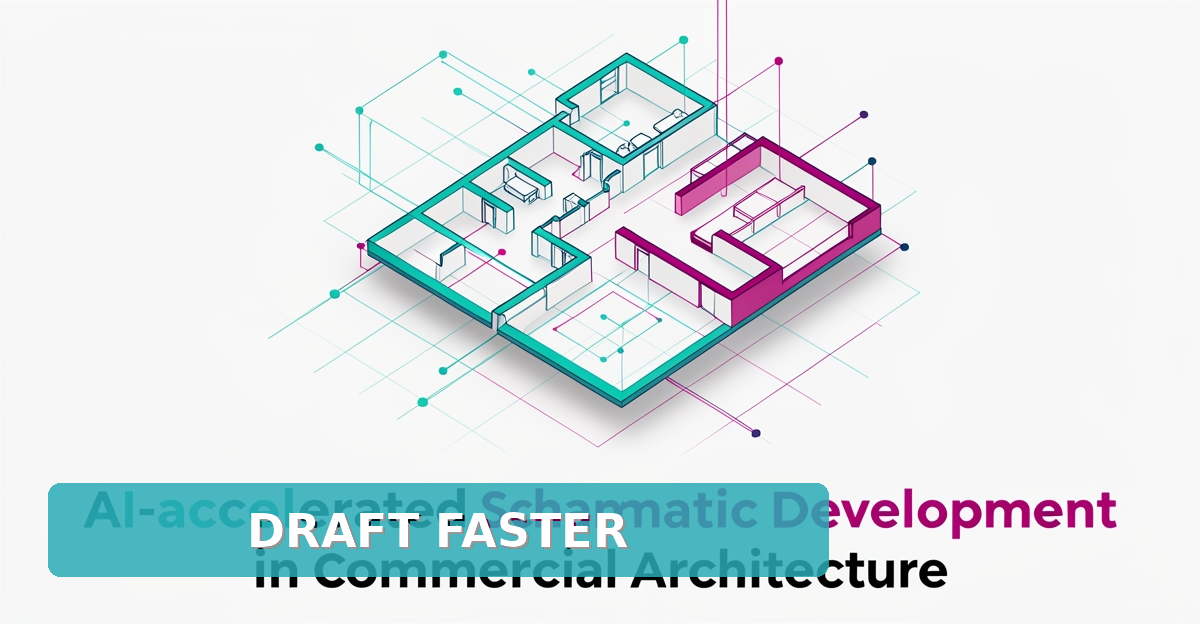
How an AI Draftsman Can Accelerate Schematic Development in Commercial Architecture
Key Facts
- Schematic design is dominated by repetitive, rule-based drafting tasks that AI handles well
- AI draftsmen generate floor plans, spatial layouts, and code notes directly from client briefs
- Gradual, phased rollout reduces risk and builds team trust
- Owned systems keep data, models, and integrations inside the firm's control
- AIQ Labs has deployed 200+ multi-agent systems and runs 4 live SaaS products daily
Hire a team member that works 24/7 — for less than a part-time wage.
AI receptionists, SDRs, dispatchers and 99+ roles. Trained on your business, fully managed.
Not sure where to start? Ask our AI planner
The Early-Stage Bottleneck in Commercial Architecture
Commercial schematic development remains a manual bottleneck that compounds as projects scale. Briefs arrive as dense narratives, site constraints pile up, and teams spend early hours translating words into lines, then revising those lines again.
Repetitive drafting consumes the first design phase. Designers interpret client briefs, build base layouts, and iterate spatial options by hand. That cycle repeats for each program change, eating hours that could move the project forward. Firms that have automated parts of this workflow typically report meaningful reductions in drafting time during schematic phases—the gains are largest in the early, iterative steps.
Market pressure is intensifying the cost of delay. Adoption of AI drafting and design automation has accelerated through 2025 and 2026 because speed at schematic stage determines feasibility, pricing, and client confidence. Firms still drafting every option by hand are competing against teams that produce three layout alternatives in the time it takes to produce one.
The early-stage workflow is dominated by tasks that are highly repetitive and rule-based:
- Brief interpretation and program-to-space translation
- Manual floor plan and spatial layout drafting
- Iterative option generation for circulation, zoning, and adjacencies
- Structural and code notes annotation across drawings
Each step requires careful attention, but not always creative judgment. Repetitive drafting ties senior designers to production work while the project clock runs.
Delay in schematics cascades. Late layout decisions force rework in documentation, clash with constructability reviews, and compress later phases. Firms that compress early hours gain schedule buffer and clearer client alignment.
AI document processing approaches are changing how briefs become drafts. Systems can generate initial floor plans, spatial layouts, and structural notes from client briefs. AIQ Labs builds custom AI systems trained on architectural standards and client data to generate actionable design drafts, keeping ownership and integration inside the firm's workflow. For firms that want to start with a single high-cost workflow rather than a full build, an AI Workflow Build rebuilds the one process that costs the most, at a fixed price, in phases.
How an AI Draftsman Accelerates Schematics
Early-stage schematics set the pace for every commercial project, and manual drafting is still the bottleneck most architecture teams feel first.
AI-powered CAD workflows automate repetitive tasks, improve precision, and compress project timelines. Teams move from redlining to refining faster because the machine produces the first pass, not the fifth.
In commercial architecture, an AI draftsman ingests a client brief and converts narrative requirements into initial geometry. The system generates initial floor plans, spatial layouts, and structural notes from text, sketches, and precedent images. Schematic generation becomes a dialogue instead of a blank-page exercise.
The biggest gains typically come from automating layout iterations, code checks, and annotation—the steps that consume hours but rarely benefit from senior design judgment.
Commercial teams use the AI draftsman to:
- Generate code-compliant floor plans from briefs, occupancy, and area targets
- Produce spatial layouts with zoning, circulation, and adjacency rules applied
- Draft structural notes and preliminary MEP coordination sketches
- Iterate options rapidly for client review without manual redraws
Adoption is driven by pressure to deliver more complex designs with leaner teams. That pressure is exactly why managed AI staff have become a practical entry point: an AI Employee can handle brief intake, document processing, and drawing-set administration as part of the team, at a fraction of the cost of a human hire.
AIQ Labs builds custom AI systems trained on architectural standards and client data to generate actionable design drafts. Briefs, standards, and past projects become training data for systems the firm owns.
The result is not replacement of design judgment. It is creators spending less time fighting tools and more time building ideas. Draftsmen review, steer, and refine AI output, while the AI handles repetitive geometry, layering, and documentation setup.
Teams that implement gradually see compounding gains. Early schematics arrive faster, client feedback loops shorten, and downstream BIM work starts from cleaner baselines. That is how AI drafting automation connects directly to commercial architecture workflows and measurable delivery improvement.
From Brief to Draft: A Practical Implementation Path
Schematic design stalls when briefs are vague and manual drafting eats early-stage time. An AI draftsman changes that by turning client language into initial floor plans, spatial layouts, and structural notes that teams can refine immediately.
The practical path starts with workflow mapping, not wholesale replacement. Identify the schematic tasks that are repetitive and rule-based — space programming, adjacency diagrams, massing studies, and code-driven notes. These early, iterative steps are where automation typically pays back first.
Integration comes next. The AI draftsman should read and write where architects already work. Connect brief intake forms, project management systems, and existing CAD/BIM tools so generated drafts land as editable files, not exports. Gradual rollout reduces risk and builds trust. Start with one project type, one team, and one deliverable, then expand as accuracy improves.
Upskilling is part of the rollout. Many professionals still lack formal AI training, and teams need clear guardrails for prompt writing, review checklists, and model feedback so the AI learns firm standards.
Monitoring keeps the system honest. Track drafting hours per schematic, revision cycles, and designer acceptance rates. Use those metrics to refine prompts, training data, and integration points. This closed loop is how schematic automation moves from experiment to standard practice.
A structured implementation path typically includes:
- Brief deconstruction and mapping to spatial parameters and building codes
- Pilot on a single commercial typology with human-in-the-loop review
- CAD/BIM integration for native file generation and version control
- Team training on prompt craft, validation, and model feedback
- Metrics dashboard for time saved, accuracy, and adoption
Commercial architecture firms can choose how fast and how deep they go, and AIQ Labs offers three payment models to match. Start Monthly lets a team add an AI draftsman with setup, training, integrations, and monitoring in a flat monthly plan that typically costs far less than a human hire. Build in Milestones suits a department-wide system built in phases with approval at each stage. For firms wanting full control, Own It Outright delivers a complete AI Operating System with code, agents, and data ownership transferred to the client.
AIQ Labs builds custom AI systems trained on architectural standards and client data to generate actionable design drafts. With 200+ multi-agent systems deployed and four live SaaS products the company runs daily, the approach is proven in production, not just in demos.
With the right workflow, integration, and upskilling, schematic development becomes faster, more consistent, and more exploratory — without losing the creative judgment architects provide.
Skills, Adoption and Risk Considerations
Many architects worry that AI will replace their creative roles, but the reality is more nuanced. AI in commercial architecture functions as an augmentation tool that handles repetitive drafting tasks, freeing professionals to focus on higher-level design decisions and client collaboration. The technology's value lies in enhancing—not replacing—human expertise.
A significant barrier to adoption is the skills gap. Many professionals lack formal AI training, which creates hesitation in integrating AI-powered CAD tools into workflows, especially when teams are unfamiliar with prompting, data validation, or interpreting AI-generated outputs. To bridge this gap, firms need targeted upskilling programs that focus on practical applications—such as refining AI-generated floor plans or validating spatial layouts—rather than requiring deep technical knowledge.
Beyond skills, integration challenges like data quality and cybersecurity must be addressed to ensure reliable and secure AI performance. Poor input data—such as incomplete client briefs or outdated standards—can lead to inaccurate drafts, while connecting AI systems to internal networks introduces potential vulnerabilities. Firms should prioritize clean, structured data pipelines and implement role-based access controls, encryption, and regular security audits. When AI systems are custom-built and owned outright—like those developed by AIQ Labs—organizations retain full control over data handling, model training, and infrastructure, reducing reliance on third-party vendors and minimizing lock-in risks. This approach supports long-term flexibility, compliance, and trust in AI-augmented design processes.
Still paying for 10+ subscriptions that don’t talk to each other?
We build custom AI systems you own outright. No vendor lock-in. Full control.
Not sure where to start? Ask our AI planner
Frequently Asked Questions
Will an AI draftsman replace architects or just speed up the boring parts?
How much time can AI actually save in schematic development?
Is the market really moving fast enough to justify investing now?
What tasks in commercial schematics are best suited for AI?
Do teams need special AI skills to use an AI draftsman effectively?
How quickly is AI adoption happening in architecture firms?
From Blueprint to Breakthrough: How an AI Draftsman Transforms Early-Stage Design
Commercial architecture teams spend countless early-stage hours turning client briefs into drafts—time better spent refining ideas, not redrawing lines. By automating space programming, adjacency layouts, and code-driven notes, an AI draftsman gives firms schedule buffer, faster client feedback, and cleaner baselines for downstream BIM work. The shift isn't about replacing design judgment—it's about freeing architects to focus on what only humans can do: creative problem-solving and client collaboration. For firms ready to test this without overhaul, AIQ Labs offers a practical path: start with a single workflow, integrate where you already work, and measure gains in time saved and adoption. To explore how an AI draftsman could fit your schematic process, take the two-minute Fit Check and schedule a free 30-minute strategy call—no obligation, just clarity on where AI can deliver real value in your early-stage design.
Make AI your competitive advantage — not just another tool.
Strategy, implementation and ongoing optimization. One partner, end to end.
Not sure where to start? Ask our AI planner