How an AI Farm Manager Can Optimize Crop Rotation and Soil Health for Organic Farms
Key Facts
- Close to 90% of Earth’s topsoil is projected to be degraded by 2050 according to recent agricultural research
- Agriculture accounts for roughly 70% of global freshwater withdrawals as reported by Intellias
- AI yield prediction models can reach high accuracy at the field level when updated with in-season satellite data per agricultural case studies
- Precision irrigation guided by AI stacks has delivered significant reductions in water usage alongside yield gains in climate-vulnerable regions per WEF Deep-Tech report
- Satellite-based soil carbon MRV has verified tens of thousands of independently verified soil carbon credits across thousands of hectares per Boomitra’s URVARA project
Hire a team member that works 24/7 — for less than a part-time wage.
AI receptionists, SDRs, dispatchers and 99+ roles. Trained on your business, fully managed.
Not sure where to start? Ask our AI planner
The Soil Health Crisis in Organic Farming: Why Guesswork Fails
Beneath the surface of every organic field lies a critical crisis: the world is running out of fertile ground. According to recent agricultural research, close to 90% of Earth’s topsoil is projected to be degraded by 2050, while agriculture already consumes roughly 70% of global freshwater withdrawals. For organic producers who cannot rely on synthetic fertilizers to mask declining fertility, this degradation represents an existential threat to both yield stability and long-term land viability.
Traditional crop rotation planning often relies on fragmented data and intuition rather than comprehensive analysis. Farmers typically juggle disparate spreadsheets, handwritten field notes, and memory to track soil nutrient levels, pest pressures, and historical performance across multiple plots. This manual approach creates dangerous blind spots, especially when machine learning research shows that standard grid sampling frequently misses nutrient deficiency patterns in fields with high variability. Without real-time insights into how specific rotations affect soil biology, organic farmers risk depleting essential microbial communities and accumulating soil-borne pathogens that synthetic inputs would normally suppress.
The complexity of organic systems demands precision that manual methods cannot deliver. Effective rotation requires balancing nitrogen-fixing legumes, heavy feeders, and pest-interrupting cover crops while accounting for unpredictable weather patterns and market demands. When modern agricultural AI demonstrates strong field-level yield prediction accuracy, the gap between algorithmic precision and human guesswork becomes stark. Organic operations face unique constraints that make optimization even more difficult:
- Limited synthetic intervention options mean soil health mistakes compound over multiple seasons
- Pest and disease cycles require precise timing of crop families to break pathogen lifecycles
- Nutrient depletion patterns vary significantly across micro-plots, demanding granular tracking
- Certification requirements restrict last-minute corrective actions, making prevention critical
These challenges compound as climate volatility increases. With global food production needing to rise substantially by mid-century to meet demand, organic farms cannot afford the yield penalties associated with suboptimal rotations or degraded soil structure. Guesswork is no longer a viable strategy when margins are tight and ecological balance is fragile.
This is where specialized AI systems offer a path forward. By aggregating soil sensor data, weather patterns, and historical crop performance into unified decision-support tools, AI can identify optimal rotation sequences that maintain fertility while disrupting pest cycles. Companies like AIQ Labs build these systems as managed [AI Employees](/ai-employees) or as a focused [Workflow Build](/workflow-builds) that rebuilds the one workflow costing the farm the most — transforming fragmented field data into actionable planting schedules. The future of organic farming depends on data-driven precision that respects biological complexity while eliminating the guesswork that threatens soil health.
How AI Farm Managers Integrate Data to Prescribe Optimal Rotations
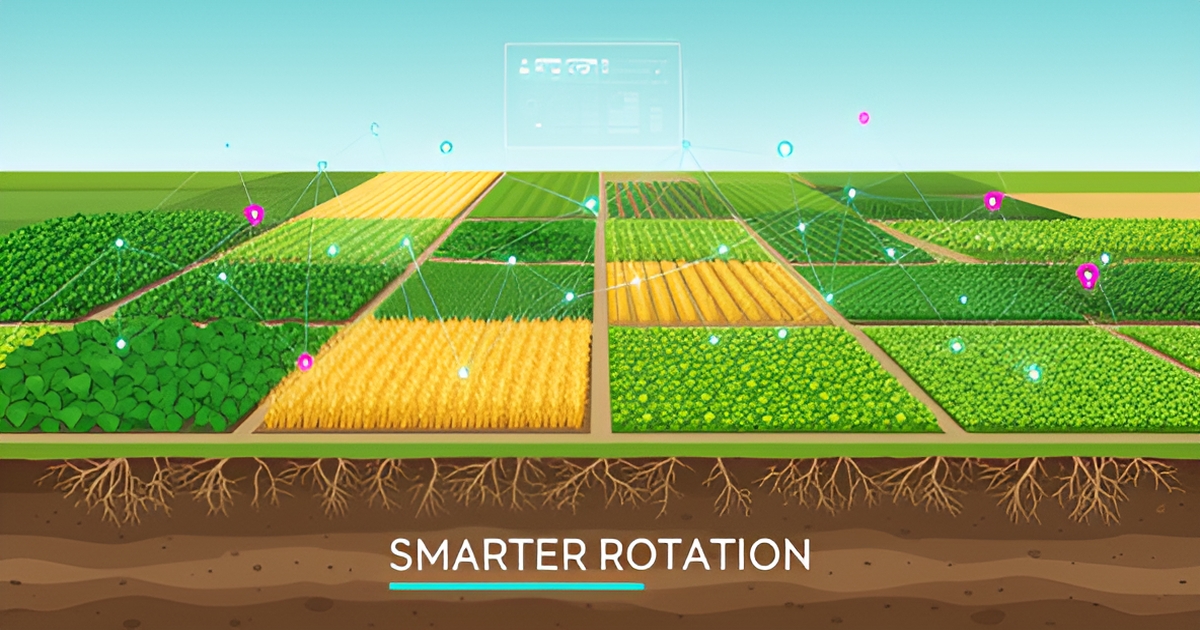
Imagine a farm manager who never sleeps, constantly analyzing every soil sensor reading, satellite image, and weather forecast to prescribe the perfect crop rotation for each field. This is the reality of AI farm managers, which transform fragmented data into precise, actionable agronomic decisions.
These systems excel at integrating multi-source data—soil sensors, satellite imagery, weather patterns, and historical crop performance—to generate dynamic, field-specific recommendations. According to Omdena's analysis, AI integrates these diverse streams to provide structured, decision-ready outputs that improve input efficiency and reduce crop loss. This capability is critical, especially as Intellias reports that agriculture accounts for roughly 70% of global freshwater withdrawals and nearly 90% of Earth's topsoil could be degraded by 2050.
The process begins with data fusion, where AI platforms aggregate real-time field data with historical records. Machine learning models then analyze this information to identify nutrient deficiency patterns that standard grid sampling misses, particularly in fields with high variability. This allows the system to recommend rotations that break pest cycles, balance nutrient uptake, and improve soil structure. For organic farms, this means optimizing legume cover crops for natural nitrogen fixation or timing brassica plantings to disrupt pest lifecycles without synthetic interventions.
Real-world deployments demonstrate the impact. Case studies show that modern AI yield prediction models achieve strong accuracy at the field level when updated with in-season satellite data, and that AI-driven precision applications have helped farms reduce input costs while lifting overall yield.
AI farm managers deliver specific rotation benefits through:
- Prescribing cover crop sequences that naturally replenish soil nitrogen
- Timing crop families to disrupt pest and disease cycles
- Balancing nutrient demands across rotation sequences
- Adapting plans in-season based on weather and soil moisture data
These systems move beyond static rotation schedules to dynamic prescriptions that respond to actual field conditions. As noted in agricultural case studies, AI platforms analyze weather forecasts, soil sensors, and market trends to generate recommendations for planting schedules and crop rotations, helping farmers make better decisions and boost productivity.
For organic operations, this data integration is transformative. By leveraging predictive analytics, farms can maintain soil health without synthetic inputs, ensuring long-term sustainability. AIQ Labs builds these systems as a connected [AI Operating System](/ai-operating-systems) — one layer that ties sensor feeds, certification rules, and planning workflows together, built in phases and owned outright by the farm.
The result is a shift from reactive to proactive farm management. With AI continuously analyzing field conditions, organic farmers can optimize rotations with confidence, knowing each decision is grounded in comprehensive, real-time data rather than intuition alone.
From Recommendation to Result: Implementing AI-Driven Rotation on Organic Farms
Moving from a theoretical rotation plan to a working system requires stitching together fragmented data streams into a single decision layer. An AI farm manager ingests satellite multispectral imagery, in-field soil sensor telemetry, historical yield maps, and microclimate forecasts, then reconciles them against organic certification constraints such as mandatory fallow periods and approved amendment windows. Research shows that effective deployments begin with a clearly defined decision problem — when to plant, what to rotate, where to amend — rather than chasing data volume for its own sake.
- Unify satellite, sensor, and weather feeds into a farm-specific digital twin
- Train models on the operation's unique soil variability and microclimate history
- Embed organic rule sets as hard constraints, not soft preferences
- Surface recommendations through field-ready dashboards and mobile alerts
Human-in-the-loop validation remains essential; agronomists review AI-generated rotation scenarios against on-the-ground realities like equipment timing and labor windows before approval. This collaborative loop sharpens the model each season, turning institutional knowledge into reusable logic. In climate-vulnerable regions, precision irrigation guided by similar AI stacks has delivered meaningful reductions in water usage alongside substantial yield gains, demonstrating the compounding value of closed-loop feedback. Meanwhile, satellite-based soil carbon MRV now verifies sequestration gains at a fraction of traditional sampling costs, with verified programs issuing tens of thousands of independently verified soil carbon credits across thousands of hectares. AIQ Labs architects these custom AI systems for organic farms, embedding the farm's specific certification rules, equipment constraints, and market windows directly into the model so recommendations are executable from day one. The result is a rotation engine that learns the land's rhythm while protecting the organic premium.
Still paying for 10+ subscriptions that don’t talk to each other?
We build custom AI systems you own outright. No vendor lock-in. Full control.
Not sure where to start? Ask our AI planner
Frequently Asked Questions
How does an AI farm manager actually improve crop rotation decisions for organic farms?
What specific benefits have organic farms seen from using AI for rotation planning?
Can AI really help prevent soil degradation in organic farming when synthetic fertilizers aren't allowed?
Is AI-based crop rotation only for large farms, or can small organic operations benefit too?
How does an AI system handle the unpredictability of weather and changing field conditions during the growing season?
What kind of data does an AI farm manager need to start optimizing rotations on an organic farm?
From Soil to Strategy: Turning Data into Organic Farming Advantage
The evidence is clear: relying on intuition for crop rotation in organic farming risks soil degradation, yield instability, and missed sustainability opportunities. By integrating soil sensor data, weather patterns, and historical performance, AI farm managers deliver precision rotation plans that break pest cycles, optimize nutrient balance, and adapt to real-time field conditions—all while respecting organic certification requirements. This shift from guesswork to data-driven decision-making protects long-term soil health and strengthens farm resilience against climate volatility. For organic producers ready to move beyond fragmented spreadsheets and reactive planning, the path forward begins with a clear assessment of where AI can unlock the highest value in their specific operations. Start the [Fit Check](/apply) — a free, no-obligation working session to map your biggest bottleneck and identify high-ROI AI automation opportunities tailored to your farm’s unique rhythm and goals.
Make AI your competitive advantage — not just another tool.
Strategy, implementation and ongoing optimization. One partner, end to end.
Not sure where to start? Ask our AI planner