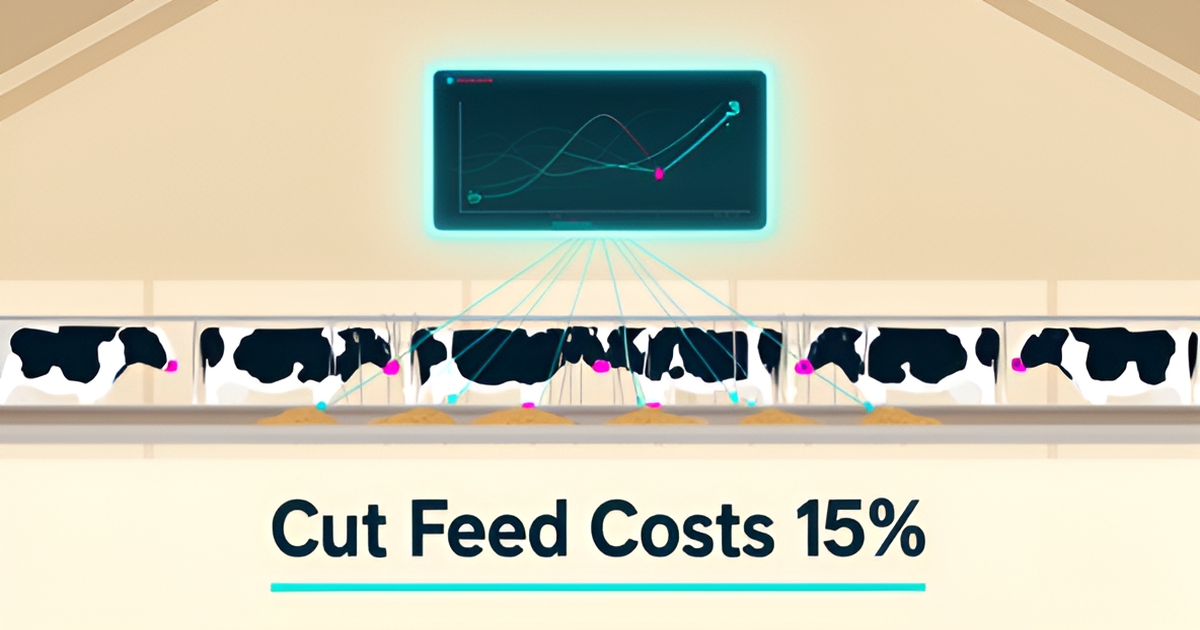
How an AI Feed Advisor Can Cut Feed Costs by 15% on a Dairy Farm
Key Facts
- Feed is typically the single largest expense category on a dairy farm, commonly consuming roughly half or more of production budgets
- Traditional group feeding overfeeds portions of the herd while underfeeding others, creating avoidable expense on every milking cow
- AI-driven precision feeding has been reported to cut feed costs by roughly 8-15% while maintaining or improving animal performance
- Larger dairy operations have adopted AI-driven tools faster than the industry average, widening the efficiency gap as of late 2026
- Modern AI feed advisors model additive dose-response curves non-linearly across dozens of ingredients and nutrients, rather than applying fixed matrix values
- Precision feeding investments vary widely by herd size and existing infrastructure; ROI timelines typically span multiple years
- AI systems can operate continuously, integrating with farm management software for ongoing feed recommendations
Hire a team member that works 24/7 — for less than a part-time wage.
AI receptionists, SDRs, dispatchers and 99+ roles. Trained on your business, fully managed.
Not sure where to start? Ask our AI planner
The Feed Cost Crisis: Why Dairy Farms Are Losing Thousands to Overfeeding
Dairy farmers face a silent profit drain that erodes margins before they see it: feed is typically the largest line item in the production budget, and traditional group feeding methods waste resources on overfeeding. This isn't just inefficiency—it's a structural leak. Imprecise nutrition planning that ignores individual animal needs and environmental variables produces avoidable expense on every cow, every day.
The problem runs deeper than wasted feed. Traditional approaches treat the herd as a single unit, applying uniform rations that fail to account for variations in lactation stage, health status, or even daily weather impacts on nutrient requirements. As a result, cows consistently receive more feed than necessary to meet production goals, driving up costs without boosting output. This one-size-fits-all mindset turns what should be a precision operation into a guessing game where profitability leaks out with every over-scooped bucket.
Meanwhile, the competitive landscape keeps shifting. Larger enterprises have adopted AI-driven precision feeding at a faster rate than the industry average, and as of late 2026 that gap continues to widen. Farms relying on manual formulation aren't just missing savings; they're falling behind competitors who use AI to analyze animal performance and weather data for optimal feed mixes, turning feed management from a cost center into a strategic advantage.
- Feed typically represents the largest share of dairy production budgets
- Traditional group feeding produces avoidable expense through systematic overfeeding
- AI adoption among larger operations outpaces the industry average, widening the competitive gap
For dairy operations still using spreadsheets and intuition to balance rations, the math is unavoidable: every day of delay means preventable losses while AI-enhanced competitors optimize nutrition down to the individual cow. The technology exists today to close this gap—systems that integrate with farm management software to deliver continuous feed recommendations—but the window to act narrows as early adopters pull further ahead in efficiency and profitability.
AIQ Labs builds production-grade AI systems that analyze animal performance and weather data to recommend optimal feed mixes, helping farms transition from reactive cost management to proactive profit protection. Depending on the scope, that can start as a single AI Workflow Build targeting the feeding workflow that costs you the most, or as a managed AI Employee that monitors herd and market data around the clock.
How AI Feed Advisors Work: Precision Nutrition Powered by Real-Time Data
Traditional feed formulation relies on static spreadsheets and safety margins that inevitably lead to overfeeding. Modern AI feed advisors replace this guesswork with continuous, data-driven precision that adapts to changing conditions in real time.
At the core of these systems lies stochastic optimization paired with non-linear ingredient modeling. Rather than applying fixed matrix values, the AI accounts for dose-response curves of additives such as phytase and proteases, calculating the probability that a given diet meets every nutritional constraint at the lowest possible cost. Industry reporting on this approach has pointed to feed expense reductions in the range of 8–15% while maintaining or improving animal performance, though actual results depend on your baseline feeding practices and data quality.
The engine ingests multiple data streams simultaneously: individual animal performance metrics, real-time weather patterns, ingredient price fluctuations, and inventory levels. By analyzing these variables together, the system recommends optimal feed mixes that reduce overfeeding and improve cost efficiency—without requiring an operator to watch dashboards around the clock.
- Continuous analysis of animal performance, weather, and market data
- Non-linear modeling of additive dose-response curves
- Stochastic optimization with user-defined confidence levels
- Autonomous operation, 24/7
- Integration with existing farm management software
Production-grade AI systems built for agricultural environments connect directly to farm management platforms, pulling sensor data and pushing ration adjustments automatically. This closed-loop operation means nutrition decisions happen continuously, not just when a consultant visits. The result is a feeding program that responds to heat stress, ingredient substitutions, or milk price shifts the moment they occur—protecting margins in an industry where feed dominates the budget.
AIQ Labs builds these custom systems on multi-agent architectures that reason through complex nutritional trade-offs while respecting the farm's operational constraints. The technology doesn't replace the nutritionist — it amplifies their expertise across every hour of every day, turning precision feeding from a periodic project into a continuous competitive advantage. For farms that want feeding connected to the rest of the operation, the same logic extends into a broader AI Operating System built in phases and owned outright.
From Strategy to Savings: Implementing an AI Feed Advisor on Your Dairy Farm
Moving from understanding the potential of AI feed advisors to actually deploying one on your dairy farm requires a structured approach that balances immediate operational needs with long-term strategic value. The farms seeing the strongest returns treat implementation not as a software purchase, but as a phased integration of data flows, decision-making processes, and team workflows.
The first practical step involves connecting the AI system to your existing farm management software and data streams. Modern AI feed advisors integrate with milking robots, rumination collars, and feed management platforms to pull real-time animal performance data. Farms that have switched from conventional formulation to AI-optimized approaches have reported feed cost reductions in the 8-15% range, but these gains depend on clean, continuous data flow between systems.
Before selecting a technology partner, establish clear data ownership protocols. Your operation generates valuable information daily, and farms often surrender this data without understanding its long-term worth. A well-structured implementation ensures you retain control over production metrics, health records, and feeding outcomes while still enabling the AI to learn and improve recommendations.
The implementation timeline typically follows a predictable arc:
- Weeks 1-4: Data integration and baseline establishment—connecting sensors, historical records, and feed inventory systems
- Weeks 5-12: Calibration period where AI recommendations run parallel to existing protocols, allowing comparison and refinement
- Months 4-6: Full deployment with automated adjustments based on weather, market prices, and herd performance
- Ongoing: Continuous optimization as the system learns your operation's specific patterns and constraints
Financial planning should account for real investment ranges, which vary considerably with herd size, existing infrastructure, and how aggressively the farm adopts the AI's recommendations. Precision feeding systems typically involve a multi-year ROI horizon rather than an immediate payback, so model your numbers against your own feed spend before committing. AIQ Labs offers flexible payment structures—Start Monthly, Build in Milestones, or Own It Outright—so the investment model matches your risk tolerance instead of a vendor's subscription targets.
Many operations find value in starting with a single workflow—such as transition cow management or lactating herd optimization—before expanding system-wide. This phased approach lets farms validate results at each stage before committing additional resources. The key is selecting a partner who builds production-grade systems you own outright, rather than subscription platforms that create ongoing dependency.
Success ultimately depends on treating the AI as a decision-support tool that enhances your team's expertise rather than replacing it. The farms achieving the strongest outcomes maintain active involvement from nutritionists and herd managers while letting the system handle continuous data analysis and routine adjustments.
Still paying for 10+ subscriptions that don’t talk to each other?
We build custom AI systems you own outright. No vendor lock-in. Full control.
Not sure where to start? Ask our AI planner
Frequently Asked Questions
How much money can an AI feed advisor actually save my dairy farm per cow each year?
What percentage reduction in feed costs can I realistically expect from implementing an AI feed advisor?
Does the AI replace my nutritionist, or how does the team work with this technology?
What kind of data does the AI feed advisor need to work, and do I need new sensors or equipment?
How long does implementation take before we see results, and what's the typical investment range?
Who owns the data my farm generates, and can I keep control of it while using an AI system?
Turn Your Feed Cost Center Into a Profit Engine
The feed cost drain on dairy farm budgets isn't going to fix itself. With feed typically the largest expense category and traditional group feeding systematically overfeeding portions of the herd, every day without precision nutrition optimization is money left on the table. AI feed advisors offer a proven path forward, with reported feed cost reductions of 8-15% through stochastic optimization that analyzes animal performance, weather patterns, and market data in real time. The technology exists today to transform your feeding program from a reactive cost center into a proactive profit engine that operates 24/7 without constant oversight. The farms already running these systems are pulling ahead with an advantage that grows harder to close each season. Start by assessing your current feed management workflow and identifying where precision automation could deliver immediate ROI. AIQ Labs builds production-grade AI systems that integrate with your existing farm management software, giving you ownership of the technology and full control over your data. Take the first step with a 2-minute Fit Check, then book a free 30-minute strategy call to map your operation's biggest opportunity and find out whether an AI feed advisor fits your farm. Questions first? Reach the team at [email protected].
Make AI your competitive advantage — not just another tool.
Strategy, implementation and ongoing optimization. One partner, end to end.
Not sure where to start? Ask our AI planner