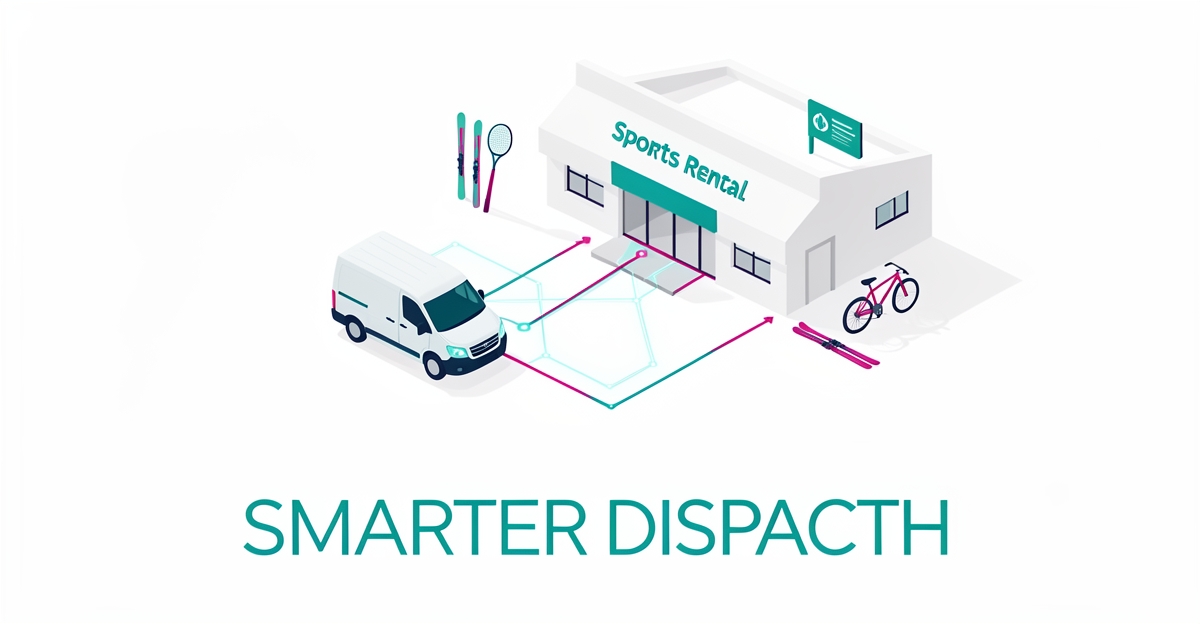
How an AI Field Dispatcher Can Streamline Equipment Delivery and Pickup at Sports Rental Outlets
Key Facts
- Assigning dozens of jobs across a full crew creates more possible combinations than any human dispatcher can evaluate, which is why manual dispatch relies on guesswork and proximity bias.
- A meaningful share of service calls require a repeat visit, most often because the right equipment or parts weren't on the truck the first time.
- Every unnecessary truck roll costs real money in fuel, labor, and lost opportunity—typically hundreds of dollars per visit.
- Static routing ignores traffic, job-duration variance, and last-minute cancellations, producing backtracking and wasted miles.
- Data quality is the most common barrier to AI dispatch success: clean job, skill, and inventory data matters more than the platform itself.
Hire a team member that works 24/7 — for less than a part-time wage.
AI receptionists, SDRs, dispatchers and 99+ roles. Trained on your business, fully managed.
Not sure where to start? Ask our AI planner
The Hidden Cost of Manual Dispatch in Sports Rental Operations
Sports rental outlets face a hidden cost in manual dispatch that silently drains resources: the sheer complexity of matching drivers and technicians to jobs. When you're assigning dozens of pickups, deliveries, and equipment swaps across a full crew, the number of possible combinations grows exponentially—far beyond what any human can evaluate. Dispatchers inevitably fall back on heuristics like proximity bias instead of optimal skill-based matching. This cognitive overload leads to mismatches that trigger repeat visits, where crews arrive with the wrong gear or without what they need to complete the job, and each unnecessary truck roll costs real money in fuel, labor, and opportunity loss. The result is a cycle of inefficiency where idle time accumulates, schedules drift, and margins erode not from lack of effort, but from the impossibility of manually solving an optimization problem that grows with every additional job and vehicle.
- Proximity bias causes dispatchers to assign the nearest available driver rather than the best-qualified one, increasing the likelihood of gaps that necessitate escalation or repeat trips.
- Static routing ignores real-time variables like traffic, job duration variance, and last-minute cancellations, leading to geographic backtracking and wasted miles that directly increase operational costs.
- Incomplete skill profiles and poor job duration estimates degrade dispatch accuracy regardless of platform, as output quality depends almost entirely on data integrity—meaning even the best AI system fails without clean inputs.
For sports rental businesses managing daily equipment pickups and deliveries, these inefficiencies manifest as crews arriving with the wrong gear, customers waiting past scheduled windows, and trucks making unnecessary trips across town—all of which compound when scaling operations. AIQ Labs addresses this by deploying AI Employees that function as intelligent dispatchers, continuously optimizing assignments using live data on crew location, skill sets, equipment availability, and customer time windows to eliminate the guesswork that plagues manual systems. These managed AI staff work around the clock at a fraction of the cost of an additional human hire. By replacing cognitive overload with data-driven precision, outlets can shift from reactive firefighting to proactive service delivery, turning dispatch from a cost center into a streamlined, predictable operation.
How AI Dispatchers Solve Scheduling Complexity with Real-Time Optimization
Manual dispatch breaks down the moment a sports rental outlet juggles dozens of pickups, deliveries, and equipment swaps across a single day. An AI field dispatcher replaces guesswork with continuous, constraint-based optimization that rebalances the schedule as conditions change.
Modern multi-agent architectures let specialized agents collaborate in real time — one tracks crew GPS and shift availability, another validates certifications for specific equipment handling, a third monitors inventory and customer time windows. The system uses constraint matching to assign the best-fit crew member based on skills, location, availability, priority, and equipment readiness. It ingests live data on job requirements, traffic, inventory, and deadlines, then solves the assignment problem against a defined constraint set.
The complexity is real. Assignment space for even a moderate day—dozens of jobs across a full crew—runs to more combinations than atoms in the observable universe, far beyond human cognitive limits. AI removes proximity bias and static routing by evaluating every viable option simultaneously, then re-optimizing when a customer cancels or traffic shifts.
The gains come from tighter sequencing, fewer backtracks, and first-time completion. Operators who move from manual to AI-assisted dispatch typically see fewer kilometres driven, more stops per hour, and materially fewer repeat trips—because the system checks equipment readiness and skill fit before a truck ever leaves the yard.
For sports rental outlets, the dispatcher continuously balances:
- Crew location and remaining shift capacity against delivery windows
- Equipment availability and required certifications for assembly or transport
- Real-time traffic and route density to minimize fuel and idle time
- Customer promises and pickup deadlines for returns
Output quality depends almost entirely on data accuracy. Bad job duration estimates and incomplete skill profiles degrade results regardless of platform, which is why data hygiene and live integrations are non-negotiable. When inputs are clean, the system shifts your dispatcher from routine assignment to exception handling.
AIQ Labs deploys this capability as managed AI employees that work 24/7, handling pickup and delivery schedules, equipment assignment by location and availability, and idle time reduction. For outlets that want to start smaller, a Workflow Build rebuilds the single most expensive dispatch workflow at a fixed price, in phases—so you see value before committing to a full AI Operating System that connects dispatch, inventory, and customer communication in one layer you own outright.
Implementing AI Dispatch: From Data Readiness to Measurable ROI
Starting with a clear assessment of workflow fit ensures the AI dispatcher aligns with existing pickup and delivery processes rather than forcing disruptive changes. Sports rental outlets must first map how work moves from customer reservation to equipment handoff, confirming the solution supports actual job types and handoffs without requiring a full process rebuild. This foundational step matters because data quality is consistently cited as the top challenge in AI implementation—workflow evaluation is critical before any technical deployment.
AIQ Labs provides a structured path forward: assessing workflow compatibility, ensuring high-quality data inputs, and integrating with your CRM and inventory systems before deploying managed AI Employees. These AI dispatchers work 24/7 without downtime, continuously optimizing assignments by analyzing crew skills, real-time location, equipment availability, and customer time windows. For sports rental operations, this eliminates the inefficiency of manual coordination where proximity bias and static routes often lead to suboptimal assignments. You can start monthly, build in milestones, or own the system outright—no lock-in, no black box.
Once implemented, measurable ROI emerges through improved KPIs that directly impact operational costs and customer experience. Tracking first-time completion rate becomes more achievable as AI reduces repeat trips caused by equipment or parts unavailability—the most common reason a crew has to circle back. By ensuring crews arrive with the correct equipment on the first attempt, outlets minimize costly truck rolls and improve productivity. The system's ability to continuously reoptimize schedules in real time further prevents idle time when jobs cancel or shift, turning potential downtime into productive service opportunities. AIQ Labs' managed AI Employees deliver this capability as functional team members that integrate with your existing tools, learn from performance data, and handle end-to-end dispatch workflows without the limitations of human availability.
Still paying for 10+ subscriptions that don’t talk to each other?
We build custom AI systems you own outright. No vendor lock-in. Full control.
Not sure where to start? Ask our AI planner
Frequently Asked Questions
How does an AI field dispatcher reduce repeat visits for sports rental equipment delivery?
What is the main reason AI dispatchers outperform manual scheduling in sports rental operations?
Can an AI dispatcher adapt to last-minute changes like cancellations or traffic delays?
What data quality issues can prevent an AI dispatcher from working effectively?
What measurable improvements can sports rental outlets expect after implementing an AI dispatcher?
Is an AI field dispatcher suitable for small sports rental businesses, or only large operations?
From Dispatch Chaos to Competitive Advantage
Manual dispatchers are fighting an unwinnable battle against exponential complexity, proximity bias, skill mismatches, and costly repeat trips. For sports rental outlets, this translates directly into missed delivery windows, wrong equipment on trucks, and hundreds of dollars lost every time a crew has to circle back. AI field dispatchers flip the equation by evaluating every viable assignment simultaneously—matching skills, location, equipment availability, and customer windows in real time while continuously reoptimizing as cancellations and traffic shift. AIQ Labs has deployed 200+ multi-agent systems and runs four live SaaS products daily, so this is capability we use ourselves, not just sell. Ready to eliminate dispatch guesswork? Start the 2-minute Fit Check at aiqlabs.ai/apply for a free 30-minute strategy call—we'll map your workflow and show you exactly where the ROI lives, or tell you honestly if it's not the right fit. Questions first? Reach us at [email protected].
Make AI your competitive advantage — not just another tool.
Strategy, implementation and ongoing optimization. One partner, end to end.
Not sure where to start? Ask our AI planner