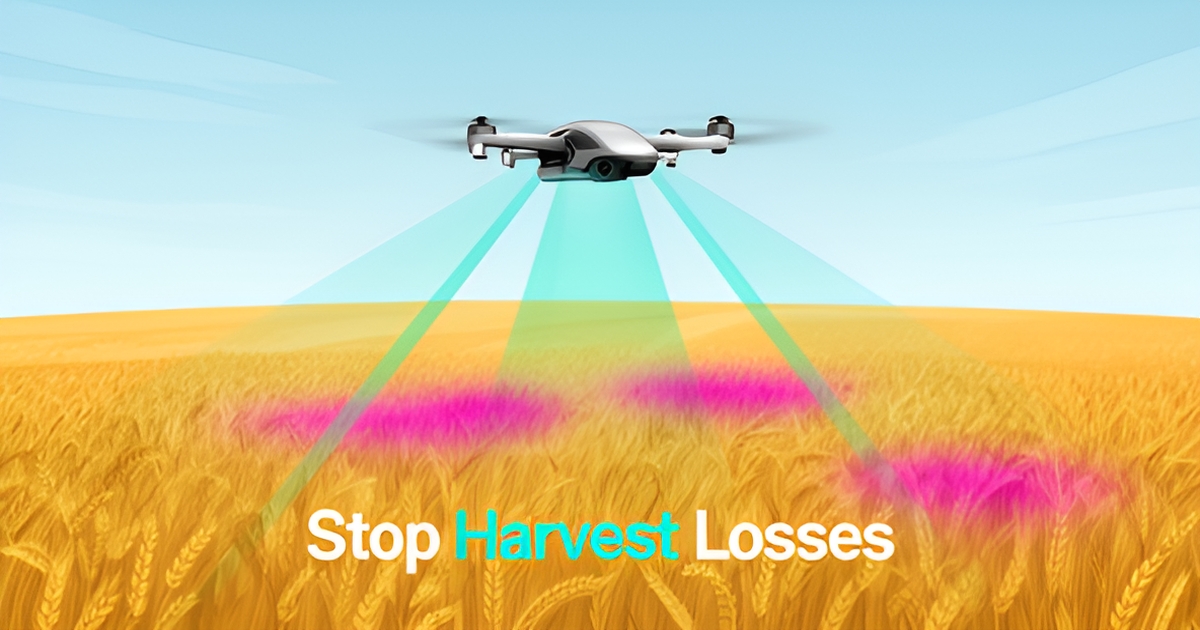
How an AI Field Technician Can Reduce Crop Losses During Harvest
Key Facts
- Harvest season compresses months of work into a window where the gap between profit and total loss narrows to hours.
- Traditional spot-checks miss early stress markers until affected acreage crosses the economic threshold and losses become irreversible.
- AI field technicians monitor moisture, temperature, and canopy health across every acre 24/7 without added overhead.
- Closed-loop control logic — sense the gap, recommend the correction, verify the result — eliminates the steady-state offset that comes from intermittent human scouting.
- AIQ Labs has deployed 200+ multi-agent systems and runs 4 live SaaS products daily, so its AI employees are built on production-proven orchestration.
- AI employees typically cost around 80% less than an equivalent human hire, with no missed shifts, sick days, or downtime.
Hire a team member that works 24/7 — for less than a part-time wage.
AI receptionists, SDRs, dispatchers and 99+ roles. Trained on your business, fully managed.
Not sure where to start? Ask our AI planner
Harvest Pressure and Why Crop Loss Spikes
Harvest season compresses months of work into a window that rarely forgives delays. When labor runs thin and weather turns, the gap between a profitable yield and a total loss narrows to hours.
Most operations still rely on visual spot-checks and end-of-day reports to catch stress signals — methods that miss the early markers of spoilage, moisture imbalance, or pest pressure. By the time a human crew spots the problem, the affected acreage has often crossed the economic threshold, and the loss is no longer recoverable.
The pressure compounds across three fronts simultaneously:
- Labor shortages leave critical scouting routes uncovered during the busiest weeks
- Narrow weather windows force harvest decisions without complete field data
- Delayed stress detection allows localized issues to spread across blocks
Traditional monitoring treats fields as uniform when variability drives outcomes. Soil moisture, canopy temperature, and disease progression shift meter by meter — patterns no periodic walk-through can map. Continuous, automated observation is what replaces reactive spot-checks with persistent visibility across complex environments.
AIQ Labs deploys managed AI employees trained for field operations, working 24/7 to support human teams without added overhead. These agents ingest sensor streams, imagery, and equipment telemetry to flag anomalies the moment they emerge — not at the next scheduled scout. The cost of inaction isn't abstract: every hour of undetected stress during harvest translates directly to bushels left in the field.
How an AI Field Technician Monitors and Responds in Real Time
Continuous monitoring during harvest separates a profitable season from one defined by preventable loss. An AI field technician operates on the same feedback principles that drive automated control systems — comparing real-time field data against optimal thresholds and applying corrective logic without waiting for human intervention. This continuous control signal ensures that emerging stress signals never sit idle while crops degrade.
- 24/7 surveillance of moisture, temperature, and canopy health across every acre
- Automated anomaly detection that flags stress patterns before they become visible to the eye
- Immediate, context-aware recommendations sent directly to equipment operators and agronomists
- Closed-loop verification that actions taken actually corrected the deviation
The system functions like a control loop for the field: the proportional response addresses the immediate error — such as a sudden moisture drop — while the integral component accounts for cumulative stress over days, and the derivative term anticipates acceleration in crop decline. This layered logic eliminates the steady-state "offset" that occurs when human scouts only sample fields intermittently. AIQ Labs' AI employees execute this loop continuously, working 24/7 to support human teams without added overhead.
Real-time observability gives the AI technician eyes and ears across the operation. Topology views, event timelines, and status tracking translate directly to harvest dashboards where every combine, grain cart, and storage bin reports live. When a combine's loss sensors spike, the AI correlates it with variety, moisture, and ground speed instantly, then recommends a specific rotor or sieve adjustment. The feedback loop closes when the next pass shows losses returning to target.
From Detection to Action: Real-Time Workflows on the Field
Harvest doesn't wait. A heat spike at noon, a dry pocket turning brittle by dusk, a crew spread across too many blocks: crop loss often comes down to how fast the field can notice, decide, and move. That's where an AI field technician earns its keep—turning live conditions into real-time harvest decisions before small problems become bin-level losses.
The workflow starts with condition sensing. Field agents pull signals from the tools farms already use—weather feeds, machine telematics, moisture readings, scouting notes, photos from the crew—and keep watch across blocks around the clock. Instead of relying on a once-a-day check, the system flags changes as they happen, so the team sees stress risk while there's still time to act.
From there, alerts need to be useful, not noisy. A good AI field technician doesn't just say "conditions changed." It ranks urgency, explains likely impact, and recommends the next move: re-check a block, adjust crew timing, prioritize a vulnerable section, or escalate to a human supervisor. That matters because farms don't need more dashboards—they need fewer missed moments.
The same logic applies to picking order and routing. When conditions shift, the AI can re-sequence harvest priorities based on ripeness, labor availability, travel time, and weather windows, then push updated instructions to supervisors or crew leads. The result is a tighter loop between detection and action, with less time lost to guesswork and fewer acres handled too late.
In practice, the workflow looks like this:
- Monitor field, weather, and equipment signals continuously
- Detect crop stress or harvest-risk patterns early
- Send prioritized alerts with recommended next steps
- Re-route crews and picking order as conditions change
- Sync updates with existing farm tools and team workflows
Integration is the difference between "interesting AI" and something crews actually use. The strongest setups plug into the systems already running the operation, rather than forcing a new layer of admin. The same operational logic that field-service businesses rely on for scheduling, dispatch, and job coordination applies on the farm, where harvest timing is measured in hours, not days.
There's also a broader lesson from real-time systems management: visibility only helps if it leads to action. In complex environments, teams rely on monitoring and orchestration layers to spot issues early and keep work moving. On the farm, the equivalent is an AI layer that watches conditions, routes attention, and keeps execution aligned.
This is where AIQ Labs fits naturally. Its managed AI employees are built to work alongside human teams, supporting field operations 24/7 without adding management burden. In agriculture, that means an AI field technician can help crews respond faster, coordinate better, and protect more of the harvest when timing matters most.
Deploying an AI Field Technician with AIQ Labs
Deploying an AI field technician with AIQ Labs starts with a Start Monthly engagement: build, training on your farm operations, tool integrations, and ongoing management, typically at around 80% less than the cost of an equivalent human hire. This model lets growers pilot the solution during a single harvest cycle and scale to full-season support based on performance, eliminating upfront complexity while ensuring the AI employee learns field-specific workflows from day one. If the harvest workflow you most need rebuilt is bigger than one role, AI Workflow Builds rebuild that single costliest workflow at a fixed price, in phases — and operations that want everything connected can graduate to an AI Operating System they own outright.
The AI field technician is trained to analyze harvest conditions, detect crop stress, and recommend real-time actions to reduce losses during peak times, working 24/7 to support human teams without added overhead. It integrates with existing farm tools via API connections, enabling automated data synchronization across irrigation systems, soil sensors, and equipment logs.
Ownership and continuous improvement are central to the deployment: AIQ Labs monitors performance, retrains the agent based on field data, and optimizes its decision-making over time, ensuring the AI employee evolves with changing conditions. This approach is grounded in production experience — AIQ Labs has deployed 200+ multi-agent systems and runs 4 live SaaS products of its own daily, so the orchestration behind your field technician is the same kind that runs real businesses.
- Starts with a defined role and job description, just like hiring a human employee
- Includes setup, training, integrations, monitoring, and improvements in a flat monthly plan
- Scales from pilot to full harvest support based on real-world performance
- Works 24/7/365 with zero missed shifts, sick days, or downtime
- Integrates with farm tools via API for end-to-end workflow automation
By treating the AI field technician as a managed team member rather than a standalone tool, growers gain a reliable, always-on resource that reduces dependency on seasonal labor while improving response times to emerging threats. Payment is straightforward — Start Monthly, Build in Milestones, or Own It Outright — with no fake prices and no vendor lock-in, just measurable outcomes in the field. See pricing details for how each model works.
To explore how an AI field technician can support your harvest operations, start with the free 30-minute strategy call at https://aiqlabs.ai/book after completing the two-minute fit check at https://aiqlabs.ai/apply.
Still paying for 10+ subscriptions that don’t talk to each other?
We build custom AI systems you own outright. No vendor lock-in. Full control.
Not sure where to start? Ask our AI planner
Frequently Asked Questions
How does an AI field technician actually detect crop stress before my crew can see it?
What happens when the AI detects a problem during harvest?
Will this replace my harvest crew or add more management overhead?
How does the AI integrate with my existing farm equipment and software?
Can the AI adapt harvest schedules when weather windows suddenly change?
How do I deploy this for my operation without a massive upfront investment?
Turn Harvest Pressure into Precision
Harvest season doesn't wait for perfect conditions—it rewards those who act fast on early warnings. As we've seen, relying on intermittent scouting means missing the narrow window where intervention saves yield. An AI field technician changes that by turning continuous data into immediate, context-aware actions: adjusting combine settings, rerouting crews, and prioritizing vulnerable blocks before stress becomes loss. This isn't about adding another dashboard; it's about closing the loop between detection and decision so your team spends less time guessing and more time protecting what's already in the field. For growers ready to move from reactive spot-checks to real-time harvest intelligence, the next step is simple. Start with a free two-minute fit check to see where an AI field technician could make the biggest impact during your peak weeks—then schedule a no-obligation strategy call to map it out. Take the fit check and discover how much more of your harvest you could bring in when every hour counts.
Make AI your competitive advantage — not just another tool.
Strategy, implementation and ongoing optimization. One partner, end to end.
Not sure where to start? Ask our AI planner