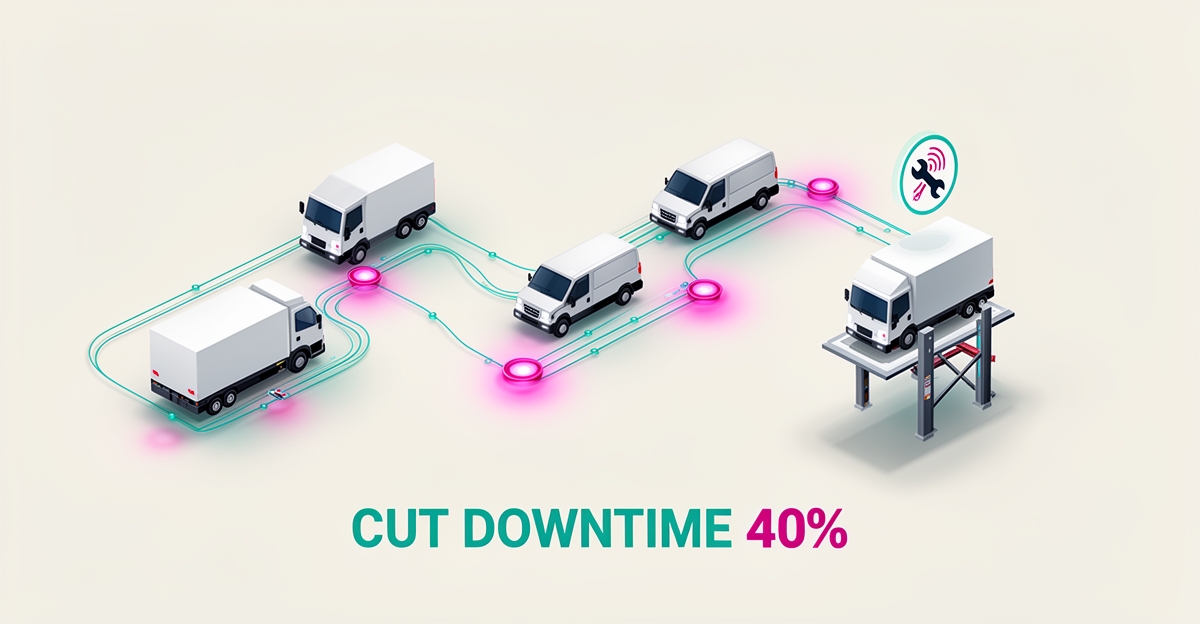
How an AI Fleet Manager Can Reduce Washing Downtime by 40% for Mobile Fleet Washing Services
Key Facts
- Predictive maintenance typically reduces fleet downtime by 25-30%, with some implementations reporting up to 50% fewer unexpected breakdowns.
- Condition-based AI systems can flag developing component issues weeks before failure, dramatically reducing surprise roadside events.
- AI-optimized routing commonly delivers fuel savings in the 10-15% range compared to manually planned routes.
- AI-supported dispatch typically lets one coordinator oversee 35-50 vehicles versus 10-12 under manual processes.
- Route planning time usually drops from an hour or more per day to under five minutes with AI-generated stop sequences.
Hire a team member that works 24/7 — for less than a part-time wage.
AI receptionists, SDRs, dispatchers and 99+ roles. Trained on your business, fully managed.
Not sure where to start? Ask our AI planner
The Hidden Cost of Reactive Fleet Management
Reactive fleet management silently drains mobile washing operations through cascading inefficiencies that compound daily. When dispatchers manually assign jobs and vehicles wait for repairs only after breaking down, the resulting downtime directly erodes billable hours and revenue potential. This break-fix approach creates a vicious cycle where minor issues escalate into major failures, forcing emergency roadside service that typically costs several times more than scheduled repairs and leaves vehicles idle when they should be generating income. Fleets relying on manual dispatch commonly carry meaningfully higher total operating expenses than AI-optimized alternatives, driven by wasted fuel, unnecessary overtime, and administrative delays that prevent optimal vehicle utilization.
The financial toll becomes stark when examining specific cost drivers in mobile washing fleets. For a typical 25-vehicle operation, manual dispatch processes generate tens of thousands of dollars in annual losses from preventable inefficiencies—suboptimal routing that burns excess fuel, dispatcher overtime spent juggling spreadsheets, and administrative overhead from manual work order creation. These losses represent not just money leaving the business, but opportunity cost: every hour a vehicle sits idle waiting for a repair or a poorly planned route is revenue that could have been earned washing fleets at client sites. Operators who switch from manual dispatch to AI-supported fleet management typically report annual savings in the $54,000-$120,000 range for fleets of this size, though your actual numbers depend on route density, fleet age, and how much manual overhead you're carrying today.
Beyond direct expenses, reactive management creates operational bottlenecks that limit growth and scalability. A single human dispatcher can effectively manage only 10-12 vehicles before becoming overwhelmed, forcing businesses to hire proportionally more staff as they expand—adding fixed costs without guaranteeing better outcomes. This constraint directly conflicts with the growth ambitions of mobile washing services seeking to serve more clients across wider geographic areas. AI-supported systems typically enable one dispatcher to oversee 35-50 vehicles by automating routine tasks like route planning and status tracking, freeing human teams to focus on exception handling and customer relationships. For mobile fleet washers, this scalability means pursuing expansion without the linear increase in administrative overhead that reactive management demands, turning operational constraints into strategic advantages.
Why Predictive Maintenance Is the Primary Downtime Killer
Predictive maintenance transforms how mobile fleet washing services handle vehicle upkeep by shifting from fixed schedules to condition-based interventions. Instead of servicing vehicles at arbitrary intervals, AI systems analyze real-time IoT sensor data—such as engine temperature, vibration, and oil quality—to detect early signs of wear. This approach enables repairs to be scheduled only when data indicates actual need, preventing unnecessary work and avoiding catastrophic failures. Industry experience consistently shows this shift reducing downtime by 25-30%, with some implementations achieving up to a 50% reduction in unexpected breakdowns. For mobile washing operations, where every idle vehicle means lost revenue, this proactive stance ensures higher availability and more consistent service delivery.
The impact extends beyond reduced downtime to significant cost and longevity benefits. By replacing parts based on actual condition rather than preset mileage, fleets avoid premature replacements and typically extend component life substantially. AI models trained on historical failure patterns can identify developing issues weeks in advance, and when predictions are acted on, unexpected failures drop sharply. The real value lies not just in predicting failure but in making the fix easy to implement—such as bundling repairs into existing maintenance windows or scheduling them during off-hours. This integration minimizes disruption and keeps technicians focused on their core tasks rather than emergency responses.
- Continuous monitoring of engine diagnostics and fluid quality
- Machine learning models trained on historical failure patterns
- Automated work order generation integrated with CMMS platforms
- Scheduled interventions during planned downtime or off-hours
- Component replacement based on actual wear data, not fixed intervals
This is exactly the kind of system [AIQ Labs](/workflow-builds) builds: a custom AI workflow that connects sensor data streams directly to maintenance scheduling and dispatch logic. These systems eliminate manual tracking and ensure that predictive insights translate into timely, actionable work orders without requiring technicians to adopt new tools or disrupt their routines. By anchoring maintenance decisions in real-time vehicle condition rather than guesswork, mobile fleet washers can achieve more reliable operations, lower long-term costs, and greater fleet availability—directly addressing one of the most persistent sources of washing downtime.
Dynamic Routing and Dispatch: Eliminating Idle Miles and Admin Drag
Mobile fleet washing lives or dies on windshield time, and manual dispatch is quietly stealing it. Hours spent planning routes and chasing exceptions create idle miles, missed windows, and dispatcher burnout that scale poorly as the fleet grows.
AI-driven dynamic routing collapses planning from an hour or more manually to under five minutes per day, freeing dispatchers from spreadsheets and phone tag. AI systems generate efficient stop sequences using live GPS, traffic, weather and service windows, then update them automatically as conditions change. That shift cuts administrative drag and keeps wash crews moving instead of waiting.
Real-time rerouting is where downtime disappears. When a traffic incident or a client delay hits, AI can dynamically reroute drivers in seconds versus the 15-45 minutes a manual replan typically takes. AI-optimized routes commonly deliver 10-15% fuel savings compared to manual routing, while improving service window adherence. For mobile washers, tighter windows mean more jobs per day without adding trucks.
Scalability changes the cost structure. Manual dispatch typically supports a 1:10-12 vehicle-to-dispatcher ratio, while AI-supported fleet management enables 1:35-50. That means one dispatcher can manage 35-50 vehicles with AI, compared to 10-12 manually. The efficiency gain is not just headcount; it is consistent coverage across expanding service areas without proportional hiring.
The operational impact shows up in three areas:
- Route planning time drops from hours to minutes, removing the daily bottleneck
- Dynamic rerouting in seconds prevents idle miles and protects promised arrival times
- Higher vehicle-to-dispatcher ratios allow growth without linear admin cost increase
This is workflow automation applied to field operations. AIQ Labs helps mobile fleet washers build custom AI systems that manage real-time dispatch and routing without manual spreadsheets or constant human oversight. The result is less idle time and more billable washes per truck.
When routing, dispatch and task assignment run as an integrated AI workflow, the fleet stops reacting and starts executing.
Implementation Roadmap: From Sensor Install to Scaled Operations
Moving from a reactive "break-fix" model to a predictive, AI-driven operation doesn't happen overnight — it happens in deliberate phases that respect how your crews already work. The goal isn't technology for its own sake; it's embedding intelligence into the daily rhythm of dispatch, maintenance, and route execution so adoption feels natural, not disruptive.
Start by equipping each wash unit with IoT sensors that stream engine temperature, vibration, fluid quality, and electrical health to a central platform. Fleets embracing AI maintenance software typically reduce downtime by 25-30% and extend component life by replacing parts only when data indicates actual need. Next, build clean data pipelines and label historical repair logs so machine learning models learn what failure looks like in your specific operation. Connect those predictions directly into your CMMS so alerts automatically become scheduled work orders — no manual handoff, no missed tickets.
- Install telematics and sensors across the fleet for continuous health monitoring
- Establish cloud data pipelines and label historical maintenance events for model training
- Deploy predictive models that flag component failures weeks before breakdown
- Integrate AI alerts with CMMS to auto-generate work orders during off-hours
- Activate dynamic routing that reroutes drivers in seconds when conditions change
Layer on AI route optimization to cut planning time from hours to under five minutes daily, recovering fuel, overtime, and admin waste across the fleet. Enable driver behavior monitoring that distinguishes coaching moments from critical safety events, reducing alert fatigue. Train dispatchers and crews in a focused 1-2 week window — framing the system as a tool that eliminates paperwork and surprise breakdowns. AIQ Labs helps mobile washing operators architect this exact sequence, ensuring each step compounds into a scalable workflow where one dispatcher manages 35-50 vehicles instead of 10-12. Monitor precision and recall in production, then expand service territory confidently knowing the operational backbone won't buckle under growth.
If you'd rather own the system outright than rent it, that's the model we build on. Our [AI Operating Systems](/ai-operating-systems) approach connects dispatch, maintenance, and routing into one operating layer, built in phases and owned by you—not a vendor lock-in subscription. You can review [pricing](/pricing) to see how Start Monthly, Build in Milestones, and Own It Outright work.
The Business Case: What the Numbers Actually Show
For mobile fleet washing services, downtime isn't just an operational hiccup—it's a direct hit to revenue. When vehicles sit idle due to breakdowns or inefficient scheduling, every minute translates to lost washing jobs and frustrated clients. AI fleet management flips this script by transforming reactive chaos into proactive precision. By predicting maintenance needs weeks in advance and optimizing routes in real time, these systems keep more trucks on the road and generating income.
A 25-vehicle fleet switching from manual dispatch to AI-supported management can typically expect annual savings in the $54,000-$120,000 range, driven by reduced fuel waste, lower overtime, and eliminated administrative delays. These gains stem from AI's ability to cut total operating expenses meaningfully compared to manual processes, primarily through 10-15% fuel savings and dynamic rerouting that takes seconds instead of minutes. Payback periods vary by operation, but operators commonly recover their investment within the first year—and often within the first quarter—because the savings compound across fuel, labor, and uptime simultaneously. Scalability amplifies this: one dispatcher using AI can effectively manage 35-50 vehicles, versus only 10-12 under manual systems, enabling growth without proportional headcount increases. AI also automates compliance reporting for HOS and DVIR requirements, eliminating hours of weekly manual logging and reducing exposure to per-incident fines that can run into five figures. For mobile washers expanding their service area, this means consistent uptime, predictable scheduling, and the ability to take on more jobs without adding dispatch staff.
- AI-driven predictive maintenance sharply reduces unexpected failures by identifying issues weeks before breakdowns occur
- Route optimization slashes daily planning time from 60-120 minutes to under 5 minutes, freeing dispatchers for higher-value tasks
- AI-based driver behavior monitoring commonly delivers double-digit fuel savings and fewer safety incidents
These efficiencies compound over time, creating a self-reinforcing cycle where savings fund further optimization. AIQ Labs has deployed 200+ multi-agent systems and runs four live SaaS products daily, so we build and operate this technology ourselves—not just sell it. For operations that need managed capacity from day one, our [AI Employees](/ai-employees) can handle dispatch coordination, scheduling calls, and customer follow-up at a fraction of a human hire's cost. The result is a fleet that runs cleaner, longer, and more profitably, with downtime minimized not through luck, but through design.
Still paying for 10+ subscriptions that don’t talk to each other?
We build custom AI systems you own outright. No vendor lock-in. Full control.
Not sure where to start? Ask our AI planner
Frequently Asked Questions
How much can AI fleet management reduce downtime for mobile washing services?
What kind of savings can a 25-vehicle mobile washing fleet expect from switching to AI fleet management?
How long does it take to break even on an AI fleet management investment for a mobile washing business?
Can one dispatcher really manage more vehicles with AI fleet management?
How much time does AI save on daily route planning for mobile fleet washing operations?
Is AI fleet management too complex or disruptive to implement for small mobile washing teams?
Key Takeaways
Mobile fleet washing doesn't have to run on spreadsheets, surprise breakdowns, and dispatcher burnout. AI-driven predictive maintenance typically cuts downtime by 25-30% while extending component life, and dynamic routing keeps crews moving between billable jobs instead of idling. The operators winning in 2026 are the ones who treat dispatch, maintenance, and routing as one connected system—not three separate problems.
The next step is simple: complete the 2-minute Fit Check at [AIQ Labs](/apply) and book a free 30-minute strategy call. We'll map where your downtime actually comes from and show you the phased path to a system you own outright.
Make AI your competitive advantage — not just another tool.
Strategy, implementation and ongoing optimization. One partner, end to end.
Not sure where to start? Ask our AI planner