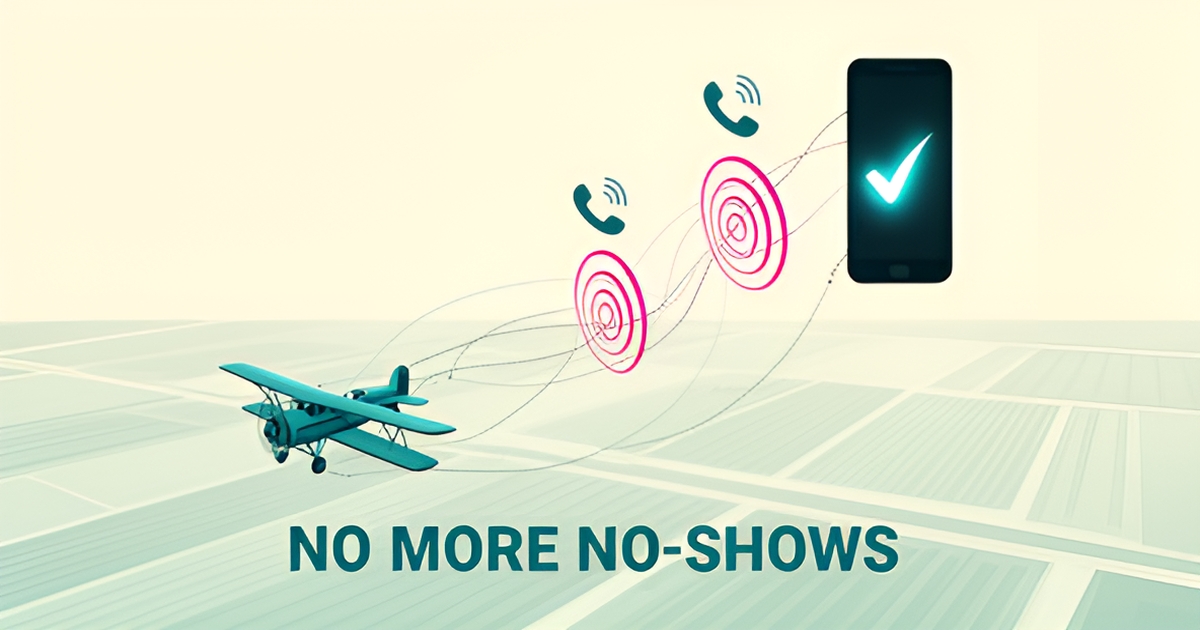
How an AI Receptionist Can Cut No-Show Calls in Crop Dusting Operations
Key Facts
- Small businesses typically miss a large share of incoming calls during business hours—a persistent revenue leak for operations where crews are airborne or in the field.
- Most callers who reach voicemail don't call back, meaning every unanswered ring is likely a lost customer.
- Over half of callers refuse to leave a voicemail, so missed calls directly erase revenue opportunities.
- In field services like aerial application, a single missed call can represent hundreds to thousands of dollars in lost revenue, depending on the job.
- AI receptionists reduce no-shows through instant answers, confirmations, reminders, and real-time field updates.
- A managed AI Employee typically costs far less than a human hire—often around 80% less—while covering nights, weekends, and peak-season surges.
Hire a team member that works 24/7 — for less than a part-time wage.
AI receptionists, SDRs, dispatchers and 99+ roles. Trained on your business, fully managed.
Not sure where to start? Ask our AI planner
The Silent Revenue Killer: Missed Calls in Aerial Application
A missed call in aerial application isn't an inconvenience — it's a spray window that closes. When a grower needs an immediate field treatment, the operator who answers first wins the job, and the one who doesn't often never gets a second chance.
Small and local businesses miss a significant portion of incoming calls during business hours, and the share climbs after hours. For crop dusting operations, that gap is costly. In field-service sectors like contracting and home services, each missed call typically represents a potential revenue loss ranging from a few hundred to a few thousand dollars.
The problem compounds because callers don't wait. Most unanswered callers never attempt to contact the business again. Voicemail makes it worse: over half of callers won't leave a message. If you miss their call, you miss their business.
That pattern creates a silent revenue leak across the season. Calls come in during flight, refueling, or between fields when a human receptionist isn't available. After-hours inquiries spike before planting and harvest, and most after-hours missed calls are never followed up on. Urgent jobs get routed to competitors who can confirm availability instantly.
Aerial application teams face specific pressure points that amplify the cost of unanswered phones:
- Peak windows where pilots and dispatchers are airborne and unreachable
- After-hours and weekend calls from growers managing weather-dependent schedules
- Rapidly changing field conditions requiring real-time updates and rescheduling
- High-value, time-sensitive jobs where delay means crop loss
Without instant answering, operations lose more than calls. They lose trust, repeat business, and the ability to route urgent jobs before the weather changes.
AI-powered inbound call management changes the math by answering instantly, every time. An AI Receptionist can screen calls, confirm field status, and book or reschedule applications while the crew is in the air. Immediate response, confirmations, and live status updates are what drive no-shows down.
AIQ Labs helps crop dusting firms deploy this capability through managed AI Employees that plug into existing workflows without disruption. The result is a consistent front door for high-value aerial work, even when the team is off the phone and on the field.
Why Traditional Fixes Fail: Staffing Gaps and Cost Traps
A full-time human receptionist typically costs several thousand dollars per month for 40 hours of weekly coverage, while offshore call centers run $10–$25 per hour—yet neither aligns with the unpredictable, weather-dependent flight schedules of crop dusting operations. These traditional fixes fail because they assume steady call volumes, ignoring how sudden storm delays or last-minute field access changes spike call volumes outside standard business hours. As a result, urgent dispatch requests go unanswered, pilots miss critical updates, and scheduling gaps trigger costly no-shows when crews arrive at unprepared fields.
Even when businesses invest in AI solutions, many initiatives stall due to poor integration with existing workflows. Offshore agents often lack industry-specific knowledge to prioritize aerial spraying urgency, while basic AI receptionists struggle to connect with flight scheduling software or weather monitoring tools without custom development. This creates a frustrating cycle: companies either overpay for 24/7 human coverage they don't consistently need or deploy fragmented tools that add complexity without solving the core problem of missed urgent calls during volatile operational windows.
- Small businesses typically miss a large share of calls during business hours and even more after hours, and most unanswered callers never retry
- Each missed call in field services like crop dusting can represent hundreds to thousands of dollars in lost revenue per incident
- AI automation typically cuts call-handling costs dramatically by handling routine scheduling, confirmations, and routing without added headcount
The real challenge isn't choosing between human or AI—it's avoiding the "build vs. buy" trap where custom development requires months of IT overhead and off-the-shelf tools fail to integrate with niche aviation dispatch systems. Without a managed approach that handles setup, training, and ongoing optimization, even promising AI solutions become shelfware, leaving crop dusting firms stuck with the same costly gaps in coverage that erode trust with time-sensitive agricultural clients. This sets the stage for an AI Employee model designed specifically for seasonal, high-stakes field operations where every missed call risks both revenue and reputation.
The AI Receptionist Advantage: Fewer No-Shows, 24/7 Coverage
Missed calls in aerial application aren't an inconvenience — they're lost spray windows and lost revenue. When a grower can't reach dispatch, the job goes to someone who answers, and the no-show cycle begins.
An AI Receptionist answers instantly, every time, which changes the economics of inbound calls for crop dusting operations. Over half of callers won't leave a voicemail, meaning missed calls directly impact revenue. Instant answering closes that gap at the moment it opens.
Instant answer rates are the first lever against no-shows. The system handles natural voice conversations, qualifies the request, and books directly into pilot and dispatcher calendars. Real-time field updates flow back to the caller so expectations are set before the aircraft is in the air. Urgent jobs are intelligently routed to the right operator without hold queues or manual triage.
The impact shows up in scheduling reliability. No-shows drop when confirmation, reminders, and live status checks happen at the moment of contact rather than after a missed handoff. For weather-driven operations, that reliability compounds across every spray window of the season.
Core capabilities that support crop dusting workflows include:
- Natural voice conversations with human-like pacing and intent recognition
- Calendar integration for direct scheduling and automated rescheduling
- Spam filtering and intelligent call routing to pilots and dispatchers
- Multi-language support for diverse grower bases
Coverage is continuous without added headcount. AI receptionists handle after-hours calls, weekend spikes, back-to-back call surges, holiday calls, and overflow during peak hours, ensuring every caller gets the same high-quality experience. Most operations see immediate savings while improving response speed.
Cost predictability matters for seasonal operations. Call centers cost $10–$25/hr for offshore agents and several thousand dollars per month for domestic coverage, while AI receptionists offer predictable monthly plans with zero HR overhead—and typically run around 80% less than the cost of a comparable human hire.
AIQ Labs deploys this AI employee seamlessly into existing operations without disrupting workflows, with flexible payment models—Start Monthly, Build in Milestones, or Own It Outright. The receptionist works 24/7/365, learns your routes and protocols, and integrates with the tools dispatch already uses.
Deployment Without Disruption: The Managed AI Employee Model
Most AI pilots stall because the operational lift—integrating with dispatch software, training on niche workflows, and managing ongoing optimization—falls entirely on the client. AIQ Labs flips that model: we build, train, and integrate the AI Receptionist into existing CRMs and scheduling tools in weeks, not months, so aerial applicators keep flying while the system learns the operation.
Phase 1: Discovery & Architecture maps call flows, field-update protocols, and escalation paths in one to two weeks. Phase 2: Development & Integration connects the agent to the dispatch board and CRM, then stress-tests real scenarios—weather holds, chemical-load changes, pilot reroutes. Phase 3: Deployment & Training goes live with a dedicated number and monitored handoff period. Phase 4: Optimization & Scale runs continuously, refining prompts and routing logic from actual call data.
- Predictable monthly cost below a part-time hire—build, training, integrations, and monitoring included
- Flexible payment models: Start Monthly, Build in Milestones, or Own It Outright
- Full ownership of the agent, its training data, and call recordings
- No vendor lock-in; the system runs on your infrastructure and APIs
The managed model means the operations manager never babysits the tech; they simply review regular reports showing booked jobs, routed emergencies, and hours reclaimed. AIQ Labs has deployed 200+ multi-agent systems and runs four live SaaS products daily, so the deployment playbook is proven, not theoretical.
From Missed Calls to Competitive Moat: Next Steps for Operators
The math on AI-powered call handling is no longer speculative. For aerial application operators, the question has shifted from "does this work?" to "how quickly can we capture the return?"
The economics are straightforward. An AI Receptionist delivers dramatic cost reduction compared to traditional call centers while answering instantly on every call. For a crop dusting operation where every missed call during a narrow spray window represents lost revenue, that translates directly to booked acres and completed jobs.
The efficiency gains extend beyond cost. AI receptionists answer instantly, every time, which matters because over half of callers won't leave a voicemail—they simply move on. By providing real-time field updates and routing urgent jobs, an AI Receptionist turns your phone line from a liability into a competitive asset.
Yet adoption alone is not the finish line. The real race in AI is operational—moving from pilot projects to systems that run reliably at scale. This is where the AI Maturity Curve becomes relevant. Most businesses stall at Stage 2 (Pilots), but the goal is progression:
- Exploration: Testing AI tools with limited scope
- Pilots: Running trials that often fail to scale
- Scaling: Expanding AI across departments
- Optimization: Establishing governance and efficiency
- Transformation: AI embedded in the operating model, driving strategic advantage
Deploying an AI Receptionist is the natural first step on this curve. It solves an immediate, measurable problem—missed calls and scheduling gaps—while building the operational foundation for broader automation. From there, operators can expand into a rebuilt dispatch workflow with a fixed-price Workflow Build, or eventually a fully connected AI Operating System covering dispatch coordination, customer follow-up, and integrated scheduling across the operation.
The path forward is straightforward. Start with the two-minute Fit Check at aiqlabs.ai/apply, then book a free 30-minute strategy call at aiqlabs.ai/book. This is a working session with an AI engineer, not a sales pitch. If there is no clear win, we will tell you. If there is, we will map the highest-ROI workflow for your operation.
Still paying for 10+ subscriptions that don’t talk to each other?
We build custom AI systems you own outright. No vendor lock-in. Full control.
Not sure where to start? Ask our AI planner
Frequently Asked Questions
How much can an AI receptionist reduce no-shows for crop dusting operations?
What percentage of calls do small businesses miss during business hours, and why does this hurt crop dusters specifically?
Why don't traditional solutions like hiring a receptionist or using offshore call centers work well for aerial application businesses?
What happens to callers who don't get through to a crop dusting business on the first try?
How does AIQ Labs' managed AI employee model avoid the common pitfalls of AI implementation in field services?
What cost savings can crop dusting operations expect from using an AI receptionist instead of a human agent or call center?
The Spray Window Never Waits
Missed calls in aerial application aren't just administrative gaps — they're spray windows that close permanently. Most unanswered callers never try again, and each missed connection can represent hundreds to thousands of dollars in lost revenue. An AI Receptionist changes that equation by answering instantly, providing real-time field updates, and routing urgent jobs without human bottlenecks. For operations where weather dictates the schedule and every acre counts, that reliability becomes a competitive moat. The shift from reactive phone management to proactive call handling doesn't require a technology overhaul — it requires a partner who handles the build, integration, and ongoing optimization so your team stays focused on flying. AIQ Labs deploys managed AI Employees that integrate with your existing dispatch tools and scale with seasonal demand, with payment models that fit how you buy: Start Monthly, Build in Milestones, or Own It Outright. The first step is a two-minute Fit Check at aiqlabs.ai/apply followed by a free 30-minute strategy call with an AI engineer — not a sales pitch, but a working session to map your highest-ROI workflow. If there's no clear win, we'll tell you. If there is, we'll show you exactly how to capture it.
Make AI your competitive advantage — not just another tool.
Strategy, implementation and ongoing optimization. One partner, end to end.
Not sure where to start? Ask our AI planner