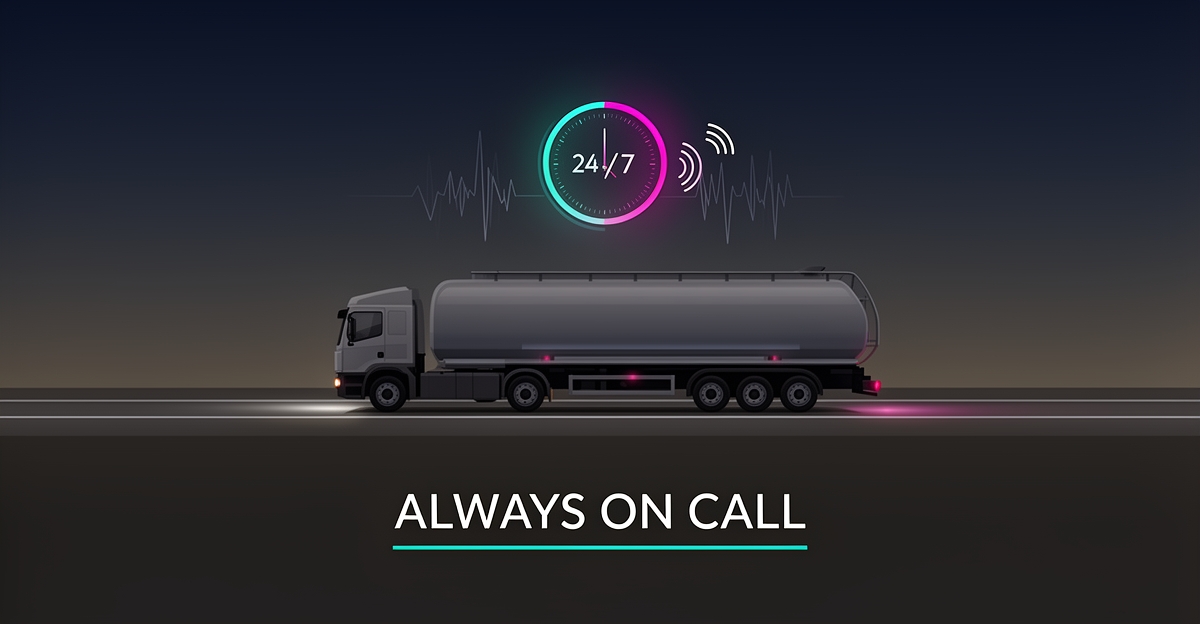
How an AI Receptionist Can Handle Customer Inquiries 24/7 for Tanker Trucking Firms
Key Facts
- AI receptionists typically answer in seconds, not the 15–30 seconds common with human phone queues—critical for urgent hazmat and rerouting calls.
- A managed AI receptionist typically costs a fraction of a full-time human hire once salary, benefits and overhead are counted.
- Most AI receptionist deployments fail at scale because firms skip integration and refinement—only a minority of companies move AI beyond proofs of concept, per widely cited adoption analyses.
- 24/7 coverage eliminates the after-hours gap that pushes tanker clients toward competitors.
- AIQ Labs has deployed 200+ multi-agent systems and runs 4 live SaaS products daily.
Hire a team member that works 24/7 — for less than a part-time wage.
AI receptionists, SDRs, dispatchers and 99+ roles. Trained on your business, fully managed.
Not sure where to start? Ask our AI planner
The Midnight Call Problem: Why Tanker Trucking Firms Lose Business After Hours
The phone rings at 2:17 AM. A long-haul driver needs to confirm a delivery window for hazardous materials, but the office has been closed for three hours. This scenario plays out nightly for tanker trucking firms, where customers call at all hours about delivery schedules, tank inspection status, or urgent service requests—yet office staff only cover standard business hours. When these after-hours inquiries go unanswered, firms don't just lose immediate opportunities; they erode trust with clients who expect real-time coordination in a time-sensitive industry. Missed calls during off-hours directly translate to delayed shipments, frustrated customers, and competitors stepping in to fill the gap.
The operational cost extends beyond lost calls. Dispatchers and office staff spend valuable morning hours returning voicemails and answering routine questions about ETAs or inspection statuses—tasks that pull them away from high-value coordination work like optimizing routes or managing compliance documentation. AI receptionists can handle customer inquiries 24/7, reducing response times and improving customer satisfaction without adding staff, making them a strong fit for SMBs that cannot afford to miss calls or carry extra payroll. By late 2026, always-on voice AI has become practical and affordable enough that running an office phone line without after-hours coverage is a choice, not a constraint.
By automating routine call handling, AI receptionists free up human teams to focus on exceptions and strategic decisions. They can instantly provide delivery window updates, schedule tank inspections, or escalate urgent service requests to the appropriate on-call technician—all while maintaining a professional, consistent experience. This shift not only improves responsiveness but also reduces the overhead costs associated with extended-hour staffing. For tanker trucking operations, where every minute of downtime impacts scheduling and safety compliance, ensuring no call goes unanswered—regardless of the hour—isn't just about customer service; it's about maintaining operational continuity in an industry that never truly sleeps.
What an AI Receptionist Actually Does for a Tanker Fleet
Tanker trucking firms operate in a high-stakes environment where every call matters—whether it's a customer asking about delivery windows, a driver reporting a tank inspection issue, or a dispatcher needing urgent shipment updates. An AI receptionist steps in as a 24/7 frontline agent, handling these real-time inquiries with speed and consistency, ensuring no call goes unanswered and no detail slips through the cracks.
When a customer calls about delivery timing, the AI receptionist accesses integrated scheduling and logistics data to provide accurate, real-time ETAs—reducing the response delays that frustrate clients waiting on critical fuel or chemical shipments. It logs tank inspection requests directly into maintenance workflows, flagging due dates or anomalies for service teams without manual data entry. For service requests—like valve repairs or cleaning schedules—the AI captures all necessary details, assigns priority levels, and routes them to the correct technician or depot, all while maintaining a natural, conversational tone that builds trust.
During peak hours or after-hours emergencies, the system handles multiple simultaneous calls and answers within seconds—far faster than typical human phone queues—ensuring urgent safety or compliance issues are escalated instantly to on-call dispatch. This capability matters for fleets operating across time zones or managing time-sensitive hazardous material transports. By automating routine inquiries and intake tasks, AI receptionists free up human staff to focus on complex decision-making, route optimization, and driver support—directly improving operational efficiency.
The result is consistent, reliable support that keeps tanker fleets moving—safely, on schedule, and without missed opportunities. Firms that deploy these systems typically see lower overhead than adding human staff while maintaining or improving service quality, because the AI covers nights, weekends, and peak surges that would otherwise require multiple hires.
Why the Market Is Moving Now: Adoption Data Trucking Firms Should Know
Tanker trucking firms are facing a window where early adoption still creates separation. Customer expectations for instant answers about delivery times, tank inspections, and service requests are rising while staffing remains tight, and AI receptionists are moving from experiment to baseline infrastructure.
The direction of travel is clear. As of late 2026, a large majority of organizations use AI in at least one business function, and voice AI in particular has matured from novelty to dependable infrastructure. Customer service is one of the fastest-moving areas: major analyst forecasts through 2025–2026 consistently pointed toward most customer service organizations adopting generative AI in some form, and that prediction has largely played out.
Logistics and transportation adoption still lags sectors like legal and financial services, which creates advantage for early movers. Firms that deploy 24/7 inquiry handling now set the service standard their competitors will have to chase later, on a steeper adoption curve.
For tanker trucking, the timing aligns with operational pressure points. Inbound call management AI can handle 24/7 inquiries about load status, inspection scheduling, and after-hours service requests without adding headcount. That reduces response times and improves customer satisfaction while keeping teams focused on dispatch and safety.
Early adopters in logistics are starting to capture measurable gains:
- 24/7 availability for delivery time and inspection inquiries outside business hours
- Faster routing of service requests and reduced missed calls
- Consistent capture of caller intent for follow-up by human dispatchers
The competitive edge comes from deployment, not just technology. Widely cited adoption analyses suggest only a minority of companies successfully scale AI beyond proofs of concept, which means firms that move from pilot to production now avoid the crowded adoption curve later.
AIQ Labs sees this pattern across SMBs that need enterprise-grade inbound coverage without enterprise overhead. With AI Employees—managed AI staff covering 99+ roles including receptionists and dispatchers—trucking firms can keep a professional voice live around the clock for tank inspections, delivery updates, and service requests, typically at around 80% less cost than a comparable human hire.
Early adoption in logistics is still emerging, and the firms that establish reliable 24/7 inquiry handling now set the service standard others will chase.
Implementation Roadmap: Deploying an AI Receptionist in 6 Practical Steps
Deploying an AI receptionist doesn't have to be overwhelming. A structured, six-step approach ensures your tanker trucking firm captures every call while maintaining the personalized service your customers expect.
Step 1: Define Your Scope
Start by identifying which call types your AI receptionist will handle. Focus on high-volume, routine inquiries like delivery status updates, tank inspection scheduling, and service request intake. Clear scoping up front is the single biggest predictor of a smooth deployment.
Step 2: Choose the Right Platform
Select a solution that integrates voice AI with your existing communication channels. Look for natural language handling, support for your callers' languages, and the ability to handle multiple simultaneous calls. By 2026 the technology is mature—the differentiator is how well a provider tailors it to your operation.
Step 3: Integrate with Dispatch and CRM Systems
Connect your AI receptionist to dispatch software, customer databases, and scheduling tools. This integration enables real-time access to delivery windows, driver availability, and service histories—the difference between an answering machine and a working member of your team.
- Map call flows for common scenarios like emergency breakdowns and scheduling changes
- Set up API connections to your TMS, CRM, and calendar systems
- Configure escalation protocols for complex or sensitive inquiries
- Test integration points with sample data before going live
Step 4: Train Your Team
Prepare staff to work alongside the AI by defining clear handoff procedures. While AI receptionists excel at routine tasks, they should transfer calls to humans whenever situations require empathy or complex problem-solving. This hybrid approach ensures critical calls—like hazmat emergencies or major client negotiations—receive immediate human attention.
Step 5: Monitor Performance Metrics
Track key indicators including first-call resolution rates, average response time, and customer satisfaction scores. AI receptionists answer within seconds compared to the 15–30 second queues common with human-staffed lines, but continuous monitoring ensures quality remains high. Address data security concerns by implementing encryption, access controls, and compliance protocols from day one.
Step 6: Refine and Optimize
Use call recordings and customer feedback to improve AI responses over time. Most companies that stall with AI skip this refinement phase. Regular updates to scripts, integration points, and escalation triggers keep your system aligned with evolving business needs.
AIQ Labs builds managed AI receptionist systems that integrate with logistics operations. Our AI Employees work 24/7/365, handling everything from routine inquiries to intelligent call routing, while your team focuses on high-value customer relationships. If your bottleneck is a broader process rather than the phone line alone, a Workflow Build targets the one workflow that costs you the most.
Ready to eliminate missed calls and reduce response times? Start the Fit Check to see whether we're a fit, or book a free 30-minute strategy call to map your implementation roadmap.
The Cost Case: AI Receptionist vs. Hiring More Office Staff
Running a tanker trucking firm means every call matters—especially when clients need delivery updates or service requests outside regular hours. Yet hiring additional office staff to cover those gaps quickly strains budgets. A human receptionist working 40 hours per week typically costs several thousand dollars monthly in loaded expenses—salary, benefits, and overhead—and still leaves a hard ceiling on availability, often leaving after-hours inquiries unanswered.
An AI receptionist flips this equation. Through AIQ Labs' Start Monthly model, a managed AI receptionist operates 24/7/365, handles multiple simultaneous calls, and never misses an inquiry—typically at around 80% less cost than a comparable human hire. Unlike a human agent limited to one call at a time, the AI system scales instantly during peak periods, ensuring every caller gets immediate attention whether it's 2 a.m. or a holiday weekend. That continuous coverage eliminates the missed-opportunity risk that damages client trust in time-sensitive logistics.
The financial advantage becomes even clearer when comparing total cost of ownership. Beyond base salary, human hires incur recruiting, training, and turnover expenses that add thousands more per employee. AIQ Labs' Start Monthly model includes setup, business-specific training, tool integrations, ongoing monitoring, and continuous improvements—all bundled into a predictable flat fee. There are no hidden costs for sick days, vacation coverage, or overtime premiums. For tanker firms managing fluctuating call volumes around delivery schedules, this means paying for consistent, reliable coverage without the variability of staffing costs.
Critically, the AI receptionist doesn't just answer calls—it actively supports core operations. It can route delivery time inquiries to dispatch teams, prioritize tank inspection requests based on urgency, and schedule service appointments directly into calendars—all while maintaining context-aware conversations. This reduces the administrative burden on existing staff, allowing them to focus on high-value tasks like route optimization or client relationship management.
For tanker trucking businesses evaluating this shift, AIQ Labs provides transparent pricing only after a free strategy call—ensuring numbers reflect your specific integration needs, call volume, and tool requirements. The Start Monthly model offers flexibility to pause or adjust service as needs evolve, while Build in Milestones and Own It Outright options let you scale toward full system ownership. By replacing unpredictable staffing costs with a fixed, always-on solution, tanker firms gain both cost predictability and the ability to capture every customer inquiry—turning phone coverage from a cost center into a competitive advantage.
Still paying for 10+ subscriptions that don’t talk to each other?
We build custom AI systems you own outright. No vendor lock-in. Full control.
Not sure where to start? Ask our AI planner
Frequently Asked Questions
How can an AI receptionist help tanker trucking firms handle after-hours calls without hiring more staff?
What specific tasks can an AI receptionist automate for a tanker fleet's daily operations?
Will customers notice they're talking to an AI instead of a person, and will it hurt trust?
How fast does an AI receptionist respond compared to a human agent, and why does that matter for urgent calls?
Is it difficult to integrate an AI receptionist with our existing dispatch and CRM systems?
What proof is there that AI receptionists actually improve efficiency and customer satisfaction in logistics?
Never Miss a Call: Turn After-Hours Inquiries Into Your Competitive Edge
Tanker trucking firms can no longer afford to let delivery questions, tank inspection requests, or urgent service calls go unanswered when the office lights go off. AI receptionists solve this by providing 24/7 coverage that captures every inquiry, slashes response times, and cuts overhead compared to hiring additional staff—all while letting your dispatchers focus on route optimization and safety compliance rather than voicemail catch-up. As of late 2026, the technology has moved from experimental to essential for logistics operations that never sleep. AIQ Labs builds managed AI receptionist systems that integrate with your existing dispatch and CRM workflows, ensuring you capture every opportunity without adding headcount. Ready to eliminate missed calls for good? Start the Fit Check or book a free 30-minute strategy call to map your implementation roadmap.
Make AI your competitive advantage — not just another tool.
Strategy, implementation and ongoing optimization. One partner, end to end.
Not sure where to start? Ask our AI planner