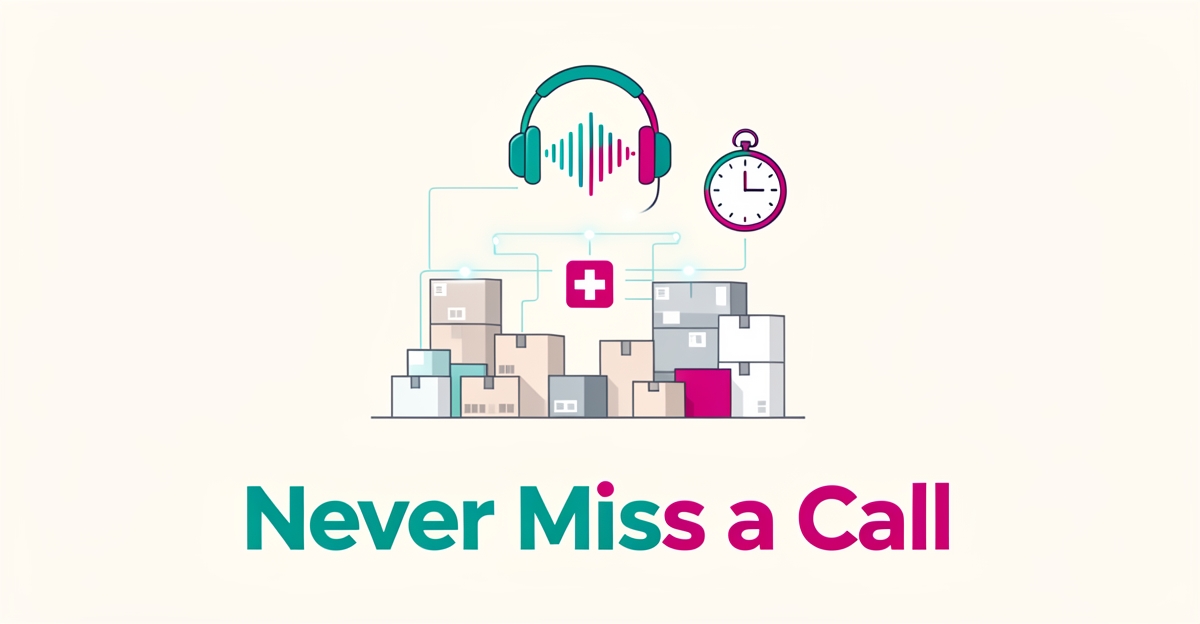
How an AI Receptionist Can Handle Inbound Calls for Medical Supply Distributors
Key Facts
- AI receptionists answer every call, 24/7—no busy signals, no voicemail, no missed after-hours orders
- A managed AI receptionist typically costs roughly 80% less than a full-time human hire
- AI receptionists handle most routine call volume—order status, stock checks, delivery windows—without human intervention
- AI receptionists answer in about two seconds and handle unlimited simultaneous calls, versus one call at a time for a human receptionist
- Human receptionists typically cover 40-50 hours per week; AI coverage never lapses
- AIQ Labs has deployed 200+ multi-agent systems and runs 4 live SaaS products daily
Hire a team member that works 24/7 — for less than a part-time wage.
AI receptionists, SDRs, dispatchers and 99+ roles. Trained on your business, fully managed.
Not sure where to start? Ask our AI planner
The Hidden Cost of Missed Calls in Medical Supply Distribution
Every missed call in medical supply distribution is a potential order walking out the door—often to a competitor who picked up. When a hospital runs low on critical supplies or a clinic faces an urgent shortage, they don't leave voicemails and wait. They call the next distributor on their list.
The stakes are highest exactly when coverage is thinnest. For a distributor, missed calls aren't random; they cluster when medical facilities need supplies most urgently—after hours and on weekends. Businesses that move from voicemail or overflow queues to always-on AI phone coverage commonly report capturing significantly more inbound leads, simply because no call goes unanswered, even at 2 AM on a Saturday.
Traditional phone systems create bottlenecks exactly when call volume spikes. A human receptionist can take one call at a time, works 40-50 hours per week, and response consistency varies with mood, fatigue, and training. During high-volume periods—flu season, emergency restocking, supply chain disruptions—callers hit busy signals or hold queues. Many hang up before anyone answers, and the order goes elsewhere.
The obvious fix, staffing a 24/7 call center, collapses under basic math. A full-time human receptionist typically costs several thousand dollars per month in salary, benefits, and taxes, and still only covers 40 hours a week. To cover nights, weekends, and holidays around the clock, you'd need multiple hires—plus recruiting and training costs on top. For most small and medium-sized distributors, that investment is simply not viable.
Meanwhile, the cost of inaction compounds quietly:
- Urgent after-hours inquiries from hospitals and clinics go unanswered, sending recurring accounts to competitors
- Front-desk staff get overwhelmed during peak periods, creating hold times that frustrate loyal customers
- Routine calls—order status, stock availability, delivery windows—consume hours that should go to complex accounts and relationship management
The economics of the alternative have shifted dramatically. A managed AI receptionist typically runs at roughly 80% less than a full-time human hire, while answering every call with the same quality at 11 PM on a Friday as the first call on Monday morning. It handles unlimited simultaneous calls with response times of about two seconds.
This is where managed AI employees have changed the calculus for SMB distributors. AIQ Labs deploys trained AI receptionists that triage calls, route inquiries to the right departments, and cut response time—without requiring a full call center overhaul. These systems aren't meant to replace human staff but to work alongside them, handling routine calls and freeing people for complex conversations.
The question is no longer whether missed calls cost distributors revenue—they do. The question is how much longer a business can afford to let after-hours leads slip away.
How AI Receptionists Triage and Route Medical Supply Inquiries
Medical supply distributors face constant pressure to manage high call volumes while maintaining fast, accurate responses to urgent inquiries. An AI receptionist uses natural language processing to instantly categorize incoming calls—whether it's a product availability question, order status check, urgent restocking request, or billing inquiry—and routes them to the right department in about two seconds. This rapid triage ensures critical calls reach the appropriate team without delay, improving both operational efficiency and customer satisfaction.
The system handles the bulk of routine call volume without human intervention, allowing staff to focus on complex issues that require personal attention. AIQ Labs deploys managed AI employees that work 24/7 to support this triage process, ensuring no call goes unanswered—even outside business hours. With response times of about two seconds and consistent performance regardless of time or call volume, the technology eliminates bottlenecks caused by staffing limitations or fatigue.
- AI receptionists capture more leads by never missing a call, even at 2 AM on a Saturday
- They reduce data entry errors by capturing order details directly into your systems instead of relying on handwritten notes
- Running at roughly 80% less than a human hire, they deliver major cost savings without reducing coverage
These capabilities make AI receptionists particularly valuable for medical supply distributors managing time-sensitive orders and regulatory compliance. By intelligently routing calls based on intent—such as directing urgent restock requests to inventory teams or billing questions to accounting—the system ensures inquiries are resolved faster and more accurately. The technology integrates with existing phone systems and CRM platforms, requiring no disruptive overhaul to implement. As a result, businesses maintain high service standards while reducing staffing burdens and operational costs.
The Financial Case: Major Cost Savings Without Sacrificing Service Quality
Medical supply distributors live and die by response time — a missed call at 7 PM can mean a delayed shipment, a lost hospital order, and a lead that goes to a competitor.
The financial case for an AI receptionist starts with a stark cost contrast. A managed AI receptionist typically costs roughly 80% less than a full-time human hire. That level of reduction is achievable without sacrificing coverage, because the technology is purpose-built for inbound call management and triage.
Availability changes the revenue math. Because the AI never misses a call—even at 2 AM on a Saturday—after-hours RFQs, urgent restock requests, and new account inquiries are captured instead of lost to voicemail. For distributors, those are often the highest-urgency, highest-value calls of the week.
AIQ Labs deploys managed AI employees that work 24/7 to improve customer service and reduce staffing costs, and the operational profile supports the ROI. An AI receptionist answers every call at 11 PM on a Friday with the same quality as the first call on Monday morning. Human teams are limited to 40-50 hours per week and can handle only one call at a time.
The comparison across core capabilities shows why the savings hold:
- Availability: 24/7 vs 40-50 hours/week
- Simultaneous Calls: Unlimited vs 1 at a time
- Response Time: About 2 seconds vs 2-4 rings
- Consistency: Identical on every call vs varies by mood, fatigue, training
Consistency also reduces error cost. When the AI captures order details and routes them directly into your CRM or inventory system, there's no re-typing, no misheard product codes, no lost notes. For medical supply distributors, accurate order details and routing reduce downstream corrections and credit memos.
Cost savings do not mean full replacement. AI receptionists handle most routine inbound call volume—triage, department routing, order status, scheduling—more effectively and at a fraction of the cost of a human receptionist.
Human escalation remains necessary for emotionally complex or sensitive calls, clinical judgment questions, and high-value negotiations. The strongest financial model pairs 24/7 AI coverage for routine inbound with human staff focused on complex conversations and relationship management. That hybrid approach delivers the savings while protecting service quality where it matters most.
Implementation Roadmap: Deploying an AI Receptionist in Your Distribution Business
Deploying an AI receptionist starts with understanding your call patterns. Medical supply distributors should first track daily inbound volume, peak hours, and call types to identify where automation delivers the most value. This evaluation helps determine if an AI solution can handle routine inquiries like product availability checks or order status updates, freeing staff for complex supplier negotiations or urgent clinical support requests. A clear baseline ensures the implementation targets real pain points rather than assumed needs.
Next, work with a provider that aligns with your technical environment and compliance requirements. Look for seamless integration with CRM systems like Salesforce or HubSpot and inventory management tools through APIs, so the AI can access real-time stock levels and customer history. AIQ Labs provides managed AI employees that work 24/7, built for industries requiring precise terminology handling and regulatory adherence—such as medical supply distribution, where HIPAA considerations may apply to certain inquiries.
The third step involves configuring and testing the AI receptionist in a controlled environment. Begin with after-hours or overflow call coverage to minimize risk while validating performance. Train the system on industry-specific phrases—like distinguishing between "sterile gauze" and "non-adherent dressing"—and establish clear routing rules for urgent versus routine calls. Monitor key metrics including call resolution rate, average handling time, and transfer accuracy during the pilot phase. Businesses using AI receptionists commonly report capturing more leads simply because no call goes unanswered, even outside standard hours.
Finally, scale in phases based on pilot results. Expand coverage to include peak daytime hours once the AI consistently resolves routine calls and maintains high caller satisfaction. Continuous improvement relies on reviewing call transcripts to refine responses and updating integrations as your CRM or inventory systems evolve. This phased, milestone-based approach ensures the AI receptionist grows with your business needs while maintaining reliability and compliance. To explore how this could work for your distribution operation, take the 2-minute Fit Check and then book a free 30-minute strategy call to assess your specific call volume and automation opportunities.
Still paying for 10+ subscriptions that don’t talk to each other?
We build custom AI systems you own outright. No vendor lock-in. Full control.
Not sure where to start? Ask our AI planner
Frequently Asked Questions
Will an AI receptionist actually pick up calls after hours for my medical supply distribution business?
How much can I really save compared to hiring a human receptionist?
Can an AI handle urgent restock requests and product availability questions accurately?
Will I lose leads if I don't answer calls 24/7?
Does an AI receptionist replace my staff or work alongside them?
How quickly can I get an AI receptionist set up for medical supply calls?
Turn Missed Calls into Measurable Growth
Medical supply distributors lose real revenue when after-hours calls go unanswered—especially during flu season or supply chain disruptions when urgency peaks. An AI receptionist solves this by capturing every inbound call through 24/7 availability, handling routine inquiries in about two seconds, and routing urgent requests to the right team without delay. At roughly 80% less than a human hire, it delivers major cost savings while maintaining consistent service. The result isn't just lower overhead—it's reclaiming lost opportunities and freeing staff to focus on high-value relationships and complex accounts. If you're ready to see how this fits your operation, take the 2-minute Fit Check and book a free 30-minute strategy call—no obligation, just clarity on where AI can move the needle for your business. Prefer email? Reach the team at [email protected].
Make AI your competitive advantage — not just another tool.
Strategy, implementation and ongoing optimization. One partner, end to end.
Not sure where to start? Ask our AI planner