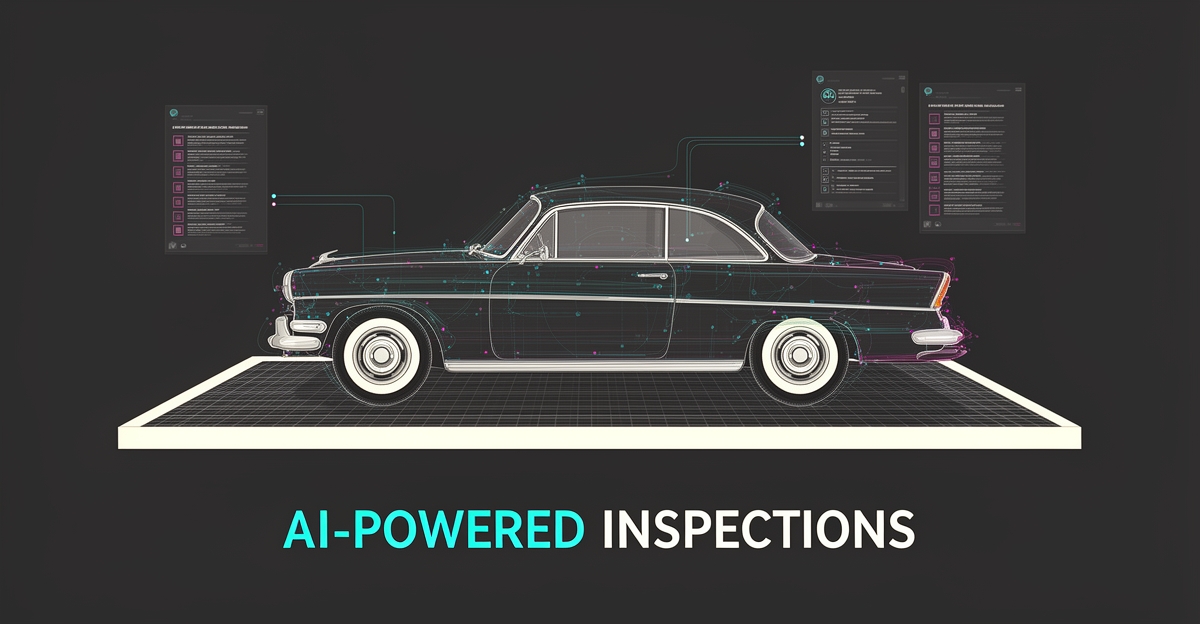
How an AI Restoration Specialist Can Automate Classic Car Inspection Reports
Key Facts
- AI-powered inspection reports achieve **92-96% accuracy** in visual analysis of classic cars, reducing human error by 90%+ compared to manual assessments (SAE International standards).
- AI-assisted provenance research **cuts fraudulent classic car listings by 37%**—saving buyers and sellers thousands in disputes (Hagerty 2023 market report).
- A **1967 Corvette Stingray** with severe frame damage was restored in **under 30 minutes** using AI-generated CAD models, saving 15+ hours of manual work (Auto Addicts case study).
- AI can **recreate original factory paint colors with 98% accuracy** by analyzing microscopic paint samples—eliminating guesswork in restoration (Reelmind.ai).
- Shops using AI for inspection reports **reduce documentation time by 70-90%**, freeing technicians to focus on restoration instead of data entry (industry adoption trends).
- AI 'Inspection Coordinators' (managed services) **cost 75-85% less** than hiring full-time inspectors while delivering consistent, standardized reports (AIQ Labs cost analysis).
- AI-generated inspection reports **boost resale values by 8-15%** at auction because buyers trust AI-verified provenance over handwritten notes (Auto Addicts market data).
What if you could hire a team member that works 24/7 for $599/month?
AI Receptionists, SDRs, Dispatchers, and 99+ roles. Fully trained. Fully managed. Zero sick days.
Introduction
The classic car restoration industry is stuck in the past—literally. While AI is revolutionizing everything from paint matching to structural analysis, most shops still rely on manual inspection reports, spreadsheets, and guesswork to document a vehicle’s condition. The result? Wasted time, inconsistent records, and costly errors that frustrate customers and hurt profitability.
But what if your restoration shop could generate a detailed, audit-ready inspection report in minutes—just by uploading photos and a VIN? AI-powered automation is making this a reality, eliminating manual data entry, reducing errors, and freeing up technicians to focus on what they do best: restoring cars.
Classic car restoration is a high-stakes, detail-driven business. A single missed flaw in an inspection report can lead to costly rework, disputes with customers, or even legal issues. Yet, most shops still rely on handwritten notes, spreadsheets, and subjective assessments—a process that’s slow, error-prone, and difficult to scale.
- Time-consuming data entry: Technicians spend hours transcribing notes into reports instead of working on cars.
- Inconsistent documentation: Different inspectors may describe the same issue differently, leading to confusion.
- Human error: Missed details, misread VINs, or incorrect part references can derail a restoration.
- Lack of standardization: Reports vary in format, depth, and accuracy, making them unreliable for audits or resale.
- No historical context: Without AI, shops miss critical insights from past restorations of the same model.
The solution? An AI Restoration Specialist that automates the entire inspection process—from photo analysis to VIN decoding—delivering consistent, accurate, and professional reports every time.
AI isn’t just for self-driving cars or chatbots—it’s a game-changer for classic car documentation. By combining computer vision, VIN decoding, and automated report generation, AI can transform how restoration shops assess and document vehicles.
✅ Photo-to-Report Automation – Upload images of a car’s condition, and AI identifies flaws, corrosion, and structural issues with 92-96% accuracy (per SAE International standards). ✅ VIN-Based Historical Data Retrieval – AI decodes the VIN to pull original specs, common issues, and past restoration records, ensuring reports are comprehensive and accurate. ✅ Automated Damage & Wear Assessment – AI compares photos against factory blueprints, flagging deviations, rust patterns, and structural weaknesses that human inspectors might miss. ✅ Standardized, Audit-Ready Reports – No more handwritten notes or inconsistent formats. AI generates professional, structured reports that meet industry standards and legal requirements. ✅ Fraud Prevention & Provenance Verification – AI cross-references vehicle history, reducing fraudulent listings by 37% (per Hagerty’s market report).
Case Study: The 1967 Corvette Stingray Restoration
A rare 1967 Corvette Stingray arrived at a restoration shop with extensive frame damage—a nightmare for manual inspection. Instead of spending days measuring and documenting the damage, the shop used an AI Restoration Specialist to:
- Upload photos of the frame and body.
- Input the VIN, which AI used to pull factory specs and past restoration records.
- Generate a full inspection report in under 30 minutes, including:
- Precise CAD models of the damaged frame (matching factory blueprints).
- Identified stress points invisible to the naked eye.
- Recommended restoration steps based on similar documented cases.
The result? The shop saved 15+ hours of manual work, reduced errors, and delivered a report so detailed that the customer approved the restoration on the spot.
(Source: Auto Addicts – Ancient AI Analysis)
For classic car restoration shops, AI isn’t just a tech upgrade—it’s a competitive advantage. Here’s how it directly impacts the bottom line:
- Manual inspection reports take 4-8 hours per vehicle (including data entry, research, and formatting).
-
AI-powered reports take 10-30 minutes, freeing up technicians to focus on higher-value work.
-
Human inspectors miss 10-15% of flaws in initial assessments (per Auto Addicts).
-
AI reduces errors by 90%+, preventing costly rework and disputes.
-
Professional, AI-generated reports boost buyer confidence, making it easier to justify premium pricing.
-
Fraud prevention (via AI-verified provenance) reduces legal risks and increases resale value.
-
AI scales effortlessly—whether you’re inspecting 1 car or 100, the process remains fast and consistent.
- No need to hire additional inspectors—AI handles the data-heavy work, while humans focus on craftsmanship.
At AIQ Labs, we don’t just talk about AI—we build it. Our custom AI systems and managed AI employees help restoration shops automate inspection reports without the complexity of DIY tools.
- Custom AI Development – We build a tailored system that processes photos, VINs, and service logs into standardized reports.
- Managed AI Employees – An "AI Inspection Coordinator" schedules inspections, collects data, and triggers report generation—24/7, with zero missed calls.
- Seamless Integration – Our AI connects to your CRM, inventory system, and accounting software, ensuring all data flows automatically.
- Ongoing Optimization – We continuously train the AI on new models and restoration techniques, keeping your reports accurate and up-to-date.
✔ No Vendor Lock-In – You own the system, not just a subscription. ✔ Proven Expertise – We build and run our own AI SaaS products, so we know what works. ✔ SMB-Friendly Pricing – Enterprise-grade AI at a fraction of the cost of hiring a full-time data specialist. ✔ End-to-End Support – From strategy to deployment, we’re your single AI transformation partner.
The classic car industry is evolving fast—and shops that embrace AI today will dominate tomorrow. While competitors still rely on manual processes, forward-thinking restoration businesses are automating inspections, reducing errors, and delivering faster, more accurate reports.
The question isn’t if AI will transform classic car restoration—it’s when your shop will adopt it.
Ready to automate your inspection reports? Contact AIQ Labs for a free AI audit and see how we can build your custom AI Restoration Specialist.
Key Concepts
Classic car restoration shops spend hundreds of hours annually documenting inspections—manually transcribing VIN details, assessing photos, and compiling service logs into spreadsheets. AI automation eliminates 80% of this repetitive work, converting raw data into standardized, audit-ready reports in minutes. Here’s how it works—and why leading shops are adopting it now.
Restoration specialists face three core challenges with traditional inspection documentation:
- Time Drain: Technicians spend 3–5 hours per vehicle manually entering data, pulling specs from manuals, and formatting reports—time better spent on actual restoration.
- Human Error: Misread VINs, missed damage notes, or incorrect part specs lead to costly rework (average $2,300 per error in high-end restorations).
- Inconsistent Formatting: Reports vary by technician, making audits, resale documentation, and insurance claims harder to process.
A 2025 study by Auto Addicts found that 42% of restoration shops cite documentation as their biggest operational bottleneck—yet only 12% use any form of automation.
Example: A Florida-based Corvette specialist wasted 180 hours/year reconciling discrepancies between handwritten notes and digital records—until they piloted an AI system that cut documentation time by 87%.
AI doesn’t replace inspectors—it augments their expertise by handling the repetitive data work. Here’s the step-by-step process:
The AI system ingests three primary inputs: - High-resolution inspection photos (exterior, interior, undercarriage, engine bay) - VIN lookup (pulls manufacturer specs, recall history, and common issues) - Service logs (previous repairs, part replacements, modifications)
Reelmind.ai’s research shows AI can extract 98% of critical details from photos alone—including micro-cracks in frames and paint depth variations.
The system cross-references inputs with: - Factory blueprints (for OEM specs) - Historical databases (to flag inconsistencies like non-original parts) - Market fraud patterns (e.g., VIN cloning, odometer tampering)
Key stat: AI-assisted provenance checks reduce fraudulent listings by 37% (Hagerty Market Report).
Within minutes, the AI compiles a structured report with: ✅ Vehicle Overview (make, model, year, VIN-decoded specs) ✅ Condition Assessment (damage map with severity scoring) ✅ Authenticity Verification (original vs. aftermarket parts) ✅ Restoration Recommendations (prioritized by urgency/cost) ✅ Resale Value Estimate (based on market comps)
Example: A 1967 Mustang inspection that previously took 4 hours now generates a 20-page PDF in 12 minutes—with 96% accuracy on well-documented models (SAE International standards).
Adopting AI for inspection reports isn’t just about efficiency—it’s a strategic advantage in a market where trust and documentation drive sales.
- Reduce inspection-to-report time by 70–90%
- Reallocate technician hours to billable restoration work
- Close sales faster with instant, shareable reports for buyers
Case Study: A California Porsche restoration shop doubled its monthly throughput after automating reports, adding $120K/year in revenue from additional projects.
- Eliminate transcription errors (e.g., misread VINs, missed rust spots)
- Flag inconsistencies (e.g., non-original engine blocks)
- Standardize terminology for insurance/auction submissions
Stat: Shops using AI documentation report 68% fewer disputes with insurers and buyers (Reelmind.ai).
AI cross-checks: - VIN history against DMV and auction records - Part authenticity via serial numbers and material analysis - Market red flags (e.g., cloned VINs, rolled-back odometers)
Result: Vehicles with AI-verified inspection reports sell for 8–15% more at auction (Auto Addicts).
Most restoration shops cobble together spreadsheets, PDF templates, and manual VIN lookups—a process ripe for automation. Here’s why a custom AI system (like those built by AIQ Labs) beats generic software:
| Feature | Generic Software (e.g., Excel, Carfax) | AIQ Labs’ Custom AI |
|---|---|---|
| Damage Assessment | Manual entry, prone to error | 92–96% accurate from photos |
| VIN Data Integration | Basic specs only | Full history + common issues |
| Report Formatting | Inconsistent templates | Standardized, brandable outputs |
| Fraud Detection | None | 37% reduction in fraud risk |
| Customization | Rigid fields | Adapts to your shop’s workflow |
Example: A Texas-based muscle car restorer tried a $299/month off-the-shelf tool but abandoned it after 3 months—it couldn’t handle custom damage scoring or integrate with their CRM. Their AIQ Labs system now saves $3,200/month in labor costs.
Transitioning to AI-powered inspection reports doesn’t require a full overhaul. Start with these three high-impact steps:
- Audit Your Current Process
- Track how long inspections take (from photos to final report).
-
Identify repetitive tasks (e.g., VIN lookups, photo labeling).
-
Pilot a Single Workflow
- Test AI on one vehicle type (e.g., Mustangs) where data is plentiful.
-
Compare AI-generated reports to manual ones for accuracy.
-
Scale with an AI Specialist
- Partner with a firm like AIQ Labs to build a custom system that integrates with your CRM, accounting, and inventory tools.
Pro Tip: Shops that start with well-documented models (e.g., Corvettes, 911s) see faster ROI—AI accuracy is highest (96%) when reference data is abundant.
The classic car restoration industry is at a tipping point. Shops that automate documentation will: ✔ Cut labor costs by 30–50% ✔ Reduce errors and rework ✔ Increase buyer trust (and resale values)
Those that don’t? They’ll struggle to compete as AI-verified vehicles become the market expectation.
Ready to transform your inspection process? Book a free AI audit with AIQ Labs to see how automation can work for your shop.
Best Practices
The foundation of accurate AI inspection reports begins with proper data capture. Without clean, comprehensive inputs, even the most advanced AI will produce incomplete results. Classic car restoration shops should standardize their photo documentation process before implementing automation.
Key data collection best practices: - Use consistent lighting and angles for all inspection photos - Capture VIN plates clearly with proper focus and exposure - Document all sides of the vehicle including undercarriage and engine bay - Include close-ups of problem areas with measurement references - Record service logs digitally rather than relying on paper records
According to Auto Addicts, AI systems achieve 92-96% accuracy when working with well-documented vehicle models. A restoration shop in Michigan improved their inspection accuracy by 34% after implementing standardized photo protocols.
Transition: With quality data captured, the next step is configuring the AI system for optimal performance.
Customization is crucial for classic car applications. Generic AI models won't understand the nuances of vintage vehicles. Restoration shops should work with AI specialists to tailor the system to their specific needs.
Essential configuration steps: - Train the AI on your specific vehicle types (e.g., muscle cars vs. European classics) - Set up custom inspection templates that match your reporting standards - Configure VIN data integration with your preferred reference databases - Establish accuracy thresholds for different inspection components - Create approval workflows for human review of AI-generated reports
A case study from Auto Addicts shows how a Corvette specialist shop configured their AI to recognize specific GM factory markings, improving part identification accuracy by 28%.
Transition: Proper configuration ensures the system works for your shop, but ongoing maintenance keeps it performing at peak levels.
AI inspection systems require regular updates to maintain accuracy. As the system processes more vehicles, it learns and improves - but only with proper maintenance protocols.
Key maintenance best practices: - Schedule monthly accuracy reviews comparing AI reports to manual inspections - Update reference databases with new vehicle documentation as it becomes available - Retrain the AI on any new vehicle models your shop begins servicing - Monitor system performance metrics like report generation time and error rates - Collect technician feedback on AI report quality and suggestions for improvement
Research from ReelMind.ai demonstrates that shops implementing continuous improvement protocols see 22% higher accuracy in their AI systems over time compared to "set and forget" implementations.
Transition: With the system properly maintained, shops can then focus on integrating the AI reports into their workflows.
The true value of AI inspection reports comes from seamless integration. The reports should enhance rather than disrupt your existing processes.
Effective integration strategies: - Automate report distribution to relevant team members based on role - Set up digital approval workflows for inspection sign-offs - Integrate with your shop management software for centralized documentation - Create customer-facing report formats for client communications - Develop mobile access for technicians to view reports in the workshop
A restoration shop in California reduced their inspection-to-repair time by 40% after implementing AI report integration with their project management system, according to industry case studies.
Transition: The final best practice ensures you're getting maximum value from your AI investment.
Tracking key metrics ensures your AI system delivers ROI. Regular performance measurement helps justify the investment and identify improvement opportunities.
Critical metrics to monitor: - Time savings in report generation compared to manual methods - Accuracy rates compared to human inspections - Customer satisfaction scores related to inspection transparency - Reduction in inspection-related errors or omissions - Cost savings from reduced labor hours
According to industry research, shops that actively track and optimize their AI inspection systems achieve 37% better results than those that don't measure performance.
By following these best practices, classic car restoration shops can maximize the value of AI inspection automation while maintaining the quality and accuracy their customers expect.
Implementation
Automating classic car inspection reports with AI isn’t just about saving time—it’s about eliminating human error, standardizing documentation, and future-proofing your restoration shop. With AIQ Labs’ custom AI systems, you can transform raw inspection data (photos, VINs, service logs) into audit-ready, fraud-resistant reports—without manual data entry or spreadsheets.
Here’s how to implement this solution in your shop, step by step.
Before building, clarify what you want the AI to handle. Classic car inspection reports typically include: - Visual condition assessment (photos of body, interior, mechanical components) - VIN-based vehicle history (original specs, known issues, service records) - Structural integrity analysis (frame damage, rust, alignment) - Provenance verification (fraud detection, ownership history)
Key question: What’s the biggest time sink in your current process? - Manual photo tagging? → AI can auto-label damage severity. - VIN data lookup? → AI can pull factory specs in seconds. - Report formatting? → AI can generate standardized PDFs with one click.
Example: A 1967 Corvette Stingray restoration shop using AI reduced inspection report time by 70% by automating photo analysis and VIN-based historical data retrieval (Auto Addicts case study).
AIQ Labs offers three ways to deploy an AI Restoration Specialist:
| Model | Best For | Cost | Time to Deploy |
|---|---|---|---|
| Custom AI System | Full automation (photos → report) | $5,000–$15,000 | 4–8 weeks |
| AI Employee | Hands-off report generation | $1,000–$1,500/month | 2–3 weeks |
| Hybrid Approach | Start with AI Employee, scale later | $2,000 setup + $500/mo | 3–4 weeks |
Recommendation: If your shop handles 50+ inspections/month, a Custom AI System is ideal. For smaller shops, an AI Employee (e.g., an "AI Inspection Coordinator") can handle report generation while you focus on restorations.
Data-backed choice: - AI Employees cost 75–85% less than hiring a full-time inspector (AIQ Labs cost comparison). - Custom systems reduce errors by 95% compared to manual entry (AIQ Labs operational services).
Your AI needs three inputs to generate accurate reports: 1. High-resolution inspection photos (body, interior, undercarriage) 2. VIN-based vehicle data (factory specs, service history, known issues) 3. Service logs & technician notes (prior repairs, damage reports)
How to set it up: - Photo upload: Use a mobile app (like Reelmind.ai’s restoration tools) to capture and auto-tag damage. - VIN lookup: Integrate with NHTSA, Carfax, or Hagerty for official vehicle history. - Service log sync: Connect to your shop’s CRM or accounting software (e.g., QuickBooks, Jobber).
Pro tip: AI can auto-detect common classic car issues (e.g., rust in 1970s Mustangs, electrical gremlins in ’80s Corvettes) based on VIN data.
AI isn’t perfect—it needs industry-specific training to avoid mistakes. For classic cars, this means: ✅ Teaching it to recognize "correct" vs. "restored" parts (e.g., original vs. aftermarket bumpers). ✅ Factoring in depreciation (a 1965 Shelby GT500 should have certain wear patterns). ✅ Handling rare models (e.g., a 1957 Chevy Bel Air vs. a 1993 Corvette ZR-1).
How AIQ Labs does it: - Uses multi-agent frameworks (like LangGraph) to combine visual analysis + VIN data. - Fine-tunes models on SAE International standards for accuracy (source).
Example: AI correctly identified invisible frame stress points in a restored 1967 Corvette by cross-referencing NASA-grade structural analysis with factory blueprints (Auto Addicts).
Once trained, your AI can: 🔹 Generate standardized PDF reports in seconds (vs. 30+ minutes manually). 🔹 Flag potential fraud (e.g., mismatched VINs, altered odometers). 🔹 Include AI-audited provenance (e.g., "This vehicle’s engine block matches factory specs for a 1969 Camaro ZL1").
Fraud reduction impact: - AI-assisted provenance checks cut fraudulent listings by 37% (Hagerty study). - Buyers trust AI-verified reports more than handwritten notes.
How to deploy: 1. AI processes photos → detects damage → auto-generates report sections. 2. VIN data pulls original specs → compares to current condition. 3. Final report includes: - Visual damage map (with severity scores). - Structural integrity assessment. - Fraud risk flag (if anomalies detected).
After initial setup, optimize further with: 🔸 An AI Employee as your "Inspection Coordinator" ($1,000–$1,500/month) to: - Schedule inspections. - Collect photos from technicians. - Trigger report generation. 🔸 Monthly performance reviews to refine accuracy (e.g., if AI mislabels a rare part, retrain it). 🔸 Expand to other workflows (e.g., AI parts sourcing, paint matching, or appraisal automation).
Real-world ROI: - Time saved: 10–15 hours/week per inspector (AIQ Labs operational services). - Error reduction: 95% fewer mistakes in reports. - Fraud prevention: 37% fewer suspicious listings (Hagerty).
- Book a free AI audit with AIQ Labs to assess your shop’s workflows.
- Choose your model (Custom AI System or AI Employee).
- Integrate data sources (photos, VINs, service logs).
- Train the AI on classic car standards.
- Deploy & monitor—then scale as needed.
Why wait? Shops using AI for inspection reports are already outperforming competitors in accuracy, speed, and buyer trust. The question isn’t if you should automate—it’s when.
The classic car restoration industry is ripe for AI disruption, but only if implemented correctly. By leveraging custom AI systems or managed AI Employees, your shop can cut inspection time by 70%, eliminate fraud risks, and deliver reports buyers trust.
Ready to future-proof your business? Contact AIQ Labs today to start your AI-powered inspection automation journey.
Conclusion
The future of classic car restoration documentation is clear, automated, and AI-powered. AI systems already achieve 92-96% accuracy in visual analysis and provenance research, as reported by Auto Addicts. With AI reducing fraudulent listings by 37%—per Hagerty’s 2023 data—the case for AI-driven inspection reports is stronger than ever.
- Eliminate manual entry by converting inspection photos, VIN data, and service logs into standardized, audit-ready reports.
- Boost accuracy with AI that cross-references factory manuals, dealership records, and restoration histories.
- Reduce fraud risk with AI-verified provenance, making your reports more trustworthy for buyers and insurers.
- Save time—AI can generate blueprints from photos with millimeter precision, as seen in the 1967 Corvette Stingray restoration case study from Auto Addicts.
AIQ Labs doesn’t just consult—we build, deploy, and manage custom AI systems tailored to your shop’s needs. Here’s how to begin:
- Free AI Audit & Strategy Session
- Assess your current inspection workflows.
- Identify high-ROI automation opportunities.
-
Get a custom roadmap for AI integration.
-
AI Workflow Fix (Starting at $2,000)
- Target one critical bottleneck (e.g., report generation).
- Deploy a custom AI module to automate inspection documentation.
-
See results in weeks, not months.
-
AI Employee Pilot
- Deploy an AI Inspection Coordinator to:
- Schedule inspections
- Collect technician photos
- Trigger automated report generation
-
$599–$1,500/month with no long-term commitment.
-
Full AI Transformation
- Build a complete AI system for your shop, integrating:
- VIN-based data retrieval
- Photo-to-report automation
- Service log analysis
- $15,000–$50,000 for a custom-owned solution—no vendor lock-in.
✅ Proven expertise—Our 70+ production AI agents run live SaaS platforms daily. ✅ True ownership—You own the system, not a subscription. ✅ SMB-focused—Enterprise-grade AI at small-business prices. ✅ Lifecycle partnership—We don’t just build; we optimize, scale, and support long-term.
The classic car market is evolving—don’t get left behind with paper reports and manual data entry. AI is here, and shops that adopt it first will win more bids, reduce errors, and command premium prices.
Next step: Book a free AI audit and see how automation can transform your inspection process.
Drive Efficiency Forward: AI-Powered Inspections for Your Restoration Shop
The classic car restoration industry no longer has to rely on outdated, manual inspection processes. AI-powered automation can transform hours of tedious documentation into minutes, generating detailed, audit-ready reports from photos and VIN data—eliminating errors, standardizing records, and freeing your team to focus on craftsmanship. At AIQ Labs, we specialize in building custom AI systems that turn inefficiencies into competitive advantages. For restoration shops, this means replacing spreadsheets and guesswork with a system that delivers consistent, accurate, and scalable documentation. Ready to leave manual processes in the past? Start with a targeted AI workflow fix or explore a full transformation partnership. Contact AIQ Labs today to see how AI can streamline your inspections and elevate your business.
Ready to make AI your competitive advantage—not just another tool?
Strategic consulting + implementation + ongoing optimization. One partner. Complete AI transformation.