How an AI Security Officer Can 24/7 Monitor Construction Sites and Reduce Unauthorized Access
Key Facts
- Human vigilance typically declines noticeably during extended continuous surveillance, a limitation long recognized in monitoring work
- AI-powered monitoring provides continuous 24/7 surveillance without staffing gaps or fatigue limitations
- Organizations can significantly reduce security operation costs while improving coverage and detection capabilities through AI automation
- AI systems can identify anomalies and suspicious behavior in real time, often catching events a fatigued human observer would miss
- Intelligent alert prioritization by AI reduces alert fatigue and ensures critical incidents are addressed promptly
- Multi-agent AI architectures enable more efficient threat detection by specializing agents for different tasks
- AI security officers operate under human-in-the-loop protocols, escalating complex incidents to supervisors for final judgment
Hire a team member that works 24/7 — for less than a part-time wage.
AI receptionists, SDRs, dispatchers and 99+ roles. Trained on your business, fully managed.
Not sure where to start? Ask our AI planner
The Critical Gaps in Traditional Construction Site Security
Construction sites face persistent security challenges that traditional human-based monitoring struggles to overcome. Despite significant investment in guards and patrols, vulnerabilities remain due to fundamental limitations in human attention and operational constraints. These gaps create opportunities for unauthorized access, theft, and safety incidents that can derail projects and inflate costs.
Human attention is not built for extended passive observation. Vigilance typically degrades the longer a person watches monitors or patrols a quiet perimeter, a limitation long recognized in security work. This means personnel watching site perimeters or access points are more likely to miss critical threats during extended shifts, especially during low-activity periods when fatigue sets in. Maintaining consistent alertness over hours is not just difficult—it is unsustainable without frequent rotation, which few sites can afford.
Staffing costs further compound the problem. Providing 24/7 coverage requires multiple shifts of trained guards, leading to expenses that strain project budgets, particularly for small to mid-sized contractors. Yet even with full staffing, response times to breaches remain delayed because human observers must first detect, assess, and then react—processes that take valuable minutes during which intruders can cause significant damage or steal equipment.
These limitations are especially pronounced in dynamic construction environments where activity levels fluctuate, lighting changes, and blind spots shift as structures evolve. Relying solely on human eyes creates a security posture that is inherently reactive rather than proactive, leaving sites exposed during the very moments when threats are most likely to occur. AIQ Labs helps address these challenges through AI employees that function as tireless, always-on security observers, capable of monitoring sites continuously without fatigue or lapse in attention.
How AI-Powered Security Officers Enable Real-Time Threat Detection
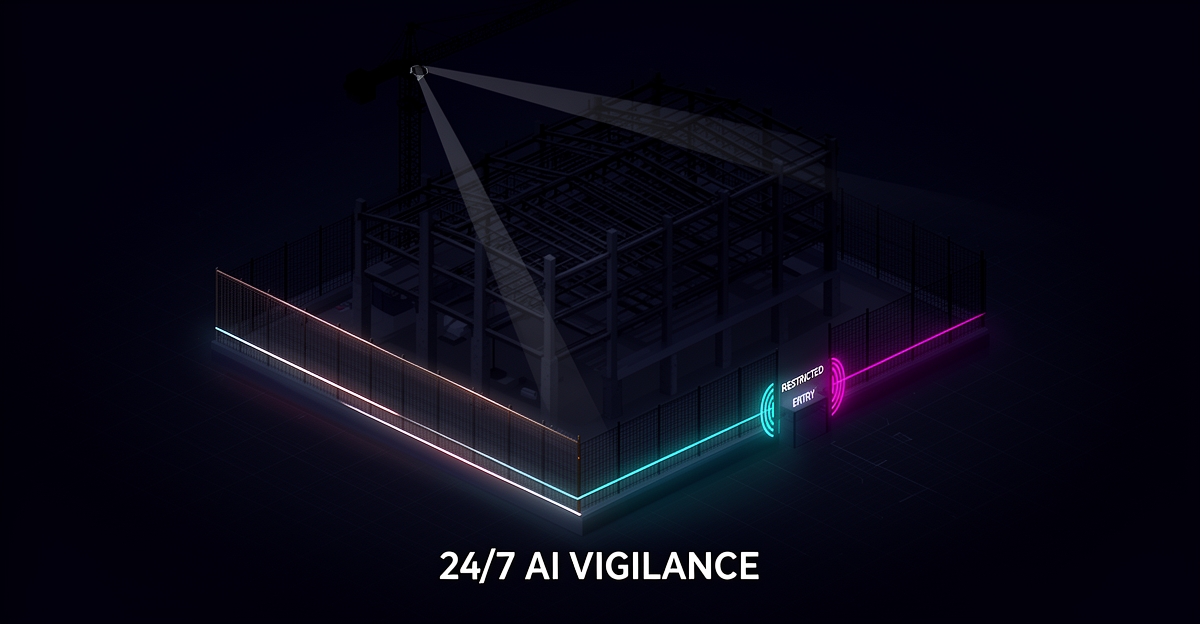
Construction sites run long hours, but human eyes cannot. An AI security officer removes the limits of shift work and attention fatigue to keep a site under constant watch.
AI-powered monitoring provides continuous surveillance without the limitations of human staffing. That 24/7 coverage matters because human vigilance degrades measurably during extended continuous surveillance. On a live site, that degradation translates to missed trespassers, unattended equipment, and delayed response.
AI replaces fatigue with consistency. Systems learn normal patterns of movement, vehicle flow, and access times, then flag deviations in real time. Behavioral analytics learn the normal rhythm of a site—people, vehicles, and schedules—and then detect deviations that may indicate suspicious activity. For construction, that means recognizing an unfamiliar vehicle after hours, loitering near material storage, or a gate left open longer than expected.
Threat detection is automated and immediate. AI can identify anomalies and suspicious behavior in real time, often catching events a fatigued human observer would miss. The system correlates video, access logs, and sensor data without waiting for a guard to scan a monitor, shrinking the window between incident and awareness.
Alert overload is a known failure point in traditional monitoring. AI addresses this through intelligent prioritization, analyzing alerts and surfacing those that pose the greatest risk first. Instead of flooding a control room, the AI security officer presents high-confidence events first and suppresses noise, reducing alert fatigue so critical incidents get addressed promptly.
Multi-agent architectures amplify these benefits. Modern security platforms increasingly use specialized AI agents for different tasks, which leads to more efficient threat detection. One agent can monitor perimeter cameras, another can audit badge access, and a third can correlate both streams to confirm an unauthorized entry. AIQ Labs has deployed 200+ multi-agent systems of exactly this kind.
Organizations can significantly reduce security operation costs while improving coverage and detection capabilities through AI automation. For construction site security companies, that means continuous coverage without constant human presence—at a fraction of the cost of round-the-clock guard shifts.
Core capabilities delivered by an AI security officer include:
- Continuous 24/7 visual and access monitoring without staffing gaps
- Real-time behavioral analytics and anomaly identification
- Intelligent alert prioritization to reduce alert fatigue
- Multi-agent correlation across cameras, sensors, and logs
AIQ Labs helps businesses implement AI employees that function as on-site security observers, providing continuous surveillance without the need for constant human presence. The result is faster detection, fewer missed events, and a security posture that does not degrade after the first hour of a shift.
Implementing AI Security Officers: From Deployment to Ongoing Optimization
Construction security firms face mounting challenges in maintaining consistent site vigilance, especially given the limitations of human attention during extended monitoring shifts. AI-powered monitoring addresses this directly by providing uninterrupted, 24/7 surveillance without fatigue or distraction.
Implementing an AI security officer begins with a structured deployment process. In the discovery phase, security teams assess existing camera networks, access control systems, and patrol routines to define clear monitoring objectives—such as detecting after-hours trespassing, identifying tailgating at entry points, or flagging loitering in restricted zones. Next comes integration, where the AI employee is configured to ingest live video feeds, connect with on-site access systems via API, and apply behavioral analytics to distinguish between authorized personnel and potential intruders. The AI system continuously learns normal site activity patterns, enabling it to detect deviations that may indicate suspicious behavior—such as unauthorized vehicle entry or individuals attempting to scale perimeter fences.
Handover and training ensures a smooth transition for security teams, who receive role-specific guidance on interpreting AI-generated alerts and initiating appropriate responses. Crucially, the AI employee operates under human-in-the-loop protocols: while it autonomously monitors and flags anomalies in real time, complex incidents—such as confrontations or ambiguous situations—are escalated to human supervisors for final judgment. This hybrid approach leverages the AI's strength in persistent observation and rapid data analysis while preserving human oversight for nuanced decision-making, a best practice emphasized in modern AI security frameworks.
Ongoing optimization is built into the model through continuous performance monitoring and iterative improvement. The AI security officer's detection logic is regularly refined using feedback from resolved incidents, reducing false positives and improving precision over time. Security teams can adjust sensitivity thresholds based on site-specific risks—such as increasing alertness during high-value material deliveries or relaxing protocols during scheduled maintenance windows. This adaptive capability ensures the system evolves alongside changing site dynamics without requiring constant reconfiguration. AI-driven monitoring reduces unauthorized access incidents by enabling near-instant detection and response, often before a breach escalates.
AIQ Labs structures this work through its workflow builds offering: rebuild the one security workflow that costs you the most, at a fixed price, delivered in phases. Firms that want a fully connected security layer across multiple sites can graduate to an AI operating system built in milestones and owned outright. By integrating AI employees into existing security infrastructure—without replacing human teams—construction firms gain a force multiplier that extends coverage, accelerates incident detection, and reduces reliance on round-the-clock human patrols. For firms ready to explore this transformation, AIQ Labs offers a structured path forward: start with the two-minute Fit Check, then a free 30-minute strategy call to assess your site's vulnerabilities and map out a tailored AI monitoring plan.
Still paying for 10+ subscriptions that don’t talk to each other?
We build custom AI systems you own outright. No vendor lock-in. Full control.
Not sure where to start? Ask our AI planner
Frequently Asked Questions
How does an AI security officer prevent unauthorized access on construction sites when human guards get tired?
Can AI security monitoring really reduce costs compared to hiring human guards for 24/7 coverage?
What happens if the AI detects something suspicious—does it respond on its own or alert a human?
How does the AI learn what's normal on a construction site so it doesn't keep false alarming?
Is AI security monitoring effective in dynamic construction environments where layouts and lighting change frequently?
What kind of data does the AI security officer use to detect threats in real time?
Build a Security Posture That Never Blinks
Construction sites can't afford the gaps that come with human fatigue and shift changes. Human vigilance degrades during extended continuous surveillance, which means missed trespassers, unattended equipment and delayed responses are built into traditional guarding. An AI security officer removes that variability with continuous 24/7 visual and access monitoring, real-time behavioral analytics, intelligent alert prioritization and multi-agent correlation across cameras, sensors and logs. The result is faster detection, fewer missed events and a security posture that holds steady when activity is low and risks are highest. For construction security firms, this is a force multiplier that extends coverage without replacing human teams, preserving human-in-the-loop oversight for complex decisions while automating persistent observation. If you're evaluating how to close coverage gaps on your sites, start with the two-minute Fit Check at https://aiqlabs.ai/apply, then book a free 30-minute strategy call at https://aiqlabs.ai/book to map vulnerabilities and a tailored AI monitoring plan.
Make AI your competitive advantage — not just another tool.
Strategy, implementation and ongoing optimization. One partner, end to end.
Not sure where to start? Ask our AI planner