How an AI Stamp Designer Can Handle High-Volume Custom Orders
Key Facts
- AI-powered design systems can compress product research and design timelines from weeks to days, according to Google Cloud retail use cases
- Specialized AI agents typically achieve high deflection rates on routine tasks that previously required human review, per industry implementation data
- Organizations implementing specialized AI agents often report meaningful improvements in operational workflow processing time, based on production deployments
- Automated hot stamping lines increase output and line speeds while decreasing reject rates and factory lead times, per manufacturing automation guidance
- Self-inking stamps are built for repeated use, making them efficient for high-volume applications, according to product specifications
- AI tools streamline creative workflows by automating repetitive tasks, allowing designers to focus on innovation rather than recreation, per creative industry commentary
- Retailers using AI report strong ROI and reduced staff workload when they start with focused use cases, according to Google Cloud case studies
Hire a team member that works 24/7 — for less than a part-time wage.
AI receptionists, SDRs, dispatchers and 99+ roles. Trained on your business, fully managed.
Not sure where to start? Ask our AI planner
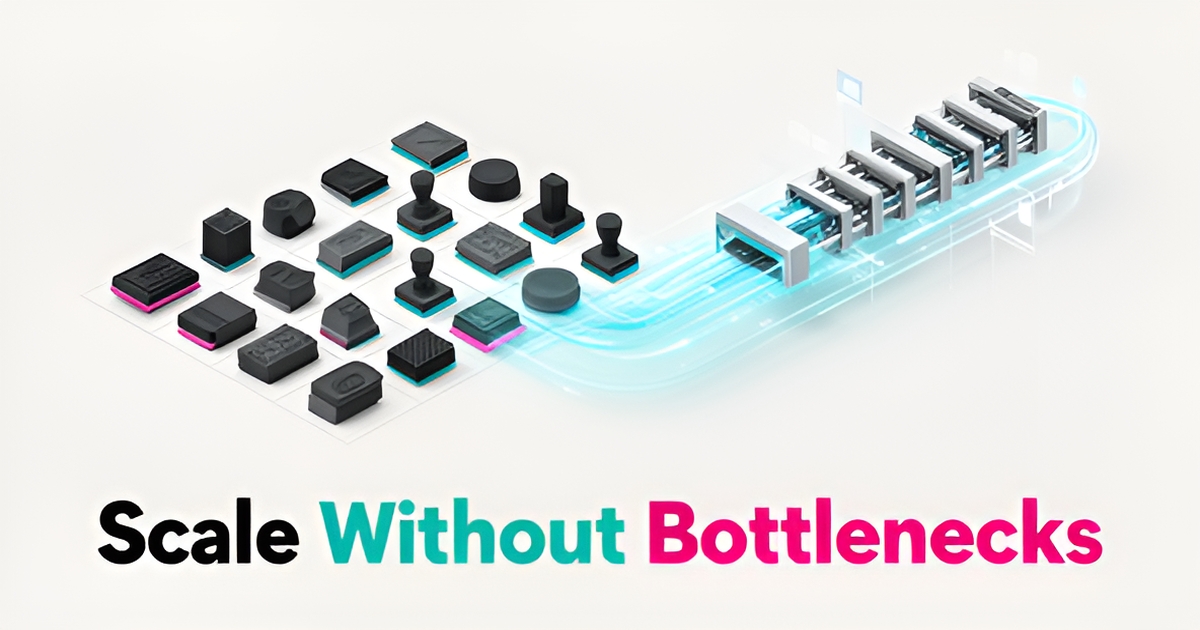
The High-Volume Bottleneck: When Custom Orders Outpace Manual Design
Custom stamp design workflows hit a breaking point when seasonal demand spikes or recurring custom orders exceed manual capacity. This bottleneck manifests as production delays, inconsistent design quality, and missed delivery deadlines—particularly in high-mix, high-volume environments where each order requires unique artwork but follows similar production constraints. Manual design processes simply cannot scale to meet sudden surges without sacrificing either speed or consistency.
Automation in similar manufacturing contexts shows what's possible. Automated hot stamping lines demonstrate how purpose-built automation increases output and line speeds while decreasing reject rates and factory lead times—principles directly applicable to design workflows facing volume pressure, per industry automation guidance. When creative tasks remain manual, they become the constraining step in otherwise efficient production lines, creating what operations experts call a "starvation point" where downstream processes idle waiting for design completion.
The impact extends beyond timing to quality and predictability. Manual design introduces variability that accumulates across high-volume runs, leading to inconsistent output that undermines brand reliability—especially problematic for recurring orders like event-themed or seasonal stamps where customers expect uniformity. As noted in creative industry commentary, AI tools excel at streamlining repetitive creative tasks by automating simplification and standardization, allowing human designers to focus on innovation rather than recreation. This shift transforms design from a bottleneck into a scalable capability.
AI-powered design systems eliminate this bottleneck by decoupling creative ideation from production execution, enabling stamp makers to handle thousands of unique variations without proportional increases in design labor. Unlike manual workflows where each custom order requires individual attention, AI systems can generate consistent, on-brand designs at scale by learning from approved templates and brand guidelines—critical for maintaining quality across high-volume custom runs. This approach mirrors how leading retailers use AI to shorten product research and design timelines from weeks to days, according to Google Cloud retail use cases.
For stamp businesses experiencing seasonal rushes or steady growth in custom orders, the operational breaking point isn't just about capacity—it's about maintaining quality while scaling. AI stamp design tools address this by providing consistent output regardless of volume, ensuring that the 10,000th stamp looks identical to the first—a level of reliability manual processes struggle to achieve at scale. When design no longer constrains production, businesses can fully leverage their manufacturing capacity without compromising on the customization their customers value.
Specialized AI Agents for On-Brand Design at Scale
When a single AI model tries to handle every step of a complex creative workflow, it often becomes a bottleneck rather than a solution. For high-volume stamp production, the answer lies in multi-agent systems that assign specialized AI agents to distinct stages of the design pipeline.
Rather than relying on one monolithic model to interpret order specs, generate artwork, and check brand compliance simultaneously, modern implementations use coordinated teams of agents. According to industry commentary on AI architecture, this approach mirrors high-performing human teams: "Don't think of support AI as one giant bot. Think of it as a system of specialised agents."
In a stamp design context, this specialization typically breaks down into three distinct roles:
- Specification Analyzers: These agents parse incoming order details—dimensions, ink colors, text hierarchies, and substrate requirements—flagging ambiguities before design begins.
- Generative Designers: Specialized creative agents produce multiple design variations based on the analyzed specs, exploring layout options while adhering to basic geometric constraints.
- Compliance Validators: Final-stage agents compare outputs against brand guidelines, checking color accuracy, logo placement, and legal requirements before approving files for production.
This division of labor delivers measurable efficiency gains. Organizations implementing specialized AI agents often report meaningful improvements in workflow processing time, with high deflection rates on routine tasks that previously required human review. When each agent masters a narrow domain—whether analyzing vector scalability or validating Pantone matches—the system maintains consistency even when processing hundreds of custom orders daily.
The validation stage proves particularly critical for brand consistency. While generative agents excel at rapid iteration, they require guardrails to ensure every holiday-themed stamp or corporate logo variation aligns with established visual identities. Advanced implementations use confidence scoring to flag uncertain outputs, automatically routing edge cases to human designers while allowing standard orders to proceed uninterrupted.
AIQ Labs builds these orchestrated multi-agent systems, where specialized agents handle research, generation, and quality assurance as coordinated workflows rather than isolated tools. With 200+ multi-agent systems deployed and four live SaaS products the company runs daily, this architecture lets stamp manufacturers scale creative output without sacrificing the precision custom orders demand. If you're mapping where AI fits in your operation, the two-minute Fit Check is the fastest starting point.
Building Production-Ready AI: Integration, Validation, and Human Oversight
High-volume custom stamp production breaks when design, approval, and manufacturing live in separate systems. A production-ready AI stamp designer keeps them in sync while protecting brand quality at scale.
Production readiness starts with architecture, not prototypes. Production-first AI development emphasizes building, deploying and maintaining machine learning and LLM systems inside your production stack, not PoCs that never leave a notebook. That discipline matters for stamp makers handling recurring event-themed or seasonal orders where consistency and speed are revenue drivers.
Confidence thresholds create a safety net for creative output. Engineers building AI agents for multi-step workflows use confidence thresholds to prevent actions in uncertain cases, with escalation channels that send uncertain cases to your people with full context. For stamp design, low-confidence artwork, off-brand color use, or ambiguous text automatically routes to human review instead of reaching production.
Validation layers must mirror physical production checks. Automated hot stamp lines increase output, line speeds, quality, safety and consistency while decreasing reject/scrap rates and factory lead times, according to industry automation expertise. A comparable digital layer inspects designs before they print: dimension limits, foil compatibility, legibility at small sizes, and trademark risk.
Seamless integration is what turns design speed into throughput. AI tools streamline creative workflows by automating and simplifying tasks, allowing creatives to work faster and focus on innovation, as noted in commentary on AI in creative industries. In practice that means two-way connections to e-commerce stores, order management, and manufacturing equipment so approved designs flow straight to production files.
A reliable system balances automation with human judgment:
- Confidence scoring flags responses the model is not sure about instead of letting them through
- Human-in-the-loop controls for critical decisions and brand-sensitive artwork
- Validation before execution with rollback patterns to reverse actions if needed
- Audit trails for compliance and review across design, approval, and production
The creative industry insight holds: AI will not replace designers, but designers who understand workflows will replace designers who only push pixels. That systems thinking is why AIQ Labs builds production-ready systems, not prototypes—with fixed pricing, phased delivery, and true ownership. For a look at how these engagements are structured, see AIQ Labs' pricing models.
Physical durability expectations reinforce the need for digital quality. Self-inking stamps are built for repeated, high-volume use, per VistaPrint product data. When a stamp is expected to perform thousands of impressions, design quality directly impacts perceived value over the product's whole life.
When AI design, validation, and manufacturing integration are built as one system, high-volume custom orders scale without slowing production or sacrificing brand consistency.
Implementation Pathways: From Pilot to Full Production
Moving from concept to production requires a deployment strategy that matches your operational reality. Most stamp manufacturers get stuck in pilot purgatory because they lack a clear path to scale. The solution lies in choosing an implementation model that aligns with your current bottlenecks and growth trajectory.
A production-first development approach prioritizes auditing the actual business problem before writing code. This means identifying whether you need a single workflow fix—like automating seasonal design variations—or a department-level system that handles everything from order intake to production-ready files. United Silicone's decades of automation experience show that successful deployments start with needs analysis and superior system design, not technology for its own sake .
AIQ Labs structures this around three entry points, each with a payment model that matches your risk tolerance:
- AI Employees (Start Monthly): Managed AI staff—design reviewers, order intake agents, production coordinators—covering build, training, integrations, and ongoing optimization at a fraction of the cost of a human hire
- AI Workflow Builds (Build in Milestones): Rebuild the one workflow that costs you the most—like seasonal stamp artwork variations—at a fixed price, in phases, with approval at each milestone
- AI Operating Systems (Own It Outright): One connected operating layer for the whole design-to-production pipeline, built in phases and owned outright—full code, agent, and data transfer with no vendor lock-in
The Start Monthly model works well for businesses proving ROI on a single high-volume workflow, such as event-themed stamp runs that currently bottleneck at design review. For operations ready to automate an entire department—handling custom artwork, proofing, and production file generation across multiple product lines—the Build in Milestones approach provides checkpoints that reduce risk. Google Cloud's retail AI case studies show that companies seeing the strongest returns start with focused use cases before expanding to broader agentic ecosystems .
AIQ Labs structures these pathways around the same multi-agent architectures proven across 200+ deployed systems and four live SaaS products the company runs daily. Whether you start with an AI Employee for design review, a Workflow Build for your highest-cost process, or a full AI Operating System for the whole operation, the engagement model stays consistent: real engineering, true ownership, and a partner who stays accountable long after launch.
Still paying for 10+ subscriptions that don’t talk to each other?
We build custom AI systems you own outright. No vendor lock-in. Full control.
Not sure where to start? Ask our AI planner
Frequently Asked Questions
How can AI handle high-volume custom stamp orders without slowing down production?
What are the benefits of using specialized AI agents in stamp design workflows?
How does an AI stamp designer ensure brand consistency across high-volume custom orders?
Can AI stamp design systems integrate with existing e-commerce and manufacturing tools?
Will AI replace human designers in stamp creation?
What implementation options does AIQ Labs offer for stamp businesses looking to automate design workflows?
From Bottleneck to Breakthrough: Scaling Custom Stamp Design with Confidence
The high-volume custom stamp bottleneck isn't a capacity problem—it's a workflow architecture problem. As this article showed, manual design processes create starvation points that idle production lines, introduce quality variance, and collapse under seasonal demand. Multi-agent AI systems solve this by separating specification analysis, generative design, and compliance validation into specialized roles that maintain brand consistency whether processing fifty orders or five thousand. Production-ready implementations add confidence scoring, human-in-the-loop guardrails, and direct integration with manufacturing equipment so approved designs flow straight to output without manual handoffs. The result: design throughput that scales with demand, not headcount. Organizations deploying these systems often report faster processing times and a large share of routine design reviews deflected from human queues per production AI benchmarks. For stamp makers ready to move past pilot purgatory, the path forward starts with auditing your actual bottleneck—whether that's seasonal artwork variations, recurring corporate orders, or proofing backlogs—and choosing an implementation model that matches your risk tolerance and ROI timeline. AIQ Labs helps businesses navigate that assessment and build systems they own outright. Start the two-minute Fit Check at https://aiqlabs.ai/apply to map your highest-impact automation opportunity, or book a free 30-minute strategy call at https://aiqlabs.ai/book to explore what production-ready looks like for your operation.
Make AI your competitive advantage — not just another tool.
Strategy, implementation and ongoing optimization. One partner, end to end.
Not sure where to start? Ask our AI planner