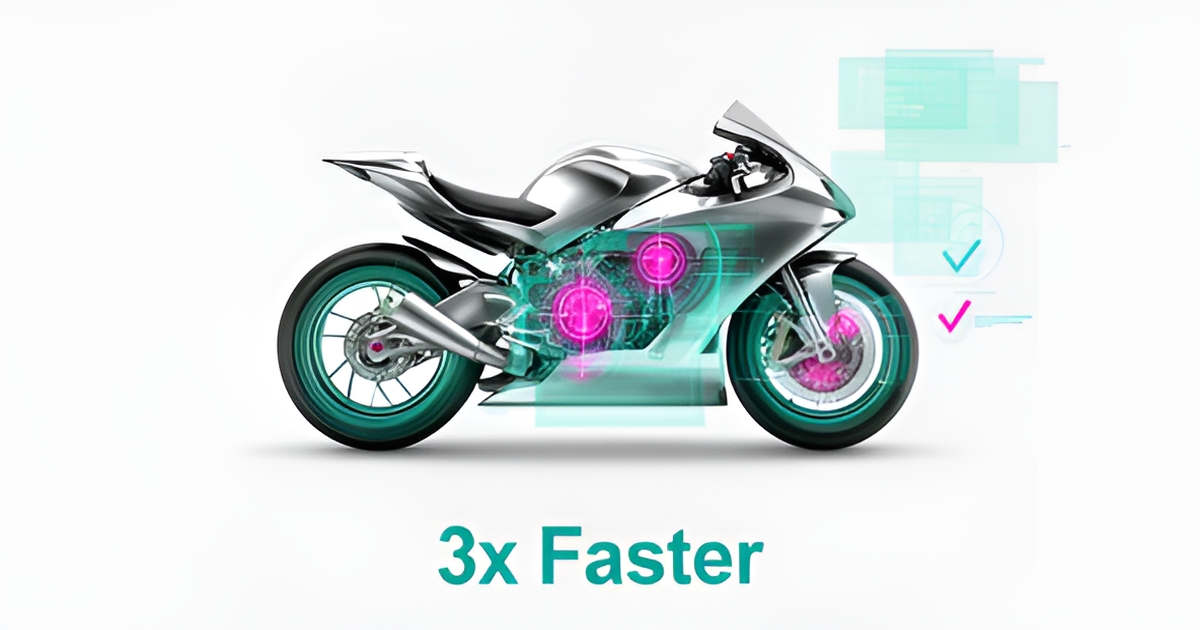
How an AI Technician Can Diagnose Motorcycle Issues 3x Faster Than Humans
Key Facts
- Motorcycle shops typically charge $80 to $150 per hour for diagnostic time, often exceeding repair value on older bikes according to MotoVault analysis
- AI technicians can diagnose motorcycle issues up to 3x faster than humans by combining computer vision, NLP, and contextual intelligence in seconds as described in MotoVault's workflow
- Cam chain tensioner wear often appears around 2,000 km and requires attention though not immediate danger per MotoVault's diagnostic example
- 8 in 10 workers globally report lacking enough time or energy for their tasks, highlighting cognitive overload in skilled trades per TechRadar report
- AI analysis of tire cupping can suggest worn suspension, imbalance, or improper pressure for targeted human verification per MotoVault's diagnostic example
- AI provides confidence-scored assessments to help technicians decide when to trust output or seek further verification per MotoVault's diagnostic workflow
Hire a team member that works 24/7 — for less than a part-time wage.
AI receptionists, SDRs, dispatchers and 99+ roles. Trained on your business, fully managed.
Not sure where to start? Ask our AI planner
Why Traditional Motorcycle Diagnosis Is Slow and Expensive
Imagine your motorcycle starts making a strange noise, and the first step to fixing it involves hours of frustrating guesswork or a hefty bill just to figure out what's wrong. This scenario is all too common for riders and shops, turning simple repairs into drawn-out ordeals.
Unlike modern cars, most motorcycles lack comprehensive OBD-II ports, making it hard to pull detailed diagnostic data. Even when basic fault codes are available, they often require dealer-specific tools to interpret, leaving owners reliant on incomplete information.
This gap forces many into a cycle of inefficient troubleshooting. Riders turn to online forums for advice, only to wade through contradictory suggestions that lead to more confusion than clarity.
The result is often trial-and-error repairs, where parts are ordered and replaced based on hunches, wasting time and money. According to MotoVault, this process can involve repeatedly installing components that don't solve the issue, escalating costs without progress.
Professional help isn't always a quick fix either. Shops typically charge $80 to $150 per hour for diagnostic time, a rate that can quickly add up and even exceed the value of repairs on older bikes, as noted in the same MotoVault analysis.
These challenges compound for technicians, who face cognitive overload from sifting through vast amounts of data manually. A TechRadar report highlights that 8 in 10 workers globally report lacking enough time or energy for their tasks, underscoring the broader issue of information overload in skilled trades.
Key friction points in traditional motorcycle diagnosis include:
- Absence of standardized diagnostic ports, limiting electronic insights.
- Conflicting advice from forums, leading to unreliable self-diagnosis.
- Trial-and-error parts replacement, inflating costs and downtime.
- High hourly rates for professional diagnostics, often uneconomical for older models.
At AIQ Labs, we see these inefficiencies as prime opportunities for AI workflow builds, where a custom system handles initial data synthesis to augment human expertise without replacing it.
Ultimately, these hurdles not only slow down repairs but also erode trust in the process, pushing riders toward unnecessary expenses or delayed maintenance.
How AI Technicians Diagnose in Seconds with Vision, Symptoms and Context
Imagine a technician snapping a photo of a flickering warning light while simultaneously describing a strange engine knock and inputting the bike's make, model, and mileage—all within seconds. This isn't science fiction; it's how AI technicians diagnose motorcycle issues by combining computer vision, natural language processing, and contextual intelligence to cut through diagnostic noise in real time.
Computer vision analyzes images of dashboard warnings, fluid leaks, or worn components like brake pads and chains, identifying specific parts and assessing their condition against known failure patterns for that exact motorcycle. For example, AI can distinguish between oil and coolant leaks or recognize early signs of cam chain tensioner wear, which MotoVault notes often appears around 2,000 km and requires attention though not immediate danger. This visual analysis bridges the gap for riders who can't identify what they're seeing, turning guesswork into targeted insight.
Meanwhile, natural language processing parses symptom descriptions—such as "metallic rattling when cold" or "stalls at idle when warm"—and correlates them against tens of thousands of documented cases. By weighting probabilities across thousands of scenarios simultaneously, AI far exceeds a human mechanic's recall, surfacing the most likely causes almost instantly. This symptom analysis reduces the trial-and-error cycle that traditionally leads to unnecessary part replacements and frustration.
Finally, contextual intelligence layers in the motorcycle's make, model, year, and mileage to prioritize failure modes specific to that platform. A 2018 Yamaha MT-09 with 40,000 km is evaluated differently than a 2023 BMW R 1250 GS with 8,000 km, ensuring the AI focuses on age- and usage-appropriate issues. The system then delivers a confidence-scored assessment, helping technicians decide whether to proceed with repair or seek further verification—especially critical for safety-related systems like brakes or suspension. AIQ Labs builds custom diagnostic workflows that integrate these three capabilities directly into repair shop tools, enabling real-time, accurate assessments without disrupting existing processes.
Augmentation Not Replacement: The Hybrid Human-AI Workflow
AI is not here to replace the skilled motorcycle technician—it's here to reduce their cognitive load and handle the heavy lifting of data synthesis. By analyzing symptoms, service history, and visual cues in seconds, AI systems free up mental bandwidth for technicians to focus on what humans do best: physical verification, safety-critical judgment, and complex repair execution. Research shows that 8 in 10 workers report lacking enough time or energy to do their work, a burden AI helps alleviate by offloading repetitive data gathering and pattern recognition.
Consider a mystery warning light on the dashboard. Instead of spending hours cross-referencing forums or flipping through manuals, a technician can snap a photo and describe the symptom. The AI instantly identifies it as an engine temperature indicator, explains common causes like low coolant or a faulty sensor, and recommends checking the coolant level first—turning an hours-long process into seconds. This visual and symptomatic analysis leverages vast knowledge bases to surface likely issues while flagging confidence scores so technicians know when to trust the output or dig deeper.
In another scenario, a metallic rattling noise from the engine that fades when warm is flagged by AI as likely cam chain tensioner wear. The system provides severity context—such as noting it's not immediately dangerous but should be addressed within 2,000 km—and offers specific inspection steps like removing a single inspection cap. This gives the technician a targeted starting point, reducing guesswork. For tire cupping, AI analyzes wear patterns to suggest worn suspension, imbalance, or improper pressure, directing the human expert to the right component for physical verification. This hybrid approach ensures AI handles data synthesis while humans retain control over safety-critical validation and final judgment—creating a workflow that's both faster and more reliable.
Implementing AI Diagnostics in Your Repair Shop
Traditional motorcycle diagnosis burns hours and dollars before a wrench ever turns. Shops charge typical diagnostic rates of $80 to $150 per hour, and without comprehensive OBD-II ports the process often devolves into forum research and trial-and-error parts replacement.
AI-assisted diagnosis changes the intake flow without removing the technician from the bay. The system captures visual and symptomatic data, enriches it with make-model-year context, and returns a prioritized assessment with confidence scores in seconds. Human expertise then validates safety-critical findings and executes the repair.
Cognitive overload is a real constraint in busy shops. 8 in 10 workers report lacking enough time or energy to do their work, and ad hoc calls and interruptions fragment attention throughout the day. An AI technician acts as a second brain, handling initial data synthesis so staff can focus on verification and complex repairs.
Implementation starts with workflow mapping, not rip-and-replace. A practical rollout follows these steps:
- Audit current intake: photo capture, symptom notes, service history access, and tool integrations.
- Connect AI to existing systems: work order software, parts catalogs, and customer records via two-way APIs.
- Train the model on shop-specific patterns, common makes, and technician language for accurate confidence scoring.
- Define escalation rules for safety-critical issues like brakes, structural damage, and fuel leaks that always require physical verification.
- Measure time-to-diagnosis, first-time fix rate, and technician hours saved per week.
AIQ Labs builds custom AI systems for repair shops that integrate directly with existing tools and workflows, enabling real-time diagnosis without replacing human expertise. The build can start small and scale with the business—see how we approach it at AI Workflow Builds.
Shops choose the engagement model that fits their maturity. Start Monthly puts a managed AI employee on your team at roughly 80% less cost than a human hire, with setup, training, integrations, monitoring, and improvements included—and the ability to pause or adjust anytime. Build in Milestones rebuilds the one workflow that costs you the most, split into phases you approve and pay for as they ship at a fixed price. Own It Outright delivers a full AI operating system built in phases, with full ownership of code, agents, and data when complete.
The hybrid model preserves skill while accelerating throughput. AI handles repetitive data gathering and pattern recognition; technicians retain independent judgment for safety-critical decisions and complex repairs.
Still paying for 10+ subscriptions that don’t talk to each other?
We build custom AI systems you own outright. No vendor lock-in. Full control.
Not sure where to start? Ask our AI planner
Frequently Asked Questions
Can an AI technician really diagnose motorcycle problems faster than a human mechanic?
How does an AI technician use a photo and symptom description to identify motorcycle issues?
Is the AI meant to replace human motorcycle technicians, or work alongside them?
What kind of motorcycle issues can AI diagnose effectively, and what are its limitations?
How much do motorcycle shops typically charge for diagnostics, and can AI help reduce those costs?
What does the AI consider when assessing a motorcycle issue to improve accuracy?
The Road Ahead: Smarter Diagnostics, Stronger Shops
Motorcycle diagnostics no longer need to be a bottleneck of billable hours and guesswork. By combining computer vision, natural language processing, and contextual intelligence, AI technicians can identify issues in seconds—cutting through the noise of forum speculation and eliminating the trial-and-error parts cycle that drains profitability. Yet the true value lies in augmentation, not replacement. When AI handles the cognitive heavy lifting of data synthesis and pattern recognition, your technicians are freed to focus on safety-critical verification and the complex repairs that require human judgment. This hybrid approach protects your team from burnout while accelerating throughput and improving first-time fix rates. At AIQ Labs, we build custom diagnostic workflows that integrate directly with your existing shop tools—scaling from a single AI employee to a full operating system you own outright. Ready to turn hours of diagnostic friction into seconds of clarity? Start the 2-minute Fit Check at aiqlabs.ai/apply, then book a free 30-minute strategy call to map your shop's highest-ROI automation opportunity.
Make AI your competitive advantage — not just another tool.
Strategy, implementation and ongoing optimization. One partner, end to end.
Not sure where to start? Ask our AI planner