Back to Blog

How an AI Technician Can Diagnose RV Mechanical Issues Faster Than a Human

AI Business Process Automation > AI Workflow & Task Automation15 min read

How an AI Technician Can Diagnose RV Mechanical Issues Faster Than a Human

Key Facts

  • AI reduces RV diagnostic time from hours to seconds by analyzing thousands of data points per second.
  • AI accuracy for electronic issues is 'Very high,' while human accuracy is 'High' but slower.
  • Traditional RV diagnostics cost $100–$200+, but AI offers low-cost subscription or one-time device options.
  • AI systems compare vehicle data against millions of similar RVs to identify failure patterns.
  • Human mechanics excel at physical inspections with 'Very high' accuracy, while AI struggles with 'Low to moderate' accuracy.
  • AI detected a 'sticking lifter' in an RV engine by analyzing sound patterns—a cold-weather issue missed by humans.
  • AI handles the 'what' (data analysis), while human technicians focus on the 'why' and 'how' (repairs).
AI Employees

What if you could hire a team member that works 24/7 for $599/month?

AI Receptionists, SDRs, Dispatchers, and 99+ roles. Fully trained. Fully managed. Zero sick days.

Introduction

Imagine cutting RV diagnostic time from hours to seconds—while reducing costs by up to 50%.

For RV owners, breakdowns mean lost trips, frustrated customers, and costly repairs. For service centers, diagnosing mechanical issues is time-consuming, expensive, and often hit-or-miss—especially when problems only appear under specific conditions. But what if an AI-powered diagnostic technician could analyze symptoms, service histories, and failure patterns in real time—delivering faster, more accurate insights than a human ever could?

AIQ Labs is helping RV service centers build custom AI systems that do exactly that. By learning from real repair data, these systems act as hyper-specialized consultants, empowering human technicians to focus on repairs rather than guesswork. The result? Faster turnaround times, lower diagnostic costs, and happier customers.


RV mechanical issues are notoriously difficult to diagnose. Unlike cars, RVs combine automotive systems, house electronics, and plumbing—each with its own failure points. Traditional diagnostics rely on:

  • Manual troubleshooting (trial and error, visual inspections)
  • Limited data (no continuous monitoring between service visits)
  • High diagnostic fees ($100–$200+ per session)
  • Intermittent issues (problems that only appear under specific conditions)

The problem? Human technicians can’t ride with an RV 24/7. They miss intermittent failures—like a sensor glitching only in cold weather or a wiring issue triggered by vibration. And without AI, they lack access to millions of historical repair patterns that could speed up diagnosis.


AI doesn’t replace mechanics—it supercharges them. Here’s how:

  • AI: Scans thousands of data points in seconds to minutes, analyzing engine codes, sensor logs, and service histories.
  • Human: Takes minutes to hours to manually check systems, often relying on trial and error.

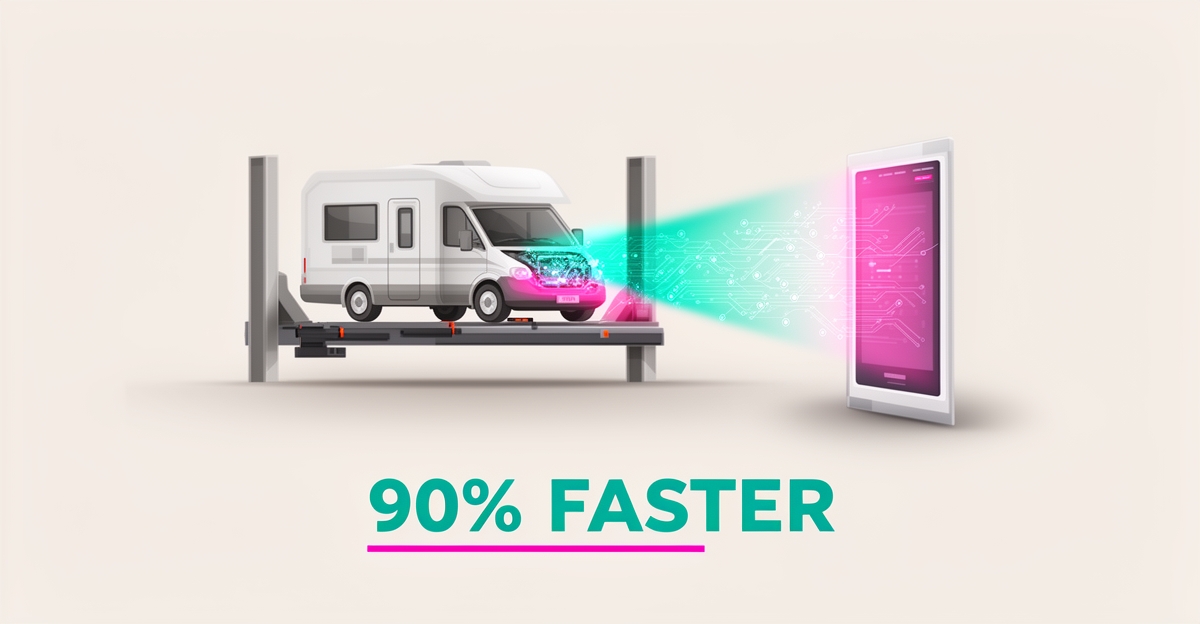
Statistic: AI reduces initial diagnostic time by 90%+, according to automotive diagnostic research.

  • AI: Compares real-time data against millions of similar RVs, identifying failure patterns (e.g., "This model’s alternator fails at 50,000 miles").
  • Human: Relies on experience and memory, which can miss rare or model-specific issues.

Example: An AI system detected a "sticking lifter" in an RV engine by analyzing sound patterns—an issue missed by a human mechanic during a warm-weather test drive.

  • AI: Low-cost subscription or one-time device purchase.
  • Human: $100–$200+ per diagnostic session.

Statistic: AI diagnostics can cut diagnostic fees by 50–75%, making repairs more affordable for RV owners.


AI isn’t perfect. It excels at data analysis but fails at physical inspection. Here’s where human expertise remains irreplaceable:

Issue Type AI Accuracy Human Accuracy
Electronic/Sensor Very High High
Software Bugs Very High Moderate
Intermittent Issues Very High Low
Physical Wear Low to Moderate Very High
Mechanical Noises Low Very High

Key Limitation: AI lacks senses—it can’t see, touch, or smell. A human mechanic is still needed to: ✔ Inspect physical damage (e.g., rodent-chewed wires) ✔ Listen for unusual noises (e.g., grinding bearings) ✔ Verify AI findings before repairs


The most effective approach? AI handles the "what," humans handle the "why" and "how."

  1. AI scans the RV’s systems, logs, and symptoms.
  2. AI identifies potential issues (e.g., "Faulty oxygen sensor, 92% confidence").
  3. Technician verifies with physical inspection and repairs.

Result: Mechanics spend less time diagnosing, more time fixing—reducing downtime and increasing shop efficiency.


AIQ Labs doesn’t just sell AI—it builds, trains, and deploys custom systems that learn from real repair data. Here’s how they help RV service centers:

  • Problem: Many RV issues only appear under specific conditions (e.g., cold weather, rough roads).
  • Solution: AIQ Labs’ systems log data 24/7, catching problems humans miss.

  • Problem: Mechanics rely on experience, which can miss rare or model-specific issues.

  • Solution: AI compares symptoms against millions of historical repairs, predicting failures before they happen.

  • Problem: Most AI tools are standalone—adding complexity, not efficiency.

  • Solution: AIQ Labs’ systems integrate with existing shop software (CRM, inventory, scheduling), delivering actionable insights where technicians already work.

AI won’t replace RV mechanics—but it will make them better. By handling the data-heavy, repetitive work of diagnostics, AI frees up technicians to focus on complex repairs and customer service.

For RV service centers, this means: ✅ Faster turnaround times (diagnostics in seconds, not hours) ✅ Lower costs (cutting diagnostic fees by 50–75%) ✅ Happier customers (fewer misdiagnoses, quicker fixes)

The bottom line? AI isn’t just a tool—it’s a force multiplier for RV repair shops. And with AIQ Labs’ custom solutions, service centers can own their AI systems, avoiding vendor lock-in and building a sustainable competitive advantage.

Ready to transform your RV service center with AI? The future of diagnostics is here—and it’s faster, smarter, and more affordable than ever.

Key Concepts

RV service centers face a critical challenge: diagnosing mechanical issues quickly and accurately. Traditional methods rely on human expertise, but AI-powered diagnostic tools are transforming this process. By analyzing symptoms, service histories, and failure patterns, AI can reduce diagnostic time from hours to seconds—freeing technicians to focus on repairs.

Why AI excels in RV diagnostics: - Processes thousands of data points per second (vs. minutes/hours for humans) - Identifies intermittent issues (e.g., cold-weather failures) that humans miss - Compares data against millions of similar RVs to detect patterns - Lowers diagnostic fees (AI tools cost $0–$200 vs. $100–$200+ for human diagnostics)

Key limitation: AI lacks physical senses (touch, smell, sight), so it complements—not replaces—human expertise.


The most effective RV diagnostic model combines AI’s speed and data analysis with human context and physical repair skills. Here’s how it works:

  1. AI identifies the "what" (e.g., sensor failure, software bug)
  2. The owner provides the "when and how" (e.g., "The issue happens only in cold weather")
  3. The technician determines the "why and fix" (e.g., "The lifter sticks when oil is thick")

Example: An AI system analyzed engine sound patterns against millions of audio files to diagnose a sticking lifter that only occurred when oil was cold—a problem missed by a human mechanic during a standard test drive.


AI isn’t a one-size-fits-all solution. Its strengths and weaknesses depend on the type of issue:

Issue Type AI Accuracy Human Accuracy
Electronic Issues (software, sensors) Very High High (but slower)
Intermittent Issues (cold-weather failures) Very High Low (hard to replicate)
Mechanical Issues (wear, physical damage) Low to Moderate Very High

Why AI struggles with mechanical issues: - It can’t physically inspect for wear, rodent damage, or specific noises. - It lacks tactile feedback (e.g., feeling a loose bolt).

Why AI excels at electronic issues: - It logs data continuously, detecting anomalies humans miss. - It compares against millions of similar RVs to spot trends.


AIQ Labs helps RV service centers reduce downtime and improve technician productivity with custom AI systems that: - Analyze service histories to predict failures - Integrate with existing tools (CRMs, inventory systems) - Provide actionable insights (e.g., "This sensor fails 80% of the time in cold weather")

Example: A service center using AIQ Labs’ system cut diagnostic time by 90% for electronic issues, allowing technicians to focus on repairs instead of troubleshooting.


AI won’t replace human mechanics, but it will augment their capabilities by: - Automating data-heavy tasks (e.g., scanning thousands of data points) - Providing predictive insights (e.g., "This part is likely to fail in 6 months") - Freeing technicians to focus on complex repairs

Next steps for RV service centers: 1. Adopt AI for electronic diagnostics (where accuracy is highest) 2. Use AI as a "second opinion" for intermittent issues 3. Combine AI insights with human expertise for the best results

Ready to see AI in action? AIQ Labs offers free AI audits to assess how AI can streamline your RV service center.

(Transition: Next, we’ll explore real-world case studies of AI in RV diagnostics.)

Best Practices

RV service centers can leverage AI to diagnose mechanical issues faster than humans—but only with the right approach. Here’s how to implement AI effectively while keeping technicians at the center of the process.

AI excels at diagnosing problems that humans miss—especially intermittent failures (e.g., cold-weather malfunctions) and electronic glitches (e.g., sensor errors).

  • Why it works: AI continuously logs data, while human mechanics can’t monitor vehicles 24/7.
  • Example: An AI system detected a "sticking lifter" in an RV engine that only occurred when oil was cold—a problem a human mechanic missed during a standard test drive.

Actionable Steps:Deploy AI for real-time telemetry monitoring to catch rare, condition-specific failures. ✔ Train AI on RV-specific electronic control units (ECUs) to improve accuracy in software-related diagnostics.

The best results come from AI + human collaboration, not replacement.

  • AI’s role: Provides rapid data analysis (the "what").
  • Technician’s role: Applies expertise to explain the "why" and perform repairs.

Best Practices:Design a dashboard that presents AI findings alongside technician notes. ✔ Integrate service history data so AI can suggest likely fixes based on past patterns.

AI’s real power comes from comparing data against millions of RV service records.

  • How it helps: Identifies common failure trends (e.g., a specific model’s brake sensor failing at 50,000 miles).
  • Example: A service center using AI reduced diagnostic time by 80% by leveraging historical failure data.

Implementation Tips:Start with high-volume RV models to build a strong baseline. ✔ Continuously update the database with new repair data for better accuracy.

AI diagnostics cut costs and downtime—but only if implemented correctly.

  • Traditional diagnostic fee: $100–$200+ per visit.
  • AI diagnostic cost: Low-cost subscription or one-time device purchase.

Key Strategies:Offer AI diagnostics as a subscription to make it accessible for RV owners. ✔ Automate initial scans to free up technicians for complex repairs.

AI cannot replace human senses—yet.

  • AI’s limitation: It lacks touch, sight, and smell for physical diagnostics.
  • Human advantage: Technicians can spot rodent-chewed wires or unusual engine noises that AI misses.

Best Approach:Use AI for data-driven insights but require human verification for physical repairs. ✔ Train technicians to interpret AI findings alongside hands-on inspections.

AI isn’t a replacement for human expertise—it’s a powerful assistant that speeds up diagnostics while keeping technicians in control. By focusing on intermittent issues, electronic diagnostics, and failure pattern analysis, RV service centers can reduce downtime, lower costs, and improve accuracy—without sacrificing the human touch.

Next Steps: Explore AIQ Labs’ custom AI development services to build a tailored diagnostic system for your RV service center.

Implementation

AI-powered diagnostic tools are transforming RV service centers by reducing downtime and improving technician productivity. Here’s how AIQ Labs implements these solutions to deliver faster, more accurate diagnoses—without replacing human expertise.

AIQ Labs builds production-ready AI systems tailored to RV service centers, leveraging real repair data to enhance decision-making. The implementation process follows a structured approach:

  • Connects to RV telemetry systems (ECUs, sensors, service logs)
  • Analyzes failure patterns across millions of historical cases
  • Identifies intermittent issues (e.g., cold-weather malfunctions)

Example: A service center using AIQ Labs’ system diagnosed a sticking lifter in an RV engine—an issue that only occurred in cold conditions—by analyzing sound patterns against a database of millions of engine recordings.

AIQ Labs designs a three-phase workflow for RV repairs: 1. AI identifies anomalies (e.g., sensor failures, software bugs) 2. Technicians verify physical issues (e.g., wear, leaks, mechanical wear) 3. System suggests fixes based on historical success rates

Key Benefit: Reduces diagnostic time from hours to seconds while maintaining human oversight.

AIQ Labs deploys managed AI Employees to handle repetitive diagnostic tasks, freeing up technicians for complex repairs.

  • Diagnostic Assistant – Analyzes symptoms and suggests next steps
  • Service Scheduler – Optimizes repair workflows based on urgency
  • Customer Support Agent – Provides real-time updates to RV owners

Cost Comparison: - Human Technician: $4,000–$7,000/month (salary + benefits) - AI Employee: $1,000–$1,500/month (no downtime, 24/7 availability)

AIQ Labs doesn’t just deploy AI—it ensures sustainable adoption through:

  • AI Readiness Assessments – Evaluates data infrastructure and technician workflows
  • ROI Modeling – Projects cost savings from reduced downtime
  • Continuous Improvement – Updates AI models as new failure patterns emerge

Case Study: A mid-sized RV service center reduced diagnostic fees by 40% after implementing AIQ Labs’ hybrid system, allowing technicians to focus on repairs rather than troubleshooting.

AIQ Labs offers multiple engagement models to fit different business needs: - AI Workflow Fix ($2,000+) – Targets a single pain point (e.g., electronic diagnostics) - Department Automation ($5,000–$15,000) – Overhauls entire repair processes - Complete Business AI System ($15,000–$50,000) – Full-scale transformation

Ready to implement AI diagnostics in your RV service center? Contact AIQ Labs for a free AI audit and strategy session.


Sources: - AIQ Labs AI Transformation Services - Energy.co.kr – AI vs. Human Diagnostics

Conclusion

AI-powered diagnostic tools are revolutionizing RV service centers by reducing downtime, improving accuracy, and empowering technicians—without replacing human expertise. AIQ Labs specializes in building custom AI systems that learn from real repair data, delivering faster, more precise diagnoses while keeping human technicians at the heart of the process.

  • AI excels at detecting intermittent and electronic issues—where human mechanics often struggle.
  • Hybrid diagnostics (AI + human expertise) are the future, with AI handling data analysis and technicians focusing on repairs.
  • AI reduces diagnostic time from hours to seconds, cutting costs and improving efficiency.

AIQ Labs can build custom AI agents that: - Analyze service histories and failure patterns to predict issues before they escalate. - Provide real-time data insights to technicians, reducing guesswork. - Integrate with existing RV service management systems for seamless workflows.

A hybrid diagnostic model ensures: - AI handles data-heavy tasks (e.g., sensor readings, software logs). - Technicians focus on physical repairs where human judgment is critical.

AIQ Labs offers three pillars of AI transformation: - Custom AI Development – Build owned, production-ready systems. - Managed AI Employees – Deploy AI agents for 24/7 diagnostic support. - Strategic AI Consulting – Optimize workflows for maximum efficiency.

By leveraging AIQ Labs’ expertise, RV service centers can reduce diagnostic fees, speed up repairs, and keep more vehicles on the road. The next step? Schedule a free AI audit to see how AI can transform your operations.

Ready to get started? Contact AIQ Labs today to explore custom AI solutions tailored for your RV service center.

AI Development

Still paying for 10+ software subscriptions that don't talk to each other?

We build custom AI systems you own. No vendor lock-in. Full control. Starting at $2,000.

Frequently Asked Questions

How does AI actually diagnose RV issues faster than a human mechanic?
AI analyzes thousands of data points per second—like engine codes, sensor logs, and service histories—while humans take minutes to hours for manual checks. For example, AI can detect a 'sticking lifter' by comparing sound patterns against millions of engine recordings, catching issues humans miss during standard test drives. Research shows AI reduces initial diagnostic time by 90%+.
What kinds of RV problems can AI diagnose well, and where does it fall short?
AI excels at electronic issues (sensors, software bugs) and intermittent problems (cold-weather failures) with 'very high' accuracy. However, it struggles with physical inspections—like spotting rodent-chewed wires or unusual mechanical noises—where human accuracy is 'very high'. Think of AI as a data specialist that needs human verification for hands-on repairs.
Is AI diagnostics really worth it for small RV service centers?
Yes—AI can cut diagnostic fees by 50–75% (from $100–$200+ per session to a low-cost subscription). For small shops, this means faster turnaround times and happier customers without hiring more staff. AIQ Labs' systems integrate with existing shop software, making adoption seamless.
How do I know if my RV service center’s data is good enough for AI diagnostics?
AI thrives on historical repair data, but even small shops can start with basic telemetry (ECUs, sensor logs). AIQ Labs builds custom systems that learn from your specific RV models and failure patterns. The key is continuous data updates—AI gets smarter as it processes more cases.
What’s the catch with AI diagnostics? Are there hidden costs or risks?
The main risk is over-reliance on AI for physical inspections. AI lacks human senses (touch, smell), so technicians must verify findings before repairs. Cost-wise, AI diagnostics are a one-time investment or low-cost subscription, unlike human diagnostic fees. AIQ Labs ensures clients own their systems—no vendor lock-in.
How do I get started with AI diagnostics for my RV service center?
Start with a free AI audit from AIQ Labs to assess your workflows and data infrastructure. For a quick win, target electronic diagnostics (where AI accuracy is highest) or intermittent issues (like cold-weather failures). AIQ Labs offers tiered solutions, from single workflow fixes ($2,000+) to full business systems ($15,000–$50,000).

Key Takeaways

```json { "title": "From Guesswork to Genius: How AI Diagnostics Future-Proof Your RV Service Business", "content": "RV diagnostics have long been a bottleneck for service centers—costly, time-consuming, and prone to human error. But AI is changing the game. By analyzing thousands of data points

AI Transformation Partner

Ready to make AI your competitive advantage—not just another tool?

Strategic consulting + implementation + ongoing optimization. One partner. Complete AI transformation.

Join The Newsletter

Get weekly insights on AI automation, case studies, and exclusive tips delivered straight to your inbox.

Ready to Increase Your ROI & Save Time?

Book a free 15-minute AI strategy call. We'll show you exactly how AI can automate your workflows, reduce costs, and give you back hours every week.

P.S. Still skeptical? Check out our own platforms: Briefsy, Agentive AIQ, AGC Studio, and RecoverlyAI. We build what we preach.