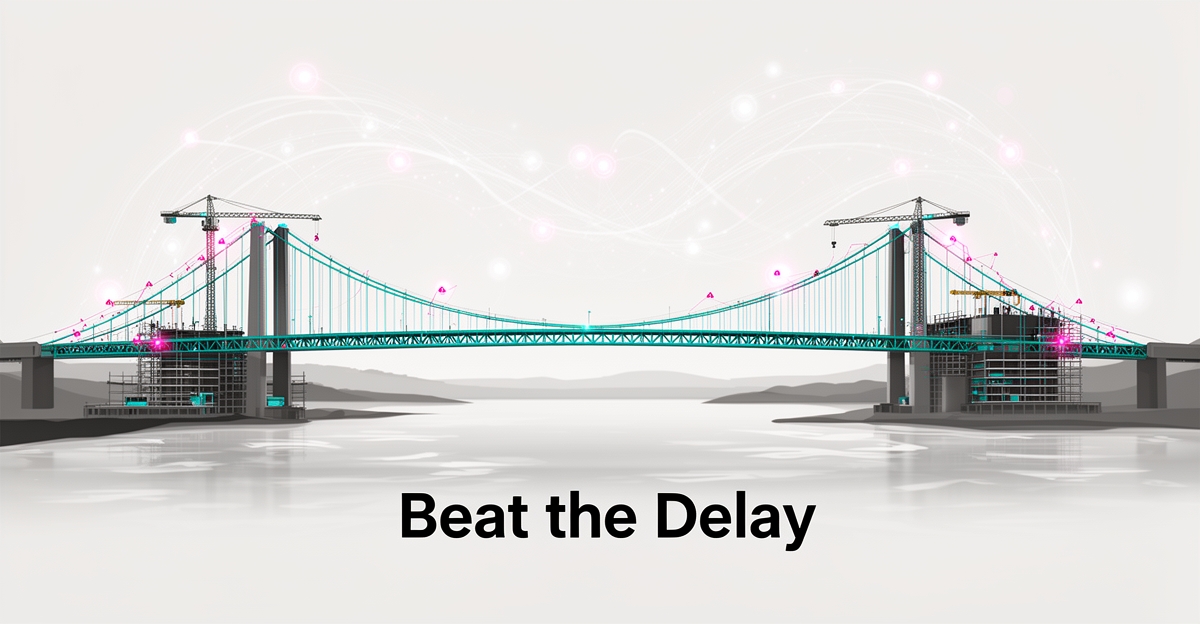
# How Bridge Construction Firms Can Cut Project Delays with AI-Powered Risk Forecasting
**Quick Answer:** Cut bridge project delays with AI-powered risk forecasting that turns historical project data into actionable foresight. Learn how predictive analytics transforms reactive crisis management into strategic anticipation for construction firms.
## The Hidden Cost of Reactive Risk Management in Bridge Construction
Bridge construction is uniquely exposed to unpredictable disruptions. Long timelines, weather-critical operations like concrete pours and steel erection, and heavy dependence on specialized materials mean a single unanticipated event can cascade across an entire schedule. Yet most firms still manage risk reactively—responding after weather closes a site, after a steel delivery slips, or after a crew sits idle waiting on materials.
Traditional risk management relies heavily on historical averages and manual inspections, creating blind spots for emerging threats. Weather patterns are becoming less predictable, supply chains face geopolitical and logistical fragility, and skilled labor gaps persist across the industry. When risks are only addressed after they materialize, the consequences compound:
- Reactive responses often require premium freight or overtime labor to recover lost time
- Material price spikes during delays can exceed original budget contingencies
- Reputational damage from missed deadlines affects future bid competitiveness
- Insurance premiums may rise due to perceived project risk profiles
These hidden costs accumulate silently, turning manageable variances into significant schedule overruns. The fix is not more contingency budget—it's earlier warning.
AIQ Labs helps firms make that shift from reactive to predictive. Through [AI Workflow Builds](/workflow-builds), we rebuild the one workflow that costs you the most—often delay response and rescheduling—into a system that flags risk before it hits the site. For firms that want forecasting connected across estimating, scheduling, and procurement, an [AI Operating System](/ai-operating-systems) provides one connected layer, built in phases and owned outright.
## How AI-Powered Risk Forecasting Transforms Project Planning
AI-powered risk forecasting turns historical data into actionable foresight. Predictive models analyze past project timelines, weather patterns, and supply chain disruptions to identify delay risks before they materialize. That lets teams adjust schedules, reallocate resources, and mitigate impacts in advance—turning reactive crisis management into strategic anticipation.
These models continuously learn from diverse data streams, including real-time weather feeds and supplier performance metrics, so forecast accuracy improves over time. For bridge construction specifically, that means anticipating seasonal challenges like freeze-thaw cycles or seasonal material shortages that historically derail timelines.
In practice, a forecasting system typically:
- Analyzes multiple years of historical project data to identify recurring delay patterns
- Integrates hyperlocal weather forecasts to predict site accessibility issues
- Monitors supplier lead times and logistics bottlenecks in real time
- Simulates "what-if" scenarios for material substitutions or crew adjustments
- Generates dynamic timeline updates as new risk signals emerge
A
AI Employees
Hire a team member that works 24/7 — for less than a part-time wage.
AI receptionists, SDRs, dispatchers and 99+ roles. Trained on your business, fully managed.
See If You’re a Fit — AI Employees from $700/mo
Not sure where to start? Ask our AI planner
IQ Labs embeds these capabilities directly into project planning workflows. The system doesn't just flag risks—it recommends specific, data-backed adjustments, like shifting concrete pours ahead of a predicted rain front or securing an alternative steel supplier when lead times spike. Where routine coordination is the bottleneck, [AI Employees](/ai-employees) can handle the monitoring and follow-up—tracking supplier confirmations, chasing delivery updates, and surfacing exceptions to project managers—typically at a fraction of the cost of adding headcount.
As predictive models mature with each project, their accuracy improves, creating a compounding advantage for firms that adopt early. The result is not just fewer delays, but more reliable bidding, stronger client trust, and smoother execution across complex bridge builds. When AI handles the noise of risk detection, human experts concentrate on high-value decisions—design resilience, sustainable materials—knowing the planning foundation is solid.
## Implementation Roadmap: From Data Integration to Continuous Optimization
Adopting AI risk forecasting doesn't require a massive capital program or an in-house data science team. The practical question for bridge firms is not whether to adopt, but how to sequence the rollout so it delivers value quickly.
**Step 1: Data preparation.** Consolidate historical project records—schedules, weather logs, material deliveries, and cost reports—into a unified source of truth. Standardization gaps across legacy systems are one of the most common obstacles in construction, so clean, connected data is the foundation every predictive model depends on.
**Step 2: Model training and validation.** Models learn from your firm's past projects to predict risks like weather delays or supply chain disruptions, then feed those forecasts directly into planning. Start narrow: apply the model to one active bridge project, compare its risk flags against actual outcomes, and refine before scaling. Plan for cybersecurity safeguards and long-term validation from the start—both are persistent challenges in AI-driven infrastructure work.
**Step 3: Workflow integration.** Risk alerts should surface inside the scheduling and procurement platforms project managers already use, not in a separate dashboard nobody opens. Integration is where forecasting becomes actionable.
**Step 4: Continuous optimization.** Treat deployment as the start of a cycle, not the finish line. Ongoing monitoring and retraining keep forecasts accurate as conditions, suppliers, and project types change. A structured roadmap typically includes:
- Consolidating historical project and site data into a single, governed repository
- Training and validating predictive models on one pilot project before scaling
- Integrating risk forecasts directly into scheduling and procurement workflows
- Establishing monitoring, retraining, and ROI tracking as an ongoing practice
This is how AIQ Labs structures its work: discovery and architecture first, then development and deployment in phases, with continuous optimization after launch. Under our [pricing models](/pricing)—Start Monthly, Build in Milestones, or Own It Outright—you can begin with a single workflow and expand as results prove out, without betting the business on an unproven platform. Firms that build this capability deliberately, phase by ph
AI Development
Still paying for 10+ subscriptions that don’t talk to each other?
We build custom AI systems you own outright. No vendor lock-in. Full control.
See If You’re a Fit — AI Employees from $700/mo
Not sure where to start? Ask our AI planner
ase, will spend less time explaining delays and more time preventing them.
## Frequently Asked Questions
**How much are bridge construction delays actually costing us right now?**
Reactive risk management creates hidden costs: premium freight, overtime labor, material price spikes during delays, and rising insurance premiums. On long-duration bridge projects, these compound quickly—a single week of idle crew time can erase a quarter's contingency.
**Can AI really forecast weather and supply chain risks for bridge projects?**
Yes. AI models analyze years of historical timelines, hyperlocal weather feeds, and supplier performance data to forecast delays before they materialize. They can also simulate what-if scenarios for material substitutions or crew adjustments and generate dynamic timeline updates as new signals emerge.
**Do we need a data science team to start using AI risk forecasting?**
No. Start by consolidating historical schedules, weather logs, deliveries, and cost reports into a unified source of truth, then pilot on one active bridge project. With a managed build partner, integration with your existing scheduling and procurement tools makes risk alerts actionable without hiring specialists.
**Is the construction industry actually using AI yet, or is this still experimental?**
Adoption has moved well past the experimental stage. AI-driven scheduling, estimating, and monitoring tools are already coordinating materials, labor, and equipment on active projects, and multi-agent systems are increasingly common in back-office construction workflows.
**What are the biggest risks when implementing AI for bridge construction?**
The commonly cited challenges are implementation cost, cybersecurity, data standardization across legacy systems, and long-term model validation. A phased approach with a pilot project addresses most of these by limiting initial exposure and proving value before scaling.
**How quickly can we see value from AI-powered risk forecasting?**
Firms typically start with a pilot project, compare risk flags against actual outcomes, and refine before scaling. As models mature with each project, accuracy compounds—leading to more reliable bidding and stronger client trust over time.
## Turning Risk Forecasting into Your Competitive Advantage
AI-powered risk forecasting transforms bridge construction from a reactive scramble into a proactive advantage—turning weather volatility, supply chain shifts, and labor constraints into predictable variables you can plan around. By consolidating historical data, validating models on pilot projects, and embedding forecasts directly into scheduling tools, firms gain the lead time needed to adjust concrete pours, secure alternative suppliers, and keep crews productive.
The result isn't just fewer delays—it's more reliable bids, stronger client trust, and the freedom to focus on building rather than damage control. Every season you operate reactively is margin left on the table.
Start by assessing your data readiness and identifying the one high-impact workflow where predictive insights could prevent the most costly overruns. Take the first step with AIQ Labs' [2-minute Fit Check](/apply), then book a free 30-minute strategy call to map your biggest bottleneck and see where AI forecasting delivers the fastest return—no obligation, just clarity on your path forward.
AI Transformation Partner
Make AI your competitive advantage — not just another tool.
Strategy, implementation and ongoing optimization. One partner, end to end.
See If You’re a Fit — AI Employees from $700/mo
Not sure where to start? Ask our AI planner