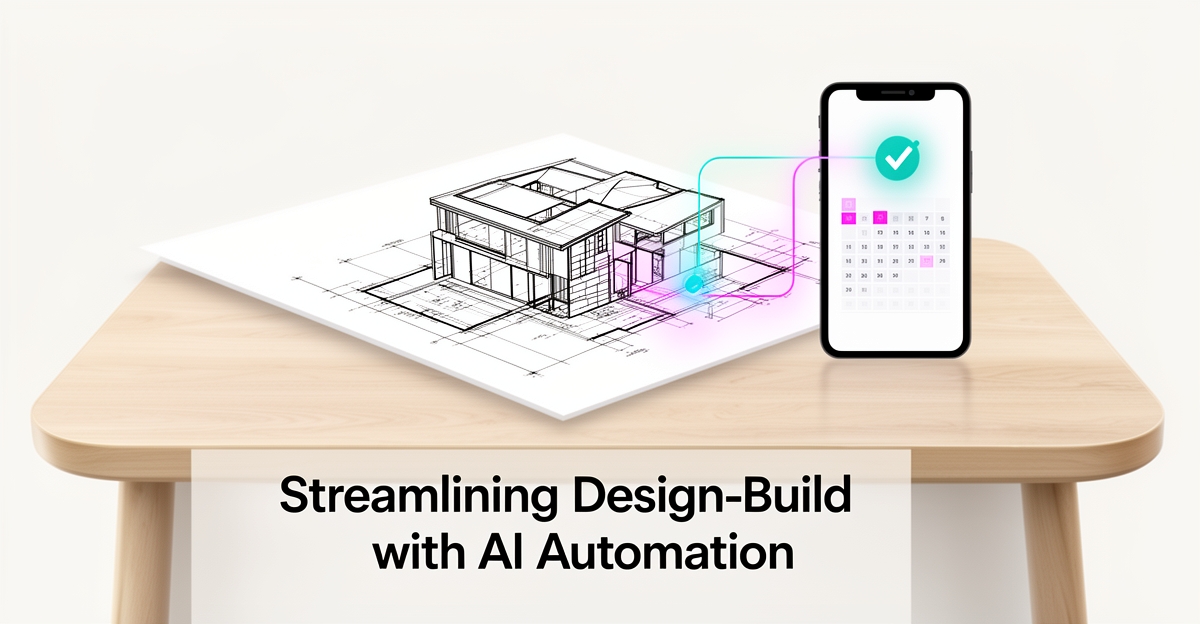
How Design-Build Firms Can Automate Site Visit Scheduling and Client Communication with AI
Key Facts
- 60% of firms implemented automation over the last 12 months according to Richmond Fed CFO survey.
- 80% of large firms anticipate adopting labor-replacing automation in the next 12 months per Richmond Fed data.
- 76% of large firms expect to use AI to automate tasks from Richmond Fed research.
- 54% of all firms anticipate utilizing AI to automate tasks per Richmond Fed CFO survey.
- 95.9% of the top million websites have detectable accessibility failures noted by DBIA.
- AI receptionists can answer inbound calls 24 hours a day, 7 days a week.
Hire a team member that works 24/7 — for less than a part-time wage.
AI receptionists, SDRs, dispatchers and 99+ roles. Trained on your business, fully managed.
Not sure where to start? Ask our AI planner
The Hidden Cost of Manual Scheduling in Design-Build
Manual coordination of site visits quietly drains design-build teams every week. Phone tags, calendar conflicts, and delayed confirmations stack up while project managers chase down clients instead of building.
Design-build firms still rely on spreadsheets, email threads, and ad-hoc calls to lock in site visits. That fragmentation creates missed calls and double-bookings that erode trust and push schedules back. Follow-ups slip through busy inboxes, and clients wait days for a simple confirmation.
Industry momentum is already shifting. According to a recent CFO survey, 60% of firms implemented automation over the last 12 months, and 80% of large firms anticipate adopting labor-replacing automation over the next 12 months. Automation is no longer experimental; it is table stakes for staying competitive.
AI adoption is accelerating alongside that automation wave. The same industry research shows 54% of all firms, and 76% of large firms, anticipate utilizing AI to automate tasks. For design-build, that means moving client requests and scheduling out of manual queues and into responsive, always-on systems.
The cost shows up in three recurring ways:
- Missed inbound calls from homeowners and GC partners, leading to lost site windows
- Double-booked crews and PMs when calendars are updated in multiple places
- Delayed follow-ups after walkthroughs, slowing approvals and change orders
These frictions compound across projects. Teams spend hours reconciling availability, resending confirmations, and apologizing for errors that an automated flow would prevent. Client experience suffers in parallel, with perception of responsiveness tied directly to how quickly scheduling and communication happen.
AI reception and scheduling changes the pattern by handling inbound client requests, confirming site visits instantly, and triggering follow-ups without a dedicated receptionist. AIQ Labs deploys managed AI Employees — including AI receptionists and schedulers — to ensure no client is missed and every appointment is well-prepared.
When scheduling is automated, the operational drag shrinks and the sales-to-site handoff stays clean. Firms can protect margin, improve utilization, and deliver the consistent communication clients expect from a modern design-build partner.
Why AI Receptionists and Schedulers Outperform Traditional Tools
The phone rings while your project manager is walking a job site. A prospective client wants to schedule a consultation, but nobody picks up. By the time someone checks voicemail, that client has already called a competitor — and booked with them.
This scenario plays out daily at design-build firms that still rely on traditional scheduling methods. According to a Federal Reserve Bank of Richmond survey, 76% of large firms now anticipate using AI to automate tasks — and client communication sits at the top of the list.
Manual scheduling creates bottlenecks at every stage. A receptionist can only handle one call at a time. Emails sit unanswered over weekends. Follow-up texts get forgotten when the office gets busy.
AI receptionists and schedulers eliminate these constraints entirely. They answer every inbound call, respond to emails and texts instantly, and book site visits directly into your calendar — 24 hours a day, 7 days a week.
The same Richmond Fed data shows that 60% of firms implemented some form of automation in the past 12 months, with 80% of large firms planning further adoption. The shift is no longer experimental. It is operational.
Modern AI employees go far beyond simple chatbots. They function as trained team members with defined roles and real capabilities:
- Answer inbound calls with natural, human-like conversation — no phone trees or hold music
- Confirm and reschedule appointments automatically, syncing with your team's calendar in real time
- Send follow-up messages via SMS or email after every site visit, keeping clients informed without manual effort
- Escalate complex requests to the right team member when a situation requires human judgment
This is not theoretical. Voice AI has already proven reliable in regulated industries like financial collections, where compliance and accuracy are non-negotiable. The Design-Build Institute of America notes that builders are actively incorporating AI into their workflows — and client-facing communication is a natural starting point.
A full-time receptionist typically costs tens of thousands of dollars annually once you add benefits, taxes, and training. That person works 40 hours per week and still misses calls during lunch, meetings, and sick days.
An AI receptionist from AIQ Labs operates at roughly 80% less than the cost of a comparable human hire, on a flat monthly basis. It never calls in sick, never misses a call, and handles unlimited simultaneous inquiries. For design-build firms managing multiple active projects, that reliability translates directly into captured revenue that would otherwise walk away.
As Brian Skripac, DBIA's Director of Virtual Design and Construction, puts it: "AI is not going to take your job; the person who knows how to use AI will take your job." The firms adopting AI schedulers today are not replacing their teams — they are freeing them to focus on the work that actually requires human expertise.
Implementing AI Scheduling and Communication in Your Workflow
Implementing AI scheduling and communication in your design-build workflow begins with a clear assessment of where manual processes create delays. Many firms find that coordinating site visits consumes disproportionate administrative time, especially when managing multiple client touchpoints and subcontractor schedules. Identifying these friction points—such as missed calls, double-booked appointments, or delayed follow-ups—is the critical first step toward meaningful automation. According to industry research, 60% of firms implemented automation over the last 12 months, signaling growing recognition of these pain points.
Once pain points are mapped, selecting the right AI tools requires alignment with both technical compatibility and workflow goals. Look for solutions that integrate seamlessly with existing calendars (like Google Calendar or Outlook), CRM systems, and communication channels—ensuring the AI can not only schedule visits but also send confirmations, reminders, and post-visit follow-ups without manual intervention. The best AI schedulers use natural language processing to understand client preferences and adjust dynamically to changes in project timelines or crew availability. This reduces scheduling conflicts and improves client satisfaction through consistent, proactive communication.
Successful implementation depends on phased deployment and team readiness. Start with a pilot focused on one project type or geographic region to refine the AI’s behavior before scaling. Provide hands-on training so team members understand how to monitor AI performance, override decisions when needed, and interpret analytics dashboards. Change management is essential—frame the AI as a tool that eliminates repetitive tasks, allowing staff to focus on higher-value client engagement and project oversight. As noted in industry insights, firms that prioritize training see faster adoption and fewer workflow disruptions.
Finally, measure impact using clear KPIs tied to your original pain points: reduction in scheduling errors, decrease in no-shows, time saved per site visit coordination, and client satisfaction scores. Track these metrics over 60–90 days to calculate ROI, which typically comes from reclaimed labor hours and improved project timelines. Firms that systematically evaluate AI effectiveness are better positioned to expand automation into other areas, such as change order management or safety documentation. This iterative approach ensures AI delivers sustained value, not just a one-time efficiency gain. For guidance tailored to your firm’s maturity level, consider starting with the free Fit Check at AIQ Labs, followed by a no-obligation 30-minute strategy call to explore how AI employees can streamline your scheduling and communication workflows.
Overcoming Integration, Adoption, and Compliance Hurdles
Automation stalls in design-build when the people, systems, and standards are not aligned from day one. Site visit scheduling and client communication touch calendars, CRM, field notes, and compliance records, so friction in any layer creates delays and missed appointments.
Data quality and accuracy remain a primary barrier. AI schedulers and client-facing agents rely on clean project timelines, contact details, and site constraints to confirm visits without human rework. Poor data leads to double-bookings, wrong addresses, and eroded client trust. Integration with existing systems and tools compounds the risk, as firms run scheduling, estimating, and project management on disconnected platforms.
Employee adoption and training shape whether automation delivers value or resistance. With 60% of firms implementing automation over the last 12 months, teams are already navigating change. Design-build staff need clear role definitions for AI receptionists and schedulers, plus hands-on practice with handoffs. Without support, adoption stalls at pilot.
Cybersecurity and data protection are non-negotiable when client conversations and site details move through voice and chat. Firms must map data flows, enforce access controls, and maintain audit trails for every automated confirmation and follow-up. Accessibility compliance adds another layer. 95.9% of the top million websites have detectable accessibility failures, highlighting how easily digital touchpoints exclude users.
Practical mitigation strategies draw from field services and healthcare deployments where scheduling accuracy and compliance are critical.
- Start with data governance: audit calendars, contacts, and project records, then build validation rules before any AI goes live.
- Design for integration first: use API-first connections to CRM, scheduling, and dispatch so confirmations write back automatically.
- Pilot with a bounded workflow: automate site visit confirmations for one project type, measure missed calls and reschedules, then expand.
- Embed accessibility and security by design: test voice and web interfaces for WCAG conformance and enforce role-based access with logging.
AIQ Labs approaches these hurdles through managed AI Employees that work alongside existing teams. An AI receptionist can answer inbound client requests, confirm site visits, and send follow-ups without a dedicated receptionist, while integration work ensures the agent reads and writes to the tools crews already use. This reduces manual handoffs and supports adoption through clear ownership.
Change management matters as much as technology. Training should focus on exceptions, escalation paths, and how staff coach the agent with real call examples. Monitoring dashboards for data quality, completion rates, and accessibility issues keep the system reliable. With 54% of all firms anticipating AI to automate tasks, firms that address integration, people, and compliance early are the ones that scale automation beyond pilot.
Measuring Impact and Scaling Across the Firm
Measuring the impact of AI-driven scheduling and communication is essential to justify scaling across the firm. Success begins with tracking core metrics: missed calls driven toward zero, caller satisfaction, and a reduced cost per appointment—outcomes AI receptionists handling inbound client requests and site visit confirmations are built to deliver. These outcomes reflect not just efficiency gains but a fundamental shift in how design-build firms engage clients, turning every interaction into a reliable, professional touchpoint.
Firms adopting AI for scheduling and communication see measurable improvements quickly. Research shows that 60% of firms implemented automation over the last 12 months, with 80% of large firms anticipating labor-replacing automation in the next year—a clear signal that competitive pressure is mounting. Additionally, 54% of all firms, and 76% of large firms, expect to use AI to automate tasks, underscoring growing confidence in its operational value. By contrast, persistent challenges like inaccessible digital experiences remain widespread, with 95.9% of the top million websites showing detectable accessibility failures—highlighting an opportunity for AI to improve not just efficiency but inclusivity in client-facing processes.
Scaling from a single AI employee to firm-wide automation follows clear engagement paths: Start Monthly, Build in Milestones, or Own It Outright. Start Monthly lets firms deploy an AI receptionist or scheduler on a flat monthly basis—roughly 80% less than the cost of a comparable human hire—covering build, training, tool integration, monitoring, and ongoing improvements. This low-risk entry point lets teams validate results in weeks, not months. For broader transformation, AI Workflow Builds rebuild the one workflow that costs the most—such as integrating scheduling with CRM, calendar, and project management tools—at a fixed price, delivered in phases you approve. Firms that want everything connected can graduate to an AI Operating System—one connected operating layer, built in phases and owned outright, with no vendor lock-in or disruptive overhauls. AIQ Labs has deployed 200+ multi-agent systems and runs four live SaaS products daily, so these patterns are proven in production, not theory. Ready to measure your firm’s AI readiness? Start the Fit Check for a free 30-minute strategy call to map your biggest bottleneck and identify high-ROI automation opportunities. If there isn’t a clear win, we’ll say so—no obligation, just clarity on your path forward.
Still paying for 10+ subscriptions that don’t talk to each other?
We build custom AI systems you own outright. No vendor lock-in. Full control.
Not sure where to start? Ask our AI planner
Frequently Asked Questions
How can AI receptionists help design-build firms avoid missed calls and double-booked site visits?
What percentage of large design-build firms plan to use AI for task automation in the next year?
Is implementing AI scheduling expensive for small design-build firms?
Can AI schedulers integrate with tools like Google Calendar or Outlook that design-build teams already use?
What are the biggest risks when adopting AI for client communication in design-build, and how can they be reduced?
How do firms measure the success of AI-powered site visit scheduling and client communication?
Stop Losing Site Windows to Manual Scheduling
Manual scheduling is quietly eroding margin in design-build: missed calls, double-booked crews, and delayed follow-ups compound across projects and damage client trust. AI receptionists and schedulers change that pattern by answering every inbound request, confirming site visits instantly, and triggering post-walkthrough follow-ups 24/7 without a dedicated receptionist. With 60% of firms having implemented automation over the last 12 months and 80% of large firms planning labor-replacing automation next, the shift is already operational, not experimental. Start by mapping your biggest friction points — missed calls, calendar conflicts, slow approvals — then pilot automation on one project type with clear KPIs for errors, no-shows, and time saved. AIQ Labs deploys managed AI Employees, including receptionists and schedulers, to ensure no client is missed and every appointment is well-prepared. Start the Fit Check for a free 30-minute strategy call to map your highest-impact bottleneck with no obligation.
Make AI your competitive advantage — not just another tool.
Strategy, implementation and ongoing optimization. One partner, end to end.
Not sure where to start? Ask our AI planner